















In today’s fast moving and competitive market, businesses must keep tight control over stock. Supply chain disruptions, changing demand, and the growth of online retail have made manual tracking unreliable. Without accurate data, companies risk stockouts, excess inventory, and lost sales.
Many Australian businesses now see that traditional inventory methods cannot keep up. Poor stock visibility makes it harder to manage purchasing, fulfil orders, and maintain steady cash flow. Businesses need a stock control system in Australia that shows accurate inventory levels at all times.
This is where perpetual inventory becomes valuable. The system updates stock records continuously as products move through sales, deliveries, transfers, and returns. It helps businesses maintain accurate inventory data and make faster, better decisions.
Key Takeaways
See how continuous inventory updates provide stronger control compared to periodic stock counts.
Understand how barcode scanning, valuation methods, and automated reorder points keep stock data accurate.

What Is Perpetual Inventory?
Perpetual Inventory vs. Periodic Inventory
To understand the value of perpetual inventory, it helps to compare it with the older periodic system. The main difference lies in how often stock data updates and how much technology supports the process.
Periodic inventory relies on scheduled inventory check through physical stock counts. Businesses only calculate the actual inventory balance and cost of goods sold at the end of an accounting period. This method is cheaper to set up but leaves businesses without clear stock visibility between counts.
Perpetual inventory updates stock records continuously as transactions occur. Systems automatically adjust inventory after every sale, delivery, return, or transfer. Although the setup costs more, businesses benefit from fewer stockouts, lower holding costs, and better operational control.
Here is a detailed breakdown of how the two systems compare across various operational metrics:
| Feature | Perpetual Inventory | Periodic Inventory |
|---|---|---|
| Data Updates | Continuous and real-time. | Only at the end of an accounting period. |
| Cost of Goods Sold (COGS) | Calculated automatically with every sale. | Calculated manually after a physical count. |
| Technology Required | High (Software, POS, Scanners, RFID). | Low (Manual ledgers, basic spreadsheets). |
| Shrinkage Detection | Identified quickly through cycle counting. | Only identified at the end of the period. |
| Business Suitability | Ideal for medium to large businesses, e-commerce, and high-volume retail. | Suitable for very small businesses with low sales volume and high-ticket items. |
| Operational Disruption | Minimal; utilizes ongoing cycle counts. | High; often requires shutting down operations for full physical counts. |
A periodic system may still work for a small boutique selling a few high-value items each week. However, businesses that want to scale, sell across multiple channels, or manage complex supply chains usually move to perpetual inventory to stay competitive.
Key Components of a Perpetual Inventory System

A perpetual inventory system works through several connected tools and processes. Software, hardware, and accounting methods work together to keep stock data accurate and updated in real time.
Real-Time Stock Tracking
Real time tracking forms the core of a perpetual system. A central inventory database records every stock movement across the business. When goods arrive, staff scan them into the system and stock levels update instantly.
The same process happens when items are sold, transferred, or shipped. Businesses with multiple warehouses or retail locations can see exactly where inventory sits at any moment. This helps prevent selling products that are already out of stock.
Inventory Valuation Methods
Perpetual systems also calculate the value of inventory as stock moves. To do this correctly, businesses choose a valuation method that determines how the cost of goods sold is recorded.
Common methods include FIFO, which sells older stock first, LIFO, which uses the newest stock first, and weighted average cost. The system applies the chosen method automatically so financial reports stay accurate.
Barcode and RFID Integration
Most perpetual systems use barcode or RFID technology to capture stock data quickly. Staff scan items during receiving, storage, picking, and shipping to update inventory without manual entry.
Barcodes require a scanner to read each item directly, which makes them affordable and widely used. RFID technology uses radio signals to scan multiple items at once, allowing warehouses to track pallets or shipments almost instantly.
Automated Reorder Points
Perpetual inventory systems can also automate purchasing decisions. The system monitors stock levels and compares them with preset minimum quantities known as reorder points.
When stock falls below the threshold, the system can trigger inventory refilling by generating a purchase order or alerting the purchasing team. Advanced systems also analyse sales trends and supplier lead times to adjust reorder levels automatically.
Implementing a Perpetual Inventory System
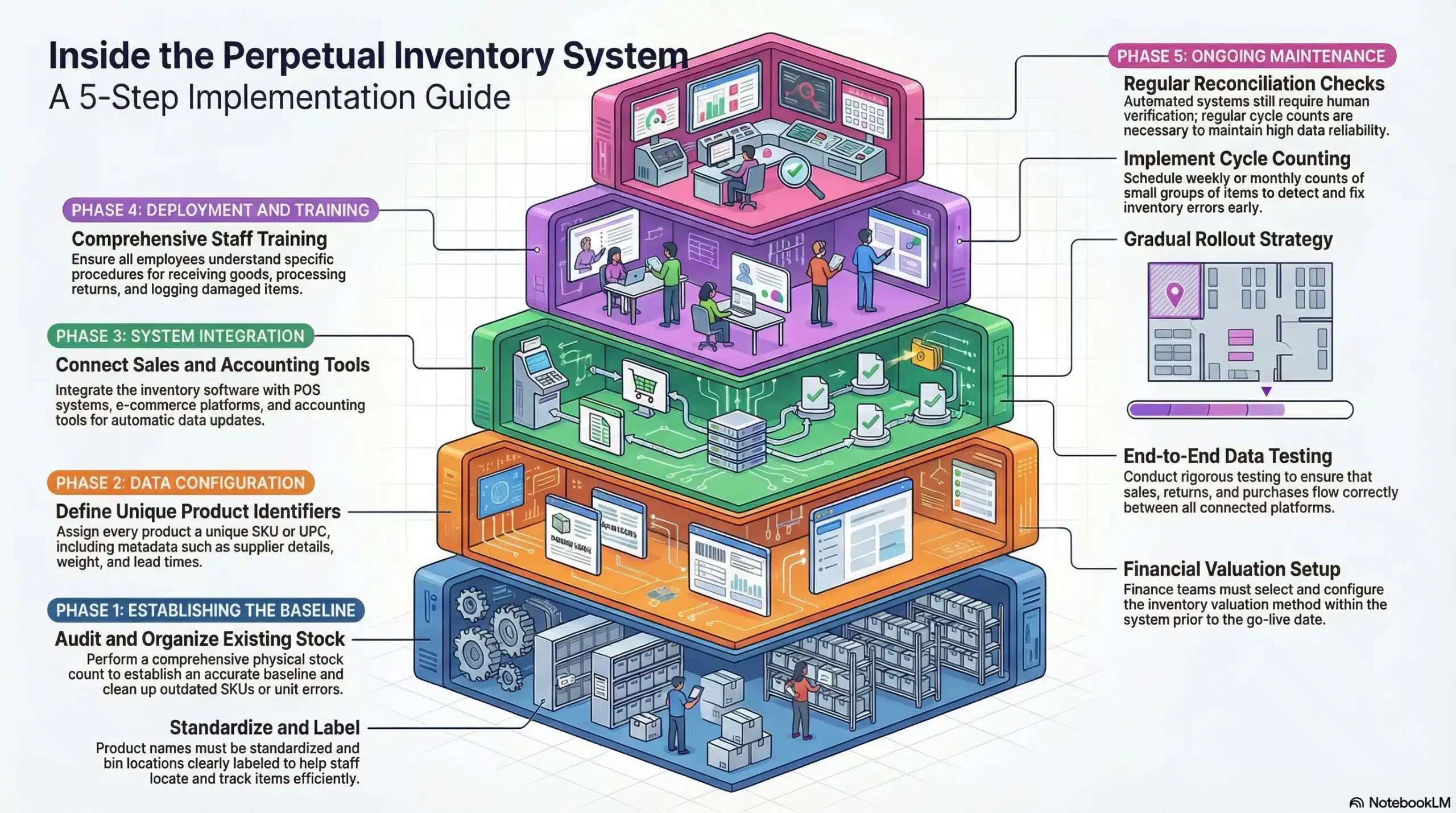
Moving from manual stock tracking to a perpetual system takes planning and coordination. Businesses must prepare their data, systems, and teams before switching. A structured rollout helps reduce errors and keeps operations stable.
Step 1: Audit and Organise Existing Stock Data
Start with a full physical stock count to create an accurate baseline. Clean up outdated SKUs, fix unit errors, and standardise product names. Clear bin locations and labels also help staff track items more easily.
Step 2: Set Up Product Codes and Cost Methods
Each product needs a unique identifier such as an SKU or UPC. Add important details like supplier information, weight, and lead time. Finance teams should also select the inventory valuation method before the system goes live.
Step 3: Integrate with Sales and Purchasing Systems
Inventory software must connect with POS systems, e-commerce platforms, and accounting tools. These integrations ensure every sale, return, or purchase updates stock records automatically. Testing helps confirm that data flows correctly between systems.
Step 4: Train Staff and Go Live
Staff training is critical before launching the system. Employees need clear procedures for receiving goods, returns, and damaged items. Many businesses roll out the system gradually, starting with one product category or location.
Step 5: Monitor Accuracy and Reconcile Regularly
Even automated systems need regular checks. Businesses should run cycle counts where small groups of items are counted weekly or monthly. This helps detect errors early and keeps inventory records reliable.
Perpetual Inventory Across Industries
Perpetual inventory supports many industries, but each sector uses it differently. Real time tracking helps businesses manage stock, reduce risk, and improve operational visibility.
- Retail and Omnichannel E-commerce:
Retailers rely on perpetual inventory to manage both physical stores and online shops. Real time data allows services like buy online and pick up in store. Accurate stock levels also help prevent overselling and backorders.
- Manufacturing:
Manufacturers track raw materials, work in progress, and finished products. A perpetual system connects with production planning tools to monitor materials as they move through the assembly process. This reduces delays caused by missing components.
- Healthcare and Pharmaceuticals:
Hospitals and pharmacies must track medical supplies carefully. Perpetual systems monitor batch numbers, locations, and expiration dates. If a product recall occurs, staff can quickly locate and remove the affected items.
- Food and Beverage: Food businesses deal with products that expire quickly. Perpetual inventory helps track stock levels and expiry dates in real time. This supports FIFO practices and reduces waste across the supply chain.
Common Perpetual Inventory Mistakes
Even with strong systems, businesses can make mistakes that reduce accuracy. Understanding common issues helps prevent stock discrepancies and operational problems.
One common mistake is ignoring physical stock conditions. If damaged items are discarded without recording them in the system, the data becomes inaccurate. This creates ghost inventory where stock appears available but does not exist.
Another issue involves poorly managed returns. Returned products must be inspected and scanned back into the system properly. Skipping this step can distort stock levels and trigger unnecessary reorders.
Businesses also struggle when an inventory management solution does not connect properly. Poor integration forces manual data entry, increasing errors and slowing operations.
Best Practices for Perpetual Inventory Management

Strong processes help businesses keep perpetual inventory systems accurate and efficient. The following practices support reliable data and smoother inventory operations.
Run Regular Cycle Counts
Cycle counting checks small groups of items regularly instead of performing large annual counts. Businesses often prioritise high value products and fast moving stock. This approach helps detect discrepancies before they affect customers.
Automate Data Entry
Manual entry increases the chance of mistakes. Barcode scanners, mobile devices, and RFID tools allow staff to capture stock data quickly. Automated supplier notifications can also preload delivery details into the system.
Keep Supplier Updated
Accurate supplier lead times are essential for automated reordering. If supplier delivery times change, businesses must update the system immediately. This prevents stockouts and improves purchasing accuracy.
Use a Dedicated Inventory Software








Conclusion
Perpetual inventory helps businesses maintain accurate, real time visibility over their stock. Instead of relying on occasional counts, companies can track every sale, delivery, and return instantly. This improves purchasing decisions, reduces stockouts, and supports better financial reporting.
As supply chains grow more complex, real time inventory data becomes essential for efficient operations. Businesses that adopt a well integrated system gain stronger control over stock and cash flow. If you want to explore how a perpetual inventory system can support your business, book a free consultation with our experts today.
Frequently Asked Questions About Perpetual Inventory
-
What is perpetual inventory?
Perpetual inventory is a system that updates stock levels automatically whenever a product is sold, received, or returned.
-
How is perpetual inventory different from periodic inventory?
Perpetual inventory updates continuously, while periodic inventory only updates after scheduled physical stock counts.
-
What businesses benefit most from perpetual inventory?
Retail, e-commerce, manufacturing, healthcare, and food businesses benefit greatly because they handle frequent stock movements.
-
Do businesses still need physical stock counts with perpetual inventory?
Yes. Businesses still perform cycle counts regularly to confirm that physical stock matches the system data.
-
What technology supports a perpetual inventory system?
Most systems rely on POS software, barcode scanners, RFID tracking, and integrated inventory management platforms.