















Work hours don’t always end when the regular shift is over. During busy periods or tight deadlines, employees may need to stay longer to finish important tasks. When that happens, the extra time is usually compensated through overtime pay.
Overtime pay ensures fair compensation for staff for the additional hours they work. It helps recognize the extra effort employees put into supporting business operations, especially during demanding periods.
However, calculating overtime is not always simple. Labor laws, company policies, and industry rules can all affect how extra hours are counted and paid. Understanding these rules helps businesses stay compliant while maintaining a fair workplace.
Key Takeaways
Learn the fundamentals of overtime compensation, including how it works, why it matters, and how businesses apply it in real-world scenarios.
Discover what hours qualify as official overtime, including different work scenarios, schedules, and conditions that affect eligibility.
Find out which employees qualify for overtime compensation based on job status, classification, and payment structure.
Explore the situations and conditions that trigger overtime payments, including weekdays, weekends, and public holidays.

What Is Overtime Pay?

Overtime pay is the extra compensation employees receive when they work beyond their regular hours. It was introduced to prevent employers from overworking staff and to ensure workers are fairly paid for additional time on the job. The idea is simple: if employees give more of their time and energy, they should receive higher pay for those extra hours.
In most cases, overtime pay is calculated using a higher rate than the employee’s normal wage. Labor laws usually define when overtime starts and how much extra pay employees must receive. Because of these rules, businesses need to track work hours carefully and calculate wages accurately.
In modern business practice, businesses use an overtime tracking platform to easily manage overtime pay. Even with the extra cost in this investment, the benefits outweigh the downsides and will likely improve your business in the long-run.






What Counts as Overtime Work?
To understand overtime, you first need to know what counts as regular working hours. Overtime doesn’t simply mean working late at night; it starts when employees go beyond the standard hours set by law or company policy.
1. Standard Working Hours
Standard working hours are not the same everywhere. Different countries set their own limits before overtime begins. For example, the United States generally uses a 40-hour workweek, while Australia often follows 38 hours, and France sets the limit at 35 hours.
In some regions, overtime is also based on daily work limits. Employees may qualify for overtime pay if they work more than a set number of hours in a single day, even if their weekly hours are still within the normal range. Because these rules vary by location, businesses need to understand the regulations that apply to them.
2. Working Beyond Regular Hours
Working beyond regular hours doesn’t only mean staying late at the office. Extra work can also happen before a shift starts, during breaks, or even after employees go home.
If an hourly employee performs work outside their scheduled hours, that time usually counts toward their total working hours. Common examples include:
- Pre-shift preparation: Arriving early to set up a workstation, start computer systems, or attend a required pre-shift meeting.
- Post-shift duties: Staying late to clean up the workspace, secure the facility, or finish remaining tasks.
- Working through meal breaks: If employees must answer calls or stay at their desk during an unpaid lunch break, that time becomes paid work.
- Digital connectivity: Responding to work emails, messages, or calls from home after the official workday ends.
- Travel time: Regular commuting usually doesn’t count, but traveling between job sites or completing special assignments in another city may count as work hours.
Employers may require approval before employees work extra hours. However, if an employee still performs overtime and the employer knows, or should reasonably know about it, the company must usually pay for that time.
3. Overtime on Weekends and Holidays
Work on weekends or public holidays is often considered overtime, but rules can vary. Employees who usually work Monday to Friday may earn extra pay for weekend hours. In industries like retail, hospitality, or healthcare, weekend shifts may be part of the regular schedule.
Weekend work may not always trigger overtime based on weekly hours. Instead, employees often receive penalty rates or special weekend pay under industry agreements. Public holiday work usually earns a higher rate, often double pay, to compensate for working on a statutory day of rest.

Who Is Eligible for Overtime Pay?
Not everyone who works extra hours automatically qualifies for overtime pay and inclusive benefits for employees. Eligibility depends on factors like employment status, payment type, and job duties. Getting these classifications right is essential for HR and payroll teams to ensure fair and legal compensation.
1. Full-Time Employees
Full-time employees who are classified as “non-exempt” are usually eligible for overtime pay. These workers, often hourly but sometimes salaried, must receive extra pay when they go beyond the standard daily or weekly hours, such as 40 hours a week. Overtime ensures their additional effort is fairly compensated.
The tricky part is keeping accurate records, especially for employees with flexible schedules or remote work. Employers need to monitor hours carefully to prevent unpaid overtime, which can lead to costly back-pay and compliance issues.
2. Part-Time Employees
Part-time employees work fewer hours than full-time staff, often around 20 hours per week. Many people assume they earn overtime as soon as they work beyond their scheduled hours, but extra hours up to the full-time threshold are usually paid at their regular rate.
Part-time workers typically qualify for overtime pay only after exceeding full-time weekly or daily limits, like 40 hours a week or 8 hours a day. In some cases, union agreements or workplace awards may require premium rates for hours outside their agreed schedule.
3. Temporary or Contract Workers
The overtime eligibility of temporary and contract workers depends on how they are legally classified. Temporary employees hired through staffing agencies are usually entitled to overtime pay for hours beyond the standard work schedule, with the agency and client company coordinating to track and compensate these hours properly.
Independent contractors, like freelancers or gig workers, are self-employed and not covered by traditional overtime rules. They are paid according to their contract, regardless of hours worked. However, misclassifying employees as contractors to avoid overtime or benefits can lead to serious legal and financial consequences for the company.
4. Salaried Employees
A common myth is that salaried employees can’t earn overtime, but that’s false. Salaried workers can be exempt or non-exempt, and only exempt employees are not entitled to extra pay.
Exempt status depends on salary level and the nature of job duties, like executive or professional responsibilities. Salaried non-exempt employees, including those doing routine or clerical work, must receive overtime for hours beyond the standard workweek. Their overtime pay is calculated by applying a premium rate to their hourly equivalent.
When Is Overtime Pay Given?
Overtime pay isn’t automatic; it depends on when and how the extra work happens. Laws, contracts, and the specific day or hours worked all determine if premium pay applies. Knowing these rules is key to getting payroll right.
- Overtime on a Regular Workday
In Australia, overtime is based on rules set by modern awards or enterprise agreements. Four 10-hour days (40 hours total) may not trigger overtime if weekly limits aren’t exceeded. Extra pay applies for hours beyond daily limits, with double time for very long shifts. - Overtime on a Weekend
For employees who normally work Monday to Friday, weekend shifts usually attract higher pay. Time-and-a-half applies for the first few hours, rising to double time for additional hours or Sunday work. If weekends are part of the normal schedule, only working on a day off qualifies for premium rates. -
Overtime on Public Holidays
Employees required to work on statutory public holidays are entitled to holiday pay or penalty rates. This is typically double time (200%) or double time and a half (250%) of the base rate. Some employers may offer a substitute paid day off (“day in lieu”) instead of higher pay, depending on the award or agreement.
Common Types of Overtime Pay
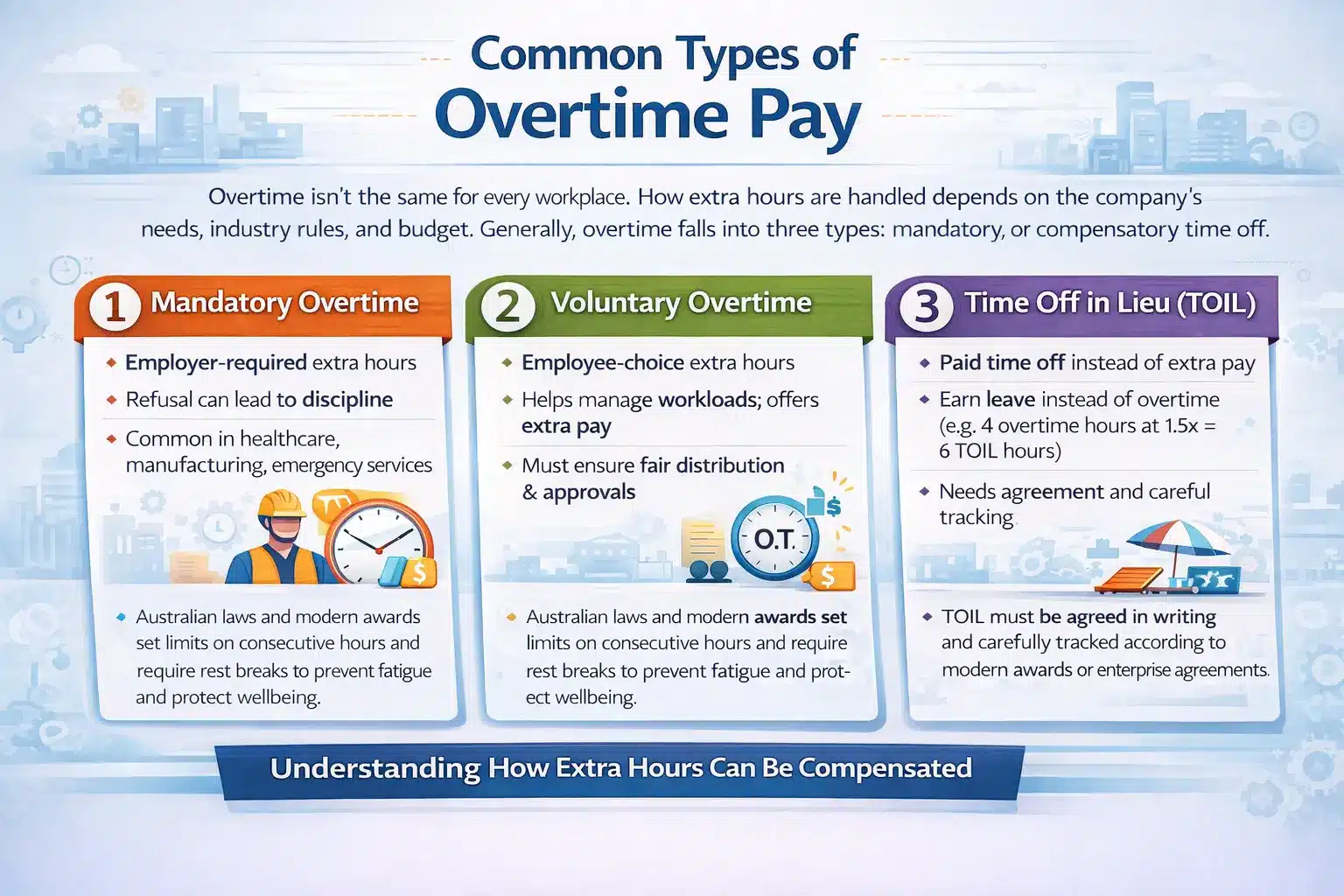
Overtime isn’t the same for every workplace. How extra hours are handled depends on the company’s needs, industry rules, and budget. Generally, overtime falls into three types: mandatory, voluntary, or compensatory time off.
- Mandatory Overtime
Mandatory overtime happens when an employer requires employees to work beyond their scheduled hours, and refusal can lead to disciplinary action. It’s common in sectors like healthcare, manufacturing, and emergency services. Australian laws and modern awards set limits on consecutive hours and require rest breaks to prevent fatigue and protect well-being. - Voluntary Overtime
Voluntary overtime lets employees choose whether to work extra hours without penalty. It helps businesses manage workloads or cover absences while giving staff a chance to earn extra pay. Employers must ensure fair distribution and approvals, as unapproved overtime is still usually payable under Australian workplace laws. - Time Off in Lieu (TOIL)
Time Off in Lieu allows employees to take paid leave instead of receiving overtime wages. For example, 4 hours of overtime at time-and-a-half could earn 6 hours of leave. TOIL must be agreed in writing and carefully tracked according to modern awards or enterprise agreements.
Overtime Pay Rates
Overtime pay is calculated by multiplying an employee’s regular wage by a set rate. These rates reward extra effort and ensure employees are fairly compensated for working beyond normal hours. The exact rate depends on how many hours are worked, the day of the week, and local labor laws.
- Overtime Pay Rates
Overtime pay in Australia is calculated by applying a higher rate to an employee’s base wage. These rates recognise extra effort and discourage excessive hours, ensuring fair compensation. The exact rate depends on the total hours worked, the day of the week, and the relevant modern award or enterprise agreement. - Time and a Half
Time and a half is the most common overtime rate, paying 1.5 times an employee’s regular hourly wage. For example, a worker earning $20/hour would receive $30/hour for eligible overtime. This rate usually applies to hours worked beyond the standard weekly limit set by the applicable award or agreement. - Double Pay
Double pay, or double time, means employees earn 2× their normal hourly rate—for example, $40/hour if the base is $20/hour. This is typically reserved for extreme conditions, such as working more than 12 hours in a day, a full seven-day week, or on Sundays and public holidays under the relevant award or agreement. -
Penalty Rates
Penalty rates apply to “unsociable hours,” like weekends, public holidays, early mornings, and late nights. Unlike standard overtime, they are based on when the work is done, not how many hours are worked. For instance, a retail employee on a Sunday shift may earn 150–200% of their base pay, even without exceeding normal weekly hours. Knowing both overtime and penalty rates is essential to stay compliant under Australian workplace laws.
How to Calculate Overtime Pay
Calculating overtime pay might seem straightforward, but it can get complicated quickly. Employers need to account for total hours, daily or weekly thresholds, and all forms of compensation to ensure employees are paid correctly. The following steps make the process easier to follow and more accurate.
- Determine the Number of Overtime Hours
Start by adding up all the hours an employee has worked in a day or week. Include regular shifts, pre-shift prep, working lunches, and post-shift wrap-up. Then subtract the standard threshold, such as 8 hours per day or 38–40 hours per week, to find the overtime hours. - Find the Regular Hourly Rate
The Regular Rate of Pay (RRP) often includes more than the base hourly wage. Employers must include base pay, non-discretionary bonuses, shift differentials, and commissions. Discretionary bonuses or expense reimbursements are excluded. - Include All Compensable Work
Overtime isn’t just about staying late at the office. Pre-shift tasks like setting up equipment, post-shift duties like cleaning, travel between job sites during work hours, or working through unpaid meal breaks all count. Any work the employer knows about and allows must be included in overtime calculations. -
Apply the Correct Multiplier
Once overtime hours and the regular rate are determined, apply the appropriate multiplier. In Australia, time-and-a-half or double time may apply depending on daily, weekly, or public holiday rules under modern awards or enterprise agreements.\
Example of Overtime Pay Calculation
Calculating overtime pay can be tricky, even for small amounts of extra work. The following example shows how to accurately calculate overtime for a standard workweek.
- Calculate Total Hours Worked: Add all hours worked in the week, including standard shifts and any pre-shift or post-shift duties. Example: an employee scheduled for 38 hours works 45 hours in total.
- Identify Overtime Hours: Subtract the standard weekly threshold (usually 38 hours). In this case, 45 – 38 = 7 overtime hours.
- Determine the Regular Hourly Rate: Include base pay and any non-discretionary bonuses or shift differentials. Exclude discretionary bonuses and reimbursements.
-
Apply the Correct Overtime Rate: Use the award or agreement rate, e.g., time-and-a-half for weekdays. Example: 7 hours × $25 × 1.5 = $262.50 overtime pay.
Overtime Pay Rules and Regulations
In Australia, overtime is regulated by modern awards, enterprise agreements, and the Fair Work Act. These rules set weekly and daily hour thresholds, standard multipliers, and higher rates for weekends and public holidays. They ensure employees are fairly paid for extra or unsociable hours. Understanding them helps employers and staff maintain a compliant and fair workplace.
Employers must include all compensable work when calculating overtime, such as pre-shift prep, post-shift duties, and approved extra hours. Accurate tracking prevents underpayment and legal risks. Following these rules also builds trust and transparency between employees and management.
Conclusion
Overtime pay is essential for recognising employees’ extra effort and ensuring fair workplace practices. By accurately tracking hours and applying the correct rates, employers can comply with modern awards, enterprise agreements, and the Fair Work Act. This not only prevents legal issues but also fosters a more motivated and satisfied workforce.
Understanding how to calculate overtime, including regular, weekend, and public holiday rates, helps businesses maintain transparency and fairness. When employers follow these rules consistently, they protect both the company and employees while promoting a positive, compliant work environment.
To learn more about this subject, you can get advices from experts through a free consultation that you can book anytime. Start now and implement overtime pay to your business with us today.

Frequently Asked Question
Employees classified as non-exempt under modern awards or enterprise agreements are entitled to overtime. This includes full-time and part-time staff, and casual employees may also qualify depending on the award.
Overtime is calculated by multiplying the employee’s Regular Rate of Pay by the applicable award or agreement rate, such as time-and-a-half for weekdays or double time for weekends and public holidays. All compensable hours, including pre- and post-shift duties, must be included.
Yes, TOIL allows employees to take paid leave instead of receiving extra wages for overtime. It must be agreed in writing and tracked carefully according to the relevant award or enterprise agreement.