














Keeping finances organised and processes efficient is essential for any company. A purchase order (PO) supports this by formally requesting goods or services from a supplier. It outlines key details such as quantity, price, and delivery terms.
Although it may look like simple paperwork, a purchase order plays a critical role. It helps control spending, maintain accurate records, and keep communication clear with suppliers. Without it, companies risk unauthorised purchases and inventory issues.
Understanding purchase orders goes beyond filling out a form. It covers the full procurement flow, from identifying needs to receiving goods and processing payments. This guide explains how the purchase order process works and why it matters.
Key Takeaways
Discover the various forms of purchase orders and when to apply them so businesses can choose the most suitable PO type for different procurement situations and maintain better control over purchasing activities.
Learn the step-by-step workflow from requisition to payment to understand how each stage of the purchase order process helps ensure proper approvals, accurate documentation, and smooth supplier transactions.
Avoiding common purchase order mistakes, such as maverick spending and vague descriptions, can help streamline operations and reduce costly errors.
An in-depth explanation of Purchase Order vs. Invoice, to help businesses understand the role of each document in the procurement process, from placing an order with suppliers to completing the final payment.
What Is a Purchase Order?

A purchase order (PO) is a formal document sent by a buyer to request goods or services. It includes details like item type, quantity, price, and delivery terms. Once accepted, it becomes a legally binding agreement that protects both sides.
More than a request, a purchase order helps control spending and track commitments. Finance teams can monitor costs before payment, while inventory teams prepare for incoming goods. As a result, companies can avoid confusion and stay organised.
Many companies now rely on a comprehensive purchasing system to manage purchase orders. These systems automate approvals and track transactions in real time. Therefore, businesses can improve visibility, manage suppliers better, and maintain accurate records.
What Should a Purchase Order Include?
For a purchase order to be effective, it must include clear and complete information. Missing or unclear details can lead to delivery delays, billing mistakes, or disputes between the buyer and supplier. To avoid these issues, a standard purchase order should contain several key elements that clearly define the order and its terms.
1. Unique purchase order number (PO #)
This is a unique reference number used to track the purchase order. It connects the order with related documents like invoices and delivery notes. Both the buyer and supplier use this number to easily monitor the order status.
2. Date of issue
This is the date when the purchase order is created. It helps track when the order was placed and sets the timeline for delivery and payment terms.
3. Vendor details
This section includes the supplier’s name, address, contact person, and tax information. Accurate vendor details ensure the order is sent to the correct supplier and that payment is processed properly.
4. Buyer details
This shows the company placing the order, including the company name, address, and department or person requesting the items. It helps the supplier know who they are dealing with and who to contact if needed.
5. Shipping address
This is the location where the goods should be delivered. It may be different from the billing address, especially for companies with multiple offices or warehouses.
6. Billing address
This is where the supplier should send the invoice for payment. It can be a physical address or a dedicated accounts payable email.
7. Product or service description
This section clearly describes the items or services being purchased. It should include specific details like product names, model numbers, or SKUs to avoid confusion.
8. Quantity and unit of measure
This specifies how many items are being ordered and how they are measured, such as per unit, box, kilogram, or pallet. Clear units prevent mistakes in delivery.
9. Price per unit and total amount
This shows the price of each item and the total cost of the order. Including these details helps prevent pricing disputes later.
10. Tax information
Taxes such as VAT, GST, or sales tax should be included if applicable. This ensures the final amount accurately reflects the total cost.
11. Delivery date
This indicates when the supplier is expected to deliver the goods or complete the service. It helps both parties plan their schedules.
12. Payment terms
Payment terms explain when the buyer must pay the supplier, such as within 30 or 60 days after the invoice is issued.
13. Terms and conditions
This section outlines the legal rules of the agreement, including policies for returns, warranties, responsibilities, and dispute resolution.

Types of Purchase Orders
Different procurement needs require different types of purchase orders. For example, buying equipment is not the same as restocking supplies or managing long-term services. Understanding each type helps companies control spending and streamline purchasing.
1. Standard purchase order (SPO)
A standard purchase order is the most common type. Companies use it when all details like quantity, price, and delivery date are clear. It suits one-off or occasional purchases.
For example, an IT team buying laptops would issue a standard PO. Everything is fixed from the start, so suppliers can fulfil the order without changes.
2. Planned purchase order (PPO)
A planned purchase order suits situations where total quantity is known but delivery timing is flexible. Companies commit to a volume but schedule deliveries later. This helps manage storage and cash flow.
For example, a manufacturer may order materials for the year but receive them in smaller batches. Therefore, they avoid overstock while keeping supply steady.
3. Blanket purchase order (BPO)
A blanket purchase order is used for recurring purchases with uncertain quantities. It usually runs for a set period and includes a spending limit. This reduces the need to create multiple POs.
For example, companies often use it for office supplies or cleaning materials. Employees can order as needed under the same agreement.
4. Contract purchase order (CPO)
A contract purchase order sets long-term terms between a buyer and supplier. It defines conditions but may not include specific items upfront. Orders are then issued under the contract when needed.
This type works well for ongoing partnerships or large projects. It provides flexibility while keeping terms consistent.
5. Digital or electronic purchase order
A digital purchase order refers to how the PO is created and shared. Many companies now use software instead of paper documents. This makes the process faster and easier to track.
ERP systems allow businesses to generate POs, automate approvals, and monitor orders in real time. As a result, companies can manage procurement more efficiently.
Purchase Order vs. Invoice
A purchase order and an invoice serve different purposes, even though they are closely related. A purchase order is created by the buyer to request goods or services. In contrast, an invoice is issued by the seller to request payment after delivery.
The timing also differs. A purchase order controls spending before a transaction, while an invoice confirms what has been delivered. Therefore, both documents support accuracy from start to finish.
To make the differences clearer, here is a simple comparison between a purchase order and an invoice:
| Aspect | Purchase Order (PO) | Invoice |
|---|---|---|
| Purpose | Request goods or services | Request payment for delivered goods or services |
| Created By | Buyer | Seller |
| Timing | Before purchase | After delivery |
| Legal Status | Becomes legally binding once accepted | Serves as a payment request |
| Key Details | Items, quantity, price, delivery terms | Items delivered, total amount due, payment terms |
| Function | Controls spending and approvals | Confirms transaction and requests payment |
Most companies match the purchase order, delivery record, and invoice before payment. This process helps prevent errors and ensures everything aligns correctly.
The Purchase Order Process Step by Step
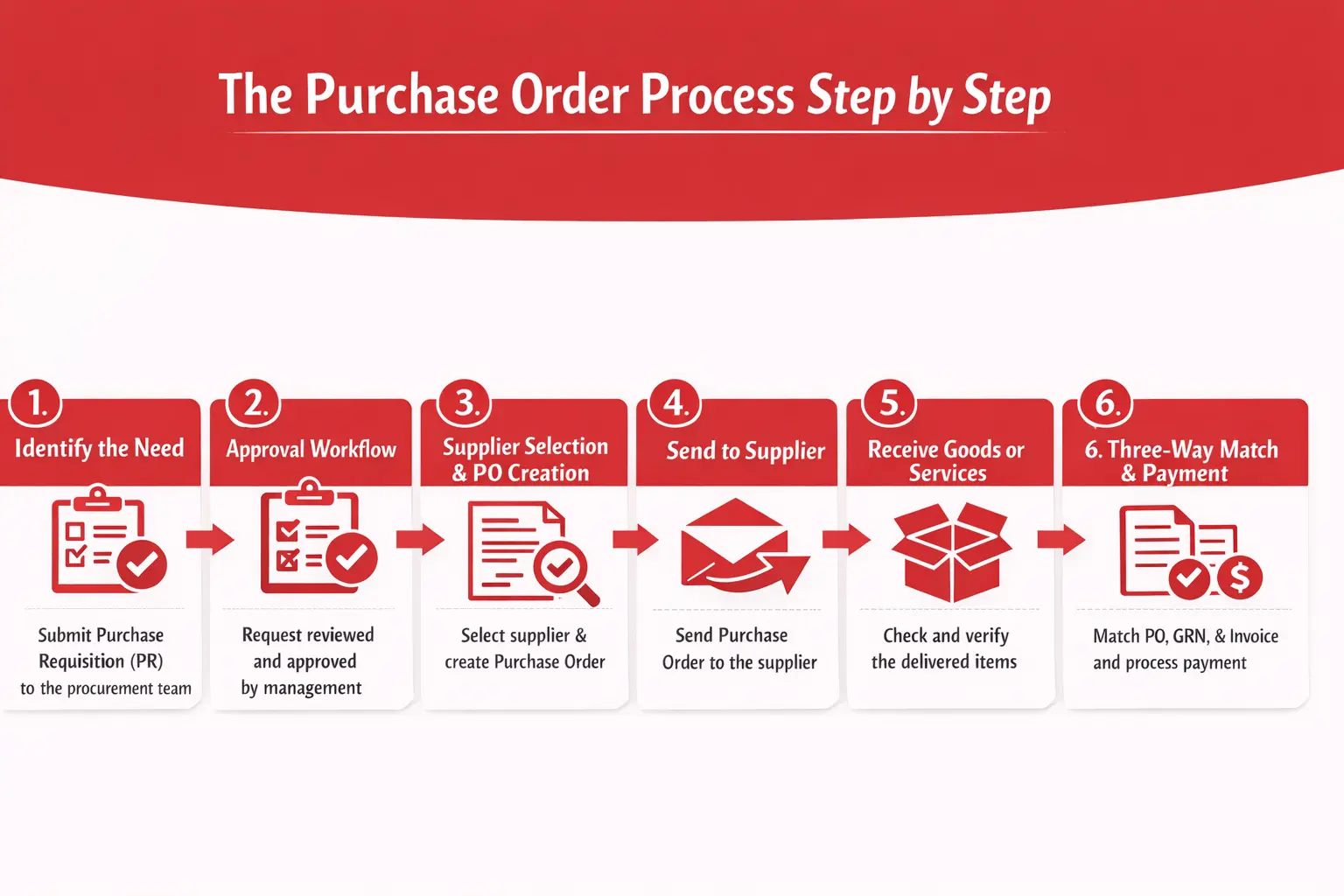
The purchase order process follows a structured workflow, starting from identifying a need to completing the final payment. While small businesses may manage purchases informally, larger businesses rely on a clear process to control spending and maintain accurate records. A well-defined PO process helps reduce errors, prevent fraud, and make procurement more efficient.
1. Identify the need and raise a purchase requisition
The process begins when a department identifies a need for goods or services. Instead of contacting a supplier directly, they submit a Purchase Requisition (PR) to the procurement team. This internal request explains what is needed, why it is required, and when it is needed.
2. Get approval
After the requisition is submitted, it goes through an approval process. Managers or finance teams review the request to confirm that it fits the company’s budget and business needs. If approved, the request moves forward; if not, it may be rejected or revised.
3. Select a supplier and create the purchase order
Once the request is approved, the procurement team selects a supplier. If there is an existing vendor, the process is quick, but sometimes suppliers are asked to provide price quotations. After choosing a supplier, the team creates a Purchase Order (PO) with details such as items, quantities, prices, and delivery terms.
4. Send the purchase order to the supplier
The purchase order is then sent to the supplier, usually through email or a purchasing software for enterprise. The supplier reviews the order to confirm they can meet the requested price, quantity, and delivery schedule. Once they accept the PO, the agreement between both parties becomes official.
5. Receive the goods or services
When the order arrives, the receiving team checks the items against the purchase order. They verify the quantity, quality, and condition of the goods. If everything is correct, a Goods Receipt Note (GRN) is recorded to confirm the delivery.
6. Perform three-way matching and process payment
Finally, the supplier sends an invoice to the accounts payable team. Before making payment, the team compares three documents: the purchase order, the goods receipt note, and the invoice. If all the details match, the payment is approved; if not, the issue must be resolved first.
Purchase Orders Across Different Industries
Avoiding Common Purchase Order Mistakes
Even with a system in place, procurement processes can falter. Being aware of common traps helps in maintaining a healthy purchasing cycle.
1. Maverick spending
Maverick spending happens when employees buy items without following the official purchase order process. This can lead to untracked expenses and budget overruns.
Solution: Enforce a “No PO, No Pay” policy so invoices are only processed if there is an approved purchase order.
2. Vague descriptions
Using unclear product descriptions in a purchase order can cause suppliers to send the wrong items. For example, writing “office supplies” instead of listing exact products can lead to confusion.
Solution: Always include detailed item descriptions, quantities, and SKUs on the purchase order.
3. Ignoring open purchase orders
Leaving purchase orders open after they have been completed can create inaccurate financial records. It may make it seem like funds are still committed when they are not.
Solution: Regularly review and close completed or cancelled purchase orders.
Conclusion
Purchase orders play a key role in helping businesses manage procurement in a clear and organised way. By defining product details, pricing, quantities, and delivery terms before a transaction begins, purchase orders help prevent misunderstandings between buyers and suppliers while keeping spending under control.
As businesses grow and purchasing becomes more complex, having a structured purchase order process becomes even more important. This is especially true for growing businesses in Australia, where efficient procurement systems help businesses scale operations while maintaining accuracy and accountability.
Your business can participate in this benefit too, with our free consultation services that will help navigate you on your journey of optimization. We can give you all the information you need to plan out the most efficient system and reach the financial success you deserve.