












Australian businesses operating mines, factories, and large facilities face growing pressure to reduce downtime and keep equipment running reliably. In remote operations, even one unexpected failure can disrupt production and increase repair costs.
To reduce these risks, many companies are moving from reactive maintenance to predictive maintenance supported by real-time monitoring and analytics. Modern sensors and machine learning help teams identify early signs of equipment failure before breakdowns occur.
When implemented properly, predictive maintenance improves asset reliability, reduces unnecessary maintenance work, and supports stable operations. This article explains how predictive maintenance works, where it delivers value, and how businesses can implement it effectively.
Key Takeaways
Understanding how predictive maintenance works helps businesses use real time monitoring to anticipate equipment failures more accurately.
The key advantages of predictive maintenance include reduced downtime, lower operating costs, and improved asset reliability across operations.
Following the right steps to implement predictive maintenance helps businesses transition from reactive maintenance to a proactive, data driven approach.
A structured predictive maintenance framework ensures sensors, analytics, and maintenance workflows remain aligned for long term operational performance.

Understanding Predictive Maintenance
Predictive maintenance is a maintenance approach that uses continuous condition monitoring to identify early signs of equipment failure. IoT sensors collect real-time data from assets, helping teams respond before breakdowns happen.
Unlike preventive maintenance, which follows fixed schedules, predictive maintenance is based on actual equipment condition. This gives maintenance teams better timing for repairs and helps reduce unnecessary servicing.
Artificial Intelligence and machine learning improve accuracy by analysing historical asset data and detecting abnormal equipment behaviour earlier. Some systems can also estimate Remaining Useful Life (RUL) for critical components.
For asset-intensive industries operating in remote or high-risk environments, predictive maintenance helps reduce mechanical risk and improve maintenance planning. With clearer visibility into equipment condition, maintenance teams can respond earlier and avoid unnecessary operational disruptions.
Key Benefits of Predictive Maintenance
Predictive maintenance can improve both operational performance and maintenance cost control when supported by reliable monitoring and asset data. The benefits below are among the most common reasons businesses adopt predictive maintenance programs.
- Reduced unplanned downtime
Continuous monitoring helps maintenance teams detect abnormal equipment behaviour before failures interrupt production. Earlier intervention also reduces the likelihood of sudden breakdowns during critical operations. -
Lower maintenance and operating costs
Predictive maintenance reduces unnecessary servicing and helps businesses avoid costly emergency repairs. Many companies also spend less on overtime labour and urgent spare part purchases. -
Extended asset lifespan
Issues such as overheating, vibration, or poor lubrication can be identified earlier before they cause severe equipment damage. This helps businesses improve asset lifecycle control and keep critical equipment operating more reliably over longer periods. -
Improved workplace safety
Unexpected equipment failures can create serious safety risks in industrial environments. Predictive alerts allow maintenance teams to plan repairs more safely and under controlled conditions. -
Better spare parts and inventory planning
Advance warning of potential failures gives procurement and maintenance teams more time to prepare spare parts. This reduces excess inventory while improving parts availability when repairs are needed. -
Higher production reliability and service consistency
More reliable equipment performance makes production schedules easier to maintain and reduces unexpected interruptions on the floor. Consistent output also supports delivery reliability and customer expectations.
How to Implement Predictive Maintenance Successfully
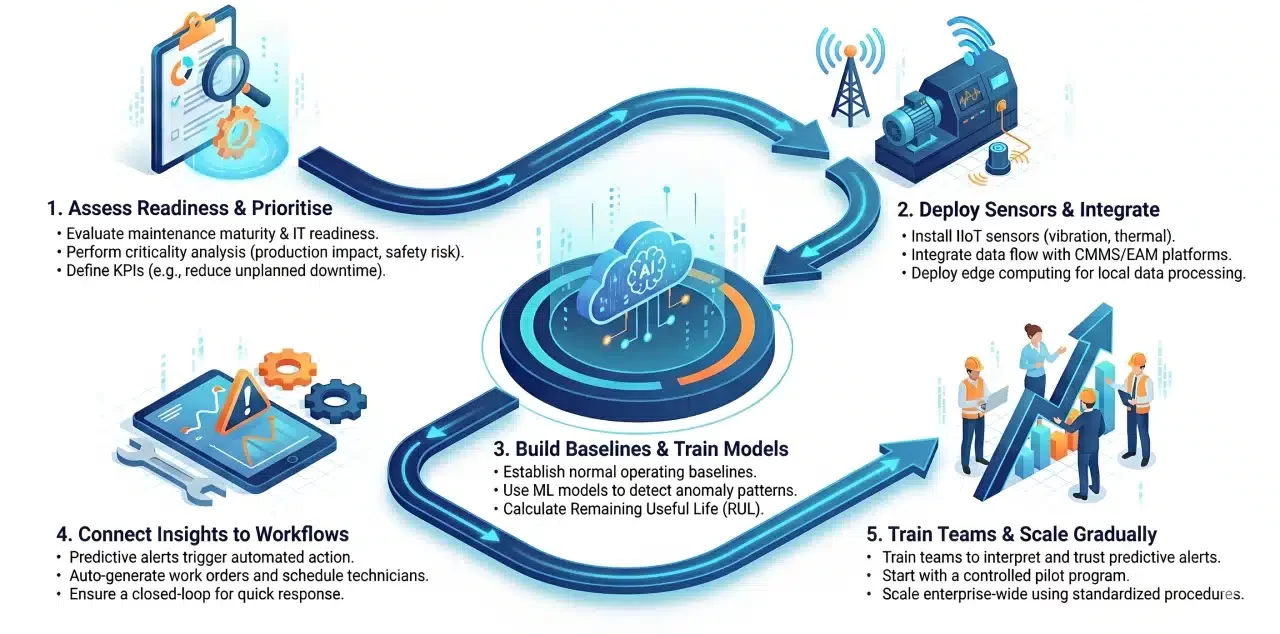
Implementing predictive maintenance involves more than simply installing sensors. Businesses also need reliable data, clear asset priorities, and maintenance processes that support long-term adoption.
Most companies begin with a small pilot before expanding across larger operations. This phased rollout helps teams validate data quality, adjust alert settings, and build confidence in the system.
1. Assess readiness and prioritise critical assets
The first step is assessing maintenance maturity, available asset data, and existing IT infrastructure. Instead of monitoring every asset immediately, businesses usually prioritise equipment based on production impact, safety risk, and failure cost.
Critical or failure-prone equipment is often selected for the initial rollout. Clear KPIs such as reducing downtime or improving MTBF should also be defined early in the process.
2. Deploy sensors and integrate data sources
After identifying priority assets, businesses can install IIoT sensors such as vibration, thermal, or ultrasonic devices at key monitoring points. Sensor placement matters because poor positioning can create inaccurate readings.
Sensor data should connect directly with CMMS or EAM platforms to centralise monitoring and maintenance records. Some businesses also use edge computing to process data locally in remote environments.







3. Build baselines and train predictive models
During the early monitoring phase, the system learns normal equipment behaviour and establishes baseline performance patterns. Machine learning models then compare live and historical data to identify abnormal conditions earlier.
Some advanced systems also estimate Remaining Useful Life (RUL) for critical components. Models typically improve over time as more operational data becomes available.
4. Connect insights to maintenance workflows
Predictive alerts only deliver value when they lead to action. Integration with CMMS platforms allows businesses to automate work orders, maintenance scheduling, and spare parts preparation.
This helps maintenance teams respond faster while giving procurement and planning teams earlier visibility into upcoming repair requirements.
5. Train teams and scale gradually
Technology alone is rarely enough for successful predictive maintenance adoption. Maintenance teams also need training to interpret alerts and understand how predictive recommendations support daily operations.
Many businesses start with a pilot project, document early results, and expand gradually using standardised deployment processes. This approach helps reduce resistance and improves long-term adoption.
Essential KPIs for Predictive Maintenance Success
Tracking the right KPIs helps businesses measure whether predictive maintenance programs are improving reliability and reducing operational risk.
- Mean Time Between Failures (MTBF): Measures how often equipment failures occur over time.
- Mean Time to Repair (MTTR): Tracks how quickly maintenance teams resolve issues after failures or alerts.
- Overall Equipment Effectiveness (OEE): Measures availability, performance, and production quality.
- Planned Maintenance Percentage (PMP): Indicates how much maintenance work is proactive instead of reactive.
Tracking these KPIs consistently helps teams fine-tune maintenance schedules, improve alert accuracy, and spot reliability trends earlier.

Industry Specific Use Cases of Predictive Maintenance
Although the core principles are similar, predictive maintenance is applied differently across industries depending on asset risk, automation levels, and operational demands.
1. Advanced Manufacturing
In advanced manufacturing environments, predictive maintenance supports Industry 4.0 operations where production lines rely on robotics, CNC machines, and conveyor systems running continuously. Even a small component failure can interrupt output.
By monitoring motors, spindles, and other critical equipment with vibration or thermal sensors, manufacturers can identify wear earlier and schedule repairs during planned downtime. This helps reduce stoppages and maintain more stable production performance.
2. Retail and E commerce Fulfilment
Predictive maintenance is becoming more common in automated fulfilment centres handling large order volumes. Facilities often depend on AS/RS systems, conveyor networks, and autonomous robots that operate around the clock.
Monitoring conveyor motors, refrigeration systems, and drive components helps operators detect issues before peak periods are affected. Catching issues earlier helps fulfilment centres avoid delivery delays and costly last-minute repairs.
3. Distribution and Logistics
In distribution and logistics environments, predictive maintenance is widely used to improve fleet reliability and material handling uptime within an integrated asset handling system. Telemetry data from vehicles and equipment can reveal early signs of mechanical problems.
Instead of relying only on fixed servicing schedules, operators can perform maintenance based on actual equipment condition. This helps reduce unnecessary servicing while improving equipment availability across large logistics networks.
Predictive Maintenance Implementation Framework
Moving from reactive maintenance to predictive maintenance usually requires a phased rollout rather than a full deployment at once. Businesses need reliable asset data, the right monitoring setup, and clear maintenance priorities before scaling further.
A structured rollout also helps teams reduce unnecessary alerts and build confidence in the system over time.
1. Conduct asset criticality analysis
Businesses should avoid monitoring every asset from the beginning. Most predictive maintenance projects start with an asset criticality assessment based on production impact, safety exposure, environmental risk, and historical failure costs.
High-risk or high-value equipment is usually prioritised during the pilot phase. This helps businesses focus sensor investment on assets with the greatest operational impact.
2. Deploy iIoT sensors and integrate systems
Once priority assets are identified, IIoT sensors such as vibration, thermal, or ultrasonic devices can be installed at key monitoring points. Accurate sensor placement is important because poor readings can affect analysis quality.
Sensor outputs should also connect with CMMS or EAM platforms to centralise maintenance data and support automated work order creation.
3. Establish baselines and train algorithms
During the early stages, the system collects operational data to establish normal equipment behaviour. Machine learning models then compare live and historical data to detect abnormal patterns earlier.
More advanced systems can estimate Remaining Useful Life (RUL), helping maintenance teams schedule repairs before equipment performance starts declining.
How Asset Management Software Enhances Predictive Maintenance in Australia’s Manufacturing Sector
According to IMARC Group, the Australian predictive maintenance market is projected to grow from USD 312.1 million in 2025 to USD 1,829.8 million by 2034. The growth shows how quickly Australian businesses are investing in predictive maintenance to reduce downtime and improve asset reliability.
To support this shift, manufacturers such as BlueScope are adopting asset management software combined with predictive maintenance technologies. Below are several ways asset management systems support predictive maintenance across Australian manufacturing operations.
1. Real-Time Asset Monitoring
Asset management software can connect with IoT sensors to monitor equipment performance continuously. This helps maintenance teams detect abnormal conditions earlier before failures disrupt production.
2. Data-Driven Maintenance Scheduling
Instead of relying only on fixed servicing schedules, maintenance activities can be planned based on actual equipment condition and performance data. This approach helps reduce unnecessary maintenance work.
3. Failure Prediction and Alerts
Advanced analytics tools can identify unusual operating patterns and trigger alerts when equipment behaviour changes. Earlier warnings give maintenance teams more time to investigate potential issues.
4. Reduced Downtime and Production Disruptions
Addressing maintenance issues earlier helps manufacturers reduce unexpected downtime and avoid sudden production interruptions. More stable equipment performance also supports smoother daily operations.
5. Optimised Asset Lifespan and Maintenance Costs
Predictive maintenance ensures assets are serviced only when needed, reducing unnecessary maintenance while extending equipment lifespan.
Challenges in Predictive Maintenance and How to Solve It
Even well-funded predictive maintenance programs can struggle without strong execution. Reliable data, team adoption, and system integration often matter just as much as the monitoring technology itself.
Addressing these challenges early makes predictive maintenance programs easier to scale and maintain over time.
1. Data overload and alert fatigue
Large sensor deployments can generate overwhelming amounts of data and notifications. When teams receive too many low-priority alerts, important warnings are more likely to be overlooked.
Mitigation: Use edge processing and alert filtering to reduce unnecessary notifications and prioritise critical anomalies.
2. Cultural resistance and capability gaps
Predictive maintenance changes how maintenance teams make decisions. Some technicians may hesitate to rely on system-generated insights, especially during the early stages of adoption.
Mitigation: Involve frontline teams early, provide practical training, and highlight early operational improvements to build trust.
3. Poor data quality and network instability
Predictive models depend heavily on accurate and stable sensor data. In industrial environments, signal interference, poor calibration, or unreliable connectivity can reduce monitoring accuracy.
Mitigation: Maintain regular sensor calibration schedules and invest in network infrastructure that supports stable data transmission.
Advanced Best Practices for Future Proofing
As predictive maintenance programs mature, many businesses shift their focus from basic monitoring toward improving long-term performance and operational coordination.
1. Leveraging digital twins
Digital twins create virtual versions of physical assets using real-time operational data. Engineers can test scenarios, monitor performance changes, and predict degradation without interrupting production activities.
2. Deep Asset Management Software and CMMS Integration
Predictive insights become more useful when connected with an asset maintenance solution and CMMS platform. Alerts can automatically trigger work orders, spare parts checks, and maintenance scheduling workflows.
3. Continuous model refinement
Machine learning models need regular refinement as operating conditions change over time. Many businesses also use technician feedback after inspections or repairs to improve alert accuracy and reduce false positives.
Conclusion
Predictive maintenance helps businesses reduce downtime, improve equipment reliability, and make maintenance planning more proactive. As equipment networks grow larger and more connected, many businesses are relying on real-time monitoring to stay ahead of maintenance issues.
Successful implementation depends on more than sensors alone. Businesses also need reliable data, practical workflows, and systems that can scale alongside operational growth.
Taking a structured approach helps businesses avoid fragmented deployments and improve long-term maintenance performance. If you want help evaluating the right solution, get expert advice without cost.

Frequently Asked Questions About Predictive Maintenance
-
What is predictive maintenance and how does it work?
Predictive maintenance is a data driven strategy that uses IoT sensors and analytics to monitor equipment condition in real time. By detecting early signs of wear or anomalies, businesses can perform maintenance at the optimal time before failures occur.
-
How does predictive maintenance improve equipment reliability?
Predictive maintenance improves reliability by helping maintenance teams catch problems before equipment fails unexpectedly. This reduces unexpected breakdowns, stabilises production performance, and extends overall asset lifespan.
-
What KPIs should be tracked in a predictive maintenance program?
Key KPIs typically include Mean Time Between Failures (MTBF), Mean Time to Repair (MTTR), Overall Equipment Effectiveness (OEE), and Planned Maintenance Percentage (PMP). Monitoring these metrics helps businesses measure reliability improvements and program ROI.
-
Can predictive maintenance be integrated with CMMS or ERP systems?
Yes. Modern predictive maintenance platforms are commonly integrated with CMMS or ERP systems to automate work orders, check spare parts availability, and synchronise maintenance planning. This integration ensures predictive insights translate into timely operational action.