














An HRM system is software that helps businesses manage employee data and HR tasks in one place. It automates processes such as recruitment, payroll, attendance, benefits, and compliance to make HR operations more efficient.
Managing human resources today goes far beyond spreadsheets and manual filing systems. Australian businesses operate in a fast-changing environment shaped by strict compliance requirements and evolving workforce expectations, making adaptability more important than ever.
A resilient HRM system helps businesses handle these challenges with greater ease by streamlining day-to-day HR operations and supporting ongoing compliance. With the right HR management system, tasks like recruitment, onboarding, payroll, and employee data management become more efficient and less error-prone.
More importantly, modern HR technology turns HR from an administrative function into a strategic advantage. It helps businesses improve decision-making, optimise processes, and build a stronger foundation for long-term growth.
Key Takeaways
An HRMS is a software platform that centralises workforce data across recruitment, payroll, attendance, and compliance into one system.
HRIS, HRMS, and HCM differ in scope and complexity. Understanding the distinctions helps businesses choose the right level of HR technology for their size and needs.
Australian HR software must support the Fair Work Act, Single Touch Payroll, and Modern Awards to help businesses stay compliant with local employment law.
A robust HR platform includes core modules such as payroll, recruitment, performance management, leave tracking, and analytics to manage the full employee lifecycle.
What Is an HRM System?
An HRM system is a software that centralises employee lifecycle processes and automates key HR tasks, including payroll, onboarding, performance management, and compliance, into one platform. It reduces manual effort, minimises errors, and gives teams a single source of truth for all employee records.
Modern systems connect recruitment, payroll, attendance, and performance in one platform. This gives managers real-time visibility into headcount, costs, and compliance without manual reporting.
As a business grows, an HRM system scales to manage more complex HR tasks without adding administrative headcount. Access controls protect sensitive data and ensure it remains visible only to authorised personnel.
How Does a Human Resource System Work?
A human resource system works by centralising employee information and connecting core HR processes such as attendance, leave, payroll, onboarding, and performance management in one platform. Instead of relying on separate files or manual follow-ups, it helps organisations manage HR tasks more accurately, improve visibility, and support faster decision-making across the business.
- Employee data is stored in one place so HR teams can access records, contracts, job details, and personal information more easily.
- Attendance and leave are tracked automatically to reduce manual errors and speed up approvals for both managers and employees.
- Payroll inputs are organised more efficiently by linking attendance, overtime, and leave data with salary calculations.
- Managers can quickly review team information, including performance, leave requests, and workforce updates.
- Employees can use self-service features to check payslips, update personal details, and submit requests without unnecessary back-and-forth.
- Reports and insights are generated more clearly so leaders can make better workforce and operational decisions.
HRM System vs HRIS vs HCM
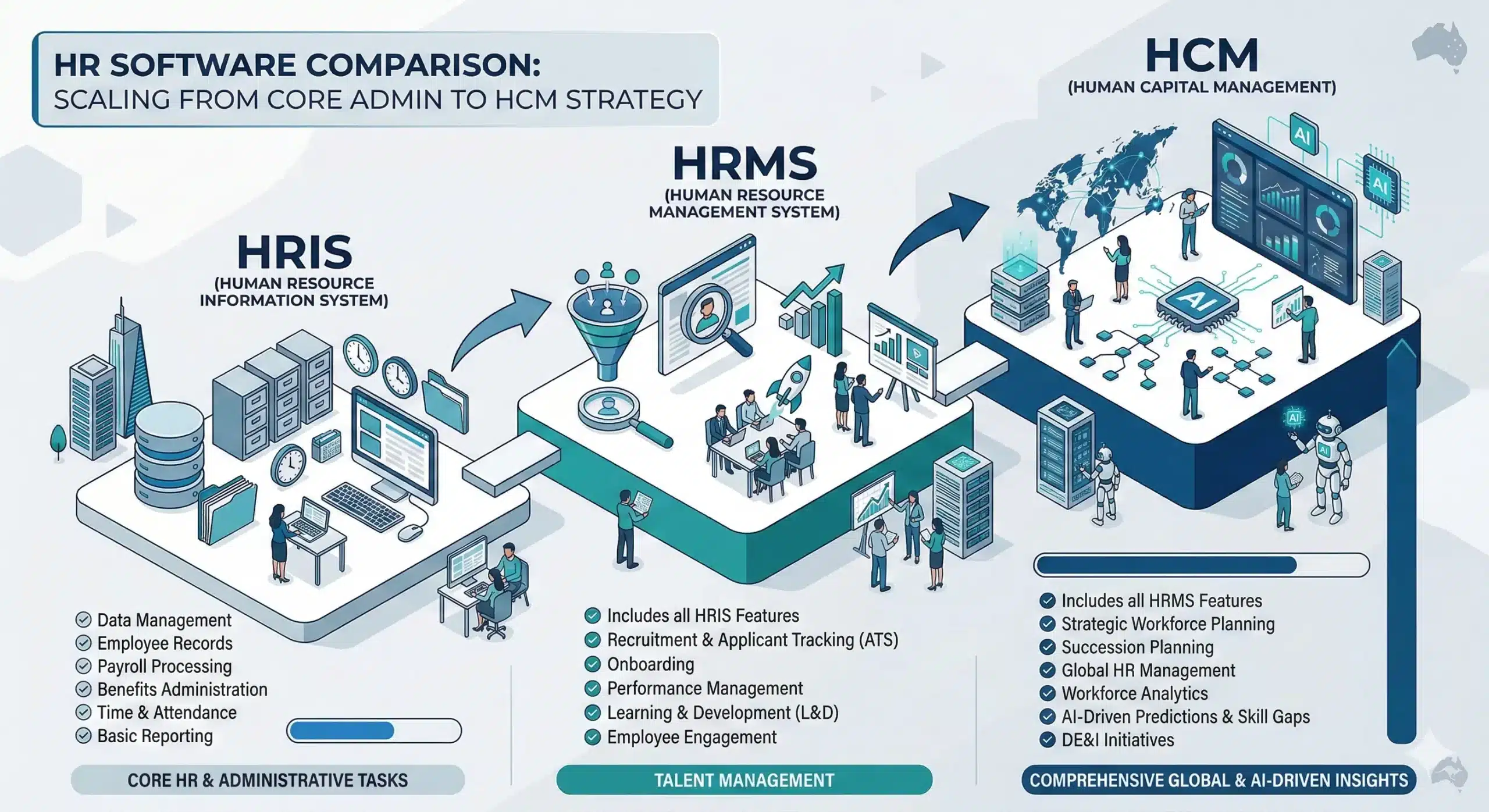
Understanding the distinctions between HRM systems, HRIS, and HCM is vital for choosing the right software for your business. While these terms are often used interchangeably, each represents a different level of functionality and complexity in workforce management.
1. HRIS (Human Resource Information System)
An HRIS is the most basic form of HR technology, primarily designed for core administrative functions such as employee data tracking, payroll, and benefits administration. It’s ideal for smaller businesses that need reliable personnel records and basic compliance.
HRIS focuses on accuracy and accessibility of quantitative data, such as attendance, paid time off, and shift schedules.
2. HRM system (Human Resource Management System)
An HRM system builds on the HRIS foundation by adding talent management features like recruitment, performance tracking, and employee development. It’s suitable for mid-sized businesses looking to manage their workforce and improve productivity actively.
The HRM system goes beyond data storage by supporting employee lifecycle management, helping businesses develop their teams for long-term success.
3. HCM (Human Capital Management)
HCM platforms offer the most comprehensive HR solution, including all features of HRIS and HRM, with additional capabilities for global payroll, advanced analytics, and succession planning.
These platforms are designed for large enterprises and multinational corporations, focusing on optimizing workforce potential through AI-driven insights and strategic alignment with business goals.
Ultimately, the right system for your organization depends on its size, complexity, and operational needs. Start with a solid HRM system and scale to more advanced solutions like HCM as your business grows. This approach ensures you invest in technology that meets both current and future workforce demands.
| Aspect | HRIS | HRM System | HCM |
| Primary Focus | Core HR administration and employee records | Workforce management and employee development | Strategic workforce optimisation and business alignment |
| Main Functions | Employee data, payroll, benefits, attendance | All HRIS functions plus recruitment, performance, and training | All HRM functions plus global payroll, succession, and advanced planning |
| Talent Management | Limited | Included | Extensive and strategic |
| Analytics | Basic reporting | Operational reporting and workforce insights | Advanced analytics and AI-driven insights |
| Best For | Small businesses | Mid-sized businesses | Large enterprises and multinational organisations |
| Business Value | Improves record accuracy and compliance | Supports productivity and employee lifecycle management | Helps shape long-term workforce strategy |
| Complexity | Low | Moderate | High |
| Scalability | Suitable for basic HR needs | Suitable for growing teams | Suitable for complex and global operations |
HRM System vs Traditional HR Methods
An HRM system gives organisations a more efficient and scalable way to manage workforce processes than traditional HR methods. While manual tools may still work for smaller teams, they often create delays, fragmented records, and greater compliance risk as operations become more complex.
| Function | Traditional HR | HRMS Solution |
| Employee Records | Paper files, spreadsheets, and disconnected documents. | Centralised digital database with easier access and updates. |
| Recruitment | Manual job posting, email tracking, and fragmented candidate records. | Automated job posting, applicant tracking, and more structured hiring workflows. |
| Compliance Training | In-person sessions and paper-based completion tracking. | Online training modules with automatic tracking and better visibility. |
| Performance Reviews | Paper forms, manual scheduling, and delayed follow-up. | Digital review workflows with automated reminders and clearer records. |
| Reporting | Manual data compilation from multiple files and sources. | Real-time analytics and automated reports for faster decision-making. |
| Employee Self-Service | Employees depend on HR for routine requests and updates. | 24/7 online access to payslips, leave, personal details, and requests. |
| Data Accuracy | Higher risk of duplicate entries and manual errors. | Automated validation and single data entry across workflows. |
| Scalability | More resource-intensive as the organisation grows. | Scales more easily with workforce growth and operational complexity. |
The Australian Regulatory Landscape Regarding Human Resources
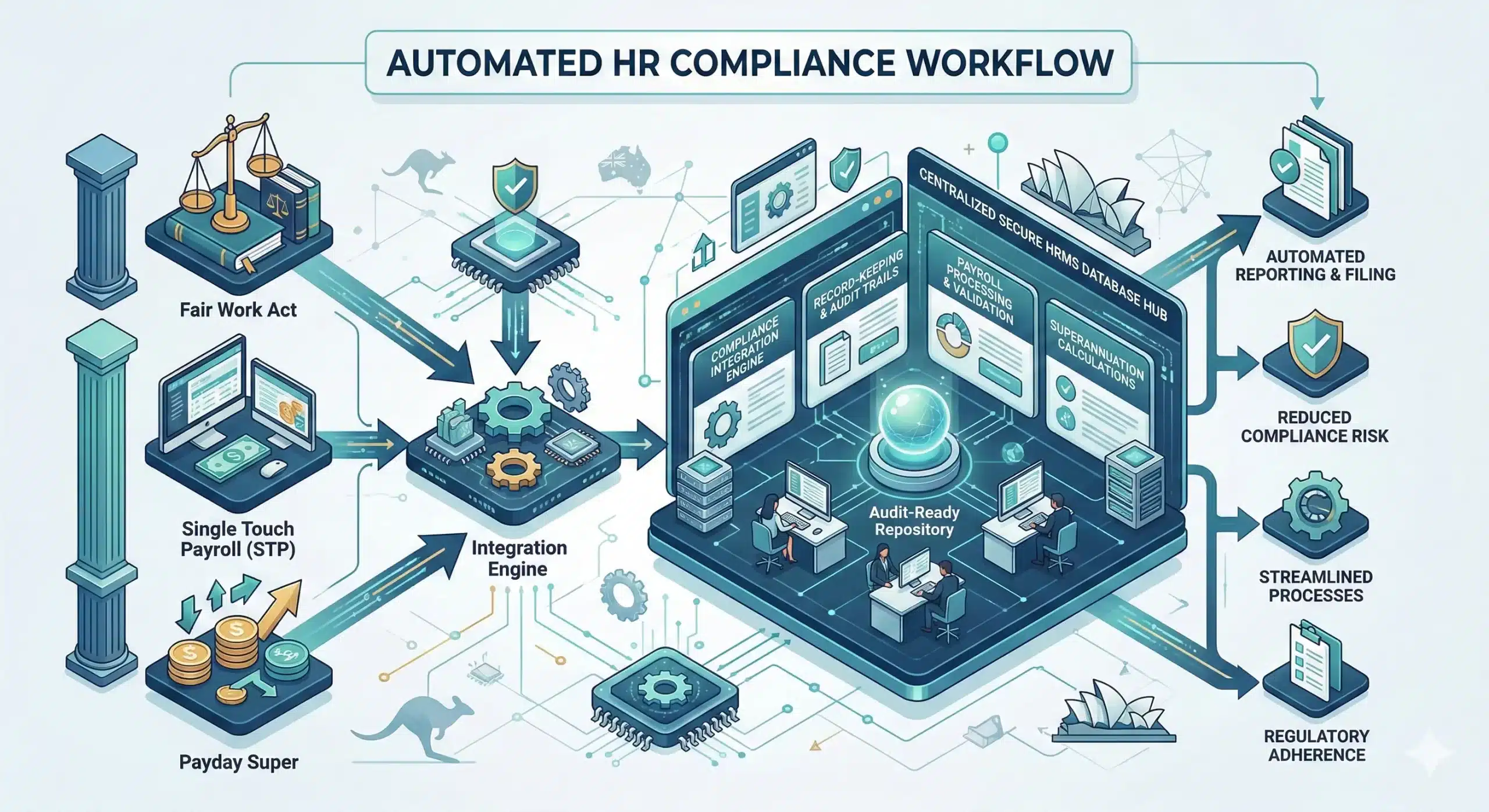
Australia’s regulatory landscape is complex, with strict employment laws designed to protect workers and impose heavy compliance obligations on employers. A modern HRM system is essential for navigating these regulations, ensuring compliance, and reducing the risk of costly penalties.
1. Fair Work Act 2009 & the National Employment Standards (NES)
The Fair Work Act and NES set the minimum entitlements for all Australian employees, including work hours, leave, and flexible arrangements. A human resource management system (HRMS) ensures that these entitlements are automatically tracked, alerting employers to any discrepancies.
It helps businesses stay compliant with legal requirements without manually checking each employee’s data. By automating these processes, the system guarantees that scheduling conflicts or leave accruals are immediately flagged.
2. Criminal wage theft offence
Wage theft is now a criminal offence in Australia, with severe penalties for employers who underpay employees. An HRM system automates award calculations, reducing the risk of underpayment errors.
The system maintains an immutable audit trail, ensuring payroll transactions are transparent and traceable. This functionality significantly mitigates the risk of wage theft claims and the associated legal consequences.
3. Single Touch Payroll Phase 2 (STP)
Single Touch Payroll Phase 2 requires detailed payroll data to be submitted directly to the Australian Taxation Office (ATO) every time employees are paid. A robust HRM system integrates with the ATO portal, ensuring accurate data transmission without manual input.
This integration eliminates human error and ensures compliance with STP requirements. The system ensures seamless, real-time reporting of payroll, tax, and superannuation information.
4. Payday super
Employers must prepare before July 1, 2026, when the Payday Super requirement becomes effective. This mandate requires superannuation contributions to be paid at the same time as salary payments.
An HR management system synchronizes payroll with superannuation clearing houses, ensuring timely and accurate payments.
By automating this process, businesses can comply with the new requirements without delay. The system prevents potential penalties related to late or missed super contributions.
5. Record-keeping obligations (Fair Work Act s535)
Employers must retain accurate employee records for at least seven years under the Fair Work Act’s section 535. An HRM system securely stores these records in a digital format, making them easily accessible for audits.
The system automatically archives critical documents such as pay records, hours worked, and leave balances. This feature ensures compliance with the long-term retention requirement while simplifying record retrieval.
6. Right to disconnect
The Right to Disconnect allows employees to opt out of work-related communication outside their contracted hours. An HRM system can automate “communication blackout” periods, ensuring that employees’ right to disconnect is respected.
The system tracks actual hours worked and enforces boundaries by disabling notifications outside of work hours. This promotes employee well-being and helps businesses comply with the legislation.
7. Privacy Act reforms & employee data
The Privacy Act reforms impose strict obligations on businesses to protect employee data and report any breaches. An HRM system offers enterprise-grade data encryption and role-based access controls to safeguard sensitive information.
The system helps businesses comply with the new privacy regulations by ensuring that only authorized personnel can access confidential data. It also supports rapid breach reporting to mitigate potential risks.
8. Modern awards & enterprise agreements
Australia’s Modern Awards and Enterprise Agreements dictate pay rates, allowances, and penalties based on industry and role. An HRM system automatically interprets and applies these complex rules to ensure employees receive their correct entitlements.
It processes various awards, including penalty rates, overtime, and specific allowances for different roles. The system ensures consistent application of these complex rules, reducing the chances of underpayment claims.
Types of HRMS Solutions
The right HRMS solution can significantly impact a business’s operational efficiency and long-term growth. Each solution offers different advantages depending on the organization’s needs, IT infrastructure, and strategic direction.
- Cloud-Based HRM Systems: Cloud-based solutions are the most popular in 2026, offering quick deployment and minimal upfront costs. These HR management systems are hosted on remote servers, managed by the vendor, and accessible through a web browser, eliminating the need for expensive IT infrastructure.
- On-Premise HRMS Solutions: On-premise systems provide businesses with full control over their data and system configurations. However, these solutions require substantial upfront investment in hardware and IT support, making them less suitable for businesses seeking agility or lower operational costs.
- Integrated ERP HRMS Solutions: This system is part of broader enterprise resource planning (ERP) suites, ensuring seamless data flow across departments like HR, finance, and supply chain. They offer a unified interface, reducing the learning curve and ensuring data consistency across various business functions.
- Best-of-Breed Standalone HRMS Solutions: It focuses on providing the most advanced and specialized HR features available. These platforms are ideal for businesses that prioritize cutting-edge HR functionality, but they require ongoing integration with other systems and regular technical oversight.
The choice between these HRM system types depends on the company’s current infrastructure and future needs, balancing cost, functionality, and scalability.
Key Features of a Human Resource System

A modern human resource management system (HRMS) includes a set of powerful features that streamline and optimize HR operations. These features work together to support every stage of the employee lifecycle, enabling businesses to improve efficiency, compliance, and decision-making.
1. Employee database & records management
The employee database is the core of any HRM system, acting as the single source of truth for all personnel data. It consolidates contact details, compensation history, certifications, and more, eliminating the need for multiple spreadsheets.
Advanced records management allows customization for industry-specific needs, like tracking certifications or licenses. The system automatically updates and alerts users when certifications are nearing expiration, preventing compliance issues.
2. Payroll & compensation
Payroll management in an HR system automates wage calculations, tax deductions, and benefits processing, ensuring accuracy and compliance. It integrates seamlessly with attendance data to calculate hourly pay or bonuses, reducing errors.
The system generates pay stubs and reports while keeping a record of all transactions for auditing purposes. With an HR management system, companies can ensure timely and accurate compensation without manual intervention.
3. Recruitment & applicant tracking
The recruitment module streamlines the hiring process by managing job postings, applications, and candidate interviews. It tracks applicants through each stage of the recruitment pipeline, from application to hiring.
The system allows for customized recruitment workflows, including automatic email responses and interview scheduling. Integration with job boards and social media platforms enables faster candidate sourcing and more efficient tracking.
4. Onboarding & offboarding
Onboarding modules support smooth employee orientation by automating document collection, training schedules, and new-hire introductions. It ensures that all legal and compliance documents are completed and submitted before the first day.
The offboarding feature handles the formal exit process, from final pay calculations to return of company property. This module helps businesses ensure consistency and compliance during both onboarding and offboarding.
5. Leave & attendance management
Leave and attendance management tracks employee work hours, absences, and leave requests in one centralized system. The system allows employees to submit leave requests and managers to approve them with ease.
Integration with payroll ensures that leave balances are automatically updated and correctly reflected in salary calculations. This reduces administrative work while ensuring compliance with leave policies.
6. Performance management
Performance management tools allow businesses to track employee goals, achievements, and areas for improvement. The system facilitates regular performance reviews, feedback collection, and goal-setting.
By providing a structured process for appraisals, it aligns employee performance with organizational objectives. Automated workflows help streamline the review process, reducing manual work and ensuring consistency.
7. Learning & development (L&D)
L&D modules track employee training progress and skills development. The system enables businesses to create personalized training plans, schedule courses, and monitor completion rates.
It also allows employees to access learning materials and certifications, fostering continuous improvement. By centralizing learning and development efforts, companies ensure their workforce remains competitive and compliant.
8. Reporting & HR analytics
HR analytics modules provide powerful reporting tools to track key metrics like employee turnover, compensation trends, and productivity. The system allows for customizable dashboards and real-time insights, helping HR teams make data-driven decisions.
It integrates with other HR features to deliver accurate reports based on up-to-date information. This helps businesses identify trends, address issues proactively, and measure the effectiveness of HR strategies.
9. Employee self-service portal
An employee self-service portal empowers staff to manage their personal information, benefits, and requests independently. Employees can access pay stubs, submit leave requests, and update contact details without HR intervention.
This reduces administrative workloads and increases employee satisfaction by giving them more control over their data. The portal also enhances communication by providing a direct channel between employees and HR.
10. Compliance management
A compliance management feature helps Australian businesses meet obligations under the Fair Work Act, Single Touch Payroll Phase 2, Modern Awards, and the Payday Super requirements taking effect in July 2026.
It automates award interpretation, flags entitlement discrepancies, and maintains an auditable record of payroll transactions to reduce the compliance burden on HR teams and minimise underpayment risk.
Benefits of Using a Human Resource Management System

How can an HRMS transform your business? These systems streamline HR operations, boost productivity, and improve the employee experience, making them essential for organizations looking to stay competitive.
- Improve employee experience and retention
An HRM system gives employees direct access to payslips, leave balances, and HR support through self-service tools.
Better visibility into engagement trends helps businesses identify and address retention risks before they escalate. - Enable data-driven workforce planning
Real-time analytics give HR teams and leadership clearer visibility into headcount, costs, and performance patterns.
Data-backed insights support more confident decisions on hiring, training, and resource allocation. - Reduce costs and streamline HR operations
For businesses managing payroll and leave across multiple departments or teams, a centralised HRM system helps prevent inconsistencies caused by disconnected records or manual handoffs.
This also reduces administrative overhead, allowing HR teams to focus on initiatives that contribute more directly to business performance - Ensure regulatory compliance
A modern HRM system automates compliance with the Fair Work Act, Single Touch Payroll, Modern Awards, and the upcoming Payday super requirement.
Built-in audit trails reduce the risk of underpayment claims and help businesses respond to regulatory audits with confidence. - Accelerate recruitment and onboarding
Automated job posting, applicant tracking, and onboarding workflows help businesses hire faster and give new employees a more consistent first experience from day one. - Support workforce deployment and scalability
An HRM system improves visibility across teams, sites, and projects so workforce resources are deployed where they are needed most.
For example, Tate & Lyle uses HashMicro’s HRM to consolidate payroll, leave, and performance data across its South-East Asia workforce into one platform. - Data accuracy and security
An HRM system uses automated validation and role-based access controls to reduce data entry errors and ensure sensitive employee information is only visible to authorised users.
Who Uses an HRM System in Australian Organisations?
A human resource system is not only for HR teams; it also supports multiple roles across the organisation with different operational and strategic needs. In Australian organisations, broader access helps each stakeholder work more efficiently while keeping workforce information accurate, connected, and easier to manage.
- HR professionals and managers use a human resources system as their primary workspace to manage employee records, leave, payroll coordination, workflows, reporting, and compliance across Australian states and territories. This helps them reduce manual admin, maintain consistency, and make day-to-day HR operations more efficient.
- Employees use the system’s self-service features to update personal details, submit leave requests, access payslips, review leave balances, and join performance or training activities without relying on HR for every request. This creates a smoother and more professional employee experience across the organisation.
- Recruiters use a human resource system to manage hiring pipelines, track applicants, coordinate interviews, and support onboarding more seamlessly. This gives hiring teams better visibility and helps them move candidates through the recruitment process with less delay.
- Executive leaders rely on HRM system reporting and analytics to support workforce planning, budget decisions, compliance oversight, and evaluation of HR initiatives. With clearer insights, leadership teams can make more informed decisions that align people strategy with business goals.
How to Choose the Right Human Resource System for Your Business
Choosing the right HRM system is key to boosting efficiency and supporting your business growth. Here’s a step-by-step guide to help you select the best fit for your needs:
- Define your HR objectives: Identify your core HR challenges and goals to ensure the HR management system addresses them effectively and aligns with your business vision.
- Evaluate system scalability: Select a system that can grow with your business, adapting to future HR needs and accommodating an expanding workforce.
- Ensure ease of use: Choose an HRMS with a user-friendly interface that minimizes training time and promotes quick adoption across your team.
- Check integration capabilities: Ensure the HRM system integrates seamlessly with your current software solutions to ensure smooth data flow and reduce manual work.
- Prioritize security and compliance: Look for a system that offers strong data protection features and complies with all relevant legal regulations, ensuring employee privacy and compliance.
- Customization features: Opt for an HRMS that lets you customize to meet your unique business requirements, such as specific workflows or compliance rules.
- Mobile accessibility: Ensure the HR management system supports mobile access, enabling employees and HR teams to use it remotely for greater flexibility.
- Comprehensive analytics: Choose a system with robust reporting and analytics tools to gain actionable insights into workforce performance and other critical HR metrics.
- Vendor support and update: Verify that the vendor provides reliable customer support, system updates, and resources to keep the HRM system running efficiently.
- Multi-site and multi-state support: For businesses operating across locations, ensure the system handles state-specific award variations and provides consolidated reporting across all sites
By following these steps, you can select the right human resources system to streamline operations, enhance employee engagement, and support your business’s growth.






HRM System Implementation Best Practices
Implementing an HR management system (HRMS) successfully requires careful planning and a strategic approach. Here are some best practices to ensure effective implementation:
- Assess Business Needs: Begin by understanding your specific HR challenges and how the HR system can address them, ensuring it integrates seamlessly with existing processes.
- Engage Stakeholders: Involve key departments and users early in the process to ensure their needs are considered and to gain buy-in across the organization.
- Provide Training: Ensure that HR teams and employees are properly trained to use the system efficiently, maximizing its capabilities for smoother day-to-day operations.
- Test and Iterate: Before full deployment, conduct testing phases and gather feedback to identify any issues and make necessary adjustments to improve the user experience.
- Monitor and Optimize: After the system is implemented, continuously monitor its performance and look for ways to optimize features for better results.
The future of HR management systems lies in AI and automation, enabling smarter, data-driven decisions. HashMicro’s HRM solutions integrate predictive analytics to help businesses plan and allocate resources efficiently.
As HRMS platforms evolve, they offer more flexible, cloud-based solutions that grow with your business. HashMicro’s HRM system adapts to businesses of various sizes, streamlining HR processes while reducing administrative workload.
With a focus on employee experience, HRMS platforms are prioritizing seamless, personalized interfaces. HashMicro leads this shift, providing solutions that empower both HR teams and employees to manage the workforce efficiently.
HRM System Options in the Australian Market
Businesses in Australia have access to a wide range of HRM systems designed for different operational needs. Choosing the right solution depends on company size, compliance requirements, and the level of automation needed.
For a more detailed comparison, explore the best HR software available in Australia. To make the shortlist easier, the table below compares the seven HRMS options side by side.
| Software | Best for | Pricing model | compliance | Deployment |
|---|---|---|---|---|
| HashMicro | Mid-market businesses needing all-in-one HR and ERP | Custom pricing | STP, Modern Awards, Payday Super | Cloud |
| SAP SuccessFactors | Large enterprises with complex global HR needs | Per user/month subscription | STP, Modern Awards | Cloud |
| Oracle HCM Cloud | Businesses needing scalable HR with financial integration | Per user/month subscription | STP, Modern Awards | Cloud |
| BambooHR | Small to mid-sized businesses needing simple HR tools | Per employee/month | Limited AU-specific compliance | Cloud |
| Employment Hero | Australian businesses focusing on payroll and engagement | Per employee/month | STP, Modern Awards, Payday Super | Cloud |
| ADP Workforce Now | Companies needing reliable payroll processing at scale | Custom pricing | STP, Modern Awards, Payday Super | Cloud |
| Rippling | Businesses integrating HR, IT, and payroll in one platform | Per employee/month | STP, Modern Awards | Cloud |
1. HashMicro
Best for: Businesses seeking an all-in-one HR system, including payroll, attendance, and STP/Payday Super, with strong automation and compliance support
2. SAP SuccessFactors
Best for: Large enterprises requiring advanced workforce analytics and global HR capabilities.
3. Oracle HCM Cloud
Best for: Organisations needing scalable HR solutions with strong financial and workforce integration.
4. BambooHR
Best for: Small to mid-sized businesses looking for user-friendly HR management tools.
5. Employment Hero
Best for: Australian businesses focusing on payroll, HR, and employee engagement in one platform.
6. ADP Workforce Now
Best for: Companies requiring reliable payroll processing and workforce management at scale.
7. Rippling
Best for: Businesses that want HR, IT, and payroll systems integrated into one platform.
Conclusion
Managing human resources effectively goes far beyond basic spreadsheets and manual processes. With the increasing complexity of compliance regulations and workforce demands, adopting a modern HRM system is essential for staying competitive in today’s business environment.
An HR management system (HRMS) helps streamline HR functions, from recruitment and payroll to performance management, ensuring operational efficiency and legal compliance. By automating routine tasks and providing actionable data insights, HRMS transforms human resources from a back-office function into a strategic business driver.
As HR technology continues to evolve, investing in the right HRMS can significantly improve employee engagement, enhance decision-making, and drive long-term growth. Ready to optimize your HR processes? Book a free consultation with our professional team today to find the best HRMS solution for your business.
FAQ About HRM Systems
-
What are the top HRIS systems in Australia?
The top HRIS systems in Australia include SAP SuccessFactors, Oracle HCM Cloud, BambooHR, and HashMicro. These systems offer robust features like payroll, performance management, and recruitment tailored to Australian businesses.
-
What are the core modules of an HRM system?
HRM systems usually include employee records, recruitment, payroll, time tracking, performance management, and leave management.
-
How long does HRM system implementation take in Australia?
It can take a few weeks for small businesses or several months for larger companies, depending on setup and data migration.
-
What is the difference between HRMS and HRIS?
HRIS focuses on core HR functions such as employee records, payroll, and attendance, while HRMS extends these capabilities by including talent management features like recruitment, performance tracking, and employee development.
-
How does an HRM system handle Modern Award interpretation in Australia?
HRM systems automate pay rates, overtime, and entitlements based on Modern Awards to help ensure compliance and reduce errors.