












ERP pricing in Australia covers more than a software licence. The total cost includes implementation, data migration, training, and ongoing support, each billed separately and often exceeding the licence itself.
This breakdown covers every major ERP cost component for Australian businesses in 2026. Use the ranges here as planning estimates to scope a realistic budget before approaching any vendor.
Key Takeaways
ERP cost is determined by user count, deployment model, module selection, and customisation depth.
A complete ERP budget covers five components: software, implementation, data migration, training, and ongoing support.
Small businesses should start with core modules and expand once adoption is stable.
The biggest ERP budget surprises come from costs not scoped before vendor selection.

What Determines ERP Software Cost?
ERP cost is determined by user count, deployment model, module selection, and customisation depth. Similar-sized businesses can receive very different quotes depending on what the system needs to do.
Customisation and integration drive the biggest cost increases. Vendor pricing also varies by model: per user, per module, by transaction volume, or a custom enterprise quote. Understanding this early helps when comparing quotes.
ERP Cost Breakdown: The 5 Cost Components
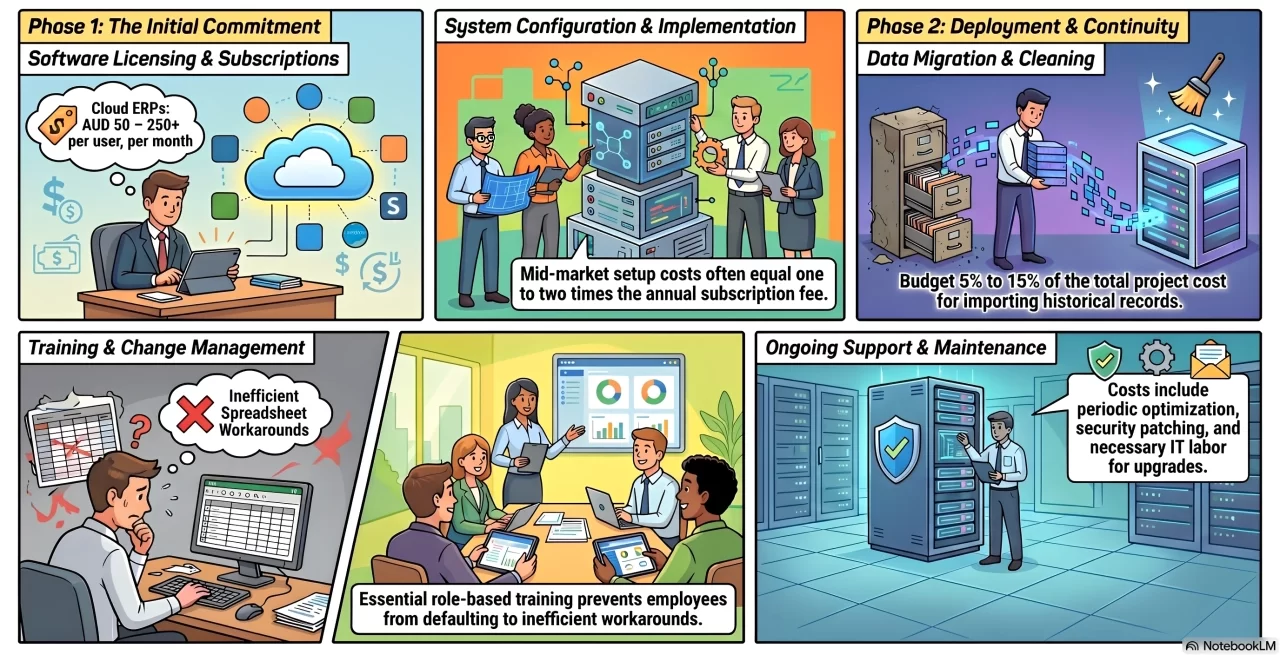
A complete ERP budget covers five components: software, implementation, data migration, training, and ongoing support. Projects overshoot mainly when the initial budget covers only the licence.
1. Software licensing or subscription fees
Cloud ERP charges monthly or annual subscriptions, priced per user, module, or transaction volume, typically at AUD 50 to AUD 250 or more per user per month. On-premise licences carry a higher upfront cost plus annual maintenance, server infrastructure, and IT labour.
2. Implementation and configuration
Implementation covers process mapping, system setup, approval workflows, custom reports, and cutover planning. For mid-market businesses, this commonly runs one to two times the annual subscription, rising with customisation or legacy migration.
3. Data migration
Data migration covers cleaning and importing customers, suppliers, inventory, accounts, and historical transactions, typically budgeted at 5% to 15% of total project cost. Migrating from MYOB, Xero, or legacy software adds mapping, validation, and reconciliation work.
4. Training and change management
Training protects the ERP investment. Without it, teams default to spreadsheet workarounds and a surge of support tickets, so budget role-based training for finance, warehouse, sales, and procurement before the project starts.
5. Support and maintenance
Cloud subscriptions often include support and updates, but businesses still need admin training and periodic optimisation after go-live. On-premise deployments add recurring costs for IT support, patching, security, and planned upgrades.
ERP Pricing by Business Size in Australia
According to the Australian Bureau of Statistics, more than 2.5 million businesses operate across Australia. The table below provides planning estimates in AUD for 2026 across business sizes.
Small businesses should start with core modules and expand once adoption is stable. Buying everything upfront increases both cost and implementation risk.
Mid-market projects grow quickly in complexity with multi-site and multi-function needs. At this scale, implementation planning matters more than licence negotiation.
Large businesses need multi-entity support, legacy migration, and staged rollouts. Budget for internal project team time alongside vendor costs.
Cloud ERP vs On-Premise: Which Costs More for Australian Businesses?
Cloud ERP costs less upfront and suits faster deployments. On-premise carries a higher initial investment in infrastructure, licences, and IT resources.
1. When cloud ERP is more cost-effective
Cloud ERP is generally the lower-cost option for businesses without dedicated IT infrastructure:
- Limited internal IT resources to manage servers and maintenance
- Faster deployment needed with lower upfront investment
- Predictable monthly or annual budgeting required
- Scaling across multiple sites or adding users over time
2. When on-premise ERP may be worth the cost
On-premise becomes more justifiable when specific control requirements or existing infrastructure are already in place:
- Strict data sovereignty or regulatory requirements
- Existing legacy infrastructure and a dedicated IT team
- Internal capability to manage upgrades, patching, and security
- Industry-specific compliance needs that limit cloud options
Before comparing quotes, confirm how each vendor handles GST. Overseas vendors may not charge GST on digital services, while domestic suppliers typically include it.
Cloud subscriptions and on-premise licences are also treated differently under accounting policy. Subscriptions are typically expensed, while capitalised software goes through depreciation and capital approval.

Hidden ERP Costs Australian Businesses Often Miss
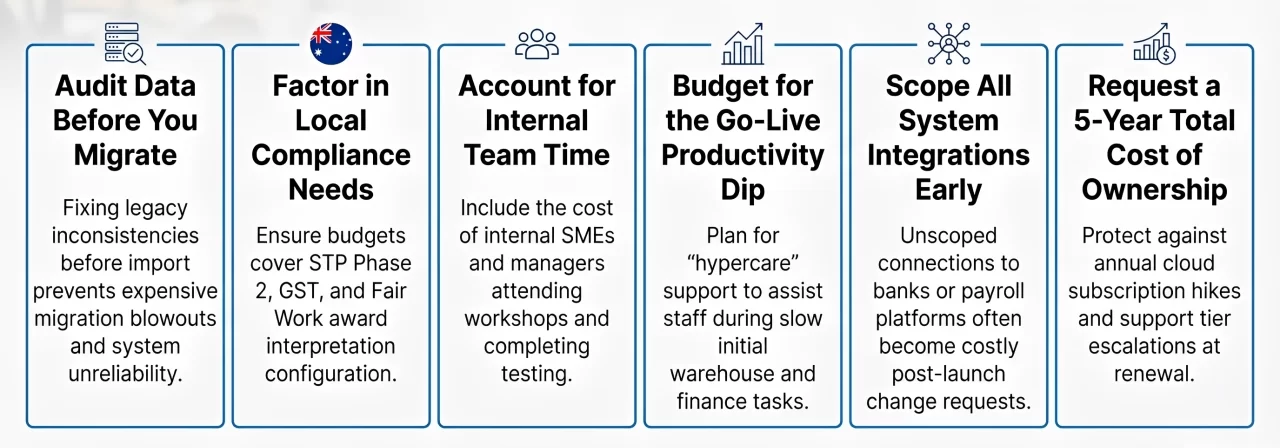
The biggest ERP budget surprises come from costs not scoped before vendor selection. Identifying them early protects the project from blowout after contracts are signed.
1. Data cleansing and migration blowouts
Legacy data inconsistencies make migration expensive. Duplicate records, outdated codes, and inventory mismatches all need fixing before import begins.
Run a data audit before vendor selection to define what to migrate, archive, or correct. Moving poor-quality data into a new ERP makes the system look unreliable from day one.
2. Australian compliance requirements
Australian payroll compliance adds cost when the ERP does not support local requirements natively. STP Phase 2, GST, PAYG withholding, and superannuation all need accurate configuration from the start.
The Fair Work Ombudsman sets minimum pay rates and conditions across many industries. Standard ERP quotes rarely cover award interpretation, overtime, or penalty rate configuration.
3. Productivity loss during go-live
ERP projects slow the business temporarily at launch. Finance close takes longer, warehouse picks move slowly, and sales staff need support in the new system.
Budget for go-live support as a line item. A short hypercare period prevents workarounds from forming before the team adapts.
4. Annual price escalation
Cloud ERP subscriptions can increase at renewal. Before signing, request a five-year total cost of ownership estimate covering subscription increases, support tiers, and upgrade terms.
5. Integration with Australian business systems
ERP integrations with banks, payroll platforms, e-commerce tools, and government reporting add scoping, development, and testing cost. Each connection needs a defined owner, data direction, and support model.
Any integration left unscoped at the start often becomes a change request after go-live, increasing cost and delaying adoption.
6. Internal project team costs
Most ERP budgets cover vendor hours but not the internal time required. Finance managers, subject matter experts, and operations leads must attend workshops, complete UAT, and make decisions throughout the project, often for weeks alongside their daily responsibilities.
ERP Cost vs. ROI: Is It Worth the Investment for Australian Businesses?
ERP is worth the investment when it removes measurable operational friction, not when it simply replaces one system with another. The business case should connect cost to specific, quantifiable outcomes.
How to calculate ERP ROI
Use these five steps to estimate ERP ROI before committing to a project:
- Identify measurable problems today: manual hours, error rates, stock gaps, and report delays.
- Estimate their annual cost in staff time or direct losses.
- Project the full ERP cost over three to five years, including implementation, support, and training.
- Estimate the annual savings or gains the ERP is expected to deliver.
- Divide total projected savings by total cost to calculate the payback period.
Most mid-market businesses plan payback over 18 to 36 months. The result depends on adoption, not just installation.
ERP delivers the strongest ROI in inventory-heavy, multi-location, and distribution operations. These environments have the most manual coordination to remove.
ERP Budget Planning Checklist
Questions to ask before requesting an ERP quote
Scope the project clearly before approaching any vendor:
- How many users need full access, and how many only need limited or approval-level access?
- Which modules are required on day one, and which can be added later?
- What systems need to integrate with the ERP, and how should data flow between them?
- How much historical data needs to be migrated, and what is its current quality?
- Does the vendor support STP Phase 2, superannuation, and Modern Award interpretation natively?
- What does the implementation quote include, and what is billed separately?
- What does the contract say about annual price increases, module additions, and user growth?
- How does the vendor handle post-go-live support and escalations?
Conclusion
ERP pricing in Australia is best understood as a full project budget. A small cloud rollout may start around AUD 20,000, while mid-market projects often exceed six figures once all components are included.
Hidden costs, compliance configuration, and integration scope all affect the final number. Scoping requirements before comparing vendors is the safest approach to keeping the budget on track.
To plan your ERP investment with confidence, book a free consultation with our team to clarify modules, migration needs, and compliance requirements before any pricing is confirmed.
Frequently Asked Question
Cloud ERP in Australia typically costs AUD 50 to AUD 250 or more per full user per month. The first-year total, including implementation, migration, and training, ranges from AUD 20,000 for small businesses to over AUD 1 million for enterprise projects.
Most mid-market businesses plan ERP payback over 18 to 36 months. The result depends on adoption, not just installation. Businesses that redesign processes and train users properly tend to see returns faster.
Yes. Cloud ERP for small Australian businesses can start from around AUD 6,000 per year in subscription costs, with first-year totals from AUD 20,000 for basic deployments. Starting with core modules and expanding over time helps manage the investment.
ERP implementation in Australia typically costs AUD 15,000 to AUD 80,000 for small businesses and AUD 80,000 to AUD 300,000 for mid-market projects. Enterprise implementations can exceed AUD 800,000 depending on scope, customisation, and migration requirements.