














Understanding non-current assets is important for maintaining accurate financial records and assessing a company’s long-term financial health. These assets represent resources that support business operations over an extended period.
Knowing how to identify and manage non-current assets helps businesses make informed financial decisions and improve reporting accuracy. Proper asset management also supports long-term planning and growth.
Investors, lenders, and stakeholders often consider non-current assets when evaluating a business. As a result, managing them effectively can strengthen financial transparency and credibility.
Key Takeaways
Non-current assets are long-term resources that support business operations, generate value over multiple years, and contribute to long-term growth.
Examples of non-current assets include property, equipment, vehicles, intangible assets, long-term investments, and leasehold improvements.
Understanding the difference between current vs non-current assets helps businesses assess liquidity, financial health, and long-term operational capacity.
Accounting software simplifies non-current asset management by automating depreciation, improving reporting accuracy, and maintaining complete asset records.

What Are Non-Current Assets?

Non-current assets are assets that a business expects to use for more than one year. Also known as long-term assets, they help generate revenue, support operations, and contribute to long-term business growth.
Unlike current assets such as cash or inventory, non-current assets are not intended for quick sale or conversion into cash. Instead, they provide ongoing value through their continued use in the business.
Examples of non-current assets include buildings, machinery, patents, and goodwill. These assets are typically depreciated or amortised over time to reflect their changing value on financial statements.
Examples of Non-Current Assets
Non-current assets include a variety of resources that provide long-term value to a business. These assets can be physical, financial, or intangible and are typically used for more than one year.
1. Property, Plant, and Equipment (PP&E)
PP&E includes assets such as land, buildings, factories, and warehouses used in business operations. These assets are generally depreciated over time, except for land, which is usually not depreciated.
2. Vehicles, Machinery, and Office Equipment
Business vehicles, production machinery, computers, and office equipment are common non-current assets. They support daily operations and are depreciated over their useful lives.
3. Intangible Assets
Intangible assets are non-physical resources such as patents, trademarks, copyrights, goodwill, and software licences. They provide long-term value and are usually amortised over time, except goodwill, which is tested for impairment.
4. Long-Term Investments
Long-term investments include assets that a company intends to hold for more than a year, such as shares in other companies, bonds, investment properties, or long-term loans. These investments can generate income or support future growth.
5. Leasehold Improvements and Other Long-Term Assets
Leasehold improvements refer to upgrades made to leased properties, such as renovations or electrical installations. Other long-term assets may include deferred tax assets, long-term prepaid expenses, and assets that are still under construction.

Current vs Non-Current Assets
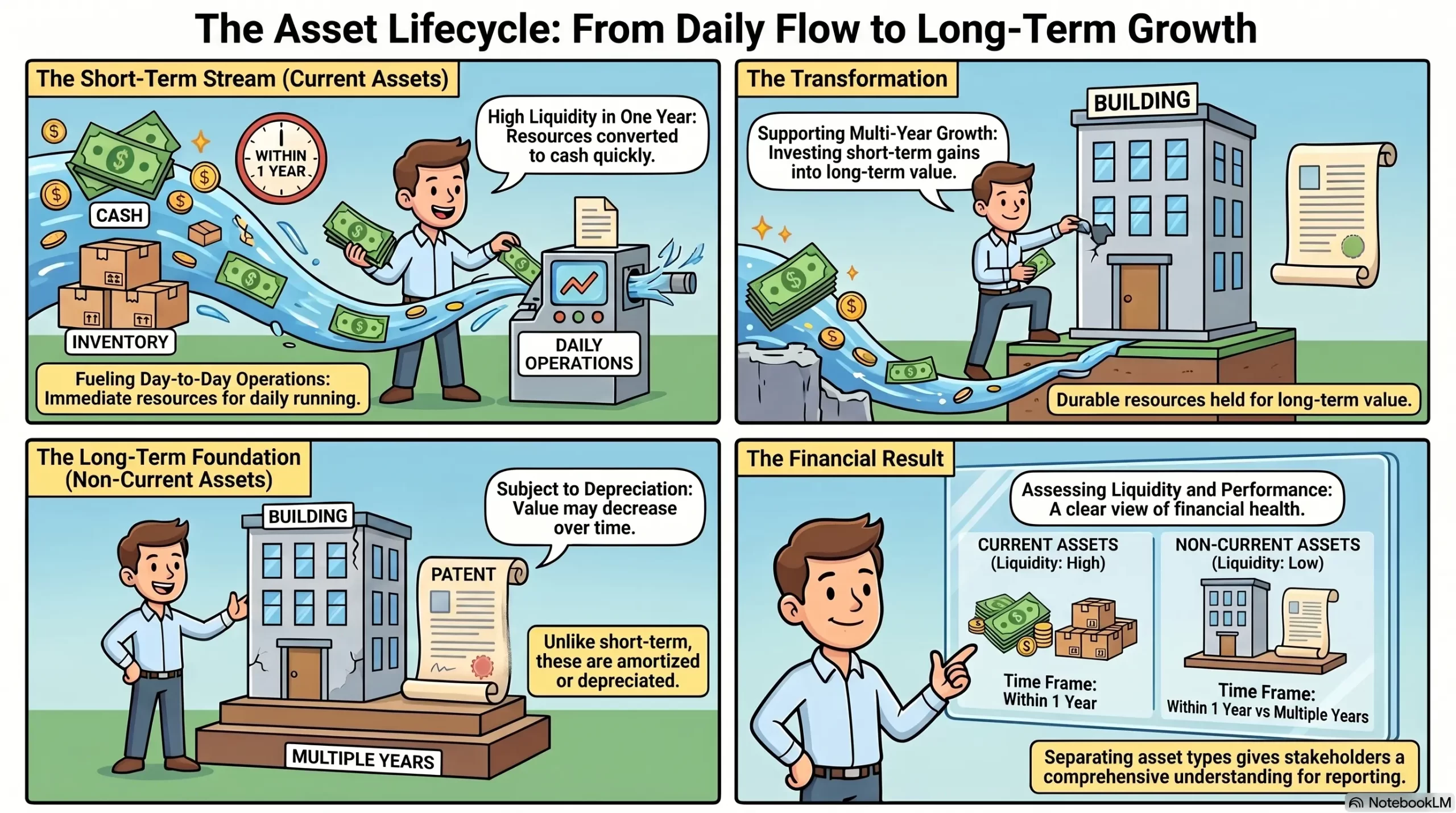
Current assets are short-term resources that can be converted into cash within one year, while non-current assets are held for longer periods and support a business’s long-term operations and growth.
1. Key Differences in Time Frame and Liquidity
Current assets are highly liquid and include items such as cash and inventory. Non-current assets are less liquid and include long-term resources such as buildings, equipment, and patents.
2. Comparison of Current Assets and Non-Current Assets
Current assets support day-to-day operations, whereas non-current assets help businesses generate value over multiple years. Most non-current assets are also subject to depreciation or amortisation.
3. Why Businesses Need to Separate Both Asset Types
Separating these asset types helps businesses assess liquidity, improve financial reporting, and provide stakeholders with a clearer view of financial performance.
How Non-Current Assets Appear on the Balance Sheet
Non-current assets are listed below current assets on the balance sheet and represent resources that provide long-term value to a business.
1. Where Non-Current Assets Are Reported
Non-current assets are typically grouped into categories such as PP&E, intangible assets, long-term investments, and other long-term assets.
2. How Depreciation Affects Asset Value
Most non-current assets lose value over time through depreciation or amortisation, reducing their reported value on the balance sheet.
3. Why Asset Classification Matters for Financial Reporting
Correct asset classification supports accurate financial reporting, compliance with accounting standards, and reliable financial analysis.
How to Calculate the Value of Non-Current Assets
Asset value monitoring starts with understanding how original cost and accumulated depreciation combine to determine the reported value of each long-term resource. This helps businesses determine the asset’s current value for financial reporting purposes.
1. Basic Non-Current Asset Value Formula
Non-current assets are typically valued using net book value (NBV):
Net Book Value = Original Cost – Accumulated Depreciation
2. Example Calculation Using Asset Cost and Depreciation
If a machine costs $120,000 and has accumulated depreciation of $36,000, its net book value is $84,000.
3. Common Mistakes When Valuing Long-Term Assets
Common mistakes include using incorrect depreciation rates, failing to account for impairment, and not updating records when assets are sold or retired.
Why Non-Current Assets Matter for Business Decisions
Non-current assets play an important role in a company’s long-term success. They represent the resources and infrastructure that support operations, growth, and overall business performance.
A business’s non-current assets can also influence financing and investment opportunities. Lenders often use these assets as collateral, while investors view them as indicators of a company’s ability to generate future value and sustain growth.
Effective asset management helps businesses plan maintenance, budget for replacements, and make informed investment decisions. Keeping accurate asset records reduces risk and supports better long-term planning.
How Accounting Software Helps Manage Non-Current Assets
Digital asset administration reduces the time and risk involved in managing non-current assets manually. Accounting software simplifies asset management by automating tracking, depreciation calculations, and financial reporting.
1. Track Asset Value, Depreciation, and Ownership Records
Tools for asset control maintain a centralised asset register, allowing businesses to track asset values, depreciation, purchase details, and ownership records in one place.
2. Reduce Manual Errors in Asset Reporting
Automation reduces common errors caused by manual data entry, helping businesses maintain accurate records and stay compliant with reporting requirements.
3. Connect Asset Data with Accounting and Financial Reports
Integrated accounting software automatically updates financial records and reports with current asset data, improving accuracy and reducing the time spent on month-end and year-end processes.
Conclusion
Non-current assets are long-term resources that help businesses operate, grow, and generate value over time. Examples include property, equipment, investments, and intangible assets such as patents and goodwill.
Properly managing and reporting non-current assets improves financial accuracy and helps stakeholders make informed business, investment, and lending decisions.
Accounting software can simplify asset management by automating tracking, depreciation, and reporting.
Consult our experts for a free demo to discover how automated asset management can improve financial accuracy and efficiency.
Frequently Asked Question
No. Fixed assets are a type of non-current asset that includes tangible resources such as buildings, vehicles, and equipment. Non-current assets also include intangible assets and long-term investments.
In most cases, no. Inventory is usually classified as a current asset because it is expected to be sold or used within one year as part of normal business operations.
No. Most tangible non-current assets are depreciated over time, but land is generally not depreciated. Intangible assets may be amortised instead, depending on the asset type.
Lenders review non-current assets because they reflect a company's long-term financial stability and may be used as collateral when assessing loan applications and creditworthiness.
Businesses should review non-current asset values at least annually to ensure accurate financial reporting. Additional reviews may be needed if there are signs of impairment or significant changes affecting asset value.