













Every construction project carries risk. The question is not whether problems will emerge, but whether your team is ready to manage them before they turn into real damage.
Australian construction recorded more than 2,800 company insolvencies in the 2023-24 financial year. Material costs kept climbing, labour stayed tight, and weather disrupted schedules from Darwin to Hobart.
This article covers the main types of construction risk, a four-step management process, how to build a risk register, and what Australian builders need to know about their WHS obligations and security of payment rights.
Key Takeaways
Construction risk management is the process of identifying, assessing, and responding to events that could harm your project, covering cost, schedule, safety, and compliance.
Type of construction risks: safety and WHS, financial, schedule, contractual, environmental, and design.
Building a construction risk register means documenting every identified risk with its rating, response strategy, named owner, and current status, updated throughout the project.
Construction risk management software centralises your register, links risks to the schedule, and alerts stakeholders the moment a risk event occurs, replacing unreliable manual spreadsheets.
What Is Construction Risk Management?

Construction risk management is the process of identifying events that could harm a project, assessing their likelihood and impact, then deciding how to respond before the damage occurs.
It covers cost, schedule, safety, quality, and compliance. The goal is to make decisions with clear information, not assumptions, at every stage from preconstruction through to handover.
Risk management is not a one-time event. Conditions change, prices shift, and subcontractors encounter problems not visible at project start. A register completed once and filed away is not risk management.

Types of Construction Risks
Construction projects face threats from multiple directions simultaneously. Organising risks by category helps teams identify them systematically rather than relying on memory or instinct from previous jobs.
1. Safety and WHS risks
Construction is consistently one of the most dangerous industries in Australia. Falls from height, struck-by incidents, and trench collapses account for the majority of serious injuries and deaths on site each year.
Under the Work Health and Safety Act, principal contractors carry primary duty of care for all workers on site. Safe Work Method Statements are mandatory for all high-risk construction work.
Every worker must hold a White Card before entering any construction site. Notifiable incidents, including deaths, serious injuries, and dangerous occurrences, must be reported to the state regulator immediately as part of complying with safety regulations.
2. Financial and economic risks
Financial risks include slow client payments, subcontractor insolvency, material price escalation, and cash flow gaps between invoicing and payment. Any one of these can halt a project with little warning.
Fixed-price contracts amplify this exposure. When input costs rise faster than the contract price allows, the builder absorbs the difference. This dynamic contributed directly to the builder collapses of 2023-24.
Early warning signs include late client payments, subcontractors requesting advance payment, and suppliers tightening credit terms. These signals are worth acting on before they escalate into a full cash flow crisis, particularly when supported by tools for construction project control.
3. Schedule and delay risks
Delays come from poor planning, permit holdups, supply chain disruptions, labour shortages, design changes, and adverse weather. Each day of delay adds direct cost through site overheads, plant hire, and supervision fees.
Indirect costs compound the problem. Liquidated damages, reputational damage with the client, and lost opportunity on the next project can follow a job well past practical completion.
4. Contractual and legal risks
Ambiguous scope definitions, unfair risk allocation, and errors in tender documents create disputes that are expensive and often impossible to resolve without formal proceedings once construction is underway.
Defect claims and regulatory non-compliance also sit in this category. Thorough contract review and legal due diligence before project start reduces these risks significantly. It is almost always worth the cost.
5. Environmental and site risks
Unexpected ground conditions, contaminated soil, flooding, and bushfire exposure create risks that are hard to quantify before work starts. Environmental risk varies considerably across Australian states and territories.
Cyclone season affects programme delivery in Queensland and the Northern Territory. Bushfire risk shapes site access and work windows in Victoria and New South Wales. Flood-prone sites present challenges in multiple states.
6. Design and scope risks
Incomplete drawings, late design changes, and clashes between structural, mechanical, and electrical disciplines lead directly to rework, variations, and cost blowouts that erode project margins fast.
These risks are highest when design and construction teams work in isolation. Involving the contractor during the design phase catches coordination issues before they become expensive site problems.
| Risk Type | Australian Examples | Typical Impact | Primary Response |
| Safety / WHS | Falls, electrical contact, confined spaces | Injury, fatality, prosecution | Mitigate (SWMS, controls) |
| Financial | Subcontractor insolvency, slow payments | Cash flow failure, project halt | Transfer (insurance, SOPA) |
| Schedule | Weather, permit delays, labour shortage | Cost overrun, LD exposure | Mitigate (contingency, float) |
| Contractual | Scope disputes, ambiguous contract terms | Claims, litigation | Avoid (clear contracts) |
| Environmental | Contamination, flooding, bushfire | Remediation cost, site closure | Transfer (insurance) + Mitigate |
| Design / Scope | Incomplete drawings, late changes | Rework, variations | Avoid (early collaboration) |
The Construction Risk Management Process
A structured process turns risk management from a reactive scramble into a repeatable discipline. The four core steps are identification, assessment, response planning, and ongoing monitoring.
1. Risk identification
Identification starts with a systematic effort to catalogue every risk that could affect the project. No single source will surface all of them, so effective identification draws on several inputs working together.
Team brainstorming brings together the project manager, site supervisor, estimator, and key subcontractors. Each role sees different risks because each person carries different responsibilities on the job.
Historical data from comparable projects fills gaps that brainstorming misses. Standardised checklists by risk category prevent blind spots. Geotechnical reports and environmental assessments add site-specific depth.
2. Risk assessment and analysis
Once risks are identified, each one gets assessed on two dimensions: likelihood and consequence. Plotting both on a risk assessment matrix produces a priority ranking that directs the team’s response effort.
| Likelihood / Consequence | Low | Medium | High | Extreme |
| Almost Certain | Medium | High | Extreme | Extreme |
| Likely | Medium | High | High | Extreme |
| Possible | Low | Medium | High | High |
| Unlikely | Low | Low | Medium | High |
| Rare | Low | Low | Low | Medium |
Risks rated Extreme or High require immediate response planning. Medium risks need monitoring plans with defined escalation triggers. Low risks can be accepted and reviewed periodically throughout the project with digital tools for risk control.
3. Risk response planning
For each significant risk, choose one of four response strategies and assign a named risk owner. That person is responsible for executing the response and monitoring the risk through to closure.
Response plans need to be specific. Allowing fifteen wet weather days based on Bureau of Meteorology rainfall data for the project location is a plan. Writing “mitigate weather risk” is not.
- Avoid: Avoidance removes the risk by changing project scope, construction method, or programme. If a particular work sequence creates unacceptable safety exposure, redesigning that sequence eliminates the risk at source.
- Transfer: Transfer shifts the financial impact of a risk to another party. Insurance policies, performance bonds, contract terms, and subcontractor agreements are the primary mechanisms for transferring construction risk.
- Mitigate: Mitigation reduces the likelihood or impact of a risk through controls, contingency planning, or process changes. Common examples include Safe Work Method Statements, schedule float, and pre-qualified supplier lists.
- Accept: Acceptance acknowledges the risk and proceeds without active intervention. It is the right strategy when mitigation costs exceed the expected loss, or when the risk falls clearly in the low-priority range of the matrix.
4. Risk Monitoring and Review
Risk management does not end once the register is built. Review it at every project meeting, update likelihood and consequence ratings as conditions change, and add new risks as they surface during construction.
Fortnightly reviews are the minimum standard during active construction. Monthly reviews leave problems undetected for up to three weeks, especially without project performance oversight tools that provide timely visibility into emerging issues.
How to Build a Construction Risk Register
A risk register tracks every identified risk, its assessment, response plan, and current status. It is a living document updated throughout the project, not a form completed once and filed away.
Each entry should capture enough detail that anyone stepping into the project manager’s role can understand the risk and act on it without needing additional context from someone else.
A standard construction risk register includes these fields for each entry: Risk ID, description, category, likelihood, consequence, risk rating, response strategy, risk owner, action required, and status.
| ID | Risk | Category | Likelihood | Consequence | Rating | Response |
| R-01 | Subcontractor insolvency mid-project | Financial | Possible | High | High | Transfer (performance bond) + monitor payments |
| R-02 | Wet weather delays exceeding allowance | Schedule | Likely | Medium | High | Mitigate (15-day float, covered work areas) |
| R-03 | Contaminated soil discovered during excavation | Environmental | Unlikely | Extreme | High | Transfer (environmental insurance) + Phase 2 ESA |
| R-04 | Design clash between structural and mechanical | Design | Possible | Medium | Medium | Avoid (BIM coordination before construction) |
| R-05 | Principal contractor WHS breach | Safety | Unlikely | Extreme | High | Mitigate (WHS plan, daily inspections, SWMS review) |
Construction Risk Management in Australia
Australian construction operates within a regulatory framework that shapes how risks are identified, managed, and documented. Understanding these obligations is not optional for any builder operating in this market.
The Australian Bureau of Statistics consistently ranks construction among the country’s largest employing industries. The regulatory obligations that govern that workforce are detailed and strictly enforced.
1. WHS Act and Codes of Practice
The Work Health and Safety Act applies across most Australian states and territories, setting a consistent baseline for construction site safety. Each state has its own regulator, but core obligations are broadly uniform.
Principal contractors must prepare and maintain a WHS management plan for every project. This covers hazard identification, risk controls, emergency procedures, and subcontractor obligations.
Safe Work Method Statements are mandatory for all high-risk construction work, including work above 2 metres, demolition, work near live utilities, and confined space entry.
Safe Work Australia publishes Codes of Practice for each category of high-risk work. These are approved guidance documents that detail how to manage specific hazards on site, and compliance is actively monitored.
2. Insurance requirements for Australian builders
Australian construction businesses typically carry several insurance policies simultaneously. Coverage gaps between policies are where claims most often fall through, so understanding what each policy covers is essential.
Public liability covers injury to third parties or damage to third-party property. Professional indemnity covers claims arising from professional advice, design input, or project management services.
Contract works insurance covers loss or damage to the works, materials, and temporary structures during the build. Workers’ compensation is mandatory in every state and territory for any business employing workers.
3. Security of Payment (SOPA)
Every Australian state and territory has Security of Payment legislation protecting contractors from payment disputes. SOPA provides a statutory right to progress payments and rapid dispute adjudication.
Key provisions include the right to make a payment claim at regular intervals, a defined timeframe for the principal to issue a payment schedule, and the right to suspend work if payment is not made after adjudication.
SOPA is a risk transfer mechanism. It shifts the financial risk of non-payment away from the contractor and toward the client, making it one of the most important legislative protections available to Australian builders.
Common Construction Risk Management Mistakes
Knowing what to avoid matters as much as knowing what to do. The same mistakes appear on projects of every size, and most are preventable with a consistent, disciplined process.
Treating the risk register as a one-off exercise is the most common error. A register completed at project kick-off and never updated again is a compliance document. It does not protect the project.
Not assigning a named owner to each significant risk means response actions rarely get executed. Accountability has to sit with a real person, or nothing happens when a risk materialises. This can also hinder efforts aimed at improving on-site safety practices.
Ignoring financial warning signals is a costly habit. Late client payments, subcontractors requesting advance payment, and suppliers tightening credit terms all point to financial stress that needs immediate attention.
Carrying the wrong insurance creates exposure the team may not discover until a claim is made and rejected. Contract works policies that exclude subcontractor default are a common example of a costly coverage gap.
Not linking the risk register to the project schedule keeps the connection between risk events and schedule impact invisible. When a risk fires, the programme impact should be visible to the team immediately.
How Software Supports Construction Risk Management
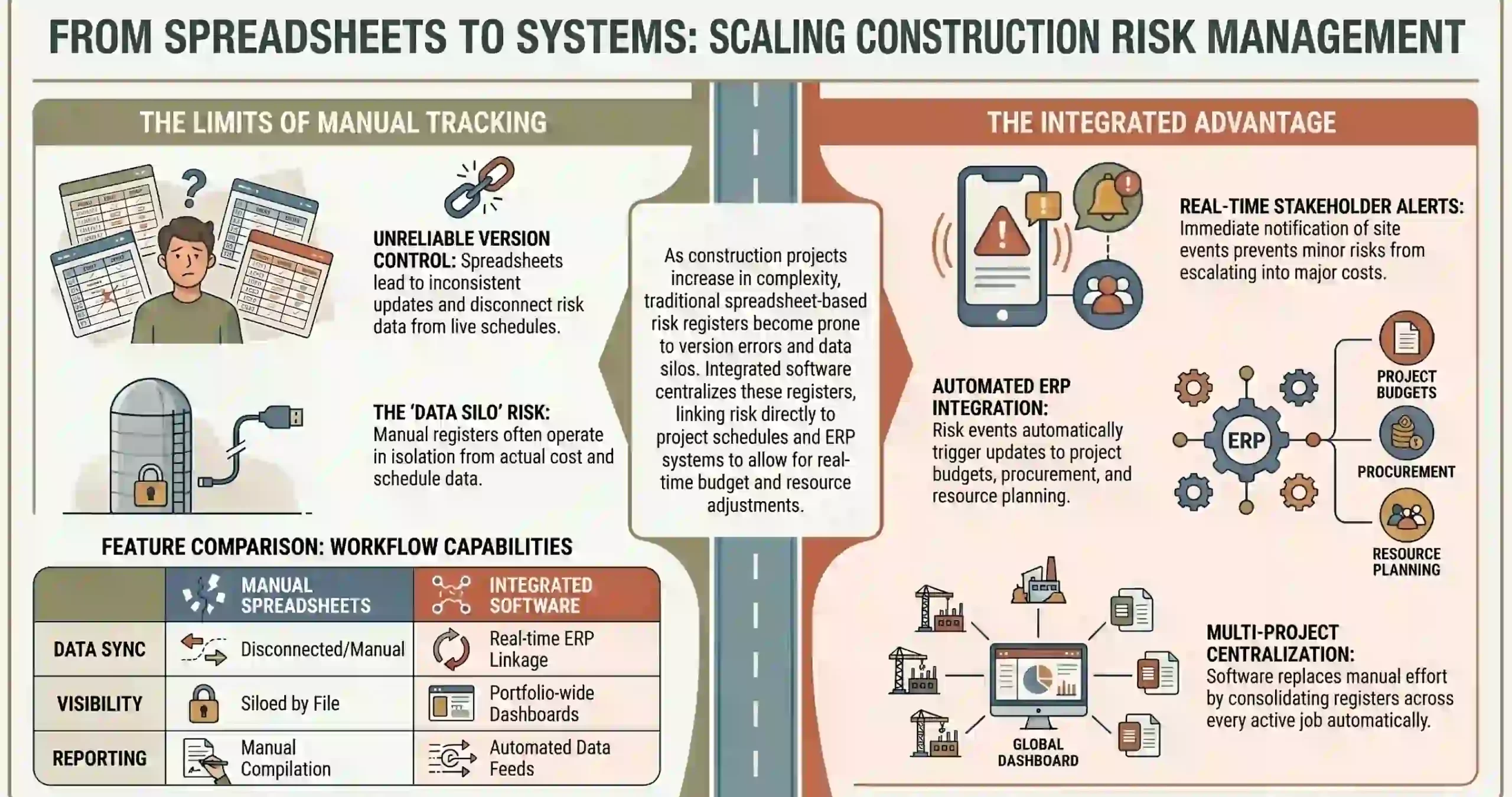
Spreadsheet-based risk registers work on small projects. As complexity grows, version control becomes unreliable, updates happen inconsistently, and the register disconnects from the cost and schedule data it depends on. This is why many contractors adopt tools for construction project control that keep risk information connected to project delivery data.
A construction risk management software centralises the register, links risk items to schedule activities, and provides dashboards showing the current risk profile across all active projects at a glance.
When a risk event occurs, relevant stakeholders are alerted immediately. There is no lag between a site event and the team’s awareness of its cost or schedule impact, which is where unmanaged risks typically escalate.
For businesses managing multiple projects, an integrated platform replaces the manual effort of maintaining separate registers, schedules, and budgets across every job. Risk data feeds into reporting automatically.
When risk management integrates with an ERP system, a risk event that triggers a cost impact updates the project budget in real time. Schedule changes flow through to resource planning and procurement automatically.
Conclusion
Construction risk management is the difference between a project that absorbs problems and one that gets derailed by them. The earlier a risk is identified and responded to, the lower its cost to the project.
For Australian builders, WHS obligations, Security of Payment legislation, and mandatory insurance requirements add regulatory layers that demand active management on every project, regardless of size.
If you are interested in applying your own construction risk management, you can request a free consultation with us for free and let us aid you in the process.
Frequently Asked Questions
-
What are the main types of risks in construction?
The six main categories are safety and WHS, financial, schedule, contractual, environmental, and design risks. Each requires different identification and response strategies.
-
How do you create a construction risk register?
List each risk with an ID, category, likelihood, consequence rating, response strategy, and named owner. Review and update the register at least fortnightly throughout the build.
-
What is a risk assessment matrix in construction?
A risk matrix plots likelihood against consequence to produce a rating: low, medium, high, or extreme. Higher ratings demand faster, more decisive responses.
-
What are the WHS requirements for construction in Australia?
Principal contractors must maintain a WHS management plan, prepare SWMSs for high-risk work, and ensure all workers hold a White Card. Notifiable incidents must be reported to the relevant state regulator immediately.
-
Who is responsible for risk management on a construction site?
The principal contractor holds overall responsibility for WHS risk management on site. The project manager maintains the register, with a named owner assigned to each risk.