









Running a fleet without the right software is like navigating without a map. Fuel costs blow out, compliance deadlines get missed, and vehicle downtime costs more than it should.
The difference between a good fleet management platform and a great one comes down to local compliance coverage, integration capability, and how well the reporting translates into decisions your team can act on.
This guide covers 10 platforms assessed against Australian compliance requirements, real-world usability, and pricing transparency.
Key Takeaways Fleet management software connects GPS tracking, driver behaviour, maintenance scheduling, and compliance documentation into one platform, turning reactive fleet operations into a cost-controlled system. Australian fleet software must cover HVNL, Chain of Responsibility, Electronic Work Diary, and WHS obligations, platforms that cannot produce timestamped compliance records put your entire business at legal risk. Real-time GPS tracking, driver behaviour monitoring, maintenance scheduling, compliance document management, fuel reporting, and an offline-capable mobile app are the six capabilities that separate platforms that deliver results from those that only look good in a demo. The right fleet management platform depends on your fleet size, compliance obligations, and whether you need fleet data integrated with your broader business systems, not just the longest feature list.


Best Because Australian fleet safety and compliance inspection platform with pre-built HVNL templates.


Best Because NHVR-certified EWD and Chain of Responsibility compliance platform built for Australian heavy vehicle operators.

What Is Fleet Management Software?
Fleet management software supports automated fleet coordination, helping businesses plan, track, maintain, and report on vehicles and mobile assets. It connects GPS tracking, driver behaviour data, maintenance scheduling, and compliance documentation into a single dashboard.
The best platforms go well beyond basic tracking. They alert your team to licence expiry, flag overdue maintenance, log electronic work diaries, and produce the audit trails your compliance team needs under Australia’s Chain of Responsibility framework. For businesses running five vehicles or five hundred, the right software turns reactive fleet management into a predictable, cost-controlled operation.
How We Selected These Tools
We did not build this list by ranking features on a spreadsheet. Each platform was assessed against four criteria that matter to Australian fleet operators.
The selection criteria we applied:
- Australian compliance coverage, does it handle HVNL, Chain of Responsibility, Electronic Work Diary, and WHS requirements without bolting on third-party tools?
- Usability for field teams, can drivers and site supervisors use it without lengthy training?
- Integration with existing systems, does it connect cleanly with ERP, payroll, and accounting platforms?
- Pricing transparency and scalability, is the cost structure clear, and does it scale without surprise charges?
We also considered verified user reviews from G2, Capterra, and Google, as well as publicly available case studies from Australian fleet operators.
Key Features to Look for in Fleet Management Software

Not all fleet platforms are built the same. The features that matter most depend on your fleet size, industry, and compliance obligations. However, these six capabilities consistently separate the platforms that deliver results from those that only look good in a demo.
Look for all of the following before committing to any platform:
- Real-time GPS tracking with route history and geofencing alerts
- Driver behaviour monitoring covering speeding, harsh braking, and fatigue indicators
- Maintenance scheduling with automated service reminders tied to odometer or engine hours
- Compliance document management for licences, registrations, and inspection records
- Fuel tracking and reporting with GST-ready cost allocation by vehicle, driver, or cost centre
- Mobile app for drivers that works offline and supports incident reporting in the field
Platforms that deliver all six capabilities support better vehicle usage optimisation and lower total operating costs.
Australian Fleet Compliance: What Your Software Must Cover

Fleet compliance in Australia is more demanding than in most comparable markets. Your software needs to handle more than a basic logbook replacement if you want to stay on the right side of the National Heavy Vehicle Regulator and your state’s WHS obligations.
Here is what your platform must cover before you sign any contract.
Heavy Vehicle National Law (HVNL) applies to vehicles over 4.5 tonnes gross vehicle mass. Your software needs to capture load and speed compliance data that can be produced as evidence if your business is ever investigated under Chain of Responsibility.
Chain of Responsibility (CoR) means the compliance obligation does not stop with the driver. Schedulers, dispatchers, loaders, and consignors all share legal liability if unsafe practices cause an incident. Your fleet software must create timestamped records proving your business took reasonable steps to ensure compliance.
Electronic Work Diary (EWD) is approved by the NHVR as a replacement for paper logbooks for heavy vehicle drivers. Not all platforms offer a certified EWD, so confirm approval status before committing.
Vehicle registration and roadworthiness records must remain current and accessible for audits. A good platform automates renewal reminders and stores inspection certificates against each vehicle profile.
Workplace Health and Safety (WHS) obligations require incident reporting and investigation records. Your fleet software should capture near-miss events, incidents, and corrective actions in a format that satisfies state WHS regulators.
10 Best Fleet Management Software in Australia for 2026
Each platform below earned its place by solving a real problem for Australian fleet operators. The right choice depends on your fleet size, your compliance priorities, and how deeply you need fleet data to connect with the rest of your business systems.
Here are the 10 best options available to Australian businesses right now.
1. SafetyCulture
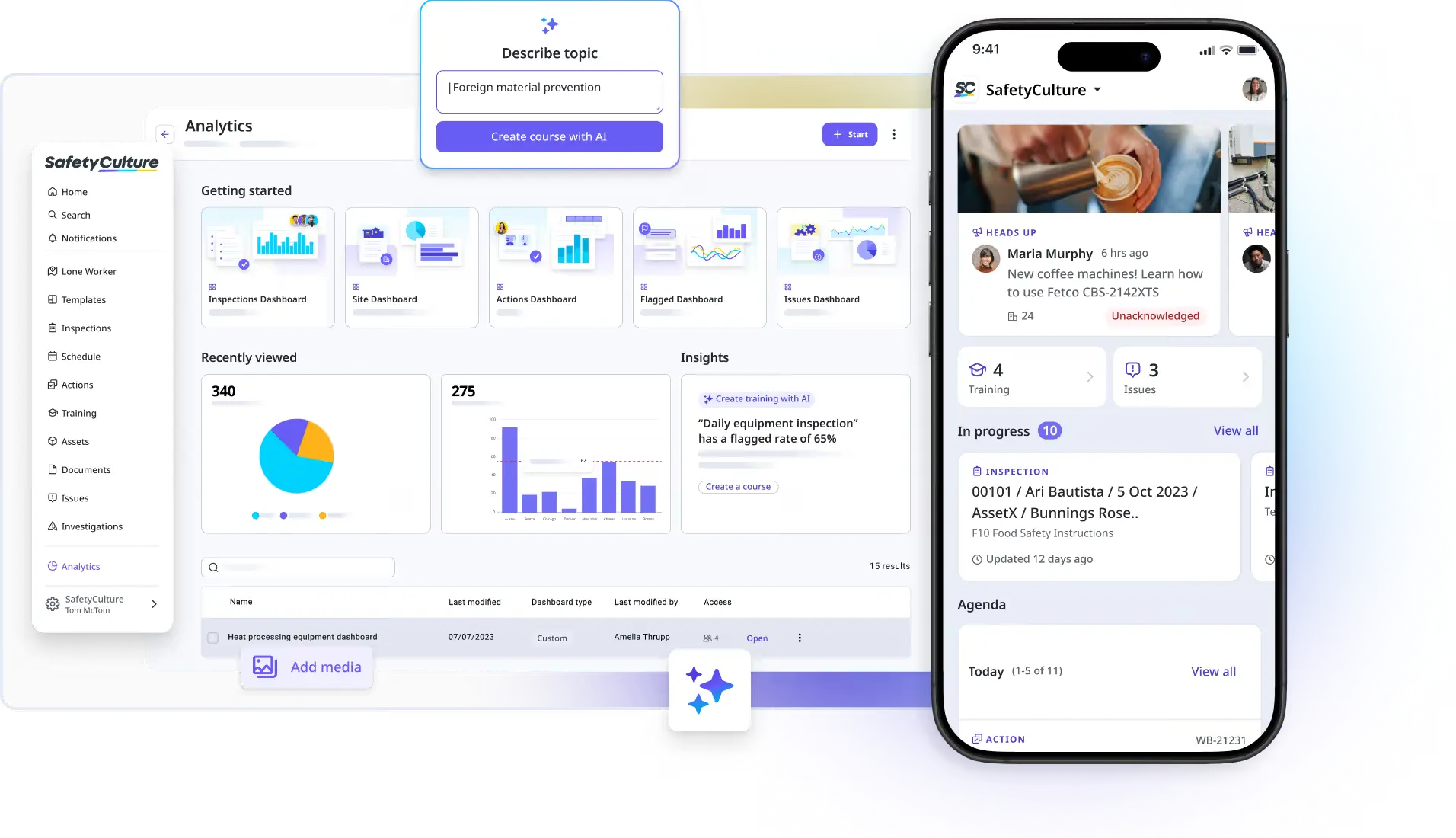
SafetyCulture has earned a loyal following among Australian fleet safety managers for good reason. Its inspection checklist builder is the most flexible on this list, and the pre-built Australian compliance templates cover everything from pre-start vehicle checks to HVNL incident reports without requiring custom setup.
What makes it stick is the field experience. Drivers complete inspections on their phones, flag issues with photos, and the results go straight to the maintenance team automatically.
Key features:
- Customisable inspection and pre-start checklists
- Photo evidence capture with automatic issue escalation
- Pre-built Australian fleet compliance templates
- Corrective action tracking and close-out
- Safety trend analytics dashboard
- Integration with maintenance and HR systems
| Pros |
Cons |
| ✓ Accurate Australian compliance templates | × No native GPS tracking |
| ✓ Photo capture with automatic issue escalation | × Needs a separate telematics tool |
| ✓ Free plan available for small teams | × Premium pricing scales up quickly |
| ✓ Strong maintenance and HR integration | × Focused on safety not full fleet ops |
Pricing: Free plan available. Premium starts at approximately $37 AUD per user per month, billed annually. Business and Enterprise tiers available on custom pricing.
Best for: Businesses that need rigorous, auditable safety inspection processes and field-ready compliance tools as their primary fleet management priority.
2. Webfleet
Webfleet has operated in Australia long enough to understand what local enterprise fleet managers need.
The telematics data is deep, the reporting engine handles large multi-state portfolios cleanly, and the API layer connects with most ERP and TMS systems without a systems integrator.
Key features:
- Real-time GPS tracking with 30-second update intervals
- Driver behaviour scoring and in-cab coaching
- Tachograph and heavy vehicle data management
- Route optimisation with live traffic integration
- Open API for ERP and TMS connection
- Fuel consumption and emissions analytics
| Pros |
Cons |
| ✓ Deep telematics with strong fuel analytics | × Pricing escalates quickly with added modules |
| ✓ Mature API connects with ERP and TMS systems | × No publicly listed pricing |
| ✓ Proven with Australian enterprise fleet operators | × Not ideal for smaller fleets |
| ✓ Strong driver coaching tools | × Configuration requires Webfleet account team involvement |
Pricing: Custom pricing only. Pricing varies by fleet size, module selection, and contract length. Request a detailed breakdown before signing.
Best for: Enterprise fleets with 50 or more vehicles that need deep telematics data, multi-state visibility, and integration with existing ERP or TMS platforms.
3. Geotab
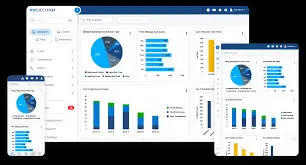
Geotab’s open SDK lets your team build custom integrations, reports, and hardware solutions on top of MyGeotab, which no other platform on this list matches.
For Australian enterprise and government fleet operators who need custom compliance reporting or proprietary system integration, this flexibility is hard to replicate.
Key features:
- MyGeotab cloud-based fleet intelligence platform
- Open SDK for custom development and reporting
- 200-plus third-party marketplace integrations
- Advanced fatigue monitoring and driver safety tools
- Electric vehicle fleet management support
- Government-grade audit trail and reporting
| Pros |
Cons |
| ✓ Open SDK allows custom integrations and reporting | × More upfront configuration than closed platforms |
| ✓ 200-plus marketplace integrations available | × Implementation needs a certified reseller |
| ✓ Handles light vehicles and heavy plant together | × Pricing varies significantly by reseller |
| ✓ Government-grade audit trail and reporting | × Not easy to self-implement for smaller teams |
Pricing: Hardware and subscription pricing through authorised Australian resellers. G2 reviewers note pricing varies significantly based on configuration, reseller, and contract length.
Best for: Large enterprises and government fleet operators that need open-platform architecture, custom reporting, and access to a broad marketplace of Australian compliance integrations.
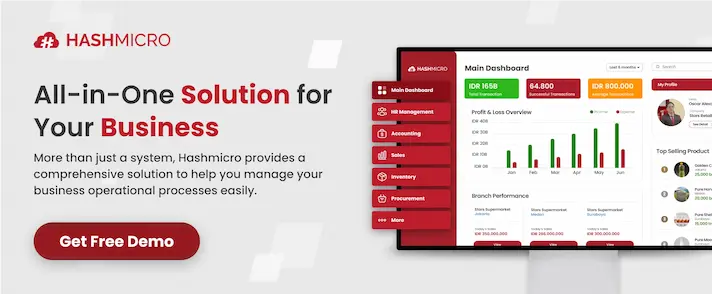
4. HashMicro
HashMicro integrates fleet operations directly into its ERP platform, connecting maintenance costs, fuel expenses, and procurement to accounting and BAS reporting in real time.
For Australian businesses where the fleet is part of a broader operation, this eliminates the data disconnect of running separate fleet and finance systems.
Key features:
- Full vehicle lifecycle management from acquisition to disposal
- Preventive maintenance scheduling by odometer and calendar
- Fuel tracking with GST-ready cost allocation
- Procurement integration for parts, tyres, and consumables
- Driver management with licence and certification tracking
- BAS-ready fleet expense reporting
| Pros |
Cons |
| ✓ Native ERP integration across fleet and finance | × Not suited for standalone fleet tracking only |
| ✓ Fleet costs connect directly to BAS reporting | × Requires a broader ERP implementation |
| ✓ Strong fit for mixed asset bases | × Custom pricing needs a demo to confirm |
| ✓ Fleet data feeds directly into budget forecasting | × Longer implementation than plug-and-play tools |
Pricing: Custom pricing based on modules and user count. Contact HashMicro for a demonstration and quote tailored to your fleet and operational requirements.
Best for: Mid-market Australian businesses that want fleet management integrated with procurement, maintenance, and financial reporting rather than managed as a separate standalone tool.
5. Fleetio
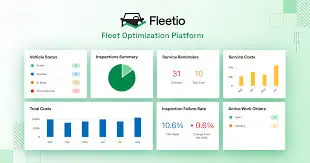
Fleetio makes maintenance tracking approachable for fleet managers who are not system administrators.
Every vehicle gets a complete record, every service gets logged, and every cost gets tracked without needing a dedicated IT team to keep things running.
Key features:
- Equipment lifecycle tracking from purchase to disposal
- Work order management and full service history
- Fuel tracking with cost-per-kilometre reporting
- Driver assignment and licence management
- Pre-start inspection apps for mobile
- Integration with GPS providers including Samsara and Geotab
| Pros |
Cons |
| ✓ Per-vehicle pricing scales cleanly with fleet growth | × No native GPS tracking included |
| ✓ Intuitive interface with low learning curve | × Advanced automation needs higher-tier plans |
| ✓ Strong vehicle-centric maintenance records | × Not built for heavy vehicle compliance or EWD |
| ✓ Integrates with major GPS providers | × Less suited for transport compliance requirements |
Pricing:
- Starter: approximately $6 AUD per vehicle per month
- Pro: approximately $12 AUD per vehicle per month
- Advanced: custom pricing
Best for: Small and mid-sized businesses that want clean, vehicle-centric maintenance and cost tracking without enterprise complexity or setup overhead.
6. Teletrac Navman
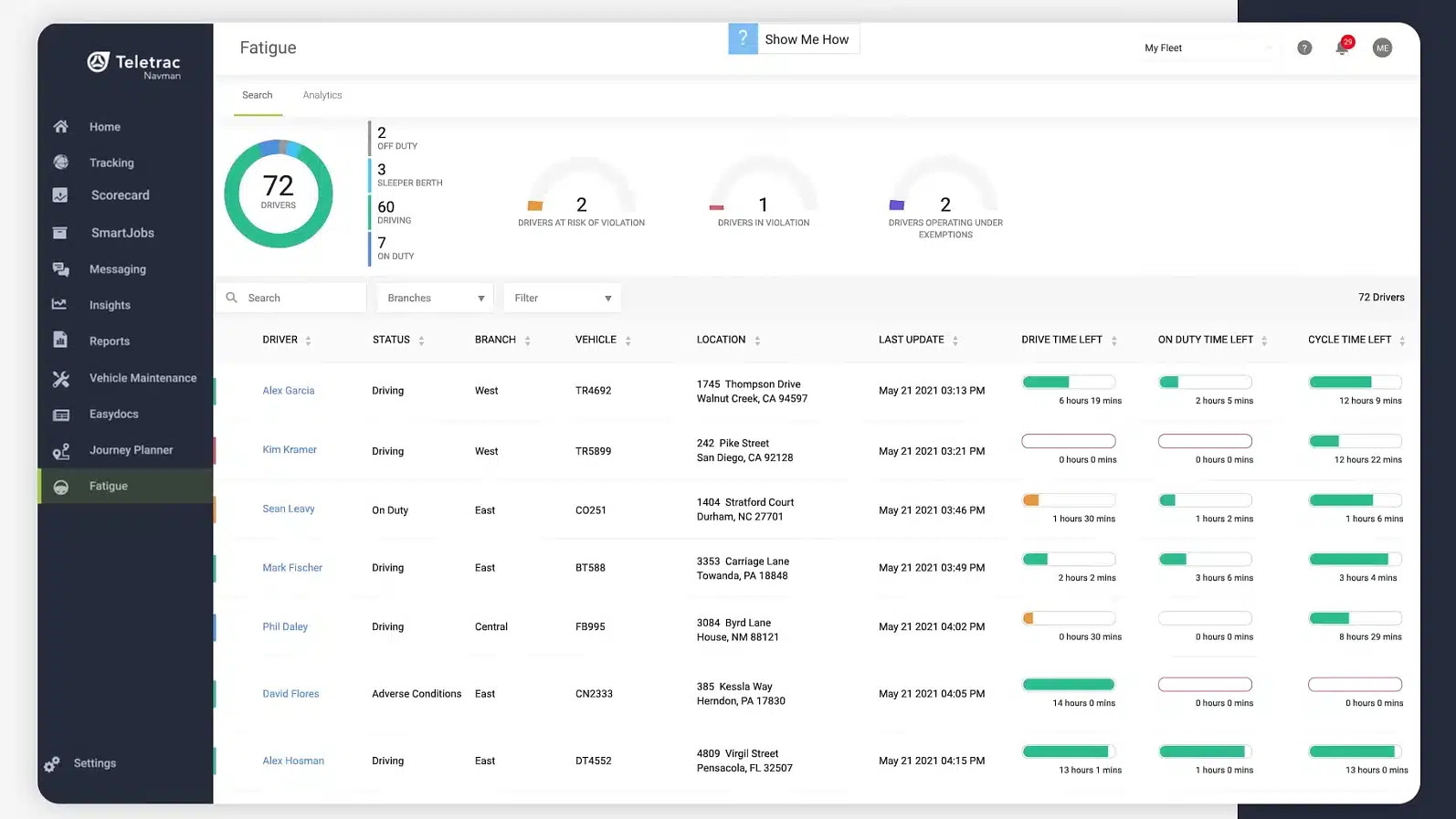
Teletrac Navman was built in Australia for Australian heavy vehicle operators. The NHVR-certified EWD, CoR reporting, and fatigue management tools are core to how the product works, not add-ons adapted from a foreign platform.
Key features:
- NHVR-certified Electronic Work Diary (EWD)
- Chain of Responsibility compliance reporting
- Real-time GPS tracking and geofencing
- Fatigue management alerts and monitoring
- Temperature monitoring for refrigerated transport
- Integration with major TMS platforms
| Pros |
Cons |
| ✓ NHVR-certified EWD built for Australian operators | × No publicly listed pricing |
| ✓ Support team understands Australian heavy vehicle law | × Heavy compliance focus not suited to light fleets |
| ✓ Strong fatigue management reduces CoR liability | × Configuration takes time to match operational needs |
| ✓ Built for Australian conditions not adapted from overseas | × Less relevant without heavy vehicle obligations |
Pricing: Custom pricing only. G2 reviewers note pricing is competitive for the level of Australian transport compliance coverage included.
Best for: Australian transport and logistics businesses operating heavy vehicles that need NHVR-certified EWD, CoR documentation, and fatigue management as non-negotiable requirements.
7. Samsara
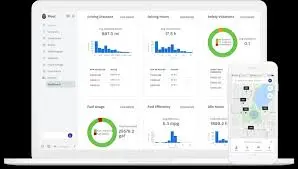
Samsara’s AI dashcams detect distracted driving, fatigue, and harsh events in real time, then coach drivers through in-cab audio alerts before incidents escalate.
For businesses where CoR liability and insurance premiums are active concerns, the proactive safety approach is worth the investment.
Key features:
- AI dashcams with real-time driver coaching
- Distracted driving, fatigue, and harsh event detection
- Live GPS tracking with street-level visibility
- Driver safety scores and fleet safety dashboards
- Equipment and trailer tracking
- Open API for third-party integration
| Pros |
Cons |
| ✓ AI dashcam technology more advanced than competitors | × Premium pricing with additional hardware costs |
| ✓ Some AU insurers factor Samsara data into premiums | × Custom pricing makes upfront budgeting difficult |
| ✓ Open API connects with a wide range of tools | × No NHVR-certified EWD for heavy vehicles |
| ✓ Strong ROI from reduced incident rates | × Hardware costs add to total cost of ownership |
Pricing (G2): Custom pricing. Hardware costs are additional to the software subscription. G2 reviewers note strong ROI from reduced incident rates and insurance savings.
Best for: Businesses that prioritise driver safety and want AI-powered dashcam analytics to reduce incident rates, CoR liability, and insurance premiums.
8. Netstar Australia
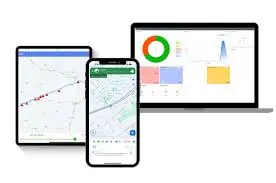
Netstar goes beyond tracking by protecting where vehicles go and recovering them when they should not be somewhere.
The 24/7 control room that coordinates stolen vehicle recovery directly with police is a capability no other platform on this list can replicate.
Key features:
- Live GPS tracking and real-time monitoring
- Remote vehicle immobilisation
- Stolen vehicle recovery with 24/7 control room support
- Plant and equipment asset tracking
- After-hours geofencing alerts
- Integration with major fleet management platforms
| Pros |
Cons |
| ✓ 24/7 control room coordinates stolen vehicle recovery | × Security specialist not a full fleet platform |
| ✓ Remote vehicle immobilisation beyond standard tracking | × Must be paired with an operational fleet tool |
| ✓ Covers plant and equipment in high-risk environments | × Custom pricing requires direct contact |
| ✓ Integrates with major fleet management platforms | × Not suitable as a standalone fleet solution |
Pricing: Custom pricing based on vehicle and asset count. Contact Netstar directly for a quote.
Best for: Businesses in construction, mining, and logistics that operate high-value vehicles or plant equipment in theft-prone environments and need security capability beyond standard fleet tracking.
9. MaintainX
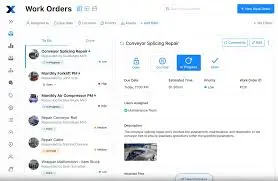
MaintainX handles what most fleet platforms overlook: businesses that manage vehicles alongside heavy plant, machinery, and facilities under one maintenance programme. The mobile experience for field technicians is one of the strongest on this list.
Key features:
- Work order management for vehicles and equipment
- Preventive maintenance scheduling by date, hours, or metres
- Parts inventory management and reordering
- Vendor and contractor management
- Inspection checklists with full audit trails
- Mobile-first interface for field technicians
| Pros |
Cons |
| ✓ Handles fleet and heavy equipment in one platform | × No native GPS or EWD included |
| ✓ Best-in-class mobile experience for field technicians | × Per-user pricing expensive for large teams |
| ✓ Free plan available for smaller operations | × Advanced automation requires paid tiers |
| ✓ Strong parts inventory reduces procurement delays | × Primarily a maintenance not a full fleet platform |
Pricing (G2):
- Free plan available
- Starter: approximately $25 AUD per user per month
- Professional: approximately $76 AUD per user per month
- Business: custom pricing
Best for: Businesses in construction, utilities, and mining that manage both fleet and heavy equipment maintenance together and need a CMMS that handles the full asset base without separate systems.
10. HubFleet

HubFleet is an Australian-built platform for small to medium fleets who want a straightforward solution without the enterprise price tag. The support team operates in Australian time zones, which matters when something goes wrong.
Key features:
- GPS tracking and fleet visibility
- Vehicle service reminders and maintenance logs
- Driver licence and compliance document storage
- Fuel and cost tracking
- Australian-built with local support
| Pros |
Cons |
| ✓ Built in Australia with accurate local compliance templates | × May not scale for significant fleet growth |
| ✓ Support team operates in Australian time zones | × Feature set limited vs enterprise platforms |
| ✓ Simple pricing with no complex module structure | × No EWD or advanced CoR compliance tools |
| ✓ Fast setup without a dedicated IT team | × Integration options more limited than larger platforms |
Pricing: Starts from approximately $15 AUD per vehicle per month. Contact HubFleet for current pricing and volume rates.
Best for: Australian businesses running fewer than 30 vehicles that want a local, affordable platform with accurate compliance features and a support team that understands the local context.
Quick Comparison Table
Not sure which platform fits your operation? Here is a side-by-side breakdown of the key features across all 10 tools to help you shortlist faster.
Features
SafetyCulture
Webfleet
Geotab
HashMicro
Fleetio
Teletrac Navman
Samsara
Netstar Australia
MaintainX
HubFleet
User-Friendly Interface
Pricing
Learning Curve
Australian Compliance
Ease of Integration
Which Fleet Software Is Right for Your Business?
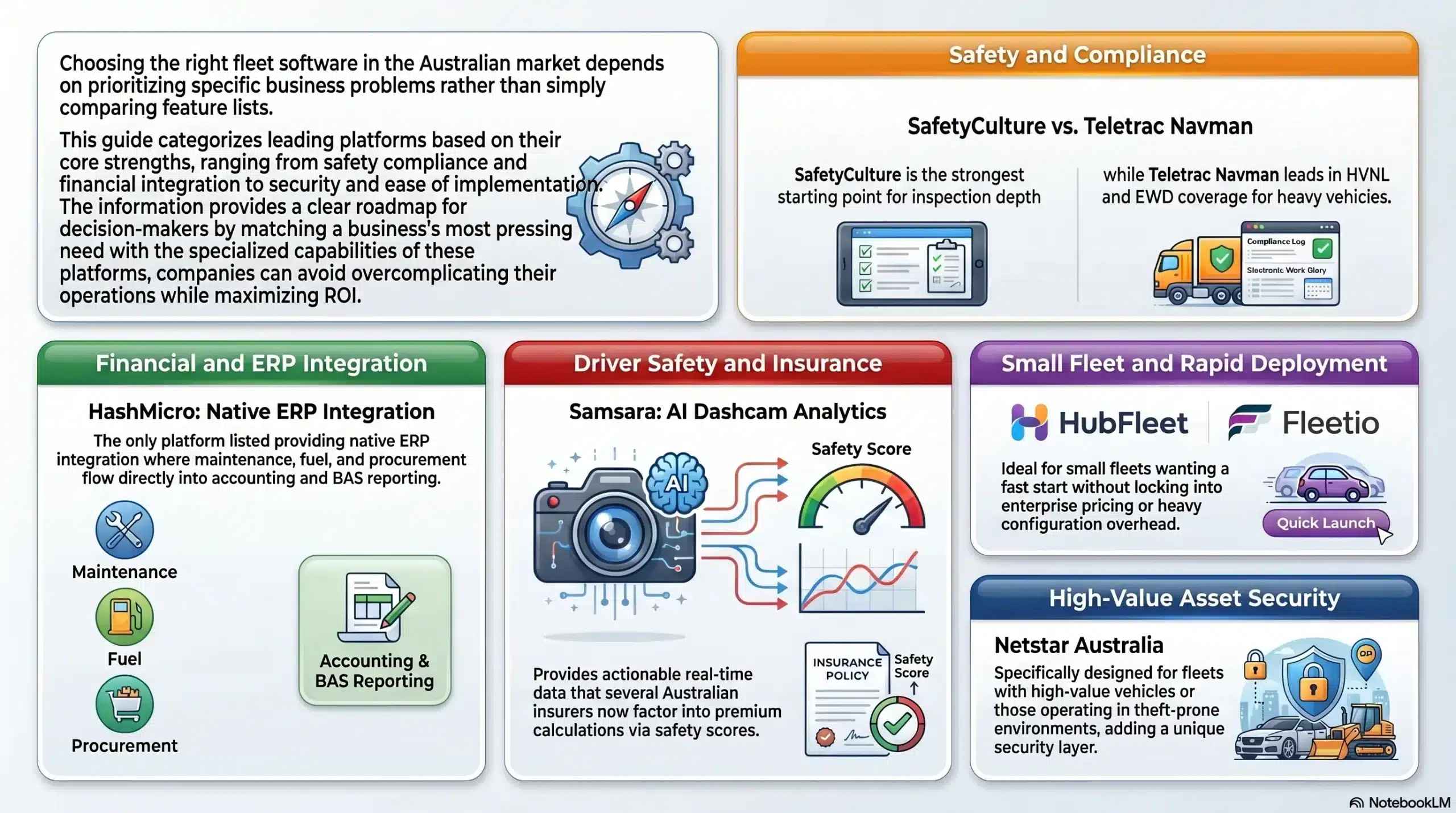
The answer depends less on which platform has the longest feature list and more on which one solves your most pressing problems without overcomplicating everything else.
If safety and compliance are your primary concern, SafetyCulture or Teletrac Navman are the strongest starting points. SafetyCulture wins on inspection depth; Teletrac Navman wins on HVNL and EWD coverage for heavy vehicles.
If you need fleet data connected directly to your financials, HashMicro is the only platform on this list that provides native ERP integration without building a custom connector. Fleet maintenance costs, fuel expenses, and procurement flow directly into your accounting and BAS reporting.
If driver safety and insurance risk reduction are your priority, Samsara’s AI dashcam analytics deliver the most actionable real-time data. Several Australian insurers now factor Samsara safety scores into premium calculations.
If you run a small fleet and want something that works without a long implementation, HubFleet or Fleetio give you a fast start without locking you into enterprise pricing or configuration overhead.
If your fleet includes high-value vehicles or operates in theft-prone environments, Netstar Australia adds a security layer that no other platform on this list can match.
Fleet Management Software by Industry
Different industries put different demands on their fleet platforms. Here is how the top options stack up for the sectors that matter most to Australian fleet operators.
1. Construction and mining
Construction and mining fleets typically include a mix of light vehicles, heavy trucks, and plant equipment. The platform needs to handle diverse asset types, operate in remote areas with intermittent connectivity, and produce Chain of Responsibility-compliant records.
Top picks for construction and mining: HashMicro for integrated asset and fleet management, Geotab for GPS coverage in remote areas, Netstar Australia for high-value plant security, and MaintainX for multi-asset maintenance management.
2. Transport and logistics
Transport and logistics operators rely on end-to-end delivery planning to manage compliance and routing. EWD, fatigue management, load compliance, and CoR documentation remain non-negotiable.
Top picks for transport and logistics: Teletrac Navman as the primary choice for CoR and EWD, Samsara for AI safety analytics on long-haul routes, and Webfleet for enterprise-scale telematics across large vehicle pools.
3. Field services and utilities
Field service businesses need mobile-first tools that help technicians and drivers log work, track jobs, and record vehicle checks without returning to the office. Integration with job management and scheduling systems is often as important as the fleet features themselves.
Top picks for field services and utilities: Fleetio for vehicle-centric maintenance tracking, SafetyCulture for inspection and safety processes, and MaintainX for combined fleet and equipment maintenance under one platform.
4. Government and municipal fleet
Government fleet operators typically face strict procurement requirements, public accountability obligations, and the need for detailed audit trails across large, diverse vehicle pools. Open-platform architecture and granular reporting matter more here than in most private-sector applications.
Top picks for government and municipal fleet: Geotab for open-platform flexibility and government-grade reporting, Webfleet for mature enterprise telematics, and Teletrac Navman for compliance-heavy heavy vehicle operations.
Conclusion
The right fleet management software reduces costs, closes compliance gaps, and gives your team the visibility to make faster decisions. Every platform on this list solves a real problem, but the one that fits your operation depends on your fleet size, compliance obligations, and how tightly you need fleet data connected to the rest of your business.
Stop running your fleet on guesswork and disconnected spreadsheets. You can schedule a free consultation with our experts to find the right fleet platform for your operation.
FAQ About Fleet Management Software
-
What is fleet management software used for?
Fleet management software helps businesses track, maintain, and manage their vehicles and mobile assets from a single platform. It covers real-time GPS tracking, driver behaviour monitoring, maintenance scheduling, compliance documentation, and fuel cost reporting. For Australian businesses, it also handles Chain of Responsibility records, Electronic Work Diary requirements, and WHS incident logging.
-
What are the 5 pillars of fleet management?
The five pillars fleet professionals most commonly reference are vehicle acquisition and disposal, driver safety and behaviour, maintenance and asset reliability, compliance and regulatory management, and cost control and reporting. Modern fleet management software addresses all five, though individual platforms specialise more heavily in certain areas.
-
How much does fleet management software cost in Australia?
Entry-level platforms for small fleets start from approximately $6 to $15 AUD per vehicle per month. Enterprise platforms with full telematics, EWD, and ERP integration are typically priced on custom contracts that include hardware, software licences, and implementation costs.
-
Does fleet management software help with Chain of Responsibility compliance?
Yes, but the level of CoR coverage varies significantly between platforms. Teletrac Navman is the strongest choice for CoR and includes an NHVR-certified EWD. Any platform you evaluate for CoR compliance should produce timestamped records proving your business took reasonable steps to prevent unsafe practices.
-
What is the difference between fleet management software and a CMMS?
Fleet management software focuses on vehicles, drivers, GPS tracking, compliance, and operational reporting. A CMMS focuses on maintenance work orders, asset service history, parts inventory, and technician scheduling. Some platforms like HashMicro and Fleetio bridge both categories.
-
What is the best fleet management software for construction in Australia?
HashMicro is the strongest overall choice for construction businesses that manage fleet and equipment alongside procurement and accounting. Geotab suits companies that need open-platform GPS tracking with remote area connectivity, while Netstar Australia covers high-value plant security in theft-prone environments.