













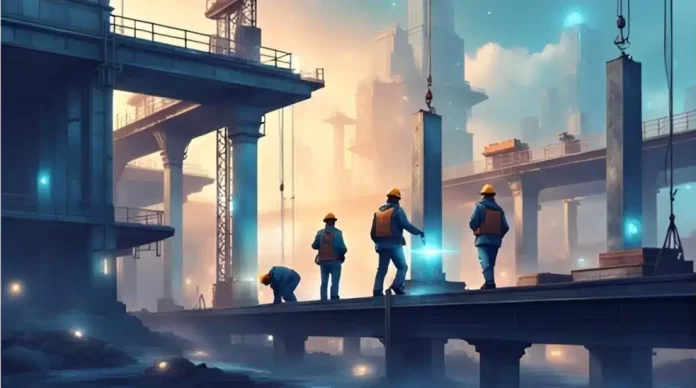
Steel construction uses steel to build strong and reliable structures across commercial, industrial, and infrastructure projects. It supports everything from warehouses to high-rise buildings where strength and efficiency matter.
By using prefabricated components and precise engineering, it enables faster assembly, flexible design, and consistent performance, helping projects run more efficiently with long-term durability.
Key Takeaways
Explains what steel construction is and how it supports strong, efficient, and reliable building structures across different types of projects.
Shows why steel is widely used due to its strength, flexibility, and ability to support faster and more efficient construction processes.
Covers different types of steel used in construction and how each type is applied based on structural needs and project requirements.
Explains common structural systems that support various building designs, helping projects achieve both stability and design flexibility.

What is Steel Construction?
Steel construction refers to the use of steel components such as beams, columns, and trusses to create the main structure of a building. These components work together to support loads and transfer them safely to the foundation.
Unlike traditional materials, steel allows for lighter structures without reducing strength. This makes it suitable for projects that require both durability and efficient use of space.
Why Steel Is Widely Used in Construction
Steel is widely used because it offers a combination of strength, efficiency, and flexibility that supports modern construction needs. These qualities make it suitable for both large-scale and complex projects.
1. High strength-to-weight ratio
Steel can carry heavy loads without adding excessive weight to the structure. This reduces foundation requirements and makes construction more efficient.
2. Durability and long lifespan
Steel resists warping, cracking, and pests, allowing structures to last longer with minimal maintenance. Proper treatment also helps protect it from corrosion over time.
3. Faster construction time
Most steel components are prefabricated off-site, allowing faster assembly on-site. This helps reduce project timelines and minimise delays. Technology for construction efficiency further accelerates coordination between fabrication and on-site assembly.
4. Design flexibility and long spans
Steel supports large open spaces without requiring many columns. This allows more flexible layouts for commercial and industrial buildings.
5. Sustainability and recyclability
Steel can be recycled without losing its properties, making it a more sustainable option. It also reduces material waste during construction.
Types of Steel Used in Construction
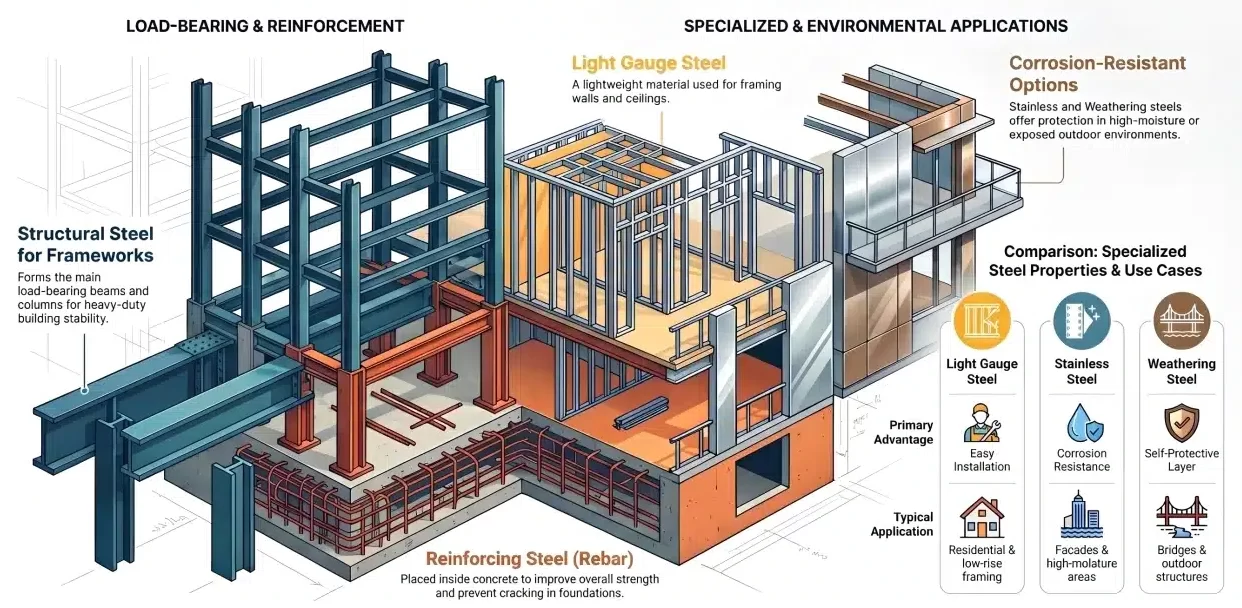
Different types of steel are used depending on structural needs, environmental conditions, and design requirements. Each type offers specific advantages for different use cases.
1. Structural steel
Structural steel is commonly used to form the main framework of buildings, including beams and columns. It is suitable for projects that require strong load-bearing capacity and stability.
2. Reinforcing steel (rebar)
Reinforcing steel is used inside concrete to improve its strength and prevent cracking. It is widely applied in foundations, slabs, and structural supports.
3. Light gauge steel
Light gauge steel is a lightweight material used for framing walls, ceilings, and smaller structures. It is often used in residential or low-rise projects due to its ease of installation.
4. Stainless steel
Stainless steel is used in environments that require corrosion resistance and a clean finish. It is commonly applied in exposed structures, facades, and areas with high moisture.
5. Weathering steel
Weathering steel develops a protective surface layer that reduces the need for painting. It is often used in outdoor structures such as bridges and architectural facades.
Common Steel Structural Systems
Steel can be used in different structural systems depending on building size, purpose, and load requirements. Each system supports specific design and functional needs.
1. Steel frame structures
Steel frame structures use a skeleton of columns and beams to support the building. This system is widely used for commercial buildings and high-rise projects.
2. Portal frame structures
Portal frames are commonly used in warehouses and industrial buildings. They allow large open spaces with minimal internal columns.
3. Truss systems
Truss systems use interconnected triangular elements to distribute loads efficiently. They are often used in roofs, bridges, and long-span structures.
4. Pre-engineered steel buildings (PEB)
Pre-engineered buildings are designed and fabricated off-site before being assembled on-site. This system is commonly used for factories, storage facilities, and commercial spaces.
The Steel Construction Process
Steel construction follows a structured process to ensure accuracy, safety, and efficiency at every stage. Managing complex build operations across fabrication, transport, and assembly requires clear coordination at every step.
- Structural design and engineering
Engineers create detailed designs based on load requirements, site conditions, and building specifications. - Steel fabrication
Steel components are cut, shaped, and prepared in a controlled environment before delivery to the site. - Transportation and logistics
Fabricated components are transported to the site and scheduled according to the construction timeline. - On-site assembly and erection
Steel members are assembled and installed to form the structural framework of the building. - Inspection and quality control
Each stage is checked to ensure the structure meets safety standards and design requirements, reducing the need for managing post-construction corrections later.






Advantages of Steel Construction
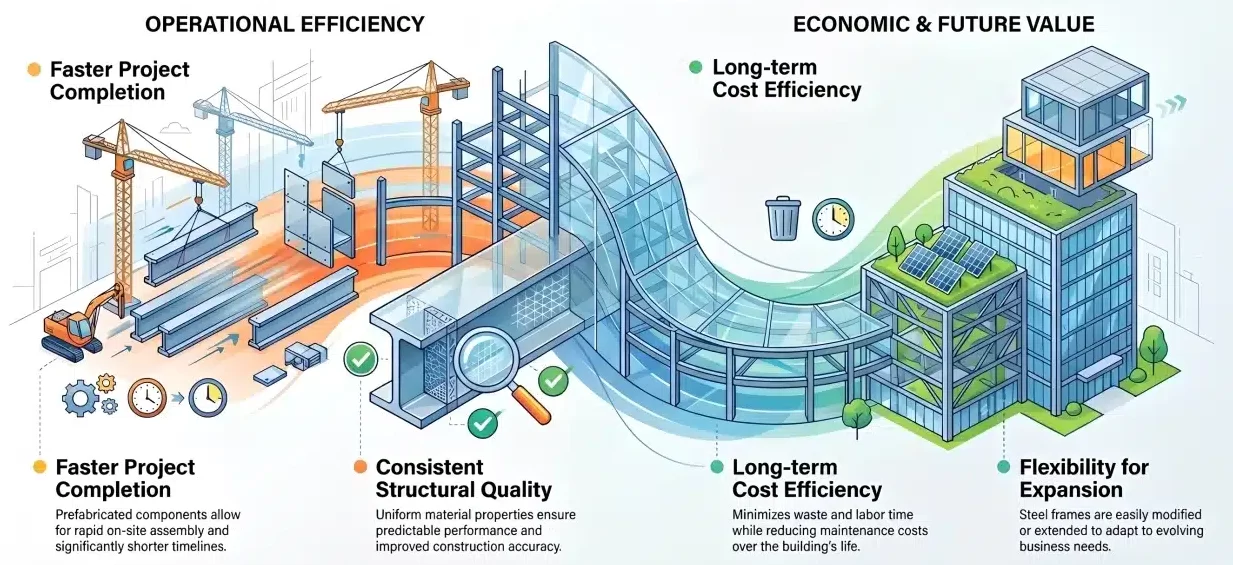
Steel construction provides practical benefits that directly affect project efficiency, cost control, and long-term performance. Using software for large-scale projects alongside steel construction helps teams coordinate workflows and track progress more effectively.
1. Faster project completion
Steel components are prefabricated, allowing faster assembly on-site. This helps shorten project timelines and supports optimizing project execution across all build phases.
2. Cost efficiency over time
While initial costs can vary, steel reduces waste, labour time, and maintenance needs. Over time, this helps control overall project costs.
3. Consistent structural quality
Steel is manufactured with uniform properties, ensuring predictable performance. This reduces variability and improves construction accuracy.
4. Flexibility for future expansion
Steel structures can be modified or extended more easily than traditional materials. This allows businesses to adapt buildings as needs change.
| Aspect | Traditional materials | Steel construction |
|---|---|---|
| Construction time | Longer due to curing and on-site work | Faster with prefabrication |
| Structural weight | Heavier, requires stronger foundation | Lighter with high strength |
| Design flexibility | Limited span and layout options | Supports long spans and open spaces |
| Maintenance | Higher over time | Lower with proper treatment |
Challenges in Steel Construction
Despite its advantages, steel construction also comes with challenges that need to be managed carefully. Understanding these factors helps reduce risks during planning and execution.
1. Corrosion risk
Steel can corrode when exposed to moisture and environmental conditions. Protective coatings and regular maintenance are needed to prevent damage.
2. Cost fluctuations
Steel prices can change due to market conditions and supply chain factors. This can affect budgeting if not planned properly.
3. Skilled labour requirements
Steel construction requires trained workers for fabrication and assembly. Limited expertise can slow down progress or affect quality.
4. Fire resistance considerations
Steel can lose strength at high temperatures, which requires additional fire protection measures. Proper treatment helps maintain structural safety.

Conclusion
Steel construction helps businesses build strong, efficient, and flexible structures while reducing construction time and long-term costs.
With the right planning and materials, projects can be completed more reliably. You can get advices from our experts through a free consultation to find the right solution for your construction needs.

FAQ About Steel Construction
-
What is steel construction used for?
Steel construction is used for buildings, bridges, warehouses, and infrastructure projects that require strong and durable structures.
-
Why is steel preferred over concrete?
Steel is lighter, faster to install, and allows more flexible designs. It also supports longer spans and reduces construction time.
-
Is steel construction cost-effective?
Steel construction can be cost-effective over time due to faster build times, reduced labour, and lower maintenance requirements.
-
How long does steel construction last?
With proper maintenance and protection, steel structures can last for several decades and maintain consistent performance.