






Manufacturers today face growing pressure to improve efficiency, reduce downtime, and respond quickly to shifting demand. Traditional automation and manual monitoring offer limited real-time visibility in increasingly complex production environments.
Many businesses are moving toward smart manufacturing to address these challenges. Integrating IIoT, AI, analytics, and cloud platforms enables manufacturers to continuously monitor operations and respond to disruptions earlier.
Cmart manufacturing connects previously fragmented production activities into a more coordinated operating environment. This article explains how it works, how it differs from traditional automation, and which technologies enable successful adoption.
Key Takeaways
|

How Smart Manufacturing Works in Modern Production Environments
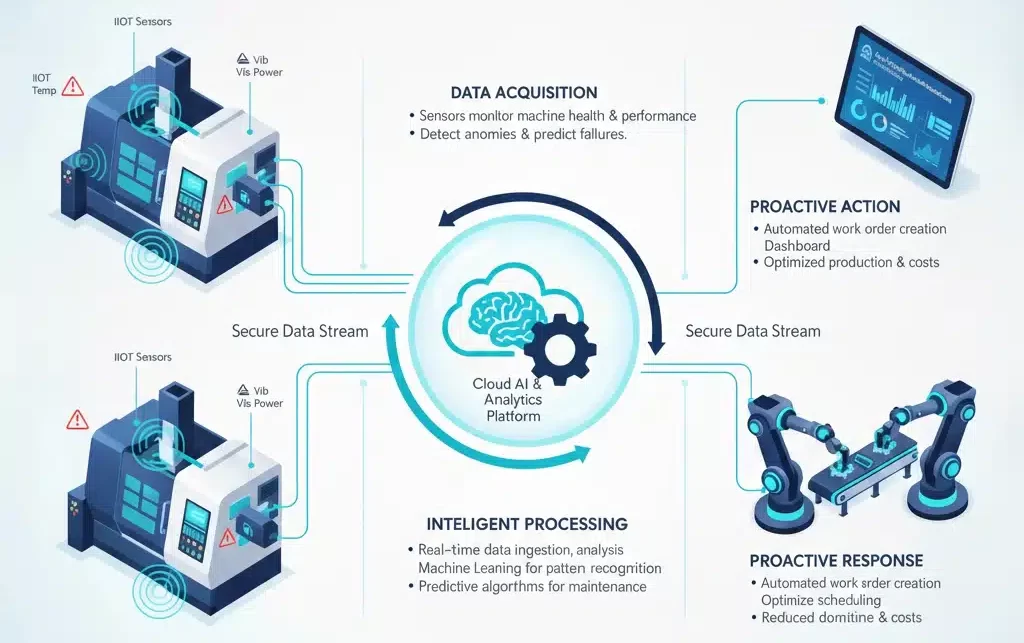
Smart manufacturing uses real-time data and advanced digital technologies to optimize manufacturing operations. Unlike traditional environments that rely on historical data and manual adjustments, smart systems continuously monitor performance and anticipate disruptions. This approach transforms linear production lines into connected networks where machines and systems exchange data in real time.
For example, a machine on the factory floor may detect abnormal vibration in a drill bit. In conventional settings, the issue might go unnoticed until production is disrupted. In smart manufacturing environments, sensors immediately capture anomalies, enabling the system to predict failure and trigger maintenance while rerouting production.
Smart manufacturing also extends beyond the factory floor by connecting suppliers, production, and logistics into one data environment. Adoption is expanding as modular sensors and cloud-based platforms allow small and mid-sized manufacturers to implement smart capabilities incrementally.
Industry 4.0 and Smart Manufacturing: Understanding Their Roles in Modern Production
Industry 4.0 and smart manufacturing are closely related but not interchangeable. Understanding their relationship helps companies align technology initiatives with measurable operational goals.
Industry 4.0 refers to the broader macro-level shift toward cyber-physical systems, IIoT, and cloud-enabled industrial environments. It serves as the overarching strategic vision for digital transformation in manufacturing.
Smart manufacturing operates as the execution layer of Industry 4.0. It applies connected technologies and real-time data directly on the shop floor to deliver measurable operational outcomes.
Industry 4.0 addresses wider shifts, including smart cities and intelligent energy systems. Smart manufacturing stays focused on the production lifecycle, supply chain coordination, and product lifecycle management.
To clearly separate Industry 4.0 and smart manufacturing, you can use this table that highlights the key differences between them.
| Aspect | Industry 4.0 | Smart Manufacturing |
|---|---|---|
| Definition | The fourth industrial revolution is driven by the convergence of physical and digital technologies. | The application of connected technologies and real-time data directly within manufacturing environments. |
| Scope | Broad, covering smart cities, intelligent energy systems, and wider economic transformation. | Focused on the production lifecycle, supply chain coordination, and product lifecycle management. |
| Role | Provides the overarching strategic vision and digital infrastructure for industrial transformation. | Serves as the execution layer that converts Industry 4.0 concepts into measurable operational outcomes. |
| Key Technologies | Cyber-physical systems, IIoT, cloud computing, and advanced connectivity infrastructure. | IIoT sensors, AI, digital twins, cobots, and MES or ERP platform integration. |
| Primary Focus | Macro-level shift in how industries and economies operate through digital convergence. | Shop floor performance, production efficiency, and real-time operational decision making. |
| Outcomes | Systemic industrial change, new business models, and cross-sector digital transformation. | Reduced downtime, improved quality, lower costs, and better supply chain visibility. |
Traditional Automation vs Smart Manufacturing in Modern Production
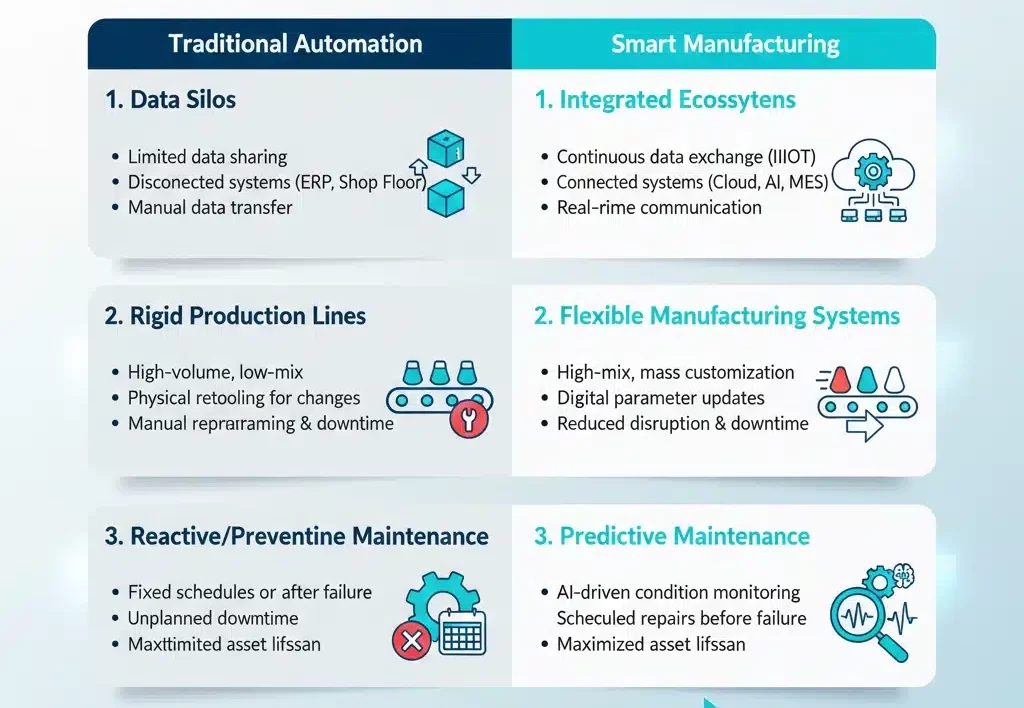
Many manufacturers assume their operations are advanced because they use robotics and automated conveyors. The key distinction between traditional automation and smart manufacturing lies in how systems share data, generate insights, and respond to changing conditions.
1. Data Silos vs Integrated Ecosystems
Smart manufacturing removes data silos by enabling continuous data exchange through IIoT. Production equipment shares status, quality, and performance data in real time across the line.
For example, a welding robot can communicate with an upstream stamping machine and adjust parameters if drift is detected. This coordination often extends to ERP and MES platforms, keeping shop floor activity aligned with enterprise planning.
2. Rigid Production Lines vs Flexible Manufacturing Systems
Traditional automation is designed for high volume, low mix production, with new variants requiring physical retooling, manual reprogramming, and planned downtime. This significantly limits responsiveness to changing production requirements.
Smart manufacturing enables more flexible production, including mass customization. Manufacturers can switch variants with minimal disruption by updating digital parameters rather than making mechanical changes.
3. Reactive Maintenance vs Predictive Maintenance Strategies
Traditional automation relies on preventive schedules or reactive repairs after failures occur. This approach can lead to unnecessary servicing or unexpected downtime.
Smart manufacturing uses predictive maintenance by analyzing vibration, temperature, and power data. AI models estimate failure risk, so maintenance is scheduled based on actual equipment condition.
Key Technologies Enabling Smart Manufacturing
Smart manufacturing relies on a combination of interconnected digital technologies. Rather than operating independently, these tools create a unified production environment that improves visibility, responsiveness, and operational control.
1. Industrial Internet of Things (IIoT)
IIoT forms the foundation of smart manufacturing, connecting sensors, machines, and devices to centralized systems. These sensors continuously capture operational data such as temperature, pressure, speed, and humidity.
By converting machine activity into real time digital data, IIoT provides continuous visibility into production conditions. This data supports performance monitoring, anomaly detection, and automated decision-making across the factory.
2. Cloud and Edge Computing
IIoT environments generate large data volumes requiring scalable processing and storage. Cloud computing enables centralized analytics, while edge computing processes data locally for near instant response, reducing latency and supporting rapid automated actions.
3. Artificial Intelligence and Machine Learning
AI and machine learning convert IIoT data into actionable insights by analyzing historical and real time patterns. Common manufacturing applications include predictive maintenance, AI-based quality inspection, and generative product design.
4. Digital Twins
A digital twin is a virtual representation of a physical asset, process, or production system. It allows teams to simulate operational changes before applying them on the factory floor, reducing risk and improving planning accuracy.
5. Additive Manufacturing (3D Printing)
Additive manufacturing enables complex geometries difficult to achieve with traditional methods such as CNC machining. Within smart environments, 3D printers produce parts on demand, supporting faster iteration and lower spare parts inventory.
6. Collaborative Robots (Cobots)
Cobots operate safely alongside human workers using advanced sensors and safety controls. In smart manufacturing environments, they handle repetitive or physically demanding tasks while operators focus on higher value work.
Business Benefits of Smart Manufacturing
Smart manufacturing delivers measurable operational and financial benefits when implemented effectively. Connecting data, automation, and analytics helps manufacturers improve visibility, reduce inefficiencies, and support more informed decision-making.
1. Enhanced Efficiency and Productivity
Smart manufacturing improves throughput by automating routine decisions and optimizing production workflows. Real time monitoring helps teams identify bottlenecks earlier and take corrective action before performance declines.
For example, if a downstream packaging machine slows, upstream equipment can automatically adjust speed to maintain flow balance. This reduces idle time and improves overall asset utilization across the production line.
2. Cost Reduction
Predictive maintenance helps reduce emergency repair costs and minimizes unplanned downtime. Improved quality control also lowers scrap and rework rates across the production line.
Energy management systems can optimize power consumption by adjusting machine usage based on operational demand. This may contribute to meaningful reductions in utility costs over time.
3. Improved Quality and Compliance
Smart manufacturing enables end-to-end production traceability by recording data from each batch, component, and process step. When defects occur, manufacturers can trace the issue back to a specific machine, operator, or material batch.
Automated inspection using sensors and computer vision improves consistency compared to manual quality checks. This also simplifies compliance reporting and supports more targeted corrective actions.
4. Supply Chain Resilience
Smart manufacturing improves real time visibility into inventory, supplier performance, and production capacity. With better data access, teams can adjust sourcing and reprioritize orders more quickly during disruptions.
5. Employee Safety and Satisfaction
Smart manufacturing supports safer workplaces by assigning hazardous or repetitive tasks to robots and collaborative systems. This reduces direct human exposure to high risk activities.
Connected operations also encourage workforce upskilling, with employees focusing more on monitoring, analysis, and process optimization. This can improve engagement and long-term capability.
How Manufacturers Can Begin the Smart Manufacturing Journey
Transitioning to smart manufacturing requires more than new technology. Manufacturers need a structured roadmap that aligns digital investment with operational priorities and workforce readiness. Without this alignment, initiatives often stall at the pilot stage.
1. Digital Maturity Assessment and Strategic Alignment
The first step is assessing current digital maturity. Manufacturers should identify data silos, high friction processes, and gaps with the greatest business impact. Priority should focus on clearly defined use cases such as recurring downtime or high scrap rates.
Early alignment between IT and OT stakeholders ensures investments support measurable operational outcomes rather than isolated experiments.
2. Building the Required Digital Infrastructure
Before advanced analytics or AI can deliver value, foundational connectivity must be in place. This typically involves linking previously isolated equipment through sensors, IoT gateways, or embedded controllers.
For legacy machinery, retrofit sensors may be required. Manufacturers should also establish reliable industrial networks combining WiFi, private 5G, or wired connectivity. Cybersecurity must be addressed early as connectivity expands.
3. Integrating ERP and MES Platforms
Connected machine data becomes valuable only when integrated with enterprise systems. Synchronizing ERP and MES platforms enables end-to-end visibility across production, inventory, and manufacturing planning.
When properly aligned, these systems support faster decisions, more accurate production planning, and better cross-functional coordination.
4. Pilot First, Then Scale Strategically
Digitizing the entire factory at once introduces unnecessary risk. A focused pilot targeting a high impact use case is typically more effective.
Common starting points include predictive maintenance on critical assets or automated quality inspection. Once the value is proven, the solution can scale across additional lines or facilities.
5. Cultural Transformation and Workforce Upskilling
Technology alone does not guarantee success. Smart manufacturing requires organisational alignment and workforce readiness.
Operators and engineers must be able to interpret dashboards, respond to alerts, and work with an intelligent system for a manufacturing business. Leadership should increasingly rely on data-driven decisions supported by structured training and change management.
Real World Applications of Smart Manufacturing
Smart manufacturing delivers the most value when applied to specific operational contexts. While the core principles remain consistent, implementation priorities vary by industry and production model.
Across global sectors, manufacturers use smart technologies to improve visibility, reduce waste, and respond faster to demand changes.
1. Discrete Manufacturing: Automotive and Electronics
In automotive and electronics, smart manufacturing supports mass customization and consistent quality. Modern lines are designed to handle high product variability without sacrificing throughput.
For example, connected automotive plants use RFID or industrial wireless networks to transmit configuration data to assembly robots. Electronics manufacturers apply AI-based visual inspection to detect defects earlier and reduce downstream rework.
2. Process Industries: Pharmaceuticals and Chemicals
In process industries, smart manufacturing focuses on consistency, compliance, and yield optimization. Continuous monitoring and automated adjustment help maintain tightly controlled production variables.
Advanced process control systems use real time sensor data and digital twins to stabilize operations. In regulated environments, automated data capture also supports end-to-end traceability and audit readiness.
3. Retail and Distribution Integration
Smart manufacturing increasingly extends into downstream retail and distribution. Many manufacturers are shifting from forecast-driven production toward demand responsive models.
In connected ecosystems, point of sale data feeds directly into planning systems, enabling faster production adjustments and better inventory balance.
4. E-commerce and Fulfillment Operations
E-commerce growth has increased pressure on packaging speed and order variability. Smart manufacturing technologies now support these fulfillment intensive environments.
For example, smart packing lines use 3D scanning to generate right sized packaging automatically. Integration with logistics platforms also enables automatic label generation and carrier routing.
5. Regional Spotlight: Smart Manufacturing in Australia
Adoption patterns vary by region. In Australia, higher labor costs and geographic distance from export markets have accelerated interest in smart manufacturing.
Government initiatives such as the Modern Manufacturing Strategy have further encouraged adoption across priority sectors. Many manufacturers are also exploring servitization by embedding sensors into products to enable ongoing monitoring and service-based revenue.
Implementing Smart Manufacturing Successfully
Enterprises that succeed align digital initiatives with clear operational objectives, measurable KPIs, and scalable infrastructure. Without this alignment, many projects stall at the pilot stage and fail to deliver enterprise value.
1. Assess Digital Readiness and Define Priorities
The first step is evaluating the current OT environment by mapping legacy equipment, identifying data silos, and pinpointing high friction processes. High impact use cases such as recurring downtime, quality losses, or limited production visibility should be prioritized.
Selecting the right pilot is critical, with ideal candidates being assets with measurable pain points and accessible machine data.
2. Establish Scalable Data and Connectivity Foundations
Machines must be properly connected before advanced analytics or AI can deliver value. This involves deploying IIoT sensors, retrofitting legacy equipment, and strengthening industrial network infrastructure.
Cybersecurity readiness is equally important, as expanding connectivity increases the attack surface. Secure architecture, network segmentation, and access control must be established from the outset.
3. Integrate Operational and Enterprise Systems
Connected machine data becomes valuable only when contextualised within enterprise systems. Integrating MES with a comprehensive manufacturing solution enables end-to-end visibility across production, inventory, and planning.
Equipment temperature data alone offers limited insight, but combined with production context such as product type or load conditions, it becomes actionable intelligence.
4. Validate Value Through Targeted Pilot Programs
A focused pilot allows manufacturers to validate ROI, test data pipelines, and build internal confidence before scaling. Common starting points include predictive maintenance on critical assets, automated quality inspection, or real time OEE monitoring.
5. Avoid Common Implementation Pitfalls
Several recurring challenges can slow smart manufacturing initiatives:
- Pilot Purgatory: pilots succeed but fail to scale due to overly customized architectures
- Data Swamps: excessive raw data collection without governance creates analysis bottlenecks
- IT/OT Misalignment: conflicting priorities between uptime and security delay progress
Mitigation strategies include adopting open communication protocols such as MQTT or OPC UA, implementing edge data filtering, and forming cross-functional digital operations teams.
6. Build Long Term Capability and Future Readiness
As maturity increases, manufacturers can expand into advanced capabilities such as AI-driven generative design and digital twins. These moves businesses beyond basic monitoring toward predictive and autonomous operations.
Workforce readiness remains equally critical, with teams needing to interpret analytics and support data-driven decision-making for sustainable transformation.
How Manufacturing Software Helps Australian Manufacturers Embrace Smart Manufacturing
In Australia, manufacturing software is no longer just an internal operations tool. An Australian Industry Group survey found that 84% of businesses are actively adopting technology, but 54% are still hampered by skills constraints.
Manufacturing software helps by simplifying technology adoption and reducing reliance on specialist technical skills. It enables businesses to connect production systems, access real time data, and automate workflows without requiring deep expertise.
- Centralised data management: Manufacturing software connects production, inventory, and planning data into one platform. Teams gain real time visibility without requiring multiple separate tools or specialist skills.
- Built-in IIoT integration: Many platforms provide pre-built connectors to sensors and shop floor equipment. This reduces the complexity of linking machines to enterprise systems.
- Automated reporting and compliance: Software automates production reporting and helps businesses meet GST and BAS obligations with less manual effort. This is particularly relevant for businesses reporting to the ATO.
- Scalable adoption: Manufacturers can start with core modules and expand capabilities incrementally as internal digital skills develop. This approach reduces the upfront cost and complexity of adoption.
- Workforce enablement: Dashboards and alerts are designed for operational staff, allowing teams to act on data without deep technical training. This directly addresses the skills gap highlighted in the Australian Industry Group research.
Conclusion
Smart manufacturing delivers the greatest impact when technology aligns with real operational needs. With the right approach, manufacturers can improve visibility, reduce downtime, and build more responsive production environments.
Each business has different priorities, from shop floor visibility to predictive maintenance and system integration. Evaluating solutions based on scalability, connectivity, and practical fit helps ensure long term value.
For companies assessing their next steps, a structured evaluation can help clarify the most suitable approach. If you want help shortlisting options, you can consult our expert anytime you are ready.

Frequently Asked Questions About Smart Manufacturing
-
What is the primary goal of smart manufacturing?
The primary goal of smart manufacturing is to improve production performance through real time data visibility, automation, and advanced analytics. It enables manufacturers to reduce downtime, optimize resource utilization, and support faster operational decision making.
-
How does IoT contribute to smart manufacturing?
IoT connects physical equipment to digital systems, enabling continuous data collection and communication across the production environment. This connectivity supports real time monitoring, predictive maintenance, and better coordination between machines and enterprise platforms.
-
What is the role of digital twins in manufacturing?
Digital twins create virtual representations of physical assets or processes. Manufacturers use them to simulate operational changes, test scenarios, and optimize performance before applying adjustments on the production floor.
-
How does smart manufacturing improve supply chain resilience?
Smart manufacturing improves end-to-end visibility across production and supply networks. With real time data on inventory, supplier performance, and demand signals, manufacturers can respond more quickly to disruptions and adjust production plans proactively.