















Sales forecasting is the process of predicting future sales over a specific period based on historical data, market trends, and current sales activity. It helps businesses plan budgets, manage inventory, and make informed operational decisions.
Accurately predicting future revenue is essential in complex and fast-moving markets. With shifting demand, supply chain disruptions, and economic uncertainty, relying on intuition or outdated data is no longer enough.
This is where sales forecasting becomes essential. By estimating future sales, businesses can better align inventory, staffing, and financial planning.
For Australian companies, strong forecasting supports smarter decisions and greater resilience, especially when supported by a reliable customer oversight software that provides full visibility into sales performance.
Key Takeaways
Understand the core concepts, methodologies, and fundamental definitions of revenue prediction.
Discover why accurate predictions are crucial for the sustainable growth of Australian businesses.
A detailed, step-by-step guide to building a robust and reliable forecasting model.
Identify and overcome the most frequent hurdles and bottlenecks in revenue prediction.

What Is Sales Forecasting?

Sales forecasting is the process of estimating future sales over a defined period. It uses historical data and market trends to predict revenue. This helps businesses make more informed decisions.
There are two main approaches: quantitative methods using data and models, and qualitative methods based on expert judgment. Most businesses combine both, with modern forecasting now using real-time data to stay accurate and responsive.
Why Sales Forecasting Matters for Australian Businesses
Australia’s diverse and spread-out market makes business planning more complex. Even small forecasting errors can impact profitability with both local and global factors. Accurate sales forecasting helps businesses make more confident decisions, supported by sales forecasting methods and tools in Australia.
It is especially important for managing cash flow, seasonal demand, and supply chains. Reliable forecasts also support better workforce planning. Overall, they help businesses reduce risk, control costs, and improve efficiency.

How the Sales Forecasting Process Works
Building an accurate sales forecast is a continuous process that combines data analysis, market insights, and regular adjustments. By following a structured approach, businesses can improve accuracy and make more informed decisions.
1. Historical sales data analysis
This stage involves reviewing past sales data to build an accurate forecasting baseline. Businesses define the forecasting period, whether short term (e.g., 30 days) or long term (e.g., 1 to 3 years), then analyse revenue trends, deal sizes, win rates, and customer segments to identify key growth drivers.
2. Market trends and seasonality assessment
After establishing a baseline, businesses factor in external influences such as economic conditions, industry trends, and seasonal demand. This includes understanding fluctuations driven by holidays, financial cycles, or market shifts.
3. Demand pattern identification
This step examines customer behaviour, preferences, and product demand at a more detailed level. By analysing purchasing patterns and segmenting customers, businesses can identify shifts in demand and adjust their forecasts accordingly.
Businesses with predictable demand tend to rely on historical forecasting, using past sales data adjusted for expected growth and seasonal shifts. Those with deal-driven sales cycles often use pipeline analysis, which evaluates active opportunities in the CRM and assigns a close probability to each stage.
4. Sales pipeline evaluation
The sales pipeline provides insight into short-term revenue by assessing active deals and their likelihood of closing. Businesses evaluate each opportunity based on defined sales stages and probabilities.
5. Forecast modelling and projections
At this stage, all data inputs are combined using forecasting models to generate revenue projections. These models can range from simple calculations to advanced analytics, depending on business complexity.
At its core, the calculation follows a straightforward formula:
Revenue = Estimated Quantity Sold × Unit Price
For example, if a business expects to sell 500 units of a product at $200 each, the projected revenue for that period is $100,000. This calculation can then be adjusted using factors such as seasonality, pipeline probabilities, and market conditions identified in the earlier stages.
6. Performance tracking and adjustments
Sales forecasting is an ongoing process that requires regular monitoring. Businesses compare actual results with projections to improve accuracy. Continuous adjustments keep forecasts relevant and aligned with changing conditions.
Common Challenges in Sales Forecasting
Many businesses struggle to produce accurate forecasts due to data issues. These challenges can reduce reliability and make it harder for leaders to trust projections. Identifying and addressing them is key to improving forecasting accuracy.
1. Inaccurate or incomplete sales data
Poor data quality is one of the biggest barriers to accurate forecasting. Inconsistent data entry, outdated records, and disconnected systems can distort the true state of the sales pipeline. Without reliable data, forecasts become misleading and difficult to act on.
2. Manual forecasting methods
Relying on spreadsheets and manual processes increases the risk of errors and slows down analysis. By the time data is compiled and reviewed, it may already be outdated. This makes it harder for businesses to respond quickly to changing conditions.
3. Poor coordination between sales and finance teams
Misalignment between sales and finance can lead to conflicting forecasts and reduced confidence in the numbers. Sales teams may be overly optimistic, while finance teams take a more cautious approach.
4. Rapid market and demand changes
Market conditions can shift quickly due to economic changes, competition, or unexpected events. Forecasts based only on historical data may struggle to keep up with these changes.
5. Limited visibility into real-time sales performance
Without real-time insights, businesses may only identify issues after targets are missed. Delayed reporting limits the ability to adjust strategies and improve outcomes. Continuous monitoring helps keep forecasts accurate and actionable.
Benefits of Accurate Sales Forecasting
Accurate sales forecasting helps businesses make smarter decisions with greater confidence. It enables better resource allocation, cost control, and investment planning while preparing for potential downturns.
It also improves inventory management, supply chain efficiency, and sales performance. Over time, consistent forecasting builds team accountability, stakeholder trust, and supports long-term growth.
See how our sales forecasting software can improve accuracy.
Core Features of a Sales Forecasting System
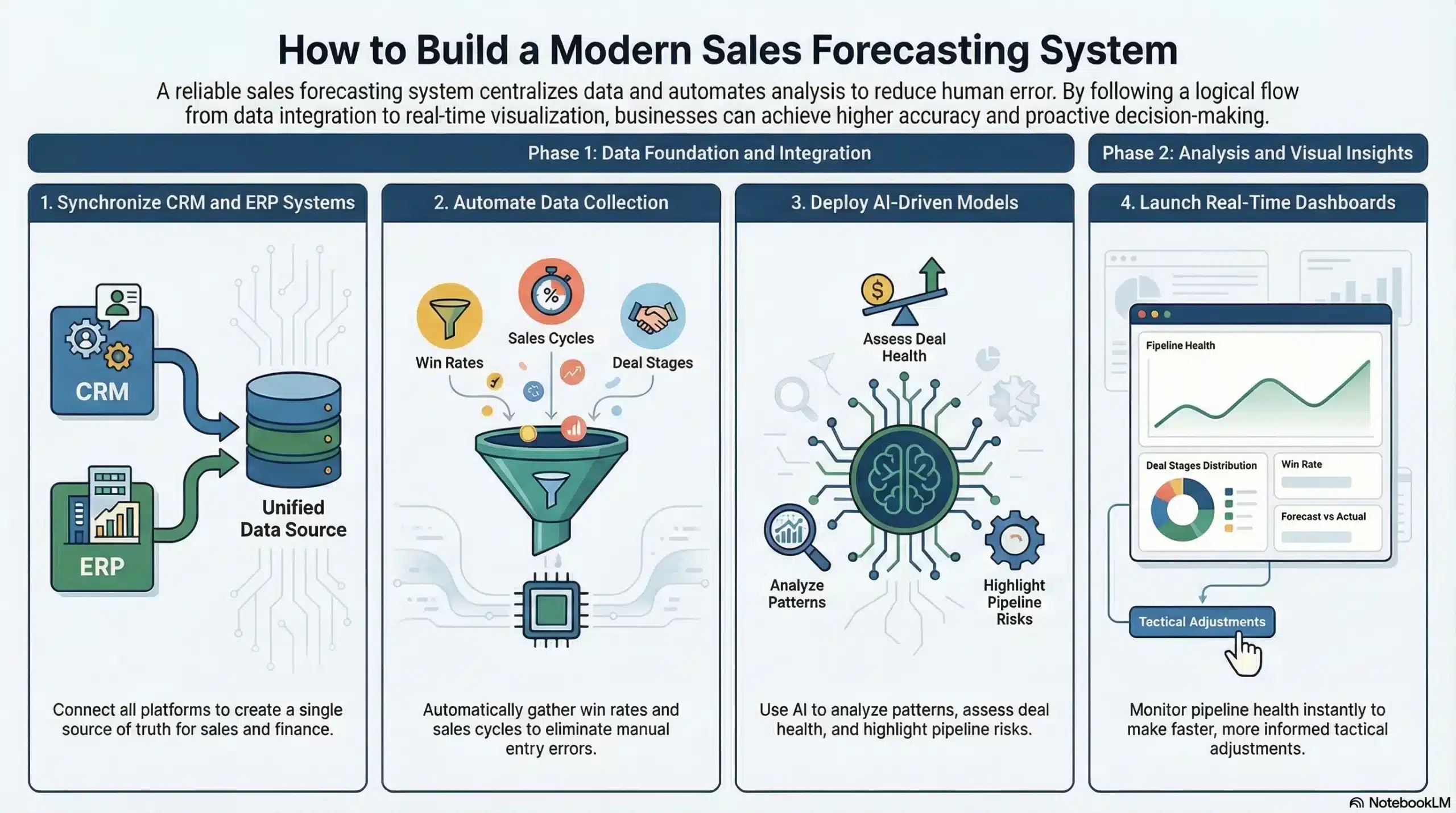
A reliable sales forecasting system centralises data, automates analysis, and provides real-time insights to support better decision-making. These features help reduce errors, improve visibility, and streamline revenue planning.
1. Automated data collection and analysis
A strong forecasting system automatically gathers data from multiple sources, reducing manual input and improving accuracy. It also processes key metrics like win rates and sales cycles without human intervention.
2. AI-driven forecasting models
AI-powered models analyse large datasets to detect patterns and improve forecast accuracy over time. They can assess deal health, predict outcomes, and highlight risks in the sales pipeline, often using concepts like AI demand forecasting.
For retail and distribution businesses, this helps predict seasonal demand, automate reordering, and prevent stock shortages or excess inventory across multiple locations.
3. Real-time sales dashboard
Real-time dashboards provide clear visibility into sales performance and forecast progress. They allow teams to track key metrics, monitor pipeline health, and identify issues quickly, especially when paired with customer interaction management software that captures every touchpoint across the sales journey.
4. Integration with CRM and ERP systems
Seamless integration with CRM and ERP systems ensures all sales, inventory, and financial data is connected and up to date. For mid-sized businesses managing data across multiple departments, this removes the need to manually consolidate figures from separate systems.
Businesses using a CRM solution in Australia can further enhance forecasting accuracy by maintaining consistent and localised customer data across every stage of the sales pipeline.








Best Practices for Improving Sales Forecast Accuracy
Accurate sales forecasting starts with clean, consistent data and standardised processes. Businesses should maintain reliable CRM data, align sales stages, and combine historical insights with real-time updates to improve accuracy.
Using tools that support an automated sales process and encouraging collaboration between sales and finance further strengthens forecasts. Regular reviews and adjustments help businesses stay agile and keep projections aligned with changing conditions.
How to Choose the Right Sales Forecasting Software
Selecting the right sales forecasting software is essential for improving accuracy and supporting business growth. With many options available, businesses should focus on solutions that align with their needs, processes, and long-term goals.
- Identify your business needs: Choose software that matches your data complexity, industry requirements, and growth plans.
- Look for automation and real-time insights: This helps improve accuracy and allows faster decision-making.
- Ensure easy integration: The system should connect seamlessly with your CRM and ERP for consistent data.
- Prioritise user-friendly design: Easy-to-use tools improve team adoption and reduce errors.
- Check scalability: Make sure the software can grow with your business and handle increasing data volume.
Conclusion
Sales forecasting plays a vital role in helping businesses plan, adapt, and grow in an increasingly complex market. By combining accurate data, structured processes, and the right technology, businesses can make more informed decisions and reduce uncertainty across operations.
As forecasting continues to evolve with automation and AI, businesses that invest in improving accuracy will gain a stronger competitive edge. With the right approach and tools in place, sales forecasting becomes not just a planning function, but a strategic driver of long-term success.
To see how the right system can improve your forecasting accuracy, book a free consultation with our experts today.

Frequently Asked Question
Sales forecasts should be updated regularly, typically monthly or quarterly, and more frequently in fast-changing industries.
Sales forecasting is usually a shared responsibility between sales, finance, and management teams to ensure accuracy and alignment.
Yes, even small businesses can benefit by improving planning, managing cash flow, and making better business decisions.