










Sales automation is the use of software and AI to eliminate repetitive sales tasks, such as lead routing, data entry, email follow-ups, and pipeline tracking. By removing this administrative burden, sales teams can focus on high-value activities that directly drive revenue, ultimately shortening sales cycles and improving customer experience.
Sales professionals spend less than a third of their working day actively selling. The rest is consumed by manual data entry, email drafting, and administrative tasks that limit revenue output and frustrate capable teams.
Sales automation addresses this directly by shifting repetitive, rule-based tasks to an automated sales software. This frees teams to focus entirely on high-value work such as closing deals, managing relationships, and solving customer problems.
For Australian businesses competing in a fast-moving market, automation is a practical necessity. Companies that implement it respond to leads faster, reduce operational costs, and scale their revenue without proportionally increasing headcount.
Key Takeaways
Sales automation uses software and AI to eliminate repetitive tasks, giving sales teams more time to focus on closing deals.
Key components includes CRM software, email automation tools, and AI analytics working together across the sales lifecycle.
Successful implementation follows five steps: audit current processes, define KPIs, select tools, integrate systems, and train your team.
Best practices involves Mapping processes, prioritize integration across platforms, test and optimize workflows, and connect sales automation to broader business software.

What Is Sales Automation?
Sales automation is the use of software, artificial intelligence, and digital tools to execute and manage repetitive tasks within the sales cycle. The primary goal is to remove administrative burden from sales professionals so they can concentrate entirely on revenue-generating activities.
Early sales teams depended on manual methods such as physical records, spreadsheets, and handwritten reminders for every follow-up. These approaches were slow, inconsistent, and difficult to scale as a business grew in size and complexity.
Modern automation creates connected systems where data flows between applications and triggers predefined actions without human input. When a prospect downloads a resource, the system can instantly log their details, score their lead value, and assign them to a sales rep within seconds.
This ensures every lead receives immediate attention while sales reps are only engaged when genuine buying signals emerge. It also provides the consistent, repeatable infrastructure businesses need to grow revenue without adding excessive overhead costs.

Why Sales Automation Matters for Australian Businesses
Automation is not simply a productivity tool. It is a strategic foundation that determines how efficiently a business can compete, convert, and grow its customer base over time.
Faster Lead Response Times
Speed is a critical factor in converting prospects into customers. Research consistently shows that responding to a lead within minutes dramatically increases the likelihood of a successful engagement compared to waiting hours.
Automated systems route new leads to the appropriate sales rep instantly and trigger personalized outreach without delay. This ensures Australian businesses never lose an opportunity due to slow manual processes.
Greater Sales Team Productivity
When sales professionals are freed from administrative tasks, they can dedicate more time to activities that directly generate revenue. Automation can reclaim several hours per day for each representative, significantly boosting total team output.
Teams using automation handle higher volumes of prospects without sacrificing quality or personalization. This makes it possible to grow revenue without proportionally increasing headcount or operational costs.
More Accurate Revenue Forecasting
Manual forecasting is vulnerable to human bias and incomplete data. Automation consolidates pipeline information in real time, enabling sales leaders to produce sales estimation based on objective, current figures rather than intuition.
This accuracy supports better budgeting, resource planning, and strategic decision-making across the business. Australian companies gain a clearer picture of future revenue, allowing them to plan and invest with greater confidence.
Key Components of a Sales Automation System
Building an effective automation infrastructure requires a clear understanding of the tools available. A well-designed system is not a single application but an integrated stack of specialized platforms working together.
Each component serves a distinct function, from managing customer data to executing outreach and analyzing performance. When these tools are properly connected, they create a seamless flow of information across the entire sales operation.
CRM Software
Customer Relationship Management (CRM) software is the foundation of any sales automation system. Rather than relying on reps to manually update records, a CRM automatically logs call histories, captures contact information, and updates deal stages in real time, so your team always has accurate data without manual typing.
This shift from manual data entry to automated record-keeping removes one of the biggest time drains in a typical sales day. When a call ends, the CRM logs it. When a proposal is opened, the deal stage updates. When a high-value deal stalls, a manager is alerted automatically.
By centralizing all data and eliminating manual input, the CRM ensures every team member, from frontline reps to executive leadership, operates from a single, up-to-date source of information.








Lead Qualification & Routing
Not every lead is ready for a sales conversation. Sales automation systems use lead scoring and qualification rules to evaluate prospects based on factors such as engagement level, company profile, and buying intent.
Once qualified, leads are automatically assigned to the most appropriate sales representative based on predefined criteria such as territory, product line, or workload. This helps reduce response times, improve lead distribution, and ensure high-value opportunities receive timely attention.
Email Automation Tools
Email remains the primary channel for B2B and B2C sales communication, making automation tools essential for executing outreach at scale. These platforms enable complex, logic-based workflows that go far beyond the capabilities of a standard email client.
Using branching logic, teams can build multi-step sequences where the next message is determined by prospect behavior. If a contact clicks a specific link, they are automatically channeled into a targeted follow-up sequence aligned to their interest.
Dynamic personalization fields allow automated emails to include the recipient’s name, company, and industry-specific details. This makes mass outreach feel individualized without requiring manual effort from the sales team.
AI and Predictive Analytics
Artificial intelligence has elevated sales technology from a system of record to a system of intelligence. AI algorithms process large volumes of historical and real-time data to identify patterns and generate actionable insights.
Predictive analytics can assess a current pipeline against years of win and loss data to calculate the probability of each deal closing. AI tools can also analyze sales call transcripts to identify buyer sentiment and highlight areas where reps may benefit from additional coaching.
These capabilities allow sales teams to move away from guesswork and toward data-driven decisions. Leads with the highest buying propensity receive priority attention, improving both conversion rates and resource allocation.
Reporting and Dashboard Tools
Data is only valuable when it can be easily understood and acted upon. Reporting and dashboard tools translate raw figures into intuitive charts, graphs, and heatmaps, giving leaders an immediate view of sales performance across key metrics.
These tools automate complex reporting that previously required hours of manual spreadsheet work. Sales managers can automatically receive customized reports covering pipeline velocity, conversion rates by representative, average deal size, and forecasted revenue.
This real-time visibility allows leaders to spot bottlenecks early, allocate resources effectively, and make strategic adjustments before minor issues escalate into significant revenue shortfalls.
How to Implement Sales Automation in Your Business
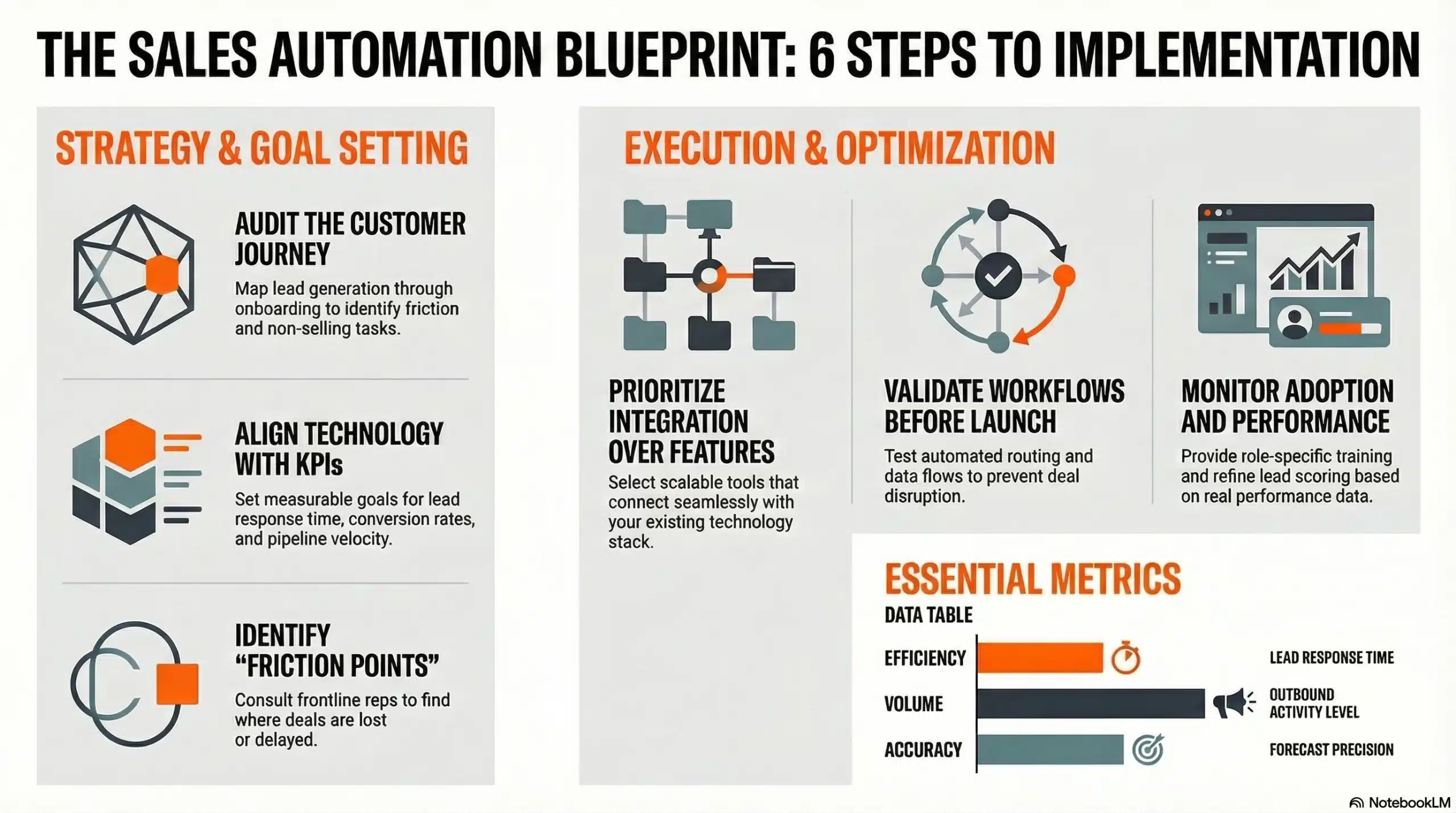
The shift to an automated sales ecosystem requires careful planning and a disciplined approach. Implementing technology without a clear strategy leads to poor adoption rates, wasted budgets, and disrupted workflows.
Step 1: Audit Your Current Sales Processes
Before introducing any technology, you need a thorough understanding of how your sales team currently operates. Map the entire customer journey from initial lead generation through to closed deals and post-sale onboarding.
Speak directly with your frontline sales representatives to identify where friction occurs, which tasks consume the most non-selling time, and where deals are most often lost. This audit creates a clear roadmap for where automation will have the greatest immediate impact.
Your audit should also review data quality, as automation depends on accurate information. Duplicate records, outdated contacts, and inconsistent data can cause errors, so clean and standardise your database before implementing new technology.
Step 2: Define Goals and Key Metrics
Technology should serve specific, measurable business objectives rather than be adopted for its own sake. After completing your audit, establish clear goals such as reducing lead response time, increasing outbound volume, or improving forecast accuracy.
Align each goal with a specific Key Performance Indicator (KPI). Common metrics include Customer Acquisition Cost (CAC), pipeline velocity, conversion rates between sales funnel stages, and the percentage of time representatives spend actively selling.
Step 3: Select the Right Tools
The software market offers thousands of solutions ranging from lightweight email sequencers to enterprise-grade platform for sales CRM. Prioritize tools that are scalable, easy to use, and capable of integrating with your existing systems.
Avoid purchasing software based on features your team does not actually need. Focus on solutions that directly address the bottlenecks identified in your audit, and ensure that any new tool connects seamlessly with your current technology stack.
Step 4: Integrate and Configure Your Systems
The full value of automation is realized when all systems share data without manual intervention. Ensure that marketing data flows into your CRM and that sales data connects with your billing and fulfillment platforms.
Build and test all automated workflows in a controlled environment before going live. A poorly configured rule, such as a misaligned lead routing protocol, can disrupt active deals and damage customer relationships.
Step 5: Train Your Team and Monitor Performance
Even the most sophisticated automation is ineffective if the team does not adopt it. Provide role-specific training that explains how the tools work and how they directly benefit each sales representative.
After launch, monitor adoption rates and track the KPIs defined in Step 2. Automation requires ongoing refinement, so review your workflows regularly, test your email sequences, and update lead scoring models based on real performance data.
Sales Automation Across Industries
While the principles of automation apply universally, the specific approach varies by sector. Different industries face unique challenges, regulatory requirements, and customer expectations that shape how automation is best deployed.
Retail and E-commerce
In retail and e-commerce, transaction volumes are high and sales cycles are short. Automation focuses on recovering lost revenue and maximizing customer lifetime value through timely, behavior-triggered communication.
Abandoned cart email sequences re-engage shoppers who did not complete a purchase, often paired with a time-sensitive incentive. Post-purchase workflows handle order confirmations, shipping updates, review requests, and personalized product recommendations automatically.
B2B and Professional Services
B2B and professional services involve long sales cycles, multiple stakeholders, and high-value transactions. Automation in this sector focuses on maintaining consistent engagement throughout an extended research and evaluation period.
Drip campaigns deliver educational content such as case studies and whitepapers at a measured pace, building authority over time. Automation also streamlines the proposal process, allowing firms to generate detailed documents and track when prospects open and sign them.
Manufacturing and Distribution
In manufacturing and distribution, sales processes are closely tied to operational logistics. Configure, Price, Quote (CPQ) automation allows sales reps to generate accurate, customized quotes based on real-time inventory data and pricing rules.
Integrating the sales CRM with business a customer engagement software ensures that a closed deal automatically triggers inventory updates, production scheduling, and shipping documentation. This eliminates the traditional handover delays between sales and fulfillment teams.
Financial Services
The financial services industry covers banking, insurance, and wealth management, where compliance are non-negotiable. Automation focuses on streamlining client onboarding while maintaining adherence to Know Your Customer (KYC) and Anti-Money Laundering (AML) requirements.
Automated workflow systems guide new clients through documentation submission, identity verification, and disclosure signing. Intelligent document processing tools use OCR and AI to extract data from passports or tax forms, populating the CRM and flagging discrepancies for human review.
Financial advisors also use automation to schedule annual portfolio reviews, send market updates, and trigger alerts when a client’s account balance drops below a set threshold. This ensures proactive, compliant client management without manual tracking.
Common Mistakes to Avoid
Understanding where businesses go wrong during implementation helps prevent costly setbacks. The following mistakes are among the most frequent and most damaging when adopting sales automation.
Over-Automating Customer Interactions
Attempting to automate every customer touchpoint results in a cold, impersonal experience that erodes trust. Prospects who feel trapped in an endless loop of generic automated responses will disengage and move to a competitor.
Automation should handle logistics and initial outreach, but complex negotiations and high-stakes conversations must remain in the hands of skilled human professionals. Establish clear triggers that pause automated sequences and prompt a rep to take over when buying intent is detected.
Neglecting Data Quality
Automation is entirely dependent on the quality of the data feeding it. A CRM filled with duplicate records, outdated contact details, and incorrect information will produce flawed outputs regardless of how well the workflows are configured.
Establish strict data entry standards and schedule regular database audits to maintain accuracy. Clean, structured data is a non-negotiable prerequisite for any automation initiative to function effectively.
Advanced Practices and Future Trends
Applying the right practices from the start ensures that automation delivers consistent, measurable results over time. These principles reflect what high-performing sales teams do to build and maintain effective automated systems.
Map Every Stage Before Automating
Document every step of the sales cycle before configuring any automation rules. A clear process map ensures that workflows reflect how your team actually operates, reducing the risk of gaps or misaligned logic.
Involving sales representatives in the mapping process produces better outcomes. They understand the nuances of daily workflows and can identify edge cases that a purely top-down approach might overlook.
Prioritize Integration Across All Platforms
Automation tools only deliver full value when they share data seamlessly with the rest of your technology stack. Disconnected systems create information gaps that undermine the consistency and accuracy of your automated workflows.
When evaluating tools, treat integration capability as a primary requirement rather than an optional feature. Every platform must connect with your CRM, marketing tools, and financial systems before you commit to a purchase.
Test and Optimize Workflows Continuously
Automation is not a one-time setup. Market conditions change, customer behaviors evolve, and workflows that performed well previously may become ineffective without regular review and adjustment.
Schedule periodic audits of all automated sequences, lead scoring criteria, and routing rules. Use A/B testing to compare subject lines and call-to-action variations, and update your workflows based on real performance data.
Connect Sales Automation to Broader Business Software
Effective automation strategies extend beyond the sales department and connect to broader business operations. Linking your CRM with inventory, finance, and procurement software creates a unified view of the customer from first contact through final delivery.
Business software platforms that bring these functions together reduce manual handoffs between departments. This improves data accuracy, accelerates fulfillment, and ensures that every team operates from consistent, real-time information.
Conclusion
Sales automation gives businesses the ability to scale their revenue operations without proportionally scaling their costs. By removing administrative burden from sales professionals, it creates more time for the high-value human interactions that actually drive growth.
For Australian businesses, the practical benefits are clear: faster lead response, better data quality, stronger forecast accuracy, and more efficiency overall. The key to success is a structured approach: audit processes, define goals, select the right tools, and commit to ongoing optimization.
Businesses that treat automation as a long-term investment rather than a one-time fix consistently achieve the best results. If you are interested in applying sales automation for your business, you can request a free consultation with us today and let us guide you through your automation journey.
Frequently Asked Question
Sales automation is the use of software and AI tools to handle repetitive tasks in the sales cycle, freeing professionals to focus on closing deals and managing customer relationships.
Costs vary widely depending on the platform and business size. Entry-level tools can start from as little as AUD 30 per user per month, while enterprise-grade platforms with full CRM, AI, and analytics capabilities can cost several hundred dollars per user per month.
Yes. Small businesses benefit from automation by reducing manual workload without needing to hire additional staff. Many platforms offer scalable pricing plans that are accessible for smaller teams.
Marketing automation focuses on generating and nurturing leads through campaigns and content, while sales automation handles the process of converting those leads into customers through pipeline management, outreach, and deal tracking.