














Workforce stagnation can quickly weaken organisational performance in a fast-evolving business environment. As technology advances and market expectations shift, static skill sets are no longer sustainable for competitive organisations.
Employee development has become a strategic priority rather than a discretionary HR initiative. Organisations that invest in continuous capability building are better positioned to improve retention, strengthen productivity, and support scalable performance.
This guide outlines the core concepts, frameworks, and metrics that shape effective employee development programs in modern organisations.
Key Takeaways
Understand what employee development is and how it supports long term workforce readiness.
Explore why employee development drives retention, engagement, and sustainable business performance.
Learn how to build a structured employee development pipeline that aligns skills with business goals.
Identify the key metrics for measuring the impact of employee development initiatives.
What Is Employee Development and Why It Matters
Employee development is a structured, long term effort to strengthen workforce skills and career readiness. Unlike short term training that focuses on immediate tasks, employee development prepares employees for future roles and changing business needs.
The process focuses on unlocking potential through continuous learning such as mentoring, job rotation, coaching, and formal education. It requires alignment between organisational goals and individual career growth to deliver measurable impact.
Many organisations follow the 70-20-10 learning model, where most capability building comes from practical experience. As automation increases, development programs also emphasise adaptability, communication, and critical thinking.
Why Employee Development Matters for Business Performance
Employee development plays a direct role in business performance, productivity, and long-term retention. When employees continue to build skills and grow in their roles, businesses benefit from stronger engagement, better results, and a more capable workforce.
1. Talent attraction and employer branding
Strong development programs enhance employer reputation and attract ambitious candidates who prioritise career growth. Organisations known as talent incubators typically reduce recruitment friction and improve candidate quality.
2. Identifying high potential employees
Structured development helps leaders assess how employees respond to new challenges and responsibilities. This visibility supports more accurate identification of future leaders and ensures investment focuses on the right talent segments.
3. Early detection of skill gaps
Regular development reviews reveal capability gaps before they affect performance. Addressing these gaps proactively helps maintain team effectiveness and reduces operational risk.
4. Strengthening engagement and value perception
Personalised development plans signal long term organisational commitment to employees. This perception typically increases engagement, productivity, and discretionary effort.
5. Improving retention and succession readiness
Clear internal career pathways reduce external job seeking behaviour. At the same time, continuous development builds a stronger succession pipeline and protects business continuity.
How to Build and Manage an Employee Development Pipeline
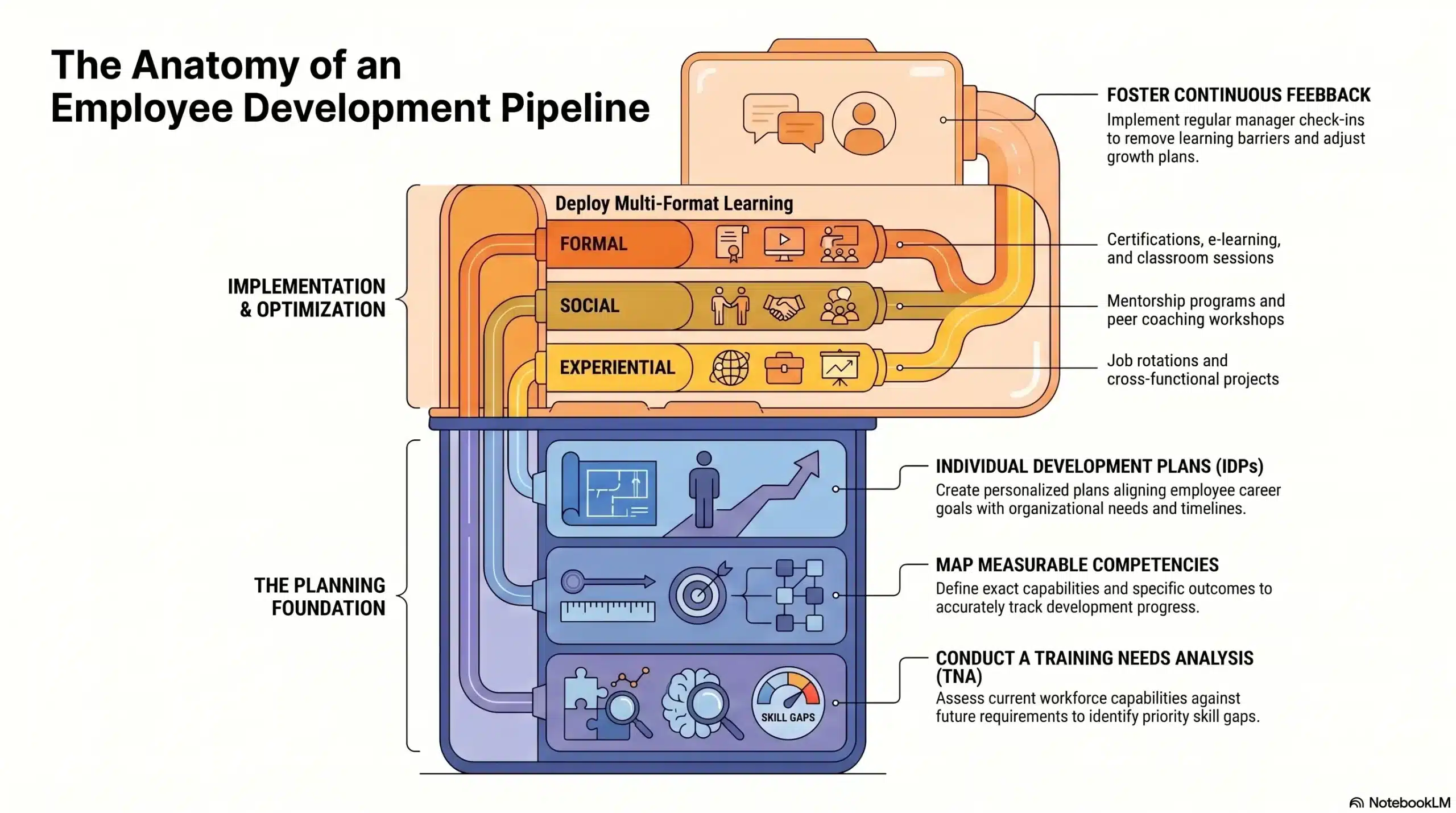
Building an effective employee development pipeline requires a structured approach that aligns workforce capabilities with long term business goals. Without clear planning, development initiatives often become fragmented and difficult to measure.
Organisations should treat development as an ongoing cycle rather than a one time training event. The structured steps below help ensure learning efforts translate into measurable performance improvement.
1. Conduct a Training Needs Analysis (TNA)
Start by assessing current workforce capabilities against future business requirements. Use surveys, interviews, and performance data to identify skill gaps and priority areas. This ensures development investments focus on the competencies that matter most.
2. Define clear objectives and competencies
Set specific, measurable goals for each development initiative. Instead of broad targets, define the exact capability to be improved and the expected outcome. Clear competency mapping helps organisations track progress more accurately.
3. Create Individual Development Plans (IDPs)
Personalised development plans align employee career goals with organisational needs. Each IDP should outline target skills, learning methods, and realistic timelines. This approach increases relevance and employee ownership of growth.
4. Implement diverse learning methodologies
A strong pipeline combines multiple learning formats to reinforce knowledge and support different learning styles. Core approaches typically include:
- Formal learning: classroom sessions, e learning courses, and certifications
- Social learning: mentorship programs, peer coaching, and collaborative workshops
- Experiential learning: job rotations, stretch assignments, and cross functional projects
Blending these methods improves knowledge retention and accelerates real world application.
5. Foster a culture of continuous feedback
Regular feedback keeps development aligned with performance expectations. Managers should hold periodic check ins to review progress, adjust plans, and remove learning barriers. This ensures the development pipeline stays responsive and effective.






Measuring Employee Development Effectiveness
To evaluate the impact of employee development initiatives, organisations must track metrics that link learning activities to business outcomes. Quantitative indicators help HR and leadership assess whether development investments are delivering measurable value.
1. Retention rate of high potentials
This metric tracks how well the organisation retains employees identified as high potential. Strong development programs typically improve retention among top talent, while declining rates may indicate gaps in growth opportunities.
2. Time to proficiency
Time to proficiency measures how quickly employees reach expected performance levels after training or role transitions. Effective development pipelines supported by HRM system options in the Australian market should shorten this timeline and accelerate productivity.
3. Internal promotion rate
A high internal promotion rate signals that development initiatives are successfully preparing employees for larger responsibilities. It also reduces reliance on external hiring for critical roles.
4. Skill gap closure rate
This indicator measures how effectively identified capability gaps are being addressed. Comparing pre and post assessment results helps organisations verify whether training efforts are improving workforce readiness.
5. Employee net promoter score for learning
eNPS focused on learning and development captures employee perception of growth opportunities. Positive scores usually correlate with stronger engagement, while low scores may signal that programs lack relevance or impact.
How HR Technology Supports Employee Development
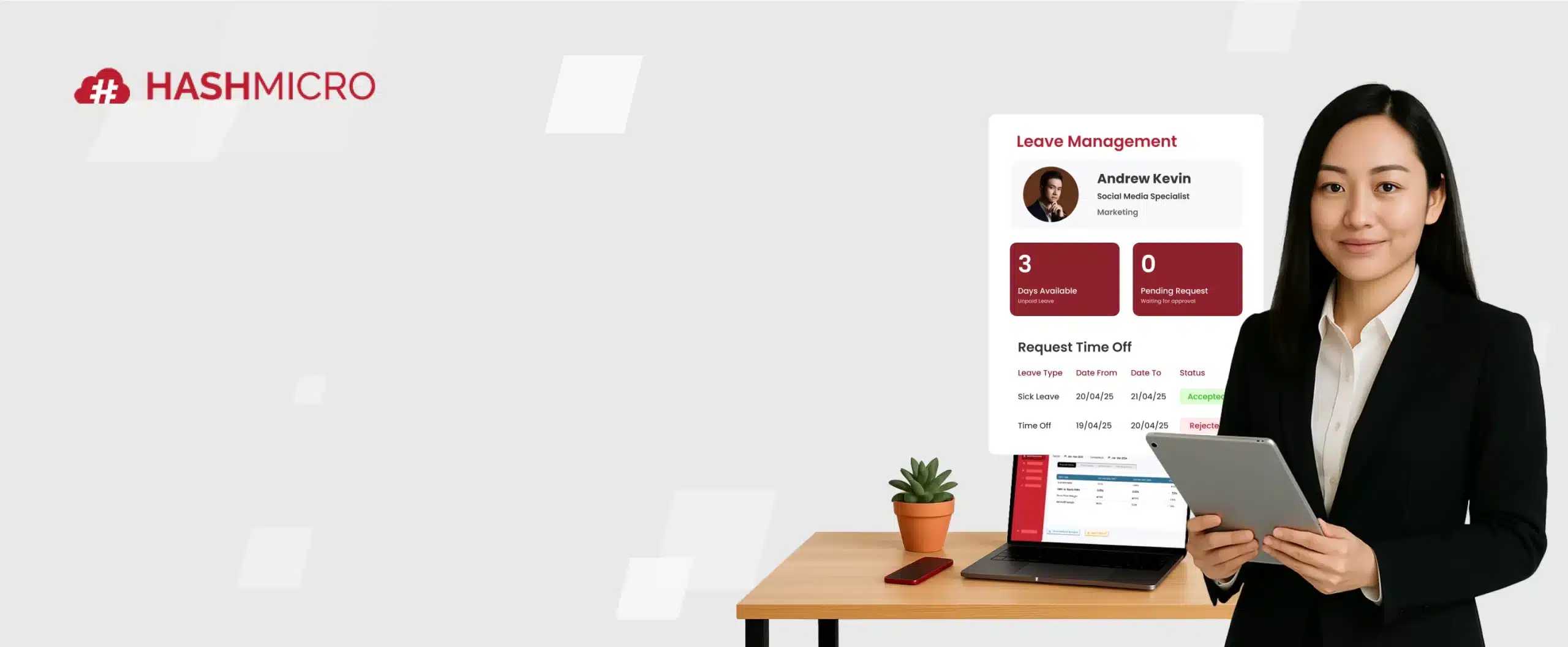
Managing employee development at scale requires more than manual tracking. Modern organisations rely on HRIS and learning management systems and an integrated people management system to centralise data, automate learning workflows, and deliver personalised growth pathways aligned with business goals.
1. Centralising development data
HRIS and Learning Management Systems act as a single source of truth for training records, certifications, and performance history. This visibility helps HR teams quickly identify skill availability and workforce capability gaps.
2. Automating the learning journey
Automation reduces administrative workload by assigning mandatory training, sending reminders, and scheduling review cycles automatically. This allows HR teams to focus more on strategy rather than manual coordination.
3. Personalisation at scale
Advanced platforms recommend learning paths based on role, performance, and career goals. Personalised development improves relevance and increases employee engagement, even in large organisations.
4. Real time analytics and reporting
Dashboards provide instant visibility into metrics such as completion rates, skill progress, and program impact. With real time insights, organisations can refine development strategies faster.
5. Integration with performance management
The strongest ecosystems connect learning with performance reviews. When competency gaps are identified, the system can automatically recommend relevant training, ensuring development remains tightly aligned with performance improvement.
Industry Specific Employee Development Strategies
Although the core goal of employee development is consistent, execution differs by sector. Aligning development programs with industry demands ensures learning initiatives translate into real operational impact and workforce readiness.
1. Technology and software development
In the tech sector, rapid change makes continuous learning essential. Organisations use hackathons, innovation days, and mentorship to strengthen technical skills and accelerate cross functional knowledge transfer.
Beyond technical depth, companies increasingly invest in certifications and soft skills development. Communication, adaptability, and product thinking help technical staff transition into leadership or cross functional roles.
2. Healthcare and life sciences
Healthcare development must balance clinical excellence with patient experience. Leading institutions use simulation based training to help medical staff practise high risk procedures safely while maintaining compliance standards.
There is also growing focus on emotional intelligence, resilience, and leadership pathways for clinicians. These programs support retention, reduce burnout risk, and improve overall quality of care.
3. Manufacturing and logistics
In manufacturing environments, development priorities centre on safety, digital literacy, and process efficiency. Modern apprenticeship models now combine hands on learning with training in automation, robotics, and data analysis.
Many organisations also deploy Lean Six Sigma programs to empower employees to identify inefficiencies. Safety leadership initiatives further strengthen workplace compliance and operational discipline.
4. Retail and hospitality
High turnover makes development a key retention lever in retail and hospitality. Organisations commonly use mobile based microlearning so frontline staff can absorb training quickly without leaving the floor.
Strong programs also emphasise brand understanding and clear career pathways. When employees see progression from associate to store leadership, engagement and retention typically improve.

Common Employee Development Pitfalls to Avoid
Even well funded employee development programs can underperform without disciplined execution. Recognising common risks early helps organisations protect ROI and maintain long term workforce impact.
- One Size Fits All Programs
Applying the same learning path to all employees ignores differences in roles, experience, and career goals. When content lacks relevance, engagement drops. Effective programs use personalised or adaptive learning paths aligned with individual needs. - Neglecting Learning Reinforcement
Without follow up, employees quickly forget new knowledge. Development initiatives should include spaced learning, coaching, and real work application to improve retention and practical impact. - Confusing High Performance with High Potential
Top individual performers are not always suited for leadership roles. Organisations should separate specialist and leadership tracks to ensure development investments target the right talent pipeline. - Measuring Activity Instead of Impact
Tracking training hours alone provides limited insight. Organisations should prioritise outcome based metrics such as productivity improvement, internal mobility, and retention among high potential employees. - Weak Executive Sponsorship
When leadership treats development as a cost rather than a strategic priority, programs lose momentum. Visible executive support and participation are essential to build a strong learning culture.
Advanced Employee Development Trends and Practices
Employee development is shifting beyond traditional training toward more adaptive, technology enabled models. Organisations increasingly combine data, AI, and experiential learning to build programs that respond faster to evolving skill demands and workforce expectations.
- AI driven personalisation
Artificial intelligence is turning learning into a recommendation driven experience. Modern platforms analyse role needs, performance data, and career goals to suggest targeted learning paths that stay aligned with business priorities. - Internal talent marketplaces
Many organisations are building internal project marketplaces that allow employees to take short term assignments across departments. This approach accelerates skill growth, improves cross functional exposure, and helps retain high potential talent seeking new challenges. - Immersive and simulation based learning
Technologies such as VR and AR are increasingly used for high risk or complex skill development. From leadership simulations to technical repair guidance, immersive learning provides safe environments for practice while shortening time to proficiency. - Data driven skills taxonomy
Leading companies are mapping roles to granular skill frameworks rather than broad job descriptions. This enables more precise gap analysis, targeted training investment, and clearer workforce planning as business needs evolve.
As these practices mature, employee development is shifting from periodic training into a continuous, intelligence driven capability that supports long term organisational resilience.
Implementing an Effective Employee Development Program
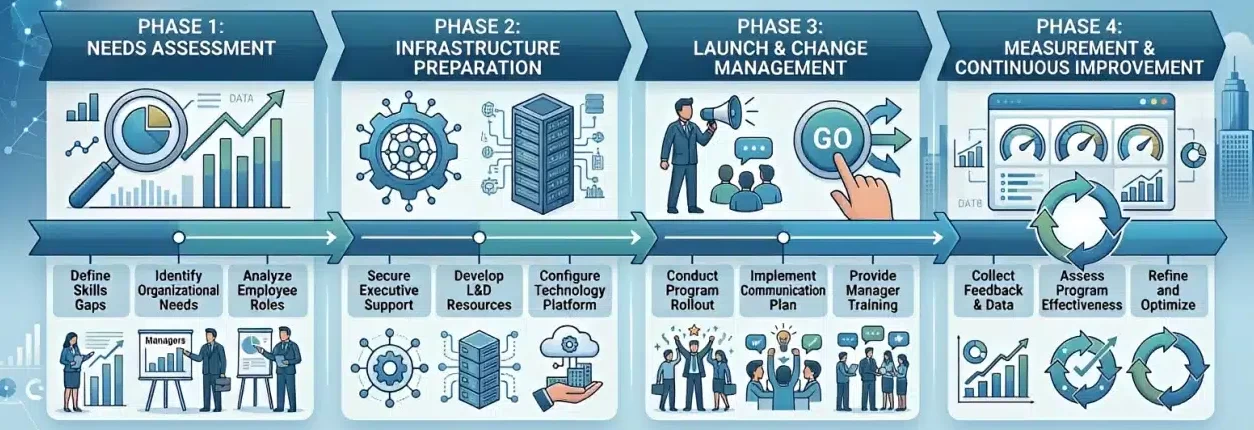
Implementing employee development requires a structured and disciplined approach. Without clear planning, organisations risk launching fragmented initiatives that fail to deliver measurable workforce impact. The phased framework below helps translate strategy into consistent execution.
1. Needs assessment and strategy alignment
This phase ensures development priorities align with business goals and future capability needs.
Action Items:
- Conduct a skills gap analysis: Evaluate current capabilities against future workforce requirements.
- Define success metrics: Establish clear outcomes such as retention improvement or faster role readiness.
- Secure executive alignment: Confirm leadership support, budget ownership, and strategic priorities early.
2. Infrastructure and content preparation
Once priorities are clear, organisations must prepare the learning ecosystem and supporting content.
Action Items:
- Select the learning platform: Choose an LMS or LXP that integrates effectively with existing HRIS and broader workforce management solutions to ensure seamless workforce planning and development tracking.
- Define buy versus build content strategy: Combine external courses with internally developed materials.
- Identify subject matter experts: Engage internal experts to support mentoring and knowledge transfer.
3. Launch and change management
A controlled rollout helps drive adoption while minimising disruption across teams.
Action Items:
- Run a pilot program: Test the approach with a focused group before full deployment.
- Execute internal communication: Promote the initiative through leadership messaging and internal channels.
- Enable managers: Train managers to support development conversations and reinforce participation.
4. Measurement and continuous improvement
Employee development must be monitored and refined to remain relevant as business needs evolve.
Action Items:
- Apply the Kirkpatrick evaluation model: Measure reaction, learning, behaviour, and business impact.
- Conduct quarterly performance reviews: Analyse engagement data and retire low value content.
- Promote success stories: Highlight employee growth outcomes to strengthen program credibility.
Government-Supported Development Programs Australian Employers Can Leverage
Australian employers do not always need to fund workforce development alone. Using these programs can make staff development more affordable while helping businesses build skills in areas facing labour shortages.
1. Australian apprenticeships incentive system
The Australian Apprenticeships Incentive System provides financial support for eligible employers and apprentices in priority occupations. It is designed to encourage hiring, training, and retaining apprentices across industries such as construction, care, and manufacturing. Employers should review eligibility rules regularly as incentives may change over time.
2. Smart and Skilled (NSW)
Smart and Skilled is a New South Wales Government program offering subsidised vocational education and training for eligible workers, apprentices, and trainees. Employers in NSW can use it to upskill staff through approved training providers while reducing course costs. (NSW Government)
3. Free TAFE (VIC)
Victoria’s Free TAFE program gives eligible students access to selected courses without tuition fees in priority industries such as healthcare, construction, cyber security, and community services. Employers can encourage employees to use this pathway for practical upskilling and recognised qualifications.
4. Skilling australians fund
The Skilling Australians Fund supports apprenticeships, traineeships, and workforce skill development through joint federal and state investment. It focuses on building talent pipelines in sectors with skills shortages and can indirectly benefit employers seeking qualified workers.
Conclusion
Employee development delivers the strongest impact when learning initiatives align with real workforce and business needs. With a structured approach, organisations can strengthen capability, improve retention, and build a more adaptable workforce.
Each organisation faces different priorities, from closing skill gaps to accelerating leadership readiness and improving internal mobility. Evaluating development programs based on scalability, data visibility, and practical fit helps ensure long term value.
For organisations assessing their next steps, a structured review can clarify the most effective development strategy. If you want help shortlisting options, book a free consultation with our team.
Frequently Asked Questions About Employee Development
-
What is an example of employee development?
An example of employee development is providing leadership training, mentoring, or job-specific courses that help employees improve their skills and prepare for greater responsibilities.
-
What are the 4 quadrants of employee development?
The four quadrants of employee development commonly include training, coaching, career progression, and performance management. Together, these areas support growth, engagement, and long-term success.
-
What should be included in an effective employee development program?
An effective program typically includes skills gap analysis, clear competency frameworks, individual development plans, diverse learning methods, and continuous feedback. Strong alignment between employee goals and business priorities is also essential.
-
How do I develop employees?
You can develop employees by identifying skill gaps, setting clear growth goals, offering training opportunities, providing regular feedback, and creating career pathways within the business.
-
How does HR technology support employee development?
HR technology centralises training data, automates learning workflows, and provides personalised learning recommendations at scale. Integrated platforms also deliver real time analytics that help organisations continuously refine their development strategy.