














Key Takeaways
Understand how intangible assets create business value through non-physical resources such as software, patents, licences, contracts, and goodwill.
Compare how tangible assets and intangible assets differ in physical form, accounting treatment, depreciation, amortisation, and impairment review.
Review how AASB 138 guides recognition, reliable measurement, useful life assessment, amortisation, and impairment for intangible assets.
See how accounting software helps businesses manage intangible asset records, amortisation schedules, supporting documents, and impairment reviews.
What Are Intangible Assets?

Intangible assets are assets without physical form that a business controls and expects to benefit from in the future. Unlike equipment or stock, they do not exist as something staff can touch, store, or move.
A software platform, registered trademark, patent, licence, or customer contract can all qualify as intangible assets when they meet accounting recognition rules. However, not every valuable idea or internal capability appears on the balance sheet.
Under Australian accounting rules, businesses need to consider whether the asset is identifiable, controlled by the business, and capable of producing future economic benefits. Therefore, finance teams should review each asset carefully before recording it.
Tangible vs Intangible Assets
Tangible and intangible assets both support business value, but they differ in form, measurement, and accounting treatment. Tangible assets have physical substance, while intangible assets rely on legal rights, technology, brand value, or commercial relationships.
For example, a delivery van is a tangible asset because the business can physically use it. A delivery routing software licence is an intangible asset because it has no physical form but still supports operations.
Tangible assets often depreciate over time. Intangible assets with a finite useful life are usually amortised, while some intangible assets require impairment testing instead.
| Aspect |
Tangible Assets |
Intangible Assets |
| Physical form |
Have physical substance, such as equipment, vehicles, buildings, or stock. | Have no physical form, such as software, patents, trademarks, or licences. |
| Business value |
Support operations through physical use or ownership. | Support value through legal rights, technology, contracts, or brand strength. |
| Accounting treatment |
Usually depreciated over their useful life. | Usually amortised if they have a finite useful life. |
| Impairment review |
Reviewed when signs show the asset may have lost value. | Reviewed when value drops, with goodwill and indefinite-life assets needing closer checks. |
| Examples |
Delivery vans, machinery, office furniture, and warehouse equipment. | Software licences, customer contracts, copyrights, patents, and goodwill. |
Common Intangible Assets Examples
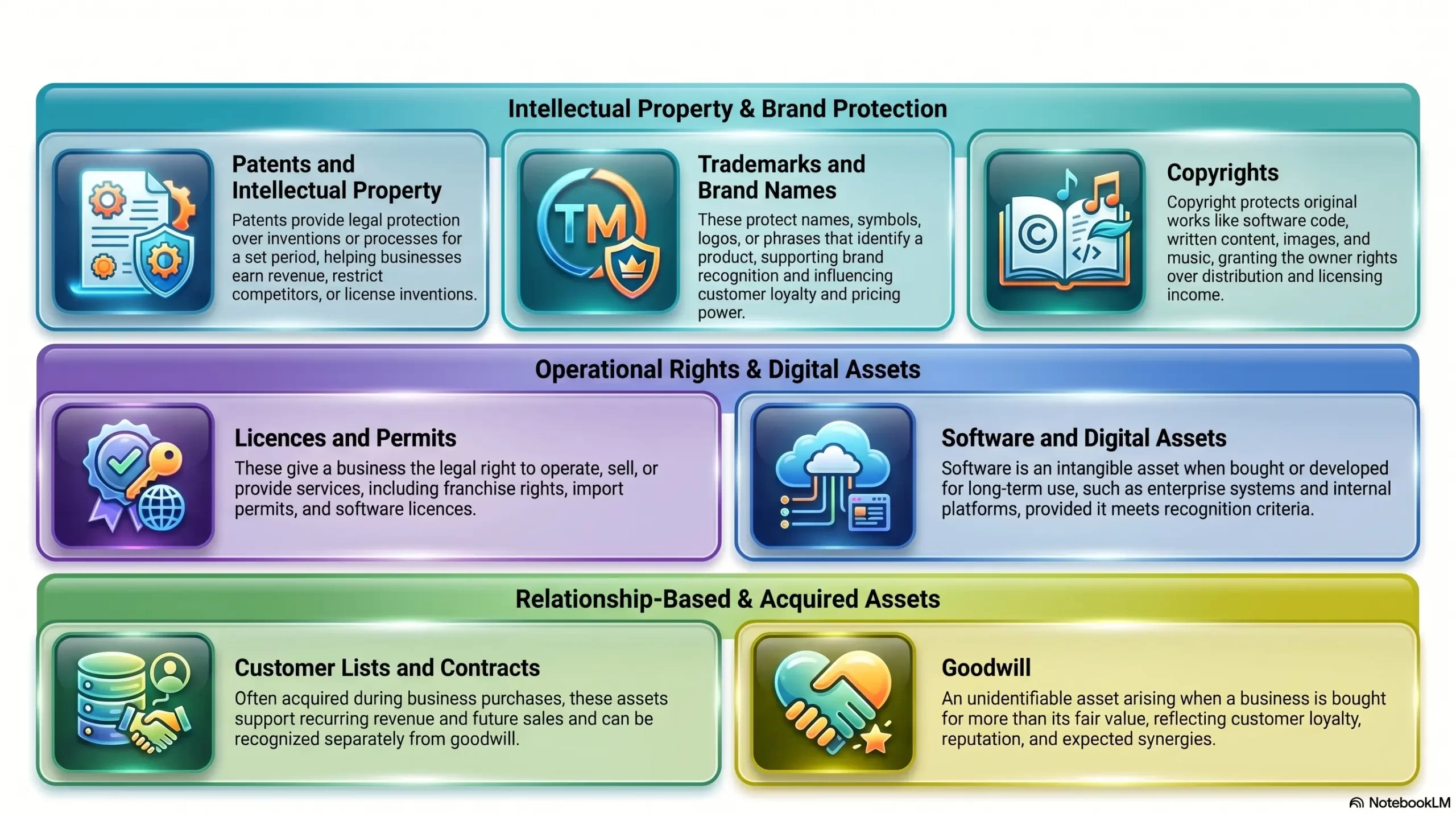
Intangible assets appear across many industries, from technology and retail to construction, healthcare, and professional services. The examples below show how different rights and resources can create value without physical substance.
Patents and intellectual property
Patents give a business legal protection over an invention or process for a set period. This protection can help the business earn revenue, restrict competitors, or license the invention to others.
Intellectual property can also include designs, trade secrets, and proprietary methods. However, businesses should confirm whether each item meets recognition criteria before treating it as an accounting asset.
Trademarks and brand names
Trademarks protect names, symbols, logos, or phrases that identify a product or company. A registered trademark can support brand recognition and help customers distinguish one business from another.
Brand names can hold significant commercial value, especially when they influence customer loyalty and pricing power. However, internally built brand reputation usually cannot be recorded as an asset unless accounting rules allow it.
Copyrights
Copyright protects original works such as written content, software code, images, music, films, and training materials. It gives the owner rights over how the work is copied, distributed, or used.
For businesses, copyright can create licensing income or protect internally developed materials. Therefore, companies should keep clear records of ownership, development costs, and commercial use.
Licences and permits
Licences and permits can give a business the legal right to operate, sell, distribute, or provide certain services. These rights may hold value when they support revenue generation.
Examples include software licences, franchise rights, import permits, and operating permits. The accounting treatment depends on whether the business controls the right and can measure its cost reliably.
Software and digital assets
Digital asset tracking starts with understanding when software qualifies as an intangible asset. This may include enterprise systems, apps, internal platforms, and certain digital tools a business buys or develops for long-term use.
However, many software costs are still treated as expenses. For example, monthly subscription fees usually go through the profit and loss statement unless they create a controlled asset that meets recognition criteria.
Customer lists and contracts
Customer lists and contracts may qualify as intangible assets when a business acquires them or can clearly identify their value. These assets can support recurring revenue and future sales.
For example, a company may acquire customer contracts as part of a business purchase. In that case, the finance team may recognise them separately from goodwill if they meet the relevant accounting rules.
Goodwill
Goodwill usually arises when one business buys another for more than the fair value of its identifiable net assets. It reflects value from factors such as customer loyalty, workforce capability, reputation, and expected synergies.
Goodwill is an unidentifiable intangible asset because it cannot be separated and sold on its own. As a result, businesses treat it differently from patents, licences, or software.
Types of Intangible Assets
Businesses can classify intangible assets in several ways. These categories help finance teams decide how to recognise, measure, amortise, and review each asset.
1. Identifiable intangible assets
Identifiable intangible assets can be separated from the business or arise from legal or contractual rights. Examples include patents, trademarks, copyrights, licences, software, and customer contracts.
This category matters because identifiable assets may be recognised separately on the balance sheet. For example, acquired software can often be measured more clearly than general business reputation.
2. Unidentifiable intangible assets
Unidentifiable intangible assets cannot be easily separated from the company. Goodwill is the most common example because it represents value attached to the business as a whole.
A company cannot usually sell goodwill by itself without selling the broader business. Therefore, goodwill has different accounting rules from separable intangible assets.
3. Internally generated intangible assets
Internally generated intangible assets come from work performed inside the business. Examples may include internally developed software, product designs, or technical knowledge.
Accounting rules treat these assets carefully because internal value can be hard to measure. For instance, research costs are generally expensed, while development costs may be capitalised only when strict conditions are met.
4. Acquired intangible assets
Acquired intangible assets are purchased from another party or obtained through a business combination. Their cost or fair value is often easier to measure than internally generated assets.
Examples include purchased software, acquired trademarks, franchise rights, and customer contracts obtained through acquisition. As a result, businesses usually find these assets easier to recognise.
How Intangible Assets Are Recorded in Accounting
An asset tracking framework helps businesses record intangible assets when they meet the recognition criteria and the cost can be measured reliably. The asset then appears on the balance sheet rather than being treated as an immediate expense.
The initial measurement usually starts at cost. This may include the purchase price and directly attributable costs needed to prepare the asset for use.
After recognition, the business must review the asset’s useful life. If the asset has a finite useful life, the business usually amortises it over the period it expects to benefit from the asset.
If the asset has an indefinite useful life, the business does not amortise it. However, it must review the asset for impairment and ensure the carrying amount remains supportable.
Intangible Assets and Australian Accounting Standards
Australian businesses that prepare financial statements under Australian Accounting Standards should consider AASB 138 Intangible Assets. This standard explains how businesses recognise, measure, amortise, and disclose intangible assets.
Recognition under AASB 138
AASB 138 applies to identifiable non-monetary assets without physical substance. An intangible asset is identifiable if it can be separated from the business or arises from legal or contractual rights.
A business also needs control over the asset. This means the company can obtain future benefits from the asset and restrict others from accessing those benefits.
Reliable measurement and future economic benefits
A business can recognise an intangible asset only when it is probable that future economic benefits will flow to the company. The business must also measure the asset’s cost reliably.
Future benefits may include revenue, cost savings, improved efficiency, or other commercial advantages. Therefore, finance teams should support recognition decisions with clear evidence.
Useful life and amortisation
AASB 138 requires businesses to assess whether an intangible asset has a finite or indefinite useful life. Finite-life assets are amortised over the period they are expected to generate benefits.
For example, software used for five years may be amortised across that expected period. The amortisation method should reflect how the business consumes the asset’s economic benefits.
Impairment review
Businesses need to review intangible assets for impairment when indicators suggest the asset may have lost value. These indicators may include market changes, poor performance, legal issues, or technology becoming obsolete.
Some assets require annual impairment testing, including goodwill and intangible assets with indefinite useful lives. This helps prevent assets from staying on the balance sheet at values the business can no longer recover.
Amortisation vs Impairment for Intangible Assets
Amortisation and impairment both reduce the carrying value of an intangible asset, but they work differently. Amortisation spreads the cost of a finite-life intangible asset across its useful life.
For example, a business may amortise a software licence over the licence period. This recognises the cost gradually as the business uses the software.
Impairment occurs when an asset’s carrying amount exceeds its recoverable amount. In that case, the business writes down the asset to reflect the lower value.
The key difference is timing and cause. Amortisation follows a planned schedule, while impairment responds to evidence that the asset’s value has dropped.
Why Intangible Assets Matter for Australian Businesses
Intangible assets can represent a major part of business value, especially in technology, retail, franchising, healthcare, education, and professional services. A company may own limited physical assets but still hold valuable software, contracts, licences, or intellectual property.
These assets influence valuations during funding rounds, mergers, acquisitions, and business sales. Investors and buyers often review intangible assets to understand the company’s future earning potential.
Long-term asset planning depends on accurate records and better financial reporting. When businesses track intangible assets properly, they can manage amortisation, impairment, ownership, and renewal dates more confidently.
Intangible asset management also protects commercial advantage. For example, a business with strong trademark records and software ownership documents can defend its rights more effectively.
Common Mistakes When Managing Intangible Assets
Just as preventing equipment downtime requires scheduled maintenance, managing intangible assets requires consistent reviews, updated records, and timely impairment checks.
The following mistakes often create reporting errors, audit issues, or poor asset visibility.
1. Recording brand reputation too early
Businesses often treat reputation as an asset because it supports sales and customer loyalty. However, internally generated brand reputation usually does not meet the recognition rules for intangible assets.
A business should avoid recording general goodwill, market presence, or customer trust too early. Instead, it should keep evidence of costs, legal rights, and measurable future benefits.
2. Confusing expenses with capitalised assets
Not every cost linked to software, marketing, research, or product development becomes an intangible asset. Many costs must be expensed because they do not create a controlled asset with reliable future benefits.
For example, research costs are generally treated as expenses. Development costs may be capitalised only when the business can demonstrate technical feasibility, intention, resources, and reliable measurement.
3. Forgetting amortisation schedules
Finite-life intangible assets need consistent amortisation schedules. If a business forgets to update them, the balance sheet may overstate asset values.
Accounting teams should review useful lives and amortisation methods regularly. This keeps financial statements aligned with how the business uses the asset.
4. Not reviewing impairment
Intangible assets can lose value when markets change, technology becomes outdated, or expected benefits fall. Ignoring impairment indicators can create inaccurate financial reports.
Goodwill and indefinite-life intangible assets need particular attention. Businesses should document impairment reviews so management can support the carrying value.
5. Keeping asset records outside accounting software
Some companies track licences, patents, and software renewals in spreadsheets or email folders. This creates risk because records can become outdated, incomplete, or hard to verify.
A central accounting system helps keep asset values, amortisation schedules, ownership documents, and impairment notes in one place. As a result, finance teams can report more accurately and respond faster during audits.
How Accounting Software Helps Manage Intangible Assets

Tools for asset control help businesses record intangible assets, track amortisation, store supporting documents, and review asset values over time. They reduce the manual work involved in maintaining spreadsheets and separate files.
For example, software can set amortisation schedules for finite-life assets and post recurring entries automatically. This helps finance teams avoid missed journals and inconsistent calculations.
A good system can also attach contracts, invoices, renewal notices, and valuation documents to each asset record. This makes it easier to support recognition, measurement, and audit review.
For growing Australian businesses, accounting software also improves visibility across teams. Finance, legal, procurement, and management can work from the same records when reviewing licences, software, trademarks, or acquired assets.
Conclusion
Intangible assets help Australian businesses create value through rights, technology, contracts, software, brand strength, and intellectual property. Although they have no physical form, they can influence profitability, business valuation, funding decisions, and long-term growth.
However, businesses need clear records and the right accounting treatment to manage amortisation, impairment, ownership, and compliance properly. To manage intangible assets more accurately, book a free consultation with our expert today.
Frequently Asked Question
Yes, intangible assets can be recorded on the balance sheet in Australia when they meet the recognition criteria. The business must usually show that the asset is identifiable, controlled, expected to generate future benefits, and measured reliably.
Intangible assets with a finite useful life can usually be amortised. Examples may include software licences, patents, customer contracts, and certain permits with a clear expiry or expected use period.
Yes, goodwill is an intangible asset. It usually arises when a business acquires another business for more than the fair value of its identifiable net assets.
Software can be either an intangible asset or an expense, depending on the facts. Purchased or internally developed software may be capitalised if it meets recognition criteria, while subscription fees and routine maintenance are often expensed.
Intangible assets are a broader accounting category that includes non-physical assets such as software, licences, customer contracts, goodwill, and intellectual property. Intellectual property refers specifically to legal rights such as patents, trademarks, copyrights, and designs.