














A construction budget is a financial plan that outlines the expected cost of completing a construction project. It helps builders and project teams understand how much funding is required before work begins.
Construction budgets allocate costs across materials, labour, equipment, overheads, contingency, and other project expenses. These costs provide a framework for managing spending, protecting profit margins, and keeping projects financially on track.
Key Takeaways
A construction budget is a financial plan that estimates project costs and guides spending.
Creating a construction budget requires defining scope, estimating costs, and reviewing project risks.
Construction budget management helps teams track costs, manage variations, and forecast final project expenses.
Software can connect budgeting, procurement, and project cost data within a single system.

What Is a Construction Budget?
A construction budget is a financial plan that estimates the costs required to complete a project within an approved scope. It serves as the baseline for managing project spending.
While an estimate predicts project costs, a budget is the approved framework used to control spending. Construction budgets help teams monitor costs, manage risks, and compare planned expenses against actual project performance.
What Is Included in a Construction Budget?
Most construction budgets include several core cost categories that cover both project delivery and business requirements.
1. Direct Costs (Materials, Labour, Equipment)
Direct costs are expenses directly related to construction activities and serve as important tools for tracking project spending throughout project delivery. They typically include materials, labour, equipment, and subcontractor costs required to complete the physical work.
2. Indirect Costs (Overheads, Insurance, Administration)
Indirect costs support the project but are not tied to a specific construction task. Common examples include site establishment, insurance, administration, project management, and utilities.
3. Contingency (5–10%)
Contingency is a reserve allowance for unforeseen costs that may arise during construction. Many projects allocate between 5% and 10% of the total budget depending on project complexity and risk management requirements.
4. Permits, Fees, and Compliance Costs
Construction projects often incur regulatory costs such as permits, inspections, development approvals, and compliance-related expenses. These costs can vary depending on location and project type.
5. Profit Margin
Profit margin is the amount added above project costs to support business profitability. It is usually calculated after direct costs, indirect costs, and contingency allowances have been determined.
Actual percentages vary depending on project type, complexity, procurement method, and contract structure.
How to Create a Construction Budget
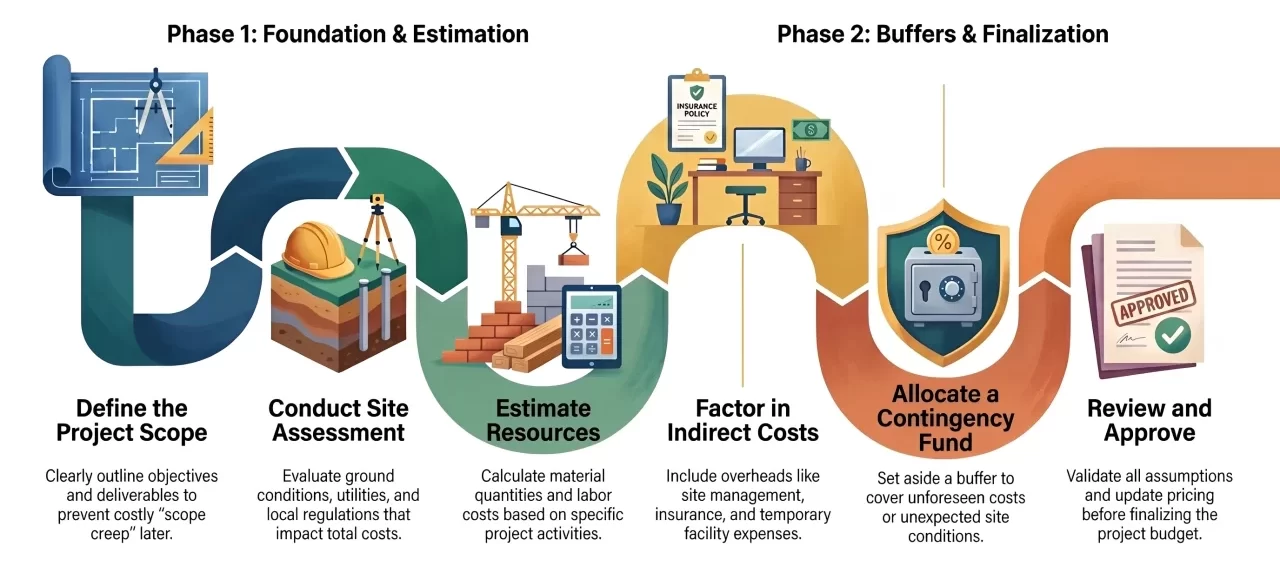
Creating an accurate construction budget requires a structured approach that considers project requirements, costs, risks, and financial objectives before work begins.
1. Define the Project Scope
Clearly outline the project’s objectives, deliverables, specifications, and work requirements. A well-defined scope helps prevent cost overruns caused by scope changes later in the project.
2. Conduct Site Assessment
Assess site conditions that may affect construction costs, including access, ground conditions, utilities, environmental factors, and local regulations.
3. Estimate Material and Labour Costs
Calculate the quantities of materials required and estimate labour costs based on project activities, productivity rates, and workforce requirements.
4. Factor in Overheads and Indirect Costs
Include expenses such as site management, insurance, administration, temporary facilities, and other costs that support project delivery.
5. Add Contingency
Allocate a contingency allowance to cover unforeseen costs, design changes, or unexpected site conditions that may arise during construction.
6. Review, Refine, and Approve
Review the budget for accuracy, validate assumptions, update pricing where required, and obtain approval before finalising the project budget.
Types of Construction Estimates
Different estimate types are used throughout the project lifecycle, with accuracy increasing as project information becomes more detailed.
1. Preliminary (Conceptual)
Preliminary estimates are prepared during the early planning stage to assess project feasibility and support funding decisions.
2. Detailed (Design Development)
Detailed estimates use more developed drawings and specifications to provide greater cost accuracy for budgeting and planning purposes.
3. Definitive (Pre-Tender)
Definitive estimates are prepared before tendering and are typically used to establish final project budgets and pricing strategies.
Estimate accuracy generally improves as project information becomes more detailed, reducing uncertainty and supporting more reliable budgeting decisions.
Construction Budget Management
Effective budget management, supported by strong accounting practices, helps construction businesses control costs and maintain financial performance.
1. Track Actual Costs Against Budget
Regularly comparing actual project costs against budgeted amounts helps identify variances early and supports timely corrective action.
2. Manage Variations
Changes to project scope, materials, or timelines should be documented and assessed to understand their impact on the approved budget.
3. Forecast Final Costs
Updating cost forecasts throughout the project supports planning future expenditures, helping teams estimate final project costs and identify budget risks early.
4. Monitor Budget Performance Metrics
Tracking key financial indicators provides visibility into project performance and helps project teams make informed financial decisions.
5. Key Budget Performance Metrics
- Budget variance: Measures the difference between budgeted and actual project costs.
- Cost Performance Index (CPI): Evaluates cost efficiency by comparing completed work against actual spending.
- Committed cost ratio: Tracks committed project costs against the approved budget to identify potential overspending.

Construction Budgeting in Australia
Construction budgeting in Australia requires a platform for monitoring project costs while considering local construction costs, compliance requirements, taxes, and payment structures.
1. AU Cost Benchmarks
The following benchmarks provide a general indication of construction costs across different project types in Australia.
Construction costs are generally higher in major cities such as Sydney and Melbourne, where labour, land, and operating expenses tend to exceed those in regional areas.
2. Permit and Council Fees
Construction projects may require development approvals, building permits, inspections, and other council-related fees. These costs vary by location and should be included during the budgeting process.
3. GST on Construction
Most construction services in Australia are subject to Goods and Services Tax (GST). Businesses should account for GST when preparing project budgets and managing cash flow requirements.
For GST-registered businesses, GST paid on eligible project expenses may be claimable through the Business Activity Statement (BAS) process, subject to applicable regulations.
4. Progress Payments
Many construction projects use progress payments, where clients pay for completed stages of work rather than the full project value upfront. This helps manage project cash flow and funding requirements.
Budget planning should align expected project costs with payment schedules while tracking budget performance to reduce the risk of cash flow shortages during delivery.
Common Construction Budgeting Mistakes
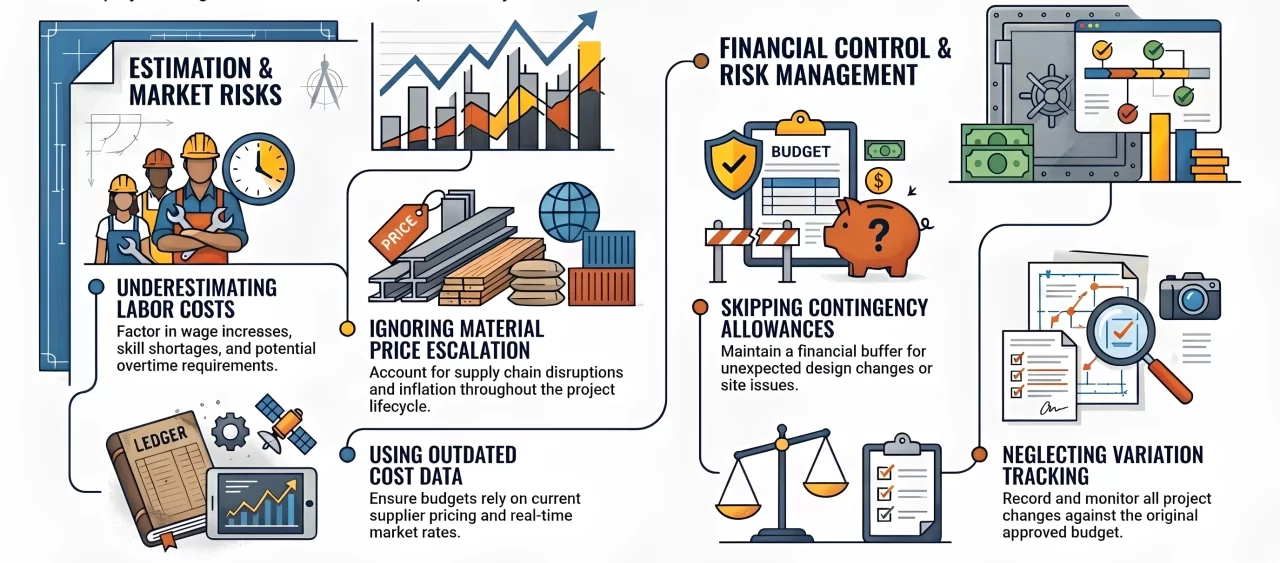
Even well-planned projects can experience budget issues when key costs or risks are overlooked. Understanding common mistakes can help businesses improve budget accuracy and financial control.
1. Underestimating Labour Costs
Labour costs can fluctuate due to wage increases, skills shortages, overtime requirements, and productivity differences. Underestimating these costs may significantly affect project profitability.
2. Ignoring Material Price Escalation
Material prices can change throughout a project due to supply chain disruptions, market conditions, and inflation. Failing to account for these increases may lead to budget overruns.
3. Skipping Contingency Allowances
Without a contingency allowance, unexpected events such as design changes, delays, or site issues can place pressure on project budgets and profit margins.
4. Using Outdated Cost Data
Construction costs change over time, making digital tools for construction cost management valuable for maintaining current supplier pricing, labour rates, and market information.
5. Not Tracking Variations Against the Budget
Project variations can quickly affect financial performance if they are not properly recorded and monitored. Tracking changes against the approved budget helps maintain cost control.
How Software Supports Construction Budgeting
Construction budgeting software helps businesses centralise project cost data, improve forecasting, and monitor budgets more effectively.
By connecting budgeting, procurement, and job costing, it provides better visibility into project costs and supports informed financial decisions.
Benefits of Construction Budgeting Software
- Centralised cost data: Store and manage project financial information in a single system.
- Better budget visibility: Access real-time insights into project spending and performance.
- Real-time cost tracking: Monitor actual costs against approved budgets as work progresses.
- Faster reporting: Generate financial reports and budget updates more efficiently.
- Improved forecast accuracy: Use current project data to produce more reliable cost forecasts.
Many businesses use budgeting tools alongside a construction management software platform to keep budgeting, procurement, project delivery, and cost control connected in one place.
Conclusion
Construction budgeting helps businesses plan project costs, manage financial risks, and maintain profitability throughout the construction lifecycle. A well-structured budget provides greater control over spending and supports better project outcomes.
By combining accurate cost estimates with ongoing budget monitoring, construction teams can respond to changes more effectively and reduce the risk of overruns.
If you want to improve construction budgeting and project cost control, you can request a free consultation to see how integrated construction software can support your operations.

Frequently Asked Question
Many construction projects allocate between 5% and 10% of the total budget as contingency, depending on project complexity and risk.
An estimate predicts project costs, while a construction budget is the approved financial plan used to control spending throughout the project.
Construction budgets should be reviewed regularly throughout the project, particularly when costs, schedules, or scope changes occur.
Construction costs vary by project type, location, specifications, and market conditions, with residential, commercial, and industrial projects having different cost ranges per square metre.
Construction budget performance is commonly tracked using budget variance analysis, cost forecasts, committed costs, and other financial performance metrics.