














The ability to predict future market needs is the dividing line between profitability and supply chain failure. Accurate forecasting helps businesses avoid overstocking and understocking while protecting cash flow.
Global markets have transformed demand forecasting from basic estimation into a data science discipline. Successful businesses combine historical data and algorithms to anticipate consumer behavior shifts.
By mastering demand forecasting, companies build supply chains that respond quickly to market volatility. This supports better inventory control, reduced waste, and more sustainable long-term growth.
Key Takeaways
Demand forecasting focuses on estimating future demand using data and analysis, while demand planning involves the operational actions taken to meet that predicted demand.
Demand forecasting is important for businesses because it helps them manage inventory and finances more effectively.
Understanding the methods of demand forecasting helps businesses choose the right forecasting approach for specific situations, whether it is planning short-term inventory needs or making long-term strategic decisions.
Unlike traditional forecasting methods that rely mainly on historical data and basic statistical models, AI-powered systems can analyze large amounts of data and identify complex patterns.
Understanding Demand Forecasting

Demand forecasting is the process of predicting how much of a product customers will purchase in the future. Businesses use it to align production, inventory, and resources with expected demand.
Historical sales data helps companies identify patterns, trends, and seasonal shifts to guide future decisions. Effective forecasting also considers market conditions, competitor activity, and economic factors.
Demand forecasting focuses on estimating future demand, while demand planning involves the actions taken to meet it. Both are essential parts of an effective supply chain strategy.
Forecasts guide decisions on raw materials, inventory levels, and distribution planning. They also help estimate profit margins, cash flow needs, and production capacity.
Benefits of Demand Forecasting
Demand forecasting gives businesses the data needed to manage inventory and finances more proactively. The benefits extend across operations, supplier management, and customer satisfaction.
- Avoids Overstocking and Understocking Accurate forecasts help maintain stock levels without tying up excess capital.
- Improves Cash Flow When demand is predicted correctly, less capital is locked in unsold inventory. Businesses can redirect those funds toward product development, marketing, or expansion.
- Reduces Inventory Risks Better forecasting helps to avoid product spoilage, outdated stock, and inventory loss.
- Strengthens Supplier Relationships With clearer purchasing plans, suppliers can prepare production and deliveries more effectively. This creates more reliable supply chains and reduces the risk of delays.
- Improves Customer Satisfaction When businesses know what customers will buy and when, products can be available at the right time and place. This prevents shortages that push customers toward competitors.
- Supports Better Business Planning Forecasting helps companies plan pricing, promotions, schedules, and production capacity. Identifying changes early allows businesses to adjust operations effectively.
Demand Forecasting Methods
Demand forecasting methods fall into two broad categories: qualitative and quantitative. The right choice depends on data availability, product type, and forecasting timeframe.
In many cases, businesses combine several methods to improve accuracy and gain a more complete view of future demand.
1. Qualitative Methods
Qualitative methods are used when historical data is limited, such as when launching a new product or entering a new market. These approaches rely on expert opinions, market research, and industry insights.
One well-known example is the Delphi Method, where a panel of experts provides forecasts through multiple rounds of discussion. This helps reach a more balanced and accurate consensus on expected demand.
2. Salesforce Composite
Salesforce Composite collects demand predictions directly from sales representatives based on their territories. Because sales teams work closely with customers, they offer valuable insight into local trends and preferences.
This method must be managed carefully to reduce potential bias, such as overly optimistic or conservative estimates. It works best when combined with data-driven methods for validation.
3. Quantitative Methods
Quantitative methods use historical data and mathematical models to estimate future demand. They are most effective for established products with consistent and predictable sales patterns.
One common technique is time series analysis, which studies past sales data to identify trends and seasonal demand. This approach is reliable when market conditions are relatively stable.
4. Causal Models
Causal models examine how external factors influence demand beyond historical data alone. They study relationships between demand and variables such as pricing, marketing activity, or economic conditions.
Tools like regression analysis help businesses understand these relationships and produce more data-driven forecasts. This is particularly useful when external factors heavily drive buying behavior.
Different Types of Demand Forecasting Explained
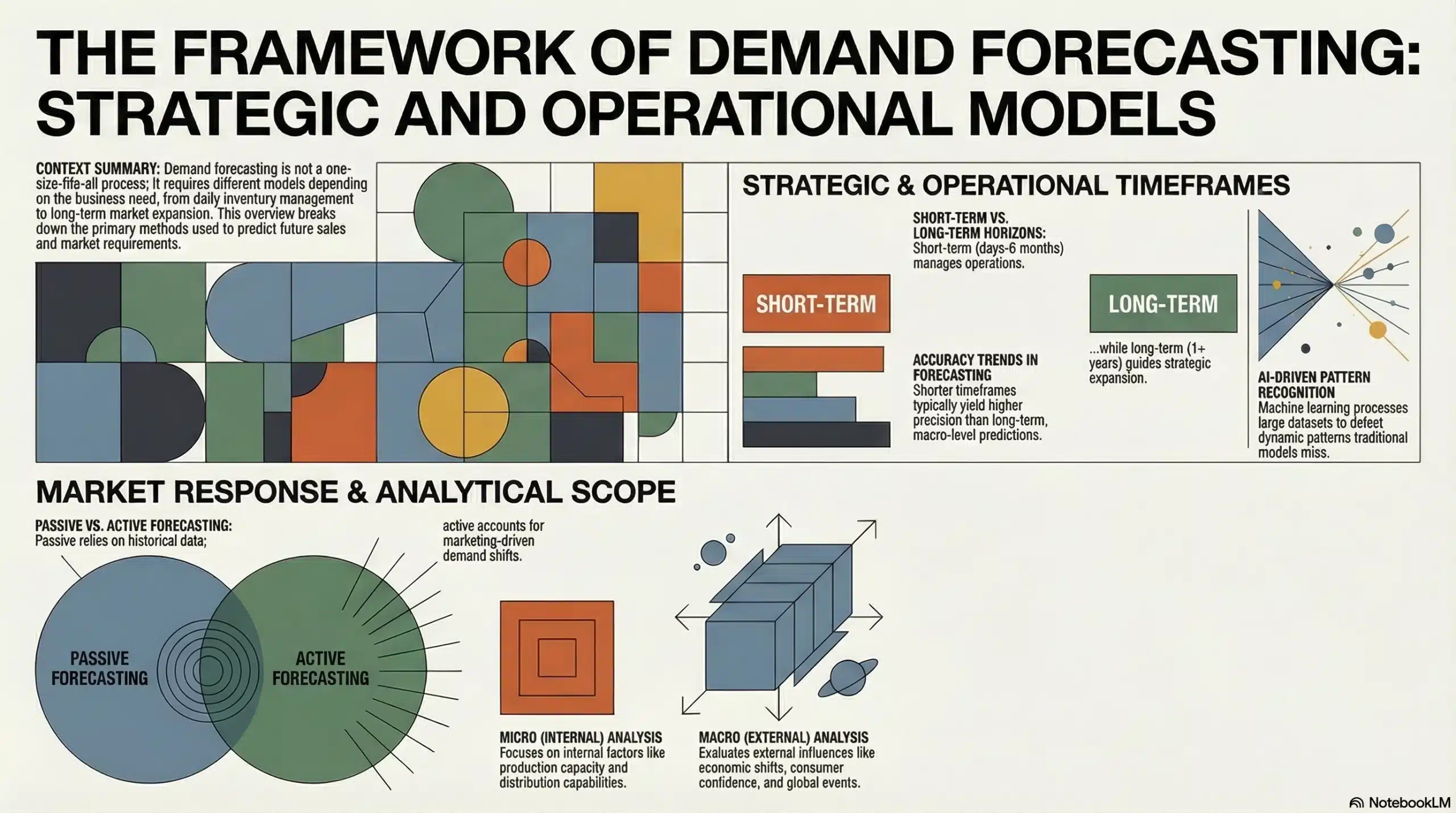
Demand forecasting includes several types, each suited to different business needs and timeframes. Understanding these helps businesses choose the right approach for each situation.
1. Short-Term Demand Forecasting
Short-term forecasting covers a period from a few days to six months. Businesses use it to manage daily operations such as stock handling, workforce scheduling, and shipment planning.
Because the timeframe is short, these forecasts are typically more accurate than long-term ones. They are supported by inventory management systems that track sales and adjust stock levels automatically.
This method suits Just-in-Time (JIT) inventory systems, where businesses keep inventory low and receive goods only when needed. It reduces holding costs and minimizes supply chain waste.
2. Long-Term Demand Forecasting
Long-term forecasting looks one year or more into the future. It supports strategic decisions such as expanding facilities, investing in equipment, or entering new markets.
Because it covers a longer period, this type is less precise and can be affected by economic shifts or behavioral changes. The goal is to understand overall demand direction, not predict exact figures.
3. Passive Demand Forecasting
Passive forecasting suits businesses with stable sales patterns that do not expect major demand changes. It assumes future demand will mirror past performance, relying primarily on historical sales data.
This method is simple and cost-effective but may not detect market shifts quickly. It works best in mature industries where demand is consistent and predictable.
4. Active Demand Forecasting
Active forecasting is used when a business plans to influence demand through marketing campaigns or new product launches. It combines historical sales data with marketing plans to estimate future demand shifts.
For example, a retailer running a “Buy One, Get One Free” promotion must account for the expected sales increase. This ensures enough inventory is prepared before demand rises.
5. Internal and External (Micro and Macro) Forecasting
Forecasting can also be divided based on the factors being analyzed. Some focus on internal business conditions, while others examine broader market and economic influences.
- Internal (Micro): Forecasting looks at internal factors such as production capacity and distribution capabilities. It identifies operational limits that may affect the ability to meet customer demand.
- External (Macro): Forecasting examines factors outside the business that may influence demand. These include economic conditions, consumer confidence, raw material availability, and global events.
- AI-Based Demand Forecasting: uses AI and machine learning to process datasets and detect patterns. By combining diverse data sources, it generates accurate and dynamic demand predictions.

Step-by-Step Guide to Demand Forecasting
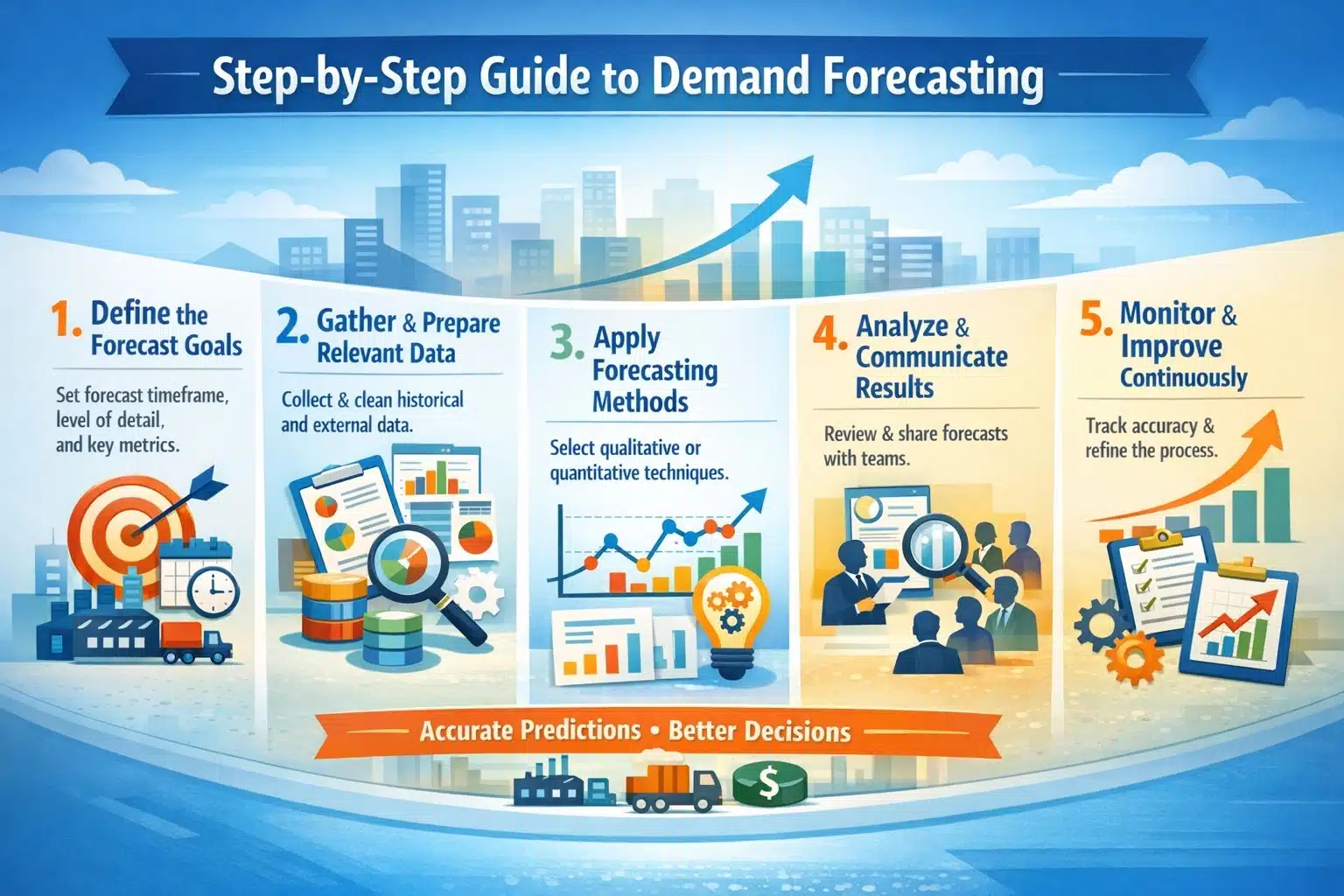
Creating an effective demand forecasting process requires planning, reliable data, and continuous improvement. The core steps remain consistent regardless of the tools a business uses.
Step 1 — Define the Forecast Goals
The first step is to clearly define the purpose of the forecast. A forecast for next week’s warehouse staffing differs significantly from one used to plan long-term factory expansion.
Businesses should determine the forecast timeframe, level of detail needed, and the key metrics that will measure success. This clarity keeps the process focused and results actionable.
Step 2 — Gather and Prepare Relevant Data
Demand forecasting relies on accurate, clean data. Companies should collect historical sales data along with information on returns, cancellations, and stockouts to understand real demand.
External data such as competitor pricing, economic conditions, and marketing activity can also improve accuracy. Before use, data should be cleaned to remove unusual events that could distort results.
Step 3 — Apply the Appropriate Forecasting Method
Once data is prepared, businesses can select the most suitable forecasting method. Qualitative approaches suit new products, while quantitative methods work better for established products with consistent patterns.
Many modern forecasting systems test multiple models and select the most accurate one automatically. This reduces manual effort and improves overall forecast reliability.
Step 4 — Analyze and Communicate the Results
After generating the forecast, analysts should review results against real market conditions and internal knowledge. Forecasts that appear inconsistent should be investigated before being acted upon.
Once validated, the forecast should be shared with procurement, operations, sales, and finance teams. Alignment across departments ensures everyone plans from the same data.
Step 5 — Monitor Accuracy and Improve Continuously
Demand forecasting is an ongoing process that requires regular evaluation. Businesses should compare forecasts with actual sales to measure accuracy and identify where gaps occur.
Understanding why forecasts were incorrect, whether due to market changes or data issues, helps refine methods over time. Continuous improvement turns basic forecasting into a genuine competitive advantage.
Common Challenges and How to Overcome Them
Even with advanced stock management software, forecasting can produce inaccurate results when process or data problems exist. Understanding these challenges helps companies improve forecast and decision-making.
1. The Silo Effect
A common problem occurs when departments use different assumptions or forecasts. Marketing may predict higher sales from campaigns while operations relies only on past data, creating misaligned plans.
Solution: Implementing a Sales and Operations Planning (S&OP) process brings departments together to review forecasts regularly. This produces one shared plan that all teams follow.
2. Ignoring External Causal Factors
Some businesses rely too heavily on historical data, assuming past patterns will always repeat. Demand can shift due to economic changes, competitor activity, or seasonal variation.
Solution: Including external data in forecasting models significantly improves accuracy. Advanced analytics and machine learning tools can identify these relationships automatically.
3. Overreacting to Short-Term Changes
Reacting too quickly to small demand fluctuations can create instability in planning and operations. A sudden spike or drop may simply be random variation rather than a real trend.
Solution: Businesses should analyze demand patterns over a longer period before adjusting forecasts. Setting clear performance thresholds helps prevent unnecessary and disruptive changes.







Advanced Best Practices in Forecasting
Businesses that have mastered the basics can use advanced techniques to turn forecasting into a competitive advantage. These approaches improve speed, accuracy, and resilience beyond what traditional models offer.
1. Demand Sensing
Demand sensing focuses on the near future, usually days or weeks, using real-time data like POS transactions and warehouse activity. This lets businesses detect behavior changes and adjust supply chains faster.
Example: If POS data shows bottled water sales rising during a heatwave, the business can immediately restock before shelves run empty.
2. Digital Twins and Scenario Planning
A digital twin is a virtual supply chain model that lets businesses test scenarios without affecting real operations. Companies run what-if simulations to understand how events might impact inventory or delivery.
Example: A company can simulate what happens if a key supplier stops delivering for two weeks. This allows them to prepare backup suppliers or increase safety stock in advance.
3. Probabilistic Forecasting
Probabilistic forecasting estimates a range of possible outcomes with different probabilities rather than a single number. This helps businesses prepare for uncertainty and make better risk-based decisions.
Example: Instead of predicting exactly 100 jacket sales next month, the forecast may show a 90% chance that sales fall between 85 and 115. This range helps the business decide how much buffer stock to hold.
How Inventory Platform Helps Predict Demands for Australian Business
According to the Australia Post eCommerce Report 2026, a record 9.8 million Australian households shopped online in 2025. It shows that demand is becoming more digital and fast-changing, requiring retailers to forecast more accurately.
Inventory platforms help Australian businesses consolidate sales data from multiple channels into accurate demand predictions. This supports smarter purchasing, stocking, and supplier management decisions.
These platforms integrate with supplier systems, automating reorder triggers based on forecast thresholds. This reduces stockout risk during peak periods like end-of-financial-year sales or seasonal surges.
For businesses managing GST and BAS obligations, forecasts aligned with financial periods reduce administrative strain. Better predictions also mean more predictable cash flow and fewer last-minute adjustments.
Inventory platforms use AI analytics to detect patterns specific to Australian conditions, including state-level and seasonal variation. This lets businesses plan inventory with greater local accuracy.
Conclusion
Demand forecasting today goes beyond analyzing past sales. Businesses now use demand sensing, digital twins, and probabilistic forecasting to respond faster to real market changes.
These approaches help businesses test scenarios, understand short-term demand, and prepare for multiple outcomes. Combined with traditional methods, they improve inventory, pricing, and supply chain decisions.
To learn more, schedule a free consultation with us and upgrade your demand forecasting processes today. This consultation is risk-free and will provide all the information needed for your future planning.

Frequently Asked Question
Demand forecasting is the process of predicting future sales based on data and trends. Demand planning is the operational process of executing actions, such as ordering stock and scheduling production, based on those forecasts.
Qualitative methods are typically best for new products lacking historical data. Techniques like market research surveys, the Delphi method, or comparative analysis with similar existing products provide the necessary insights.
AI improves accuracy by analyzing vast amounts of structured and unstructured data to identify complex patterns human analysts might miss. It also reduces human bias and adapts to changing market conditions in real-time.
The Bullwhip Effect occurs when small fluctuations in retail demand cause progressively larger fluctuations in demand at the wholesale and manufacturing levels, leading to severe inefficiencies and waste in the supply chain.
The frequency depends on the industry volatility. While some stable industries forecast monthly, dynamic sectors like retail or e-commerce often require weekly or even daily forecast updates to respond to market changes.