













Purchase costs can change quickly due to supplier pricing, market conditions, freight costs, and currency movements. These fluctuations often create differences between expected procurement budgets and actual purchasing expenses.
Purchase Price Variance (PPV) helps businesses measure the gap between standard costs and actual purchase prices during procurement activities. Finance and procurement teams use PPV to monitor cost control, supplier performance, and purchasing efficiency.
Key Takeaways
Understand how Purchase Price Variance (PPV) measures the gap between standard procurement costs and actual purchase prices.
Master the PPV formula, favourable and unfavourable variance classification, and practical procurement examples.
Discover how supplier pricing, currency movements, commodity volatility, and purchasing behaviour affect procurement variance.
Learn how PPV affects procurement visibility, standard costing, budgeting accuracy, and financial reporting workflows.

What Is Purchase Price Variance (PPV)?
Purchase Price Variance (PPV) is a procurement and accounting metric used to measure the difference between the standard cost of an item and the actual price paid during purchasing.
Businesses use PPV to monitor procurement performance, supplier pricing changes, and purchasing cost fluctuations across operational categories.
A favourable PPV occurs when actual prices are lower than expected, while an unfavourable PPV happens when purchasing costs exceed standard pricing.
How to Calculate PPV
PPV is calculated by comparing the standard purchase price against the actual price paid, then multiplying the difference by the purchased quantity.
1. The PPV formula explained
Purchase Price Variance uses a standard formula to measure the financial impact of procurement price changes.
PPV = (Standard Price − Actual Price) × Actual QuantityPPV = (Standard \ Price – Actual \ Price) : times Actual : Quantity
- SP (Standard Price): The planned or budgeted unit cost set before purchasing begins.
- AP (Actual Price): The real unit price paid to the supplier during procurement.
- AQ (Actual Quantity): The total quantity purchased during the transaction or reporting period.
2. Favourable vs unfavourable PPV
PPV results are generally classified as either favourable or unfavourable depending on whether the actual purchase price is lower or higher than the standard cost.
| PPV type | Condition | Impact |
| Favourable PPV | Actual price is lower than standard cost | Reduces purchasing costs and improves margins |
| Unfavourable PPV | Actual price is higher than standard cost | Increases procurement costs and reduces margins |
3. PPV calculation example
- A procurement team sets the standard cost of a component at AUD $15 per unit.
- The supplier later increases the actual purchase price to AUD $17 per unit.
- The business purchases 2,000 units during the reporting period.
- PPV = ($15 − $17) × 2,000 = -AUD $4,000, resulting in an unfavourable variance.
Main Causes of Purchase Price Variance

Several internal and external factors can cause procurement prices to differ from standard costs during purchasing activities.
1. Supplier price changes and contract escalations
Supplier pricing may increase due to inflation, freight costs, labour expenses, or raw material shortages. Contract escalation clauses can also adjust pricing automatically during volatile periods.
2. Supply and demand fluctuations
Changes in global supply and demand can quickly affect procurement pricing across materials, commodities, and finished goods. Supply shortages commonly increase purchasing costs.
3. Currency exchange rate movements
Businesses importing from overseas suppliers are highly exposed to currency volatility. A weaker Australian dollar can increase actual purchasing costs and create unfavourable PPV.

Conclusion
Purchase Price Variance helps businesses measure how actual procurement costs differ from planned purchasing expectations. Strong PPV analysis also improves supplier visibility, budgeting accuracy, and procurement control.
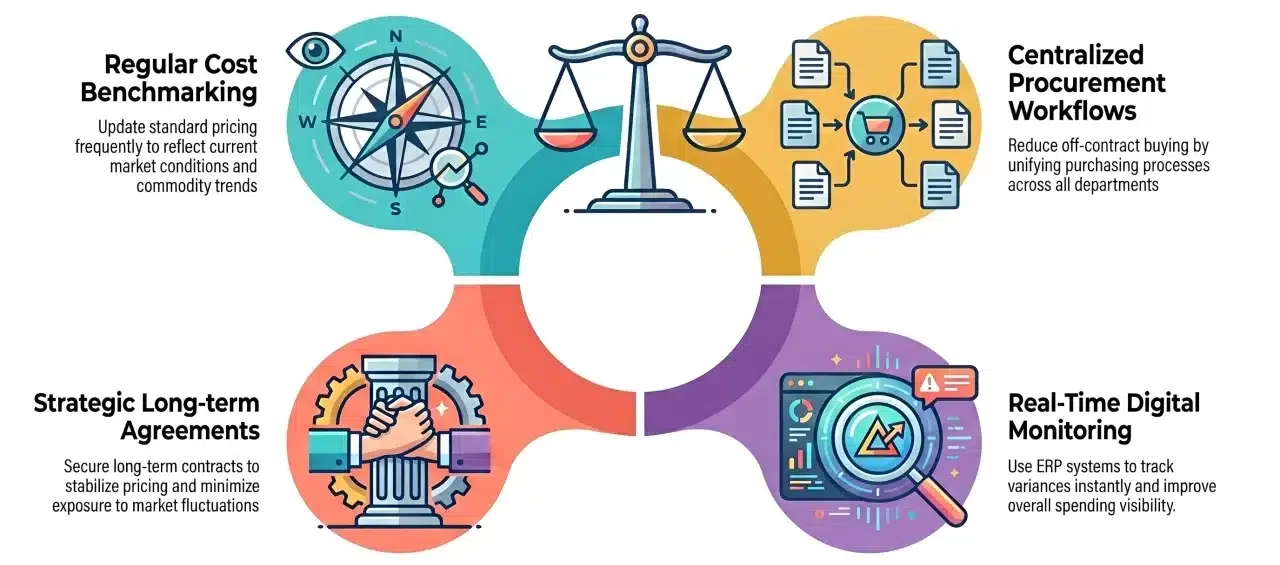
As market volatility and supplier pricing pressures increase, many businesses use ERP and procurement systems to monitor PPV more accurately across purchasing operations.
If you want to improve procurement visibility and purchasing cost control, you can request a free consultation to explore suitable procurement and ERP solutions.

Frequently Asked Question
There is no universal benchmark for a good PPV percentage because acceptable variance depends on industry conditions, commodity exposure, supplier contracts, and procurement strategy. Many businesses focus more on consistent variance control and trend monitoring over time.
No. A negative or favourable PPV may reduce purchase prices, but it does not always lower total procurement cost. Lower-cost suppliers may still create quality issues, delays, freight increases, or operational inefficiencies.
Businesses commonly review standard costs monthly or quarterly depending on procurement volatility, commodity exposure, and supplier pricing changes. Highly volatile industries may require more frequent updates.
AUD exchange rate movements directly affect procurement costs for imported goods and overseas supplier contracts. A weaker Australian dollar generally increases purchasing costs and creates unfavourable PPV for importers.
PPV measures the difference between standard and actual purchase prices, while cost avoidance refers to procurement actions that prevent future cost increases through negotiations, sourcing strategies, or operational improvements.