















The Fair Work Act 2009 is the national law governing workplace relations across Australia, setting baseline standards for pay, conditions, dismissal, and dispute resolution that every covered business must follow.
It operates through the National Employment Standards, modern awards, and enterprise agreements, giving employers a structured framework while protecting employees from underpayment and unfair treatment.
With the right to disconnect, casual conversion reforms, and criminalised wage theft arriving through 2025 and 2026, Australian employers face the most significant compliance shift in more than a decade.
Key Takeaways
Fair Work Act is the Commonwealth law governing pay, conditions, dismissal, and dispute resolution across Australia's national workplace system.
Every employer must meet the National Employment Standards, pay at least the award wage, issue compliant pay slips, and retain records for seven years.
Penalties for non-compliance range from back-pay orders and civil fines of up to $990,000 per breach through to criminal prosecution and personal director liability.
Best practices include accurate payroll, trained managers, regular contract audits, and integrated HR and payroll software

What Is the Fair Work Act and Why Does It Apply to Your Business?

The Fair Work Act 2009 is the primary Commonwealth law shaping how Australian businesses interact with their workforce, replacing the previous Workplace Relations Act 1996 and unifying employment standards nationally.
It sits at the centre of the national workplace relations system, setting a guaranteed safety net of minimum terms while also promoting workplace flexibility, freedom of association, and the right to representation.
The Act applies through the Commonwealth’s corporations power, which means any Pty Ltd or Ltd company engaged in significant trading or financial activity is automatically covered by its national framework.
Coverage also extends to most private sector employers in Victoria, New South Wales, Queensland, South Australia, Tasmania, the ACT, and the Northern Territory through historical referrals of power from those states.
Western Australia is the exception. Non-corporate entities such as sole traders and unincorporated partnerships there remain under the WA state system, while incorporated businesses still fall under the national Act.
For employers, the Act governs nearly every stage of the employment lifecycle, from job advertisements through day-to-day management to termination or redundancy, dictating the lawful boundaries at each step.
Its reach also extends to enterprise bargaining, unfair dismissal claims, adverse action protections, and strict record-keeping obligations, making it the central reference point for compliance-focused HR programs.
The Act is underpinned by a good faith principle, expecting employers and employees to engage honestly during bargaining and dispute resolution rather than treating compliance as a box-ticking exercise.
For business leaders, that philosophy matters, because a workplace that respects statutory rights and values transparent communication tends to see fewer disputes, stronger retention, and lower regulatory risk.

What the Fair Work Act Requires from Every Employer
The Fair Work Act sets the baseline for employee entitlements in Australia through the 12 National Employment Standards, which apply to every national system employer regardless of any award or enterprise agreement.
- Maximum weekly hours: No more than 38 hours per week unless additional hours are reasonable.
- Flexible working arrangements: Eligible employees such as parents and carers can request flexible arrangements in writing.
- Casual to permanent conversion: Regular, systematic casuals must have a pathway to permanent employment.
- Parental leave: 12 months of unpaid leave after 12 months of service, with the right to request another 12 months.
- Annual leave: Four weeks paid per year (five for shift workers), paid out on termination if unused.
- Personal and family leave: 10 days paid personal leave, 2 days compassionate leave per occasion, and 10 days paid family and domestic violence leave.
- Community service leave: Unpaid leave for emergency work and up to 10 days paid for jury duty.
- Long service leave: A transitional entitlement under state and territory laws until a national standard is set.
- Public holidays: A paid day off, with any request to work needing to be reasonable.
- Notice and redundancy pay: Written notice based on service and age, plus redundancy pay at most businesses with 15 or more employees.
- Information statements: New employees must receive the Fair Work Information Statement, plus the matching casual or fixed-term versions.
- Superannuation contributions: Recognised as a workplace right under the NES and enforceable by the Fair Work Ombudsman.
Beyond the NES, employers must keep complete employment records for at least seven years and issue a compliant pay slip within one working day of payment.
Each compliant pay slip must cover ABN, pay period, gross and net pay, hourly rates, and super details, with every employee paid at least the applicable award or enterprise agreement rate.
Know What the Fair Work Act Covers and Where Your Business Fits
Determining whether the Fair Work Act applies to your business is a critical first step, because while the national system covers most Australian workplaces, it is not entirely universal in its reach.
Coverage is shaped by the Australian Constitution and the historical referral of industrial relations powers from the states to the Commonwealth, which together produced the current national system of employment law.
Your business qualifies as a national system employer if it operates in the private sector in Victoria, New South Wales, Queensland, South Australia, Tasmania, the ACT, or the Northern Territory.
In those jurisdictions, the Fair Work Act applies whether you run a sole trader operation, a partnership, a trust, or an incorporated company, so entity type does not change your coverage.
Western Australia is the exception, because it did not refer industrial relations powers for non-corporate entities to the Commonwealth, creating a split that depends on how the business is structured.
Businesses operating in WA as Pty Ltd companies are covered by the Fair Work Act, while sole traders, unincorporated partnerships, and unincorporated trusts remain under the WA state industrial relations system.
Public sector and local government coverage also varies, so Commonwealth government employees sit under the national system while state and local government employees may fall under state-based systems depending on jurisdiction.
Correctly classifying workers matters as much as jurisdiction, since the Act covers employees but generally not independent contractors, and getting this distinction wrong is a common and costly compliance error.
Courts now assess the totality of the working relationship, looking at control, tools, the ability to delegate, and integration into the business, rather than relying solely on the wording of a written contract.
Fair Work Act & Modern Awards
The Fair Work Act works alongside modern awards, which translate the Act’s broad principles into industry-specific pay rates, hours, allowances, and conditions that cover more than 100 occupations in Australia.
Modern awards sit beneath the Act as the second layer of the safety net, so employers must meet both the National Employment Standards and the award rates that apply to each employee’s actual duties, not job title.
Understanding which award covers a particular employee is essential, because misclassification can lead to systematic underpayment, especially where one business uses several awards across departments or locations.
Where industry circumstances require more tailored conditions, enterprise agreements can replace awards, provided they pass the Better Off Overall Test and give employees stronger combined rights than the underlying award.
Together, the Act, awards, and enterprise agreements form the legal architecture protecting employee rights in Australia, ensuring that pay, leave, and working conditions remain consistent across the national system.
How the Fair Work Commission and Ombudsman Enforce Your Obligations
Two distinct bodies enforce the Fair Work Act: the Fair Work Commission, the national workplace relations tribunal, and the Fair Work Ombudsman, the independent regulator for compliance and education.
The Commission was established in 2013 as a renaming of the body formerly known as Fair Work Australia, and its role includes setting minimum wages, approving enterprise agreements, and resolving unfair dismissal claims.
The Commission also handles general protections disputes, anti-bullying orders, and disagreements over casual conversion, providing a structured forum that keeps disputes out of the courts wherever possible.
The Fair Work Ombudsman takes a more operational role, investigating complaints, auditing businesses, issuing infringement notices, and prosecuting serious breaches in the Federal Court or Federal Circuit Court.
Employers who want to stay ahead of enforcement should engage proactively with the Ombudsman, using its free advisory services, online tools, and published guidance before small issues become formal investigations.
Together, the two bodies cover the full compliance lifecycle, from rule-making and mediation through to prosecution, giving every Australian employer clear channels for advice, dispute resolution, and statutory enforcement.
What are the penalties for non-compliance with the Fair Work Act?
Non-compliance with the Fair Work Act can be costly, with penalties ranging from infringement notices and back-pay orders through to civil penalties, disqualifications, and in serious cases, criminal prosecution.
Standard civil penalties for breaches currently sit at up to $19,800 per contravention for individuals and $99,000 per contravention for businesses, and each underpaid employee can constitute a separate breach.
Serious contraventions involving deliberate or systemic misconduct attract tenfold penalties, which means businesses can face fines of $990,000 per breach for actions such as repeated underpayment or falsified records.
Financial penalties are only part of the exposure, because successful claims usually require full back payment, superannuation top-ups, and interest, plus legal costs where the matter reaches the Federal Court.
Directors and senior managers can also be held personally liable under accessorial liability provisions, which means payroll mistakes are not always confined to the business entity that committed them.
Reputational harm compounds the financial cost, since the Fair Work Ombudsman publishes enforcement outcomes, and media attention around underpayment scandals can damage brand equity and hiring for years afterwards.
Industry-Specific Use Cases: How the Fair Work Act Applies Across Sectors
The Fair Work Act provides a universal framework, but its practical application shifts sharply between industries, because modern awards tailor pay, penalties, and allowances to more than 100 different occupations.
Understanding how obligations play out in real scenarios matters for compliance, since the same provision of the Act can produce different payroll and rostering outcomes in retail, hospitality, or construction.
1. Retail and fast food: managing complex rostering and penalty rates
Retail and fast-food sectors rely heavily on casual and part-time labour across extended hours, weekends, and public holidays, so their modern awards set tight rules around penalty rates, overtime, and minimum shifts.
Dynamic rostering creates compliance risk, since asking a part-time retail employee to work outside agreed fixed hours can trigger overtime rates immediately, and junior pay rates must update automatically on birthdays.
2. Hospitality: annualised salaries and split shifts
Hospitality employers face complex wage structures shaped by split shifts, late-night penalties, and seasonal demand, with many turning to annualised salary arrangements under the Hospitality award to simplify payroll.
Reconciliation is non-negotiable, since the salary must leave employees better off overall each pay cycle, and tracking start and finish times plus unpaid breaks is essential to avoid wage theft exposure.
3. Construction and manufacturing: enterprise agreements and union engagement
Construction and manufacturing often operate under enterprise agreements rather than modern awards, so the Act’s provisions around freedom of association, union right of entry, and good-faith bargaining take centre stage.
Employers must understand when union officials can enter a workplace, navigate specialised allowances for height or dangerous work, and ensure any industrial action stays inside protected legal frameworks set by the Commission.
4. Healthcare and social assistance: continuous care and shift allowances
Healthcare, aged care, and disability support run 24/7, so awards such as the Nurses Award and the SCHADS Award layer complex rules on sleepover allowances, broken shifts, and minimum breaks onto the Fair Work Act.
If a support worker is not given the mandatory break between shifts, the employer must pay penalty rates for the entire next shift, and recent reforms have also tightened contractor classification rules.
5. Technology and professional services: the right to disconnect and contracting
Technology and professional services firms face distinct Fair Work Act challenges around worker categorisation, since many rely heavily on independent contractors, freelancers, and gig workers for scalable delivery.
Recent amendments introduced tighter sham contracting definitions and the right to disconnect, so tech employers must review classifications carefully and set clear policies for after-hours contact across global time zones.
2026 Fair Work Changes That Directly Affect Your Business
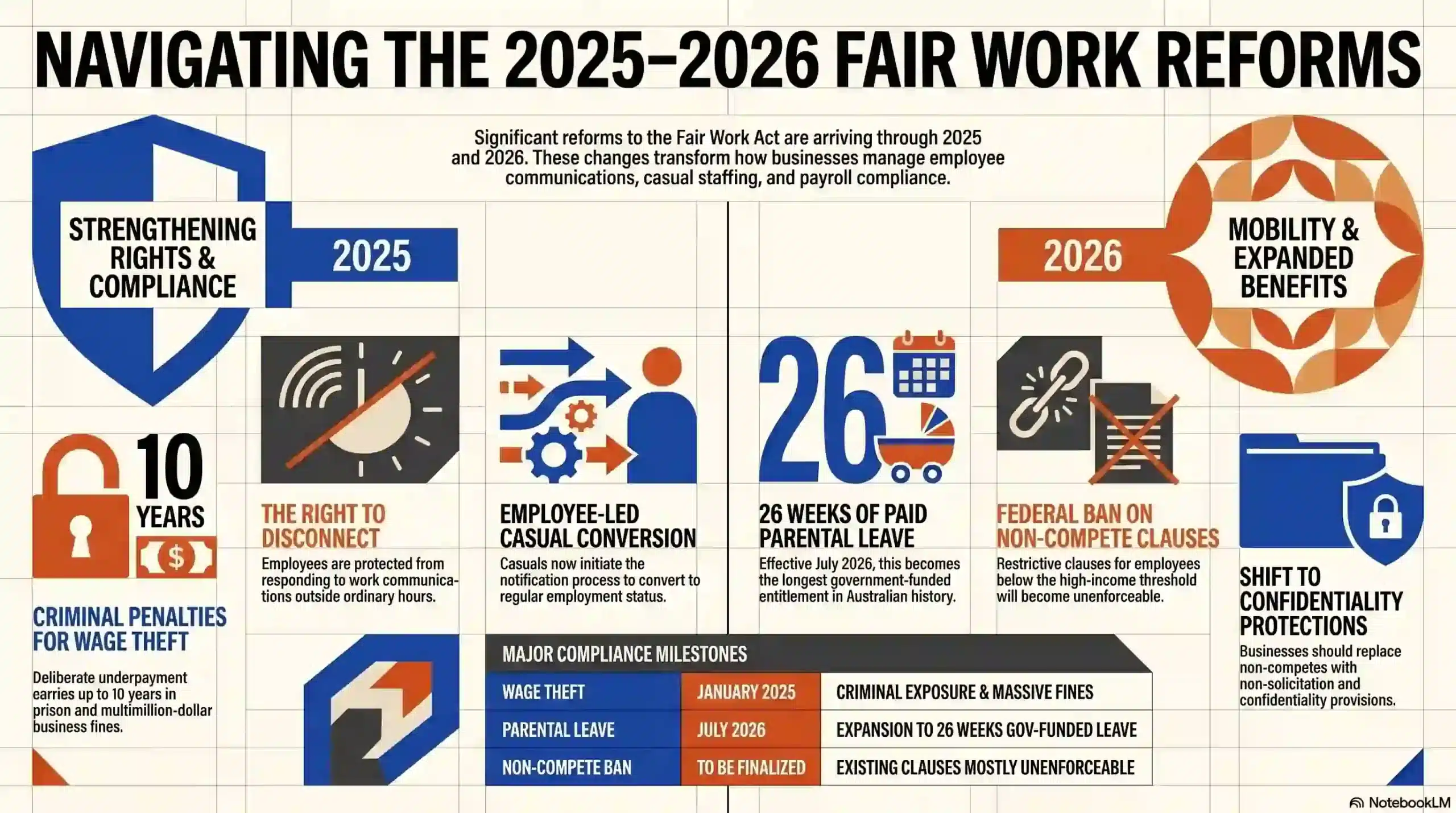
Australian workplace law is changing quickly through 2025 and 2026, and several of the most significant reforms in the Fair Work Act’s history are arriving in close succession, each with distinct implementation timelines.
1. Prepare for the right to disconnect
The right to disconnect protects employees from being required to monitor, read, or respond to work communications outside ordinary hours, unless the refusal would be unreasonable in the circumstances.
Employers should review after-hours communication norms, update employment contracts to reference the new protection, and brief managers on when contact outside hours is reasonable, such as genuine emergencies.
2. Manage casual conversion notifications
Casual conversion has shifted from an employer-initiated offer to an employee-initiated notification process, so casuals who believe they have become regular can notify their employer of their intention to convert.
Employers must respond within specific timeframes and can only refuse on reasonable grounds, so payroll teams should review casual rosters regularly to identify patterns that could legally trigger a conversion right.
3. Plan for 26 weeks of paid parental leave from July 2026
Commonwealth paid parental leave is expanding to 26 weeks from July 2026, giving eligible working parents the longest government-funded parental leave entitlement in Australian history.
Although the payment is funded by the government, employers remain responsible for processing leave requests, protecting job security during absence, and coordinating return-to-work arrangements for employees taking the benefit.
4. Review non-compete clauses before the ban takes effect
The federal government has announced a ban on non-compete clauses for most employees earning below the high-income threshold, ending a practice that has long restricted mobility in many Australian industries.
Employers should audit existing contracts, identify which clauses become unenforceable once the ban takes effect, and consider alternative protections such as confidentiality and non-solicitation provisions.
5. Treat wage theft as a criminal offence from January 2025
From January 2025, deliberate underpayment of wages became a criminal offence under the Fair Work Act, carrying penalties of up to 10 years in prison for individuals and multimillion-dollar fines for businesses.
Accidental mistakes still fall under civil penalties, but any employer accused of systemic underpayment now faces criminal exposure, making rigorous payroll audits a non-negotiable safeguard for employee rights.
Best Practices for Fair Work Act Compliance
Sustainable compliance with the Fair Work Act depends on consistent systems, well-trained managers, and clear documentation, rather than one-off audits triggered by investigations or complaints.
1. Keep payroll data accurate and current
Maintain precise records of hours worked, leave balances, superannuation contributions, and pay rates, because accurate data is the foundation of every compliance conversation with regulators or employees.
2. Train frontline managers on general protections
Equip managers to recognise protected rights such as requesting flexible work, taking leave, or raising pay concerns, since most adverse action claims trace back to a manager’s response to a protected activity.
3. Run regular contract and award audits
Review employment contracts, award classifications, and enterprise agreements at least annually, because awards update, rates change, and employees move between roles that can shift their coverage.
Once those operational habits are in place, leadership can sharpen compliance further by understanding how HR management systems function alongside the Fair Work Act, since the right platform automates the steps most prone to human error.
4. Use integrated HR and payroll software to automate compliance
Adopt a centralised people management system that applies award rules, issues compliant pay slips, retains seven-year records, and flags anomalies, because automation cuts the human error that drives most underpayments. For a deeper comparison, see our recommended HR software picks for Australian businesses navigating Fair Work compliance.
Conclusion
Understanding what is the Fair Work Act 2009 goes beyond the written text of the legislation, because it sits at the core of how Australian businesses interact with their people, their payroll, and their regulators every day.
The purpose of the Fair Work Act 2009 is to balance the interests of employers and employees, creating a fair, transparent, and enforceable framework for modern employment across the national workplace relations system.
With reforms landing through 2025 and 2026, staying current is no longer optional, and proactive compliance, clean payroll data, and well-trained managers remain the best defence against costly breaches.
If you want to modernise your HR and payroll systems to stay ahead of the Fair Work Act’s evolving requirements, you can book a free consultation to explore a platform built for Australian compliance.
FAQ About the Fair Work Act
-
What does the Fair Work Act require from your business?
National system employers must meet the National Employment Standards, pay at least the applicable award or minimum wage, issue compliant pay slips, keep records for seven years, and respect general protections provisions.
-
What are 5 fair reasons for dismissal?
Fair reasons typically include poor performance, serious misconduct, genuine redundancy, inability to perform due to medical incapacity, and breach of core employment obligations, provided procedural fairness is followed.
-
Who is not covered by the Fair Work Act?
Independent contractors, state and some local government employees, and certain non-corporate Western Australian businesses are not covered, since they fall under contractor law or state industrial relations systems.
-
What is the national minimum wage for employers in 2026?
The national minimum wage is reviewed each year by the Fair Work Commission and takes effect from the first full pay period on or after 1 July, with 2026 rates set during the Annual Wage Review earlier that year.
-
Do casual employees get leave entitlements under the Fair Work Act?
Casual employees do not receive paid annual or personal leave, though employee rights under the Act still cover paid family and domestic violence leave, unpaid compassionate leave, and community service leave.