















Just in time inventory management helps businesses reduce excess stock and keep operations lean. Instead of storing large quantities, companies receive goods only when needed. As a result, they free up cash and reduce storage costs.
This approach reflects Australian modern stock solutions, shifting inventory from a static asset into a continuous flow. Materials arrive based on actual demand, not forecasts. Therefore, businesses can respond faster while avoiding overstock and waste.
However, just in time inventory requires careful planning and strong supplier coordination. Without the right systems in place, even small delays can disrupt operations. For this reason, companies must balance efficiency with reliability.
Key Takeaways
Just in time inventory aligns stock with real demand, helping businesses reduce excess inventory and improve cash flow.
The core idea of JIT focuses on demand-based production, minimising inventory, and eliminating operational waste.
JIT relies on real-time data, supplier coordination, and continuous flow to keep operations efficient and responsive.
While JIT improves efficiency, businesses must manage risks such as stockouts and supplier dependency carefully.

What Is Just-in-Time (JIT) Inventory?
Just in time inventory, often called JIT, aligns material orders directly with production schedules. Instead of holding surplus stock, businesses order items only when needed. This reduces storage costs and improves cash flow.
Traditional systems rely on forecasts and maintain extra inventory as a buffer. However, this often leads to waste, higher costs, and unused stock. JIT removes that buffer and focuses on real demand.
The concept started in Japan, particularly within Toyota’s production system. By observing how supermarkets restock shelves, manufacturers applied a demand-driven approach. As a result, production became more efficient and cost-effective.
Today, JIT applies across industries such as retail, manufacturing, and food services. It combines process improvement with waste reduction and efficient resource use. Therefore, businesses treat it as both a strategy and a long-term mindset.
The Core Idea Behind JIT

This section explains how just in time inventory works at a practical level. Each concept connects closely, so understanding them together helps you see the full picture.
Producing based on actual demand
JIT uses a pull system for demand-based stock handling, where production begins only after real demand appears. This prevents overproduction and reduces unnecessary stock. As a result, businesses avoid tying up capital in unsold goods.
Each stage requests materials only when needed, which keeps the supply chain flowing smoothly. Therefore, companies reduce delays and stay aligned with customer demand while focusing on delivering value.
Minimizing inventory levels
Reducing inventory remains a key goal of just in time inventory. Excess stock ties up capital and limits flexibility, so businesses keep inventory lean to improve cash flow. This also helps reduce financial pressure.
Holding inventory creates hidden costs such as storage, insurance, and damage risks. Therefore, companies rely on accurate data and supplier timing to maintain balance and avoid shortages.
Eliminating waste in operations
JIT focuses on removing waste from every process. Waste includes any activity that does not add value to the customer, so businesses regularly review and improve workflows. This keeps operations efficient.
Overproduction and waiting time often create the biggest inefficiencies. JIT limits production to actual demand and ensures materials arrive when needed. As a result, companies improve flow and reduce unnecessary movement.
How JIT Works Across the Supply Chain
To make JIT effective, businesses must coordinate every part of the supply chain. The following points explain how materials move efficiently from suppliers to production.
Demand triggers replenishment
JIT systems rely on signals to trigger inventory replenishment. In the past, businesses used manual cards, while modern real-time stock control software automates this process. As a result, stock updates happen instantly and align with real demand.
When inventory drops to a set level, software generates new orders automatically. Accurate data remains critical, as errors can delay or duplicate orders. Therefore, companies use tracking tools and real-time systems to improve visibility and decision-making.
Supplier coordination and timing
Suppliers play a key role in JIT success, as businesses depend on timely and accurate deliveries. Even small delays can disrupt operations, so reliability becomes essential. Strong partnerships help reduce risks and improve coordination.
Companies often share forecasts and schedules with suppliers to improve planning. In addition, supplier location affects delivery speed and consistency. Clear agreements on timing and quality ensure both parties meet expectations.
Continuous flow of goods
Where JIT Creates the Most Value

Not every business benefits equally from just in time inventory. However, certain conditions make it more effective and easier to manage.
Businesses with predictable demand
JIT works best when demand remains stable and predictable. Businesses can plan production accurately and reduce the need for safety stock. Therefore, operations become more efficient.
Historical data helps improve forecasting and supports better planning. Seasonal demand can also fit this model if trends are clear. As a result, businesses avoid overstock after peak periods.
High-value or perishable products
JIT suits high-value and perishable goods where holding stock increases risk. Expensive items tie up capital, while perishable goods can spoil quickly. Therefore, ordering only when needed protects margins.
This approach ensures products remain fresh and relevant. Businesses avoid waste and maintain quality. As a result, they improve profitability and customer satisfaction.
Limited storage capacity
Some businesses operate with limited storage space. Large inventories become impractical in these cases. JIT helps manage stock without requiring extra space.
Frequent deliveries replace the need for storage areas. Products move directly to shelves or production lines. Therefore, businesses use space more efficiently.
The Trade-Offs of Running Lean Inventory
While JIT offers benefits, it also introduces risks. Understanding these trade-offs helps businesses make informed decisions.
Lower costs and faster turnover
JIT reduces storage and handling costs, which improves profitability and lowers overhead. It also increases inventory turnover, so products move faster and improve cash flow. Therefore, businesses can reinvest sooner while improving quality control and reducing waste.
Higher risk of stockouts
JIT lowers safety stock, which increases the risk of shortages when delays occur. Stockouts can lead to lost sales and reduced customer trust, especially when demand spikes unexpectedly. Therefore, businesses must monitor supply and demand closely to respond quickly.
Supply chain dependency
Industry Use Cases: Who Benefits Most from JIT?
Different industries apply JIT in unique ways. The following examples show where it delivers strong results.
- Automotive manufacturing
Car manufacturers rely on precise delivery schedules for parts. Components arrive just before assembly, reducing storage needs. This improves efficiency and lowers costs. - Technology and consumer electronics
Tech companies deal with short product lifecycles. JIT helps them avoid outdated inventory. Therefore, they reduce losses from obsolete stock. - Retail and fashion
Retailers adjust production based on real-time demand. Smaller batches reduce unsold products. This improves profitability and flexibility.
Implementating Just in Time Inventory
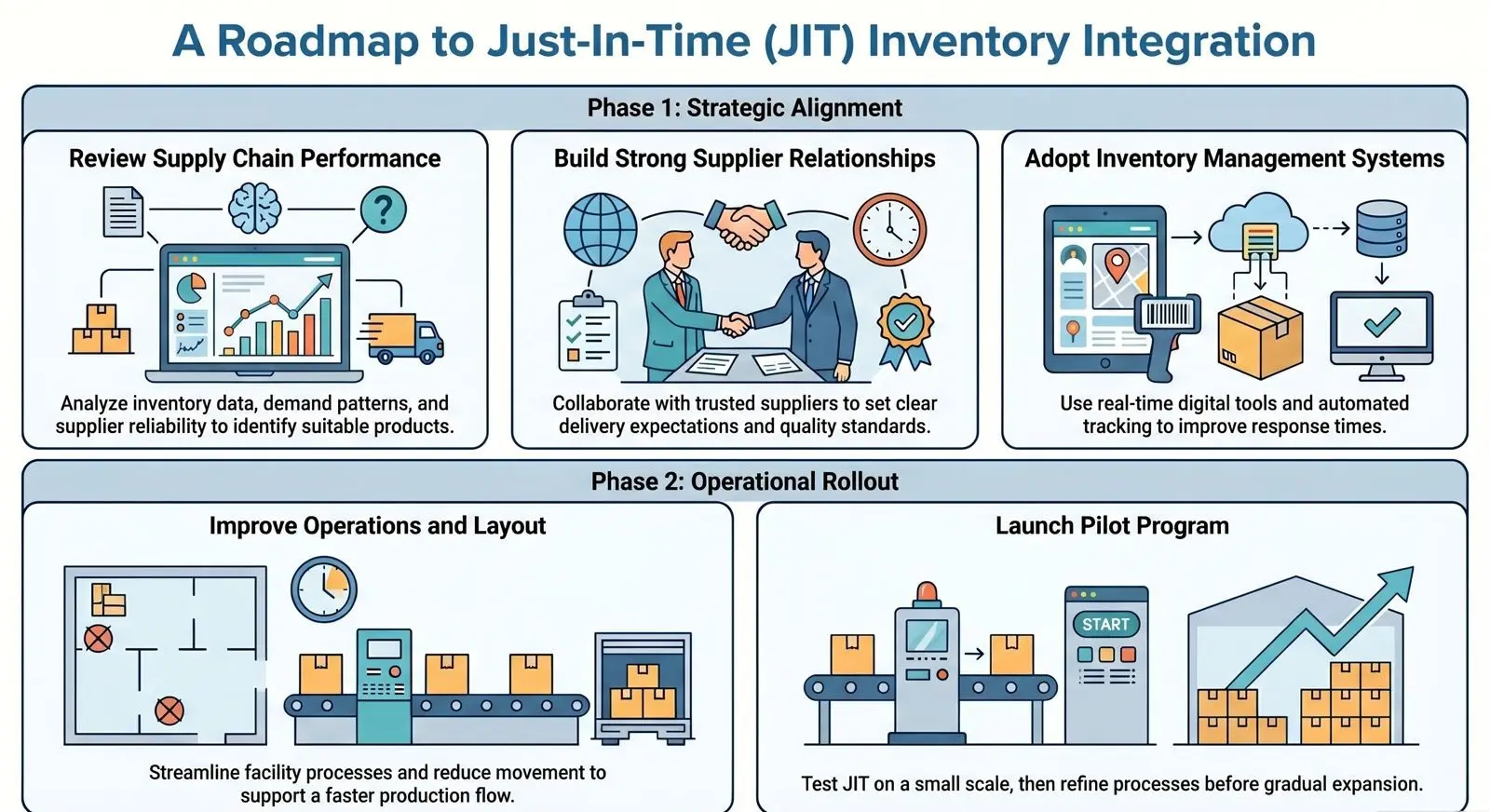
Transitioning to a JIT system is a major operational overhaul. It requires a methodical approach to ensure that the reduction of safety stock does not lead to crippling stockouts or production halts.
1. Review supply chain performance
Analyse inventory data, demand patterns, and supplier reliability. Identify suitable products for JIT. This helps reduce risks early.
2. Build strong supplier relationships
Work closely with trusted suppliers. Set clear delivery expectations and quality standards. This ensures consistent performance.
3. Adopt inventory management systems
Use an inventory tracking system to monitor stock in real time. Automated systems improve accuracy. Therefore, businesses respond faster.








4. Improve operations and layout
Reduce movement and streamline processes. Efficient layouts support faster production. This improves overall flow.
5. Start with a pilot program
Test JIT on a small scale first. Monitor results and refine processes. Then expand gradually.
Common Pitfalls and How to Avoid Them
Despite its benefits, just in time inventory requires careful management. Without proper planning, disruptions can quickly affect operations.
External disruptions can impact supply chains without warning. Delays affect production and delivery timelines. Therefore, businesses should diversify suppliers and consider local sourcing to reduce risk.
Quality issues can also create major setbacks. Defective materials stop production when no backup stock exists. For this reason, suppliers must meet strict quality standards before delivery.
Forecasting errors present another challenge. Sudden demand changes can lead to shortages or delays. Businesses should use data insights and maintain strong communication between teams.
Regular reviews and flexible planning help address these risks. Companies that monitor performance closely can adapt quickly. This improves resilience and stability.
Advanced JIT Practices: The Future of Lean Inventory
Just in time inventory continues to evolve as businesses adopt new technologies. Companies now combine lean principles with advanced systems for smarter stock management and better performance.
Artificial intelligence improves demand forecasting accuracy. It analyses large data sets and predicts trends earlier. Therefore, businesses can plan with greater confidence.
Automation also enhances operational speed and accuracy. Machines handle repetitive tasks efficiently, which reduces errors. As a result, processes become more reliable.
Businesses also adopt hybrid inventory models to balance risk. They combine JIT with limited buffer stock for critical items. This improves stability without sacrificing efficiency.
These advancements help companies stay competitive. By adapting to change, businesses build stronger and more responsive supply chains.
Conclusion
Just in time inventory helps businesses reduce excess stock, improve cash flow, and run more efficient operations. By aligning supply with real demand, companies avoid waste and respond faster to market changes.
However, JIT requires strong supplier coordination and accurate data. Businesses must balance efficiency with risk to stay consistent. You can consult our experts to assess and improve your JIT implementation.

Frequently Asked Question
Just in time inventory is a system where businesses receive goods only when needed for production or sales. This reduces storage costs and improves cash flow.
JIT lowers inventory costs, improves efficiency, and increases turnover. It also helps businesses reduce waste and optimise operations.
The main risk is stockouts due to supply delays or demand spikes. Therefore, businesses must rely on accurate data and reliable suppliers.
Industries with predictable demand, perishable goods, or high-value products benefit the most. Examples include manufacturing, retail, and food services.
Businesses should improve supplier relationships, use inventory management systems, and start with a small pilot program. This helps reduce risks during implementation.