















An inventory list is a structured record of every item a business holds, from raw materials to finished goods, capturing quantities, values, and locations for consistent and accurate stock control.
By consolidating stock data in one place, it gives warehouse, purchasing, and finance teams a shared source of truth, helping them coordinate restocks, reconcile counts, and report inventory value reliably.
For businesses in Australia, an accurate inventory list cuts stockouts, tightens margins, and sharpens purchasing and fulfilment decisions by turning raw stock data into inventory data insight.
Key Takeaways
An inventory list is a structured record that connects purchasing, storage, sales, and finance around one source of truth, keeping stock data aligned across every team and decision.
Creating an inventory list starts with defined data fields and SKU standards, then extends to a tracking method, reorder points, real-time updates, and regular audits.
Free inventory list templates cover basic, retail, warehouse, valuation, reorder, and supplier-linked formats, giving businesses structured starting points they can adapt to spreadsheets or systems.
Inventory list in Australia directly shapes working capital, supply chain efficiency, and compliance with tax and reporting obligations, making accurate tracking a practical lever on business performance.

What an Inventory List Means in Business Operations

An inventory list acts as goods monitoring system that ties purchasing, storage, sales, and finance together, ensuring stock data is recorded in a consistent and structured format across every team.
When records stay aligned with physical stock, warehouse, sales, and procurement teams work from the same numbers, avoiding duplicate orders, missed replenishments, and stock that sits unaccounted for.
This shared visibility also strengthens internal coordination, because finance can value inventory accurately, operations can plan capacity, and leaders can base decisions on data that reflects real stock.

Why Inventory Lists Are Critical for Operational Control
Maintaining an accurate inventory list directly shapes how well a business controls operations, giving teams visibility into stock levels and grounding inventory decisions in reliable data rather than guesswork.
1. Prevent stock issues
A current inventory list helps businesses avoid both stockouts and overstocking, because quantity changes surface early enough for teams to adjust orders before gaps or excess stock disrupt operations.
Early visibility also exposes slow-moving items, so buffer stock and reorder thresholds can be tuned regularly instead of drifting out of date and tying up working capital in stock that is not selling.
2. Improve operational efficiency
Clear inventory records cut the time teams spend hunting for items or correcting errors, which smooths workflow across warehouse and fulfilment processes and lets everyday tasks finish faster and accurately.
Consistent records also standardise how stock is picked, packed, and despatched, so new staff can follow the same process without extensive retraining and existing teams absorb peak periods with less strain.
3. Support financial accuracy
Inventory is a significant asset that directly shapes financial reporting, so an accurate inventory list keeps stock valuation and cost calculations reliable, lowering the risk of reporting errors at year-end.
Accurate records also support smoother audits, because finance teams can reconcile stock movements against the general ledger quickly, without chasing missing entries or correcting miscoded transactions.
4. Enable better demand forecasting
Historical inventory data exposes sales patterns and seasonal trends, which supports sharper planning of stock levels and reduces the uncertainty that often drives reactive or over-cautious purchasing decisions.
When forecasts draw on clean records, procurement can negotiate better supplier terms, time replenishments precisely, and prevent the cash drag that comes with holding unnecessary stock across long periods.
What to Include in a Complete Inventory List
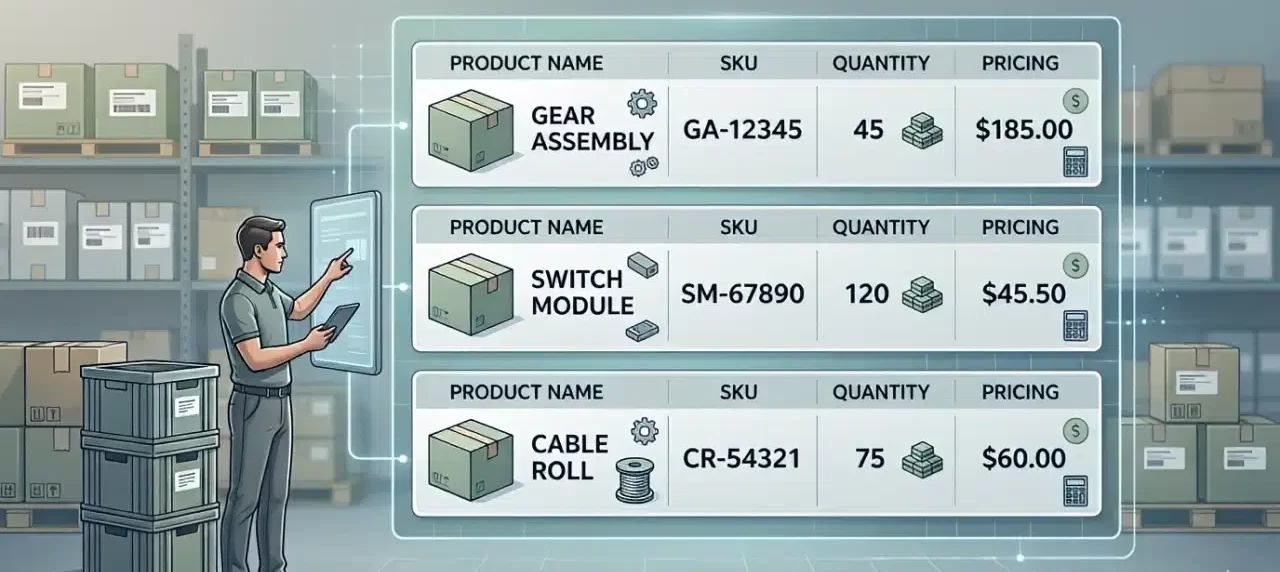
A complete inventory list captures every data point needed to track, manage, and evaluate stock with precision, with each field playing a distinct role in making inventory easy to identify, measure, and control.
1. Item name and description
Every item on the list should carry a clear name and a detailed description, which prevents confusion between similar products and keeps tracking consistent across teams, warehouses, and retail locations.
Descriptions should cover attributes like material, size, colour, or variant, since these details support accurate picking, packing, and customer communication when orders include similar but not identical items.
2. SKU, barcode, or serial number
Unique identifiers such as SKUs, barcodes, or serial numbers underpin accurate tracking, letting businesses record and update inventory quickly while cutting the risk of duplication or manual data-entry errors.
Consistent identifiers also simplify integration with point-of-sale systems, e-commerce platforms, and accounting tools, so stock movements flow automatically between channels without manual reconciliation work.
3. Supplier or manufacturer details
Recording supplier information streamlines purchasing and restocking, giving teams a quick way to identify where items come from and coordinate replenishment when stock approaches reorder thresholds.
Supplier data also strengthens vendor management, because procurement can track performance, compare lead times, and decide whether to diversify sources when a single supplier becomes unreliable or costly.
4. Unit cost and sale price
Tracking both cost and selling price gives visibility into profit margins on every item, which feeds directly into financial reporting and helps leaders evaluate the overall value of stock held on the books.
Price data also supports smarter pricing decisions, since businesses can see where margins are thin, where promotions are eroding profit, and where supplier costs have risen faster than retail prices allow.
5. Quantity in stock and total value
The inventory list must show how much stock is on hand at any moment, which allows daily fulfilment, purchasing, and customer commitments to rest on real numbers rather than stale or estimated figures.
Combining quantity with unit cost also calculates total inventory value for operational and financial reporting, supporting tax obligations, insurance coverage, and balance sheet accuracy at period close.
6. Reorder point and lead time
Reorder points flag when stock needs replenishing, while lead time shows how long new stock takes to arrive, and together they help prevent stockouts and keep products continuously available for customers.
Tuning these values with real demand and delivery data supports the inventory list creation tools, since purchasing teams can act on automatic triggers rather than reacting to crises once shelves run low.
How to Create an Inventory List
Creating an inventory list calls for a structured approach, so data management is optimized, with each step contributing to a product tracking solutions for Australian businesses that supports the business.
1. Define your data fields and format
Begin by identifying every piece of information needed for each item, including product details, quantity, pricing, and supplier data, so the inventory list stays consistent across the entire catalogue.
Agreeing on a format early prevents fragmentation later, because once teams start recording data differently across warehouses or spreadsheets, consolidating records becomes a slow and error-prone exercise.
2. Establish a SKU and labelling system
Create a clear naming and labelling structure for every item, which prevents duplication, improves tracking accuracy, and makes it easier to identify products across warehouses and retail locations.
A well-designed SKU system encodes useful attributes such as category, variant, and size, letting teams recognise items at a glance and cutting the need to look up reference data for routine stock decisions.
3. Choose a tracking method or platform
Decide whether inventory will be managed manually, through spreadsheets, or using dedicated software, matching the method to the scale of operations and the complexity of inventory being handled daily.
Factoring in growth matters, because a process that fits a small catalogue today can buckle once SKUs multiply, locations expand, or sales channels increase, so pick a method that scales with the business.
4. Set reorder points and stock alerts
Define minimum stock levels and trigger points for replenishment, which keeps inventory restocked on time and reduces the risk of running out of essential items during periods of unexpected demand.
Stock alerts should also account for supplier lead times and seasonal peaks, otherwise a fixed threshold can misfire when demand spikes, leaving teams short even when the reorder system runs correctly.
5. Maintain real-time updates
Update inventory data whenever stock moves in or out, because consistent updates prevent the discrepancies that grow between recorded and actual stock levels and slowly erode trust in the data.
Real-time updates also give sales and customer service teams confidence when quoting availability, which cuts cancelled orders, backorders, and the reputational cost of promising what cannot be delivered.
6. Conduct regular reviews and audits
Review inventory records periodically to keep accuracy intact over time, since regular checks catch discrepancies early and keep inventory data aligned with actual stock conditions on the warehouse floor.
Audits also expose process gaps, whether staff are skipping scans, damaged goods are going unlogged, or returns re-enter stock without inspection, so teams can tighten procedures before small issues compound.
Download Free Inventory List Templates
Creating an inventory list manually often leads to inconsistent formats and incomplete data. Using structured templates helps standardise how information is recorded and improves tracking accuracy.
The templates below support different inventory needs, from basic tracking to more structured control. Each format can be adapted into spreadsheets or integrated into inventory systems.
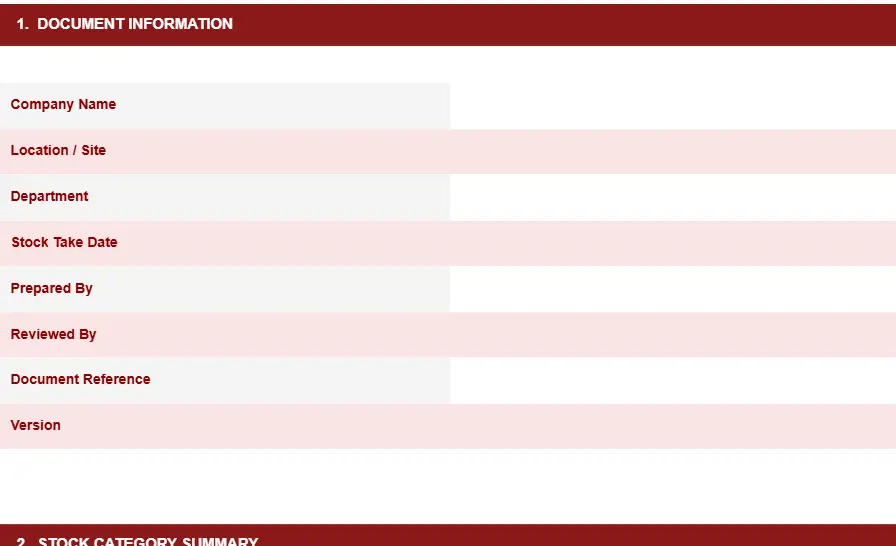
1. Basic inventory list template
Tracks item names, quantities, and storage locations for straightforward stock monitoring, making it a practical starting point for small catalogues or early-stage operations still formalising stock processes.
BASIC INVENTORY LIST TEMPLATE
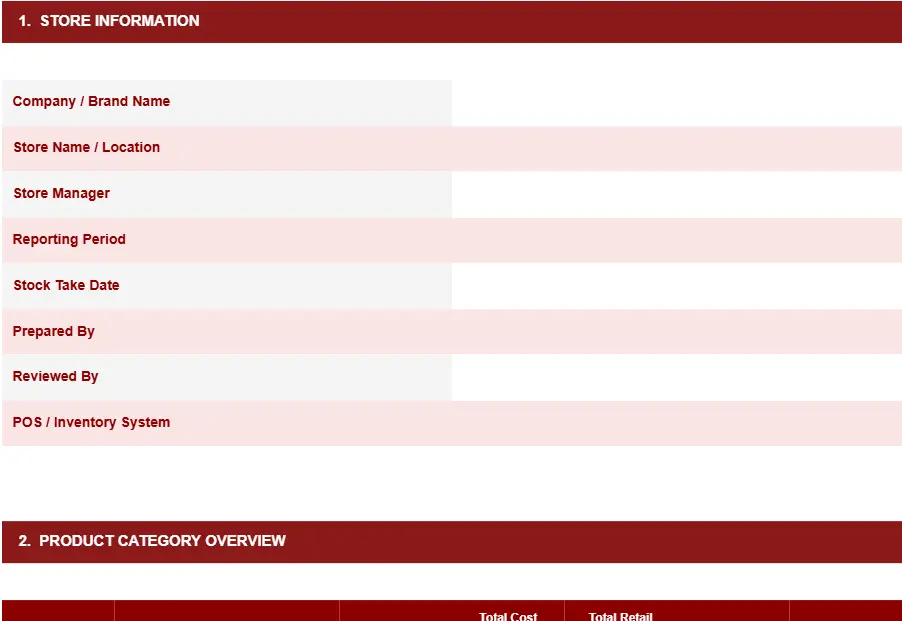
2. Retail inventory list template
Organises product variants such as size, colour, and SKU to support retail inventory tracking across storefronts, warehouses, and e-commerce platforms, keeping multi-variant stock easy to manage at scale.
RETAIL INVENTORY LIST TEMPLATE
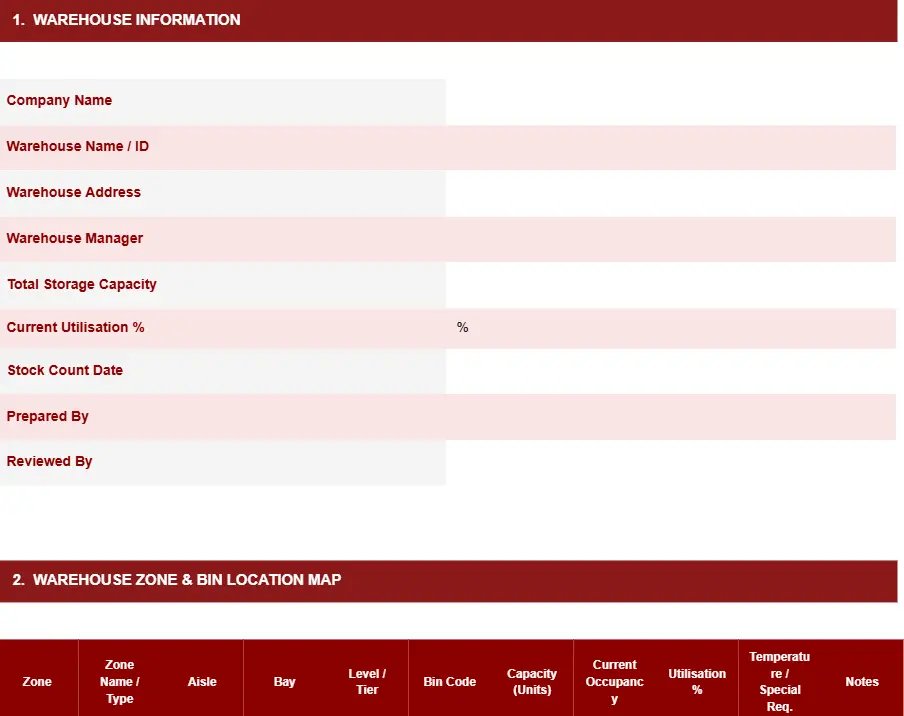
3. Warehouse inventory list template
Tracks inventory across multiple locations, bins, and storage zones, improving stock visibility for distribution centres and businesses running more than one physical storage site across regions.
WAREHOUSE INVENTORY LIST TEMPLATE
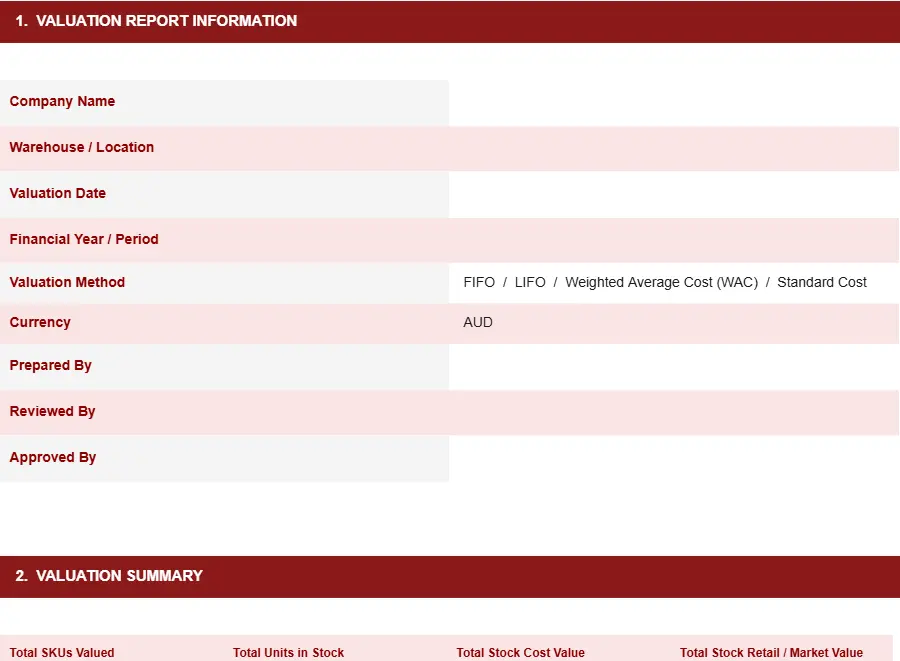
4. Inventory valuation template
Calculates total inventory value based on unit cost and quantity, supporting financial reporting, tax obligations, and balance sheet accuracy for businesses tracking stock value across periods.
INVENTORY VALUATION TEMPLATE
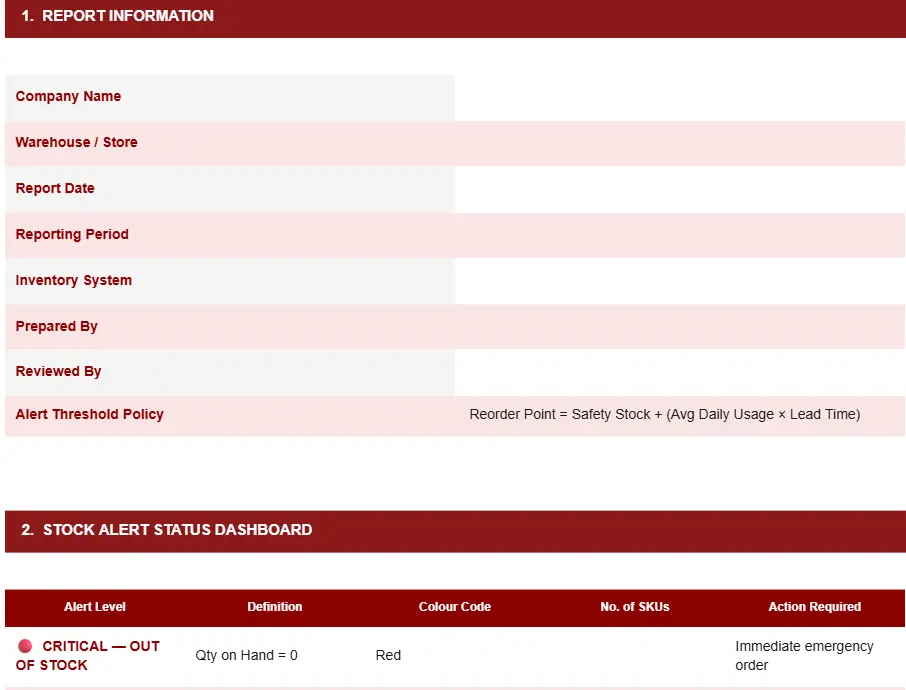
5. Reorder and stock alert template
Tracks reorder points, lead time, and minimum stock levels to prevent shortages, helping purchasing teams trigger replenishments before customer-facing operations lose momentum during busy periods.
REORDER AND STOCK ALERT TEMPLATE
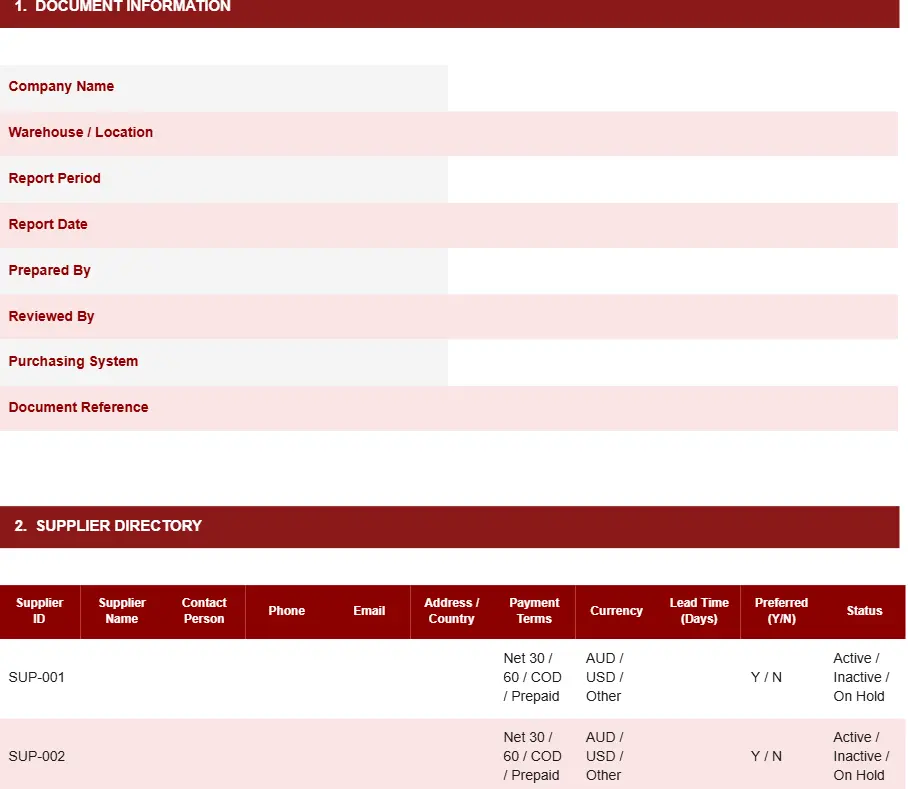
6. Supplier-linked inventory template
Connects inventory data with supplier information to simplify purchasing and replenishment, giving procurement one view of stock levels, supplier details, and reorder triggers in a single structured format.
SUPPLIER-LINKED INVENTORY TEMPLATE
Periodic vs Perpetual Inventory List Systems
Inventory lists can be managed using different approaches depending on how frequently stock data is updated. The choice between periodic and perpetual systems affects accuracy, reporting, and overall inventory control.
Periodic inventory lists are updated at fixed intervals, such as weekly or monthly counts. This method is simpler to manage but can create gaps between recorded and actual stock levels.
Perpetual inventory lists are updated continuously as stock moves in and out. This approach provides real-time visibility and higher accuracy but requires consistent tracking or system support.
| Aspect | Periodic Inventory | Perpetual Inventory |
| Update frequency | Updated at set intervals | Updated in real time |
| Accuracy | Lower between counts | High and consistent |
| Ease of use | Simpler to manage | Requires system support |
| Best for | Small or low-volume operations | Businesses with high inventory movement |
Inventory Tracking Methods and Tools
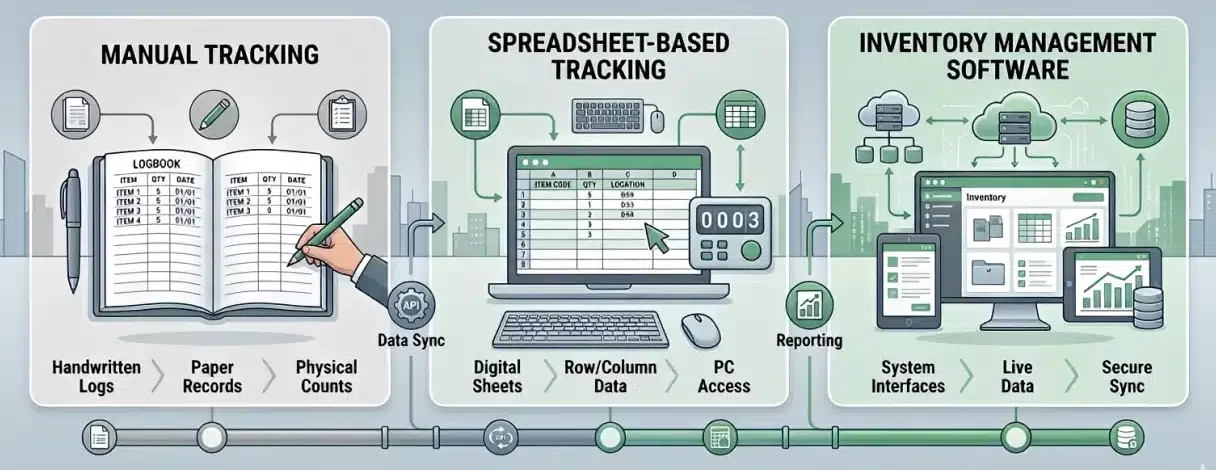
Businesses use different methods to track inventory depending on their scale and operational complexity. The chosen approach affects how accurately stock is recorded and how efficiently inventory is managed.
1. Manual inventory tracking
Manual tracking relies on handwritten records or basic logs to monitor stock. While simple to implement, this method is prone to human error and becomes difficult to maintain as inventory volume grows.
2. Spreadsheet-based tracking
Spreadsheets provide a more structured way to record inventory data. They allow basic calculations and organisation, but still require manual updates and can become inefficient for larger operations.
3. Inventory management software
Software-based tracking automates inventory updates and centralises data in real time. This improves accuracy, reduces manual work, and supports better visibility across multiple locations or sales channels.








Inventory List Use Across Industries
Inventory lists look different across industries, because the data fields, valuation methods, and tracking frequency depend on how stock moves and how critical accuracy is to day-to-day operations.
Retail and e-commerce businesses rely on SKU-level tracking for fast-moving goods, while manufacturers need batch numbers and work-in-progress data to follow stock through production stages.
Healthcare, food, and pharmaceutical businesses depend on expiry and lot tracking to meet compliance requirements, and distribution operators focus on multi-location visibility to manage regional stock flows.
Common Inventory List Mistakes and How to Avoid Them
Inventory lists often become unreliable due to inconsistent practices and lack of regular updates. Identifying common mistakes helps businesses maintain accurate records and avoid operational disruptions.
- Incomplete item details leading to confusion and tracking errors
- Inconsistent naming or SKU formats across inventory records
- Delayed updates that cause mismatches between actual and recorded stock
- Lack of regular audits to verify inventory accuracy
- Overreliance on manual processes without proper controls
Inventory List Relevance for Australian Businesses
Inventory accuracy in Australia matters significantly, where long supply chains, regional distribution, and strict retail competition make efficient stock management a direct lever on business performance.
According to the Australian Bureau of Statistics, inventories held by Australian businesses represent a substantial share of working capital, making precise tracking critical for cash flow and profitability.
Businesses that maintain accurate inventory lists are better positioned to manage rising freight costs, shifting demand, and reporting obligations under Australian tax and accounting standards.
Best Practices for Managing an Inventory List
Maintaining an effective inventory list requires consistent processes and clear standards. Applying best practices helps improve accuracy and supports better inventory control over time.
1. Maintain detailed and complete data
Ensure every item includes essential information such as description, quantity, and pricing. Complete data reduces errors and improves visibility across inventory records.
2. Standardise naming and categorisation
Use consistent naming conventions and categories for all items. This helps avoid duplication and makes inventory easier to organise and manage.
3. Enable real-time tracking where possible
Updating inventory data as stock moves improves accuracy and reduces discrepancies. Real-time tracking also supports faster decision making.
4. Use inventory systems for better control
Implementing inventory software helps automate tracking and centralise data. This improves efficiency and reduces the risks associated with manual processes.
Conclusion
An inventory list is essential for maintaining accurate stock data and ensuring smooth operations across purchasing, storage, and reporting. Without a structured system, inventory quickly becomes difficult to manage and prone to errors.
If you want to simplify inventory tracking and improve accuracy, you can book a free consultation with our experts to explore a system that fits your business needs.

FAQ About Inventory Lists
-
-
Is it better to track inventory by item or category?
Tracking by item gives the most precise control, while categories keep the list structured and easy to report on. Most businesses use both, so each item sits under a category and detail plus overview stay accessible.
-
How should I handle items that expire or are tracked by batch number?
Add batch number, expiry date, and received date as separate fields, and sort stock by earliest expiry during picking. This supports FIFO rotation and keeps perishable or regulated goods compliant.
-
How are returns and damaged stock recorded without distorting the inventory list?
Record them in a separate status field instead of folding them back into sellable quantity. This keeps available stock accurate, gives finance clean data for write-offs, and prevents over-promising to customers.
-
Does an inventory list replace an inventory management system, or work alongside one?
An inventory list is the data layer, while a management system is the platform that updates, analyses, and acts on that data. Most businesses scale from a list to a system rather than replacing one with the other.
-
Should work-in-progress and raw materials appear on the same list as finished goods?
Yes, but separated by stock type so reporting stays clear. Keeping raw materials, work-in-progress, and finished items on one list with a category field gives leaders full visibility without mixing valuations.
-