


FnB manufacturers must manage compliance, costs, and customer expectations at the same time. Since spreadsheets and disconnected systems can no longer support that complexity, food producers need a system for streamlining business processes to stay competitive.
A food manufacturing ERP helps companies manage recipes, yields, traceability, compliance, and quality control in one system. It also improves coordination across supply chains and production.
Why Food Manufacturers Need Specialized ERP Systems


Key Challenges in Food Manufacturing Operations
Raw materials in food manufacturing can vary by season and supplier, affecting quality and consistency. Food manufacturing ERP systems help teams adjust recipes in real time to maintain product standards.
Because ingredients and finished goods have limited shelf lives, production must be carefully managed to reduce spoilage and waste. ERP systems improve planning and efficiency while helping control rising material, labour, and energy costs.
High staff turnover can also disrupt operations when key knowledge is held by experienced workers. ERP systems store recipes, procedures, and machine settings to standardise production and speed up training for new staff.
Regulatory compliance and food safety requirements
Food manufacturers must also meet strict compliance, audit, and food safety requirements. ERP systems help businesses manage these obligations more accurately and efficiently.
- Food manufacturing operates under strict regulations, including the Food Standards Code by FSANZ. ERP systems replace paper logs with digital records for temperatures, pH levels, inspections, and other safety checks.
- Manufacturers often need certification standards to supply major retailers. A specialised ERP centralises quality and production records, making audits and reporting faster and easier.
- Allergen control is a critical safety requirement. Food manufacturing ERP systems help separate ingredients, reduce cross-contamination risk, and verify cleaning before production starts.
The importance of traceability in food production
Traceability is important in modern food supply chains. Businesses need to track products from raw ingredients to the final item sold. Food manufacturing ERP systems support this by assigning lot or batch numbers to materials and finished goods.
Traceability is especially important during recalls caused by contamination, undeclared allergens, or foreign materials. Manual systems can slow investigations and lead to wider recalls than necessary.
ERP systems help manufacturers identify affected products faster and respond more accurately. By entering a batch or lot number, the ERP can generate a full traceability report. This helps reduce recall costs while protecting customers and brand trust.
Core Capabilities of a Dedicated Food Manufacturing ERP
To modernize a food processing facility, an ERP system needs specialised tools designed for food manufacturing. These features help reduce manual work, improve accuracy, and create a single source of data across the business.
1. Recipe and formulation management
Food ERP systems allow recipes to be adjusted easily for demand changes while keeping ingredient ratios accurate. They can also suggest ingredient substitutes, update nutrition and allergen data, and track by-products for reuse or sale.
2. Traceability and recall readiness
ERP systems track ingredients and finished goods using batch numbers, making it easy to trace products forward and backward. This helps identify affected items quickly during recalls and reduces time spent on manual checks.
3. Quality control and assurance
Quality checks are built into production workflows. The system can hold materials for testing, monitor key safety checks like temperature or pH, and stop production if results fall outside safe limits.
4. Catch weight management
For industries like meat and seafood, ERP systems track both unit count and exact weight. This ensures accurate pricing, billing, and inventory control without discrepancies.
Industry-Specific Use Cases for Food ERP
Food manufacturing includes a wide range of production environments, each with different operational requirements. A modern food ERP addresses this complexity by adapting to the specific demands of each industry segment.
A Blueprint for Successful ERP Implementation Steps
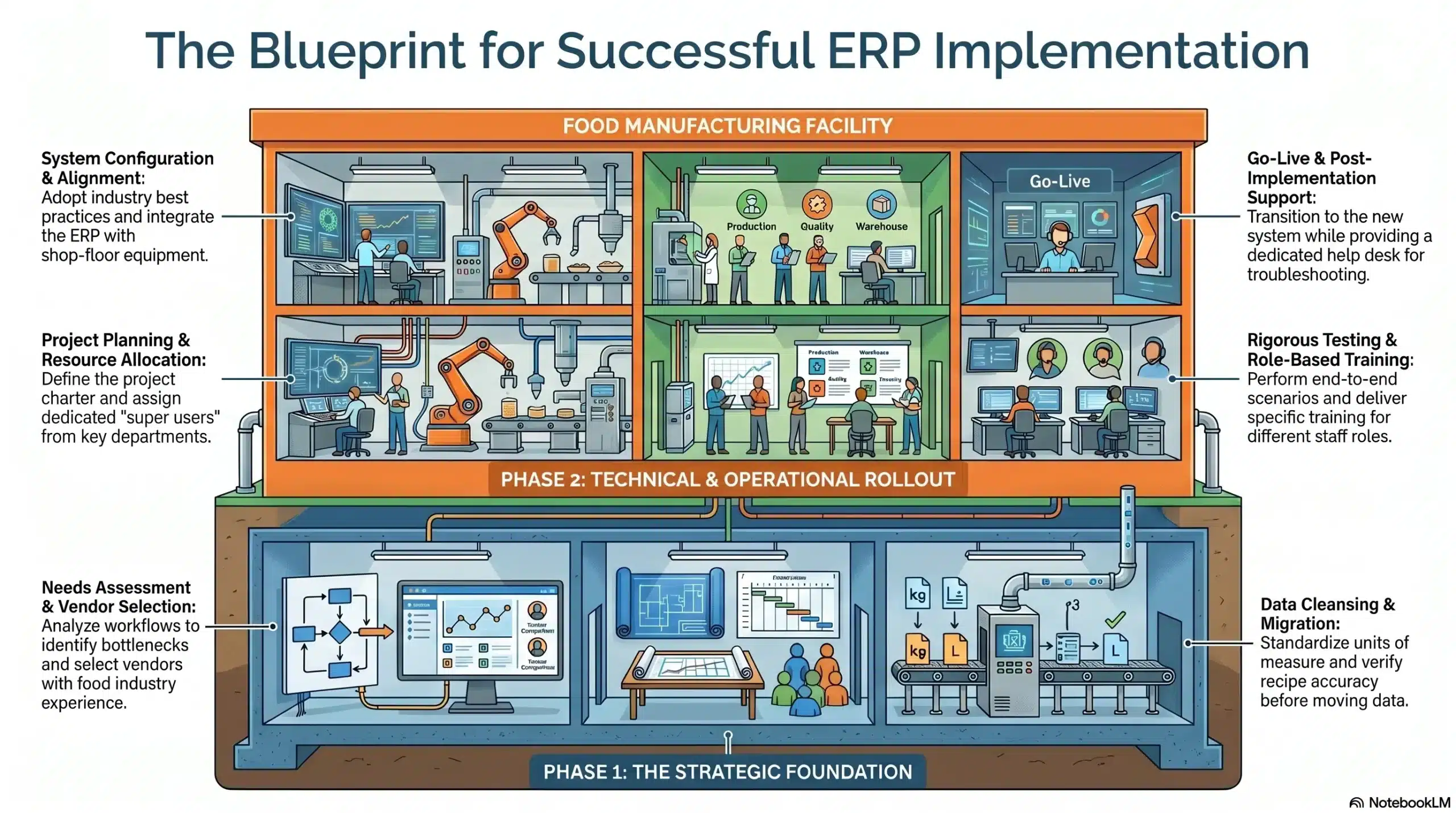
1. Needs assessment and vendor selection
ERP implementation starts by reviewing current workflows to find inefficiencies and manual processes. Businesses then choose a vendor based on features and experience in the food industry, often using demos to confirm suitability.
2. Project planning and resources
After selecting a vendor, the company sets a clear project plan, including scope, timeline, and budget. An internal team is formed with a project manager and key staff from departments like production, finance, and inventory.
3. Data cleansing and migration
Before moving data into the ERP, companies clean and fix errors in existing records. This includes removing duplicates, updating costs, and standardising recipes and inventory data to ensure accuracy.
4. System setup and workflow alignment
The ERP is configured to match improved business processes. This includes setting user roles, production steps, and quality controls, as well as integrating with other systems like logistics and shop-floor equipment.
5. Testing and training
The system is fully tested using real business scenarios to ensure it works correctly. Employees then receive role-specific training so they can use the system effectively in their daily tasks.
6. Go-live and support
The new ERP is launched either all at once or in stages. Some disruption is normal at first, so ongoing support and training help employees adapt and keep operations running smoothly.
Common Implementation Pitfalls and How to Avoid Them
Despite the best intentions, ERP implementations in the food manufacturing sector can falter if proactive measures are not taken to mitigate risk. Understanding the most common pitfalls is the first step for you to avoid them.
1. Inadequate change management
ERP failures often happen due to employee resistance rather than technical issues. If users don’t understand the new system, they may continue using old tools like spreadsheets, reducing data accuracy. Strong leadership and early user involvement are key to improving adoption.
2. “Paving the cow path”
This mistake happens when companies copy old, inefficient processes into a new ERP system. Instead, ERP implementation should improve workflows using built-in best practices, not recreate outdated methods through heavy customisation.
3. Scope creep
As the project progresses, new feature requests can expand the original scope and delay delivery. To avoid this, changes should be carefully reviewed and only approved if they are essential for launch, with non-urgent items added later.
4. Underestimating reporting needs
Many businesses focus on data entry but forget about reporting and analytics. KPIs and reporting requirements should be defined early so the ERP can provide clear dashboards and insights from day one.
Advanced Practices and the Future of Food ERP
As the food manufacturing industry mature, the role of the ERP system is expanding beyond basic transactional processing. Leading-edge manufacturers are leveraging advanced ERP ecosystems to drive efficiency, predictive capability, and sustainability.
1. Internet of Things (IoT) integration
Food manufacturing ERP systems can connect with IoT sensors on machines like ovens, mixers, and refrigeration units. These sensors automatically send data such as temperature, performance, and energy use into the system. This improves accuracy, reduces manual logging, and supports predictive maintenance to prevent equipment failures.
2. Artificial intelligence and machine learning
AI and machine learning help improve demand forecasting and inventory planning by analysing sales trends, seasonality, and external factors like weather. They can also optimise production by suggesting adjustments to recipes and processes when raw materials change, reducing waste and improving efficiency.
3. Blockchain for supply chain transparency
Blockchain can work alongside ERP systems to improve traceability across the supply chain. While ERP tracks internal production, blockchain records external movement of goods, creating a secure and transparent product history that consumers can verify.
4. Sustainability and ESG tracking
Modern ERP systems can track environmental metrics such as water usage, carbon emissions, and production waste. This helps manufacturers measure sustainability performance and generate reports for compliance and ESG reporting.
Conclusion
Food manufacturing requires strict control over safety, traceability, and production efficiency. Specialized ERP systems help manage recipes, compliance, and supply chain coordination in a single platform. Consequently, this system became the standard of operation in this industry.
By replacing fragmented tools, manufacturers gain better operational visibility and control. This allows companies to scale while maintaining product consistency and regulatory compliance. These benefits are no longer a luxury, as ERP becomes more accessible and affordable for all businesses.
You can book a free consultation with the experts to partake in these benefits too, and let us guide you through this journey of ERP implementation for your business.
Frequently Asked Question
A food manufacturing ERP system is software that helps manage production, inventory, quality control, compliance, and traceability in one platform.
It helps improve efficiency, reduce waste, ensure food safety compliance, and manage complex production processes more effectively.
ERP systems track quality checks, store digital records, and help businesses meet food safety regulations and audit requirements.
Yes. ERP systems improve traceability by tracking batch numbers, making it faster to identify and isolate affected products during a recall.