

Payroll is one of the most important tasks in any business. It’s the process of calculating and paying employees for their work, including salaries, wages, bonuses, and deductions. When payroll runs smoothly, employees get paid correctly and on time.
But payroll involves more than just sending payments. Businesses also need to handle taxes, benefits, overtime, and legal requirements. Even small mistakes can cause frustration for employees and lead to compliance issues for the company.
As companies grow, payroll becomes more complex. Different pay structures, tax rules, and labor laws all need careful management. A reliable payroll processing system helps businesses stay organized, avoid errors, and keep employees confident about their pay.
Key Takeaways
Payroll processing covers calculating wages, taxes, and deductions before issuing employee payments.
Businesses can run payroll manually, outsource it to a provider, or automate it through payroll software.
Australian payroll compliance covers Fair Work obligations, Single Touch Payroll reporting, and superannuation requirements.

What Is Payroll Processing?

Payroll is the process businesses use to calculate and pay their employees. It includes tracking hours worked, calculating wages, subtracting taxes and deductions, and issuing the final payment. Payroll also records these transactions in the company’s financial system so the business can track labor costs and stay organized.
But payroll is more than just paying employees. It also involves handling overtime, bonuses, benefits, and required deductions like taxes or retirement contributions. When payroll is accurate and on time, employees feel confident about their pay, and businesses avoid costly mistakes, legal issues, and compliance problems.
Key Components of the Payroll Process
Before calculating wages, businesses need to set up the right foundation. This means having accurate employee data and clear policies for salaries, benefits, and deductions. When this information is organized from the start, payroll becomes much easier and less prone to errors.
1. Employee Onboarding and Payroll Documentation
Payroll starts as soon as a new employee joins the company. During onboarding, HR collects important documents such as identification, tax forms, and direct deposit details. These records determine how the employee will be paid and how taxes will be handled.
Accuracy matters a lot at this stage. A small mistake, like a wrong bank account number or tax code, can cause payment issues or tax problems. Employees may also need to report things like wage garnishments or update details later if their personal situation changes.
2. Payroll Policies and Pay Periods
Clear payroll policies help businesses calculate pay consistently. Companies need rules for tracking work hours, paying overtime, and handling leave like vacation days, sick leave, or public holidays. Another key decision is choosing the pay period. Common options include:
- Weekly: Employees are paid 52 times a year.
- Bi-weekly: Employees are paid every two weeks (26 times a year).
- Semi-monthly: Employees are paid twice a month (24 paychecks a year).
- Monthly: Employees are paid once a month (12 paychecks a year).
3. Worker Classification
Businesses must classify workers correctly because it affects taxes, benefits, and legal responsibilities. The two main categories are employees and independent contractors. Misclassifying workers can lead to tax penalties, legal trouble, and compliance issues.
- Standard Employees: Employers withhold taxes, contribute to social security programs, and often provide benefits. Employees usually work under company supervision and follow set schedules.
- Independent Contractors: Contractors work independently and handle their own taxes. They typically use their own tools, control how they complete their work, and may work for multiple clients.
"Getting classification and pay period rules right at the start saves far more time than fixing a misclassified worker or a miscalculated pay run months later."
Main Steps in the Payroll Processing Workflow
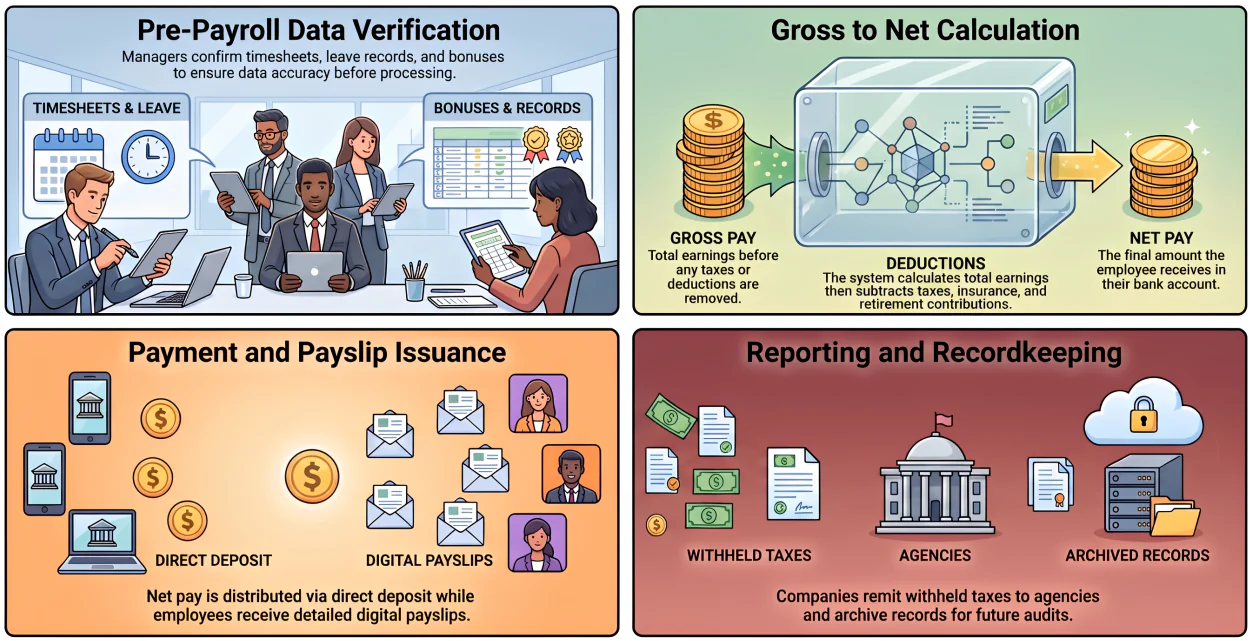
Once payroll policies are set and employee data is organized, the payroll process runs every pay period and must be handled consistently to avoid mistakes.Most businesses handle it in stages, starting with preparation, then calculating wages, sending payments, and finishing with reports and records.
1. Pre-Payroll Activities
Pay can change based on hours worked, leave taken, or bonuses earned, so this stage requires careful checks. Teams often work together to make sure the data is complete and accurate before calculations begin. Key information collected during pre-payroll includes:
- Time and Attendance: Managers review timesheets to confirm regular hours, overtime, and shift work.
- Leave Records: PTO, sick leave, or unpaid leave must be included so total payable hours are correct.
- Variable Pay: Bonuses, commissions, tips, or salary adjustments are added if they apply.
- Deduction Updates: Any changes to benefits, retirement contributions, or wage garnishments must be recorded.
2. Calculating Wages, Taxes, and Deductions
Once all payroll data is verified, the system calculates each employee’s pay. It starts by determining gross pay, which is the total earnings before any deductions. Salaried workers usually receive a fixed amount per pay period, while hourly employees are paid based on hours worked plus overtime.
After gross pay is calculated, the system subtracts taxes and other deductions. These may include income tax, social contributions, health insurance, retirement savings, or court-ordered garnishments. What remains after all deductions is the net pay, which is the amount the employee actually receives as their paycheck.
3. Payslip Generation and Payment Processing
After calculating net pay, the company sends payments to employees. Most businesses use direct deposit, which transfers money straight into employees’ bank accounts on payday. Some companies may also offer paper checks or payroll cards for employees without bank accounts.
At the same time, the company issues a payslip that explains how the pay was calculated. The payslip usually shows the pay period, total earnings, taxes, deductions, and final net pay. Many companies now provide digital payslips through secure employee portals.
4. Post-Payroll Reporting and Recordkeeping
Payroll doesn’t end after employees receive their pay. Companies still need to record the payroll data in their accounting system. This helps track labor costs, update financial reports, and keep company records accurate.
Businesses must also send withheld taxes and deductions to the correct agencies or companies. Governments require employers to report and pay these amounts on strict deadlines. Companies also keep payroll records for several years in case of audits, disputes, or legal checks.
Different Ways to Process Payroll
Businesses handle payroll in different ways depending on their size, budget, and needs. Some manage payroll manually, others use payroll software, and many choose to outsource it to specialized providers. Each option has its own benefits and challenges.
1. Manual Payroll Processing
Manual payroll means calculating wages, taxes, and deductions using basic tools like spreadsheets or calculators. The person in charge enters work hours, calculates taxes using official tax tables, and prepares employee payments. This approach relies heavily on careful data entry and manual calculations.
The main advantage of manual payroll is the low cost, which can work for very small businesses with only a few employees. However, it becomes difficult to manage as the company grows and payroll data increases. Small errors in formulas or numbers can easily cause payment mistakes or tax issues.
2. Outsourcing Payroll Services
Some companies outsource payroll to a third-party service provider. The business sends payroll data such as work hours, bonuses, and employee updates to the provider. The service then handles calculations, payments, and tax filings.
Outsourcing allows businesses to focus on other tasks while payroll experts manage the process. These providers usually understand complex tax rules and labor regulations. However, companies must rely on the provider and trust them to handle sensitive employee data securely.
3. Automated Payroll Systems
Many businesses use payroll software to manage employee payments automatically. These systems calculate wages, apply tax rates, process direct deposits, and generate digital payslips. Most modern payroll platforms are cloud-based, allowing managers and employees to access payroll information online.
Automated systems help businesses save time and reduce payroll errors. They also provide reports that make it easier for finance teams to track labor costs and payroll expenses. Using advanced tools for processing payroll ensures higher accuracy and efficiency across payroll cycles.






Payroll Compliance Requirements Under Australian Law
Running payroll in Australia means meeting specific legal obligations set by the ATO and Fair Work. Getting these right protects both your employees and your business from penalties.
1. Single Touch Payroll reporting
Employers must report salaries, taxes, and superannuation to the ATO each pay run through Single Touch Payroll reporting. This replaces manual end-of-year reporting and keeps payroll data current with every payment.
2. Superannuation guarantee contributions
Businesses must pay the superannuation guarantee for eligible employees into a complying super fund. Contributions are calculated on ordinary time earnings and paid by the quarterly due dates.
3. PAYG withholding obligations
Employers withhold income tax from wages under PAYG withholding and send the amounts to the ATO. Correct withholding relies on each employee's tax file number declaration and current tax tables.
4. Fair Work pay and record-keeping
Pay rates must meet the National Minimum Wage or the relevant modern award set by the Fair Work Ombudsman. Businesses must also keep payroll records for seven years and issue compliant payslips within one working day of payment.
Common Payroll Challenges and Best Practices
Even with sophisticated software or expert partners, managing employee compensation remains a challenging endeavor. The landscape is constantly shifting, and the stakes for accuracy are incredibly high. Recognizing common pitfalls and proactively implementing best practices is essential for maintaining a smooth, compliant operation.
1. Payroll Compliance and Regulations
Payroll compliance can be challenging because tax rules and labor laws often change. Governments regularly update minimum wage rates, tax brackets, and employee benefit requirements. Businesses must follow these regulations carefully because mistakes can lead to penalties or legal issues.
The challenge becomes bigger when companies hire employees in different regions or countries. Each location may have its own tax rules, labor laws, and reporting requirements. Managing these differences requires careful monitoring and organized payroll systems. Best Practices for Compliance:
- Stay Updated: Follow updates from tax authorities and HR associations to track legal changes.
- Use Payroll Software: Systems with automatic tax updates help reduce compliance mistakes.
- Run Regular Audits: Review worker classifications, wages, and overtime rules at least once a year.
- Keep Clear Records: Store tax forms, timesheets, and employee documents securely for compliance checks.
For businesses needing guidance, it’s often beneficial to seek a no-cost consultation to ensure payroll processes remain compliant and efficient.
2. Improving Payroll Accuracy and Efficiency
Payroll errors can quickly create problems for both employees and businesses. Overpaying employees leads to financial losses, while underpaying them can hurt trust and cause disputes.
Many payroll mistakes come from simple issues like wrong data entry, outdated employee records, or incorrect overtime calculations. Poorly connected systems can also cause errors when payroll data needs to be transferred between different tools. Best Practices for Accuracy and Efficiency:
- Use Employee Self-Service (ESS): Let employees update their own personal and banking details.
- Create Clear Procedures: Document step-by-step payroll processes so every cycle runs consistently.
- Integrate Systems: Connect HR, time-tracking, and accounting systems to avoid manual data transfers.
- Add a Review Process: Have one person prepare payroll and another review it before payments are approved.
Conclusion
Payroll plays a key role in the relationship between a business and its employees. It involves calculating wages, handling taxes, and keeping accurate financial records. Because payroll is closely tied to legal and financial rules, businesses must handle every step carefully to avoid mistakes.
Although payroll can be complex, the process becomes much easier with the right systems and clear policies. Using payroll software, organising employee data, and following consistent procedures can reduce errors and save time. When payroll runs smoothly, employees feel confident about their pay and businesses can focus on growth.
Ready to simplify payroll for your team? Book a free product tour to see how automated payroll processing fits your business.
Frequently Asked Question
Payroll is the process businesses use to calculate and pay employees for their work. It includes tracking work hours, calculating wages, deducting taxes and benefits, and issuing payments to employees.
To process payroll, businesses need employee information such as work hours, salary or hourly rate, tax forms, bank details for direct deposit, and any deductions like insurance or retirement contributions.
Payroll is usually processed on a regular schedule called a pay period. Common payroll schedules include weekly, bi-weekly, semi-monthly, or monthly, depending on the company’s policy and local labor regulations.