




Modern organizations operate in an environment defined by rapid market changes, increasing competition, and growing volumes of business data. Companies therefore need structured frameworks that connect strategic planning with daily operational decisions.
Enterprise Performance Management (EPM) integrates planning, budgeting, forecasting, and reporting into one system. By centralizing financial and operational insights, EPM platforms help organizations evaluate performance and guide long-term strategy.
This guide explains how the enterprise performance system works, the core components of EPM systems, and how organizations use them to improve financial visibility and decision-making.
Key Takeaways
Understand the role of ERP as the operational foundation that records transactions and provides the data needed for performance analysis in Enterprise Performance Management.
Learn how EPM acts as the analytical engine that transforms operational and financial data into insights for planning, forecasting, and strategic decision-making.
Explore how EPM and ERP systems work together by connecting transactional data with strategic planning to improve organizational performance.
Discover how Enterprise Performance Management helps CFOs move from reactive reporting to proactive decision-making through real-time insights and advanced planning tools.
What is Enterprise Performance Management (EPM)
Enterprise Performance Management (EPM) is a framework that helps organizations monitor and improve overall business performance. It combines processes, metrics, and software tools to connect strategic goals with daily operational activities.
Through EPM systems, companies can manage financial planning, budgeting, forecasting, and reporting in a single environment, creating a digital system for business planning and performance management. This integration allows leaders to track performance and align operations with long-term business objectives.
Unlike traditional financial tools that focus mainly on historical reports, EPM platforms also support forward-looking analysis. Organizations can run scenario models, evaluate potential outcomes, and adjust strategies before major changes occur.
EPM vs ERP: Key Differences and How They Work Together
Enterprise Performance Management (EPM) and Enterprise Resource Planning (ERP) systems support different aspects of business operations. ERP manages daily transactions such as accounting, procurement, and inventory.
EPM focuses on analyzing that operational data to support planning, forecasting, and strategic decision-making. When used together, both systems help organizations align daily operations with long-term business strategy.
The Role of ERP: The Transactional Foundation
Enterprise Resource Planning systems are designed to manage operational activities across the organization. They record transactions from departments such as finance, procurement, inventory management, manufacturing, and human resources.
ERP platforms act as the operational backbone of the business, functioning as a system for business operations that stores and processes large volumes of transactional data. When sales occur, purchase orders are created, or employees are paid, these activities are recorded within the ERP system.
Because ERP systems capture detailed operational data, they provide the foundation for accurate financial reporting and operational visibility across departments.
The Role of EPM: The Analytical Engine
While ERP systems focus on recording transactions, EPM systems focus on analyzing business performance. They use operational and financial data to support planning, budgeting, forecasting, and strategic reporting.
EPM platforms aggregate data from ERP and other systems, allowing finance teams and executives to evaluate trends and performance indicators. This helps organizations understand not only what happened, but also why it happened.
Through advanced modeling and scenario analysis, EPM tools help leaders evaluate potential outcomes and plan future business strategies.
The Synergy Between EPM and ERP
When integrated effectively, EPM and ERP can function as a digital business platform that connects transactional data with planning, reporting, and strategic analysis. ERP systems supply the transactional data, while EPM systems transform that data into strategic insights.
In many organizations, financial and operational data flows from ERP platforms into EPM systems through structured data transfer for analysis and planning. Once budgets and forecasts are finalized, those targets can guide operational activities within the ERP system.
This integration ensures that long-term strategy and daily operations remain aligned, helping organizations maintain both financial discipline and strategic agility.
Core Components of an Enterprise Performance Management System
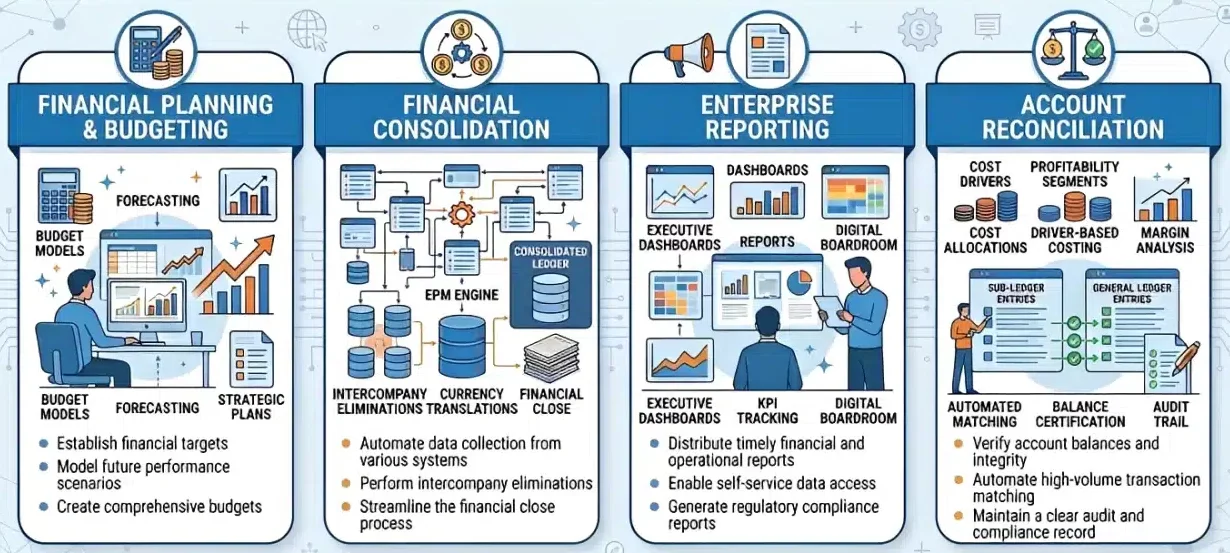
Enterprise Performance Management platforms typically consist of several interconnected modules. These components help organizations manage financial planning, reporting, and performance analysis within a single system.
By integrating these capabilities, EPM solutions allow companies to improve financial visibility, streamline reporting processes, and support more accurate business planning.
Financial Planning, Budgeting, and Forecasting
Financial planning, budgeting, and forecasting are among the most widely used functions of EPM systems. These tools allow organizations to create financial plans, allocate budgets, and monitor performance against expected targets.
Modern EPM platforms support collaborative planning across departments. Managers can submit budget inputs while finance teams review and consolidate financial projections in real time.
Many systems also support rolling forecasts and scenario modeling. This allows organizations to update financial projections continuously as market conditions or operational assumptions change.
Financial Consolidation and Close
For organizations with multiple subsidiaries or business units, financial consolidation can be a complex process. EPM systems automate consolidation activities by aggregating financial results across entities and standardizing reporting structures.
These tools also support functions such as intercompany eliminations, currency translation, and journal entry management. Automation reduces manual errors and accelerates the financial close cycle.
By streamlining consolidation processes, EPM platforms help finance teams produce accurate financial statements more efficiently.
Enterprise Reporting and Disclosure Management
Reporting capabilities allow organizations to transform financial and operational data into structured reports for executives, investors, and regulators. EPM platforms support the creation of financial statements, management reports, and board-level dashboards.
Disclosure management features also help automate regulatory and narrative reporting. Financial data can be directly linked to reports, ensuring that updates in underlying data automatically appear in related documents.
This integration improves reporting accuracy while reducing the risk of inconsistencies across multiple reports.
Profitability and Cost Management
Profitability analysis helps organizations understand which products, services, or customers generate the most value. EPM systems enable detailed cost allocation across departments, product lines, and business units.
Advanced models such as activity-based costing allow organizations to distribute overhead costs more accurately. This helps leaders identify profitable segments and areas that require operational improvements.
By analyzing profitability at a granular level, companies can make more informed decisions about pricing, investment, and resource allocation.
Account Reconciliation
Account reconciliation ensures that balances in financial records match supporting documents such as bank statements, sub-ledgers, or external reports. This process is essential for maintaining financial accuracy and regulatory compliance.
EPM systems automate many reconciliation activities through rules-based matching and workflow management. High-volume accounts can be reconciled automatically while exceptions are flagged for review.
Automation helps finance teams complete reconciliations faster while improving audit readiness and financial transparency.
If your team wants to improve reconciliation accuracy and reduce manual finance work, it may be the right time to review a more connected EPM approach. You can get in touch with our experts to discuss how the right system can support faster close cycles, stronger controls, and better financial visibility.
"Enterprise Performance Management enables organizations to transform financial data into actionable insights, helping leaders align strategy, operations, and long-term growth."
The Strategic Impact of EPM on the Office of the CFO
Enterprise Performance Management significantly changes how finance leaders manage organizational performance. Instead of spending most of their time consolidating spreadsheets and preparing reports, finance teams can focus on analysis and strategic planning.
By centralizing financial data and automating reporting processes, EPM systems allow CFOs to monitor performance more effectively and guide decision-making across the organization.
From Reactive to Proactive Decision Making
Without EPM, finance teams often spend a large portion of their time collecting and preparing data. This leaves limited time for deeper analysis or strategic planning.
EPM systems automate data consolidation and reporting, allowing finance teams to focus on interpreting insights rather than preparing reports.
With real-time dashboards and continuous forecasting, CFOs can detect potential risks or performance gaps earlier and respond before they impact the business.
Fostering Cross-Functional Alignment (xP&A)
Modern EPM platforms support Extended Planning and Analysis (xP&A), which connects financial planning with operational planning across departments.
Instead of finance working separately from operations, teams such as HR, marketing, and supply chain can align their plans within the same system.
This integrated approach helps organizations evaluate how operational decisions affect financial outcomes, ensuring departments remain aligned with overall business strategy.
Industry Use Cases of Enterprise Performance Management
Although EPM principles apply across industries, organizations use these systems in different ways depending on operational challenges and market dynamics.
Modern EPM platforms support industry-specific planning models that help organizations analyze performance, forecast demand, and allocate resources more effectively.
Retail and Consumer Goods
Retail companies operate in highly dynamic markets where demand can change quickly. EPM systems help retailers forecast sales, plan inventory levels, and evaluate store-level profitability.
By analyzing historical sales data and promotional performance, retailers can adjust pricing strategies and marketing budgets more effectively.
This visibility helps organizations reduce excess inventory while ensuring popular products remain available across stores and online channels.
Manufacturing and Distribution
Manufacturers rely on accurate cost analysis and supply chain planning to maintain profitability. EPM platforms help companies model production costs, raw material prices, and operational capacity.
By integrating operational data with financial planning, manufacturers can evaluate the financial impact of supply chain disruptions or changes in commodity prices.
Scenario modeling also allows companies to assess investments such as expanding production capacity or launching new product lines.
Healthcare and Life Sciences
Healthcare organizations face complex operational challenges involving patient demand, regulatory compliance, and cost management.
EPM systems help hospitals and healthcare providers forecast patient volumes, plan workforce requirements, and evaluate service-line profitability.
These insights support better resource allocation while ensuring healthcare organizations maintain both operational efficiency and financial sustainability.
Financial Services
Financial institutions operate in highly regulated environments where risk management and capital planning are critical.
EPM platforms help banks and insurance companies model interest rate scenarios, evaluate portfolio performance, and manage regulatory reporting requirements.
By integrating financial planning with risk analysis, these systems help institutions maintain compliance while improving long-term financial performance.
EPM Implementation Roadmap and Best Practices
Implementing Enterprise Performance Management is a strategic initiative that requires coordination across finance, IT, and operational teams. Without a structured roadmap, organizations may struggle with data inconsistencies, low user adoption, or unclear business outcomes.
A well-planned implementation helps ensure that EPM systems deliver measurable improvements in planning accuracy, reporting efficiency, and decision-making.
Define Strategic Objectives
Before selecting an EPM platform, organizations must clearly define what they want to achieve. Common goals include improving forecast accuracy, shortening the financial close cycle, or gaining visibility into product profitability.
Clear objectives help the implementation team prioritize system capabilities and align the project with broader business strategy.
Data Governance and Data Cleansing
Data quality plays a critical role in the success of any EPM implementation. If financial or operational data contains inconsistencies or duplicates, the resulting analysis and forecasts may become unreliable.
Organizations should standardize data definitions, clean historical records, and establish governance policies to ensure long-term data consistency.
Phased Implementation Approach
Implementing all EPM modules simultaneously can overwhelm both technical teams and business users. A phased approach helps reduce risk and allows organizations to deliver value gradually.
Many companies begin with financial consolidation or reporting modules before expanding into budgeting, forecasting, and advanced analytics.
Change Management and User Adoption
EPM implementation is not only a technology project but also an organizational change process that affects how employees perform planning and reporting activities. Without proper training and communication, users may continue relying on legacy spreadsheets.
Organizations should invest in training programs, clear documentation, and leadership support to encourage adoption and ensure the system becomes part of daily workflows.
Common Pitfalls in EPM Adoption
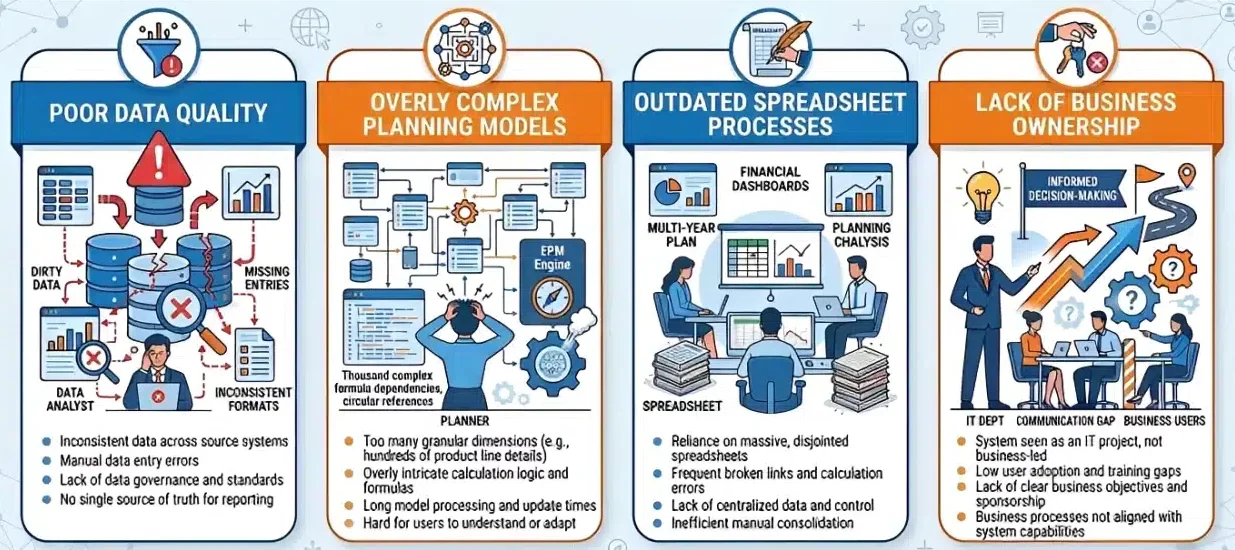
Despite the benefits of Enterprise Performance Management, many organizations struggle to realize the full value of their systems. Implementation challenges often occur when planning processes, data management, or organizational readiness are not properly addressed.
Common pitfalls include:
- Replicating outdated spreadsheet processes instead of redesigning workflows within the new system
- Poor data quality, which leads to unreliable forecasts and reporting
- Overly complex planning models that become difficult to maintain
- Lack of business ownership, where EPM projects are driven only by IT teams
Recognizing these challenges early helps organizations design a more effective implementation strategy.
The Future of Enterprise Performance Management
Enterprise Performance Management is evolving rapidly as organizations adopt advanced analytics, artificial intelligence, and real-time data processing.
These technologies are transforming EPM from a traditional reporting tool into an intelligent platform that continuously analyzes business performance and supports faster decision-making.
Predictive Forecasting and Machine Learning
Predictive forecasting is becoming a core capability of modern EPM platforms. Machine learning algorithms analyze historical data and external indicators to generate more accurate financial projections.
These models continuously learn from new data, allowing forecasts to improve over time and respond more effectively to changing market conditions.
Extended Planning and Analysis (xP&A)
Extended Planning and Analysis expands traditional financial planning into other business functions such as HR, sales, and supply chain.
By connecting operational planning with financial models, organizations can evaluate how decisions in one department affect overall financial performance.
This integrated approach helps companies maintain alignment between operational activities and strategic goals.
Continuous Planning and Rolling Forecasts
Many organizations are moving away from static annual budgets toward continuous planning models.
Rolling forecasts allow companies to update financial projections regularly as new data becomes available. This helps leaders respond faster to market changes and maintain greater strategic flexibility.
Automated Narrative Reporting
Modern EPM systems increasingly support automated narrative reporting through natural language generation technologies.
These tools automatically produce written explanations for financial results, highlighting key trends and variance drivers.
Automation reduces the time required to prepare reports while ensuring stakeholders receive clearer insights into business performance.
Measuring the ROI of Enterprise Performance Management
Implementing an EPM system requires investment in technology, implementation services, and internal resources. Because of this, organizations often evaluate the return on investment through both financial metrics and operational improvements.
The value of EPM typically appears through improved planning accuracy, faster reporting cycles, and stronger alignment between financial strategy and operational execution.
Quantitative ROI
Quantitative ROI refers to measurable improvements that organizations achieve after implementing an EPM system. These benefits typically include:
- Reduction in financial close time
- Shorter budgeting and planning cycles
- Improved forecast accuracy
- Lower IT maintenance costs by consolidating multiple planning tools
These measurable outcomes help organizations evaluate the financial impact of their EPM investments.
Strategic and Operational Benefits
In addition to measurable savings, EPM platforms also deliver broader strategic advantages.
Key benefits include:
- Better visibility into financial and operational performance
- Stronger alignment between departments and corporate strategy
- Improved risk management through scenario modeling
- Faster decision-making using real-time insights
These capabilities help organizations operate more strategically and respond quickly to market changes.
Conclusion
Enterprise Performance Management (EPM) helps organizations connect strategic planning with daily operations. By integrating budgeting, forecasting, reporting, and performance analysis, EPM systems provide clearer visibility into business performance.
With better data visibility and planning tools, companies can make faster and more informed decisions. This helps leaders respond to market changes, allocate resources efficiently, and keep departments aligned with long-term strategy.
If your organization is evaluating EPM solutions, choosing the right system and implementation approach is critical. Request a free consultation with our professional team to explore how integrated EPM platforms can support smarter planning and decision-making.

Frequently Asked Questions About Enterprise Performance Management
Enterprise Performance Management (EPM) is a framework and software system used to monitor, analyze, and improve organizational performance. It integrates planning, budgeting, forecasting, consolidation, and reporting to help companies align strategic goals with operational execution.
ERP systems manage daily operational transactions such as accounting, procurement, and inventory. EPM systems analyze that operational data to support financial planning, forecasting, and strategic performance management.
Core components of an Enterprise Performance Management system typically include financial planning and budgeting, forecasting, financial consolidation, enterprise reporting, profitability analysis, and account reconciliation.
EPM systems centralize financial data and automate planning processes. This allows organizations to create more accurate forecasts, run scenario analysis, and adjust strategies based on real-time performance insights.
EPM software is commonly used by finance teams, CFOs, financial planning and analysis (FP&A) teams, and senior executives who need to monitor financial performance and support strategic decision-making.