














Modern consumers expect seamless interactions across every platform they use, moving effortlessly between mobile apps, emails, and phone calls. As a result, businesses must adapt their support strategies to ensure communication remains consistent across all channels.
When support systems are disconnected, customers often have to repeat their issues to different agents. Implementing an omnichannel customer service strategy helps businesses integrate all support channels into one system, providing a smoother and more efficient experience.
Key Takeaways
Understand the core definition of omnichannel customer service and how it seamlessly connects all communication platforms.
Explore how a unified support strategy drives brand loyalty, enhances agent productivity, and boosts overall revenue.
Discover the essential platforms required to build a comprehensive and effective communication ecosystem.
Learn how to implement an omnichannel strategy by auditing channels, integrating systems, and improving support workflows.

What Is Omnichannel Customer Service?

Omnichannel customer service connects all communication channels into one system. It helps businesses deliver consistent support and gives agents full visibility of customer interactions.
Unlike multichannel support, omnichannel integrates all interactions into one profile. Customers do not need to repeat issues, making support faster and more seamless.
This approach uses tools such as a customer relationship solution for business to centralise data. Real-time synchronization helps businesses manage conversations across channels consistently.
Key Benefits of an Omnichannel Approach
Core Channels in an Omnichannel Strategy
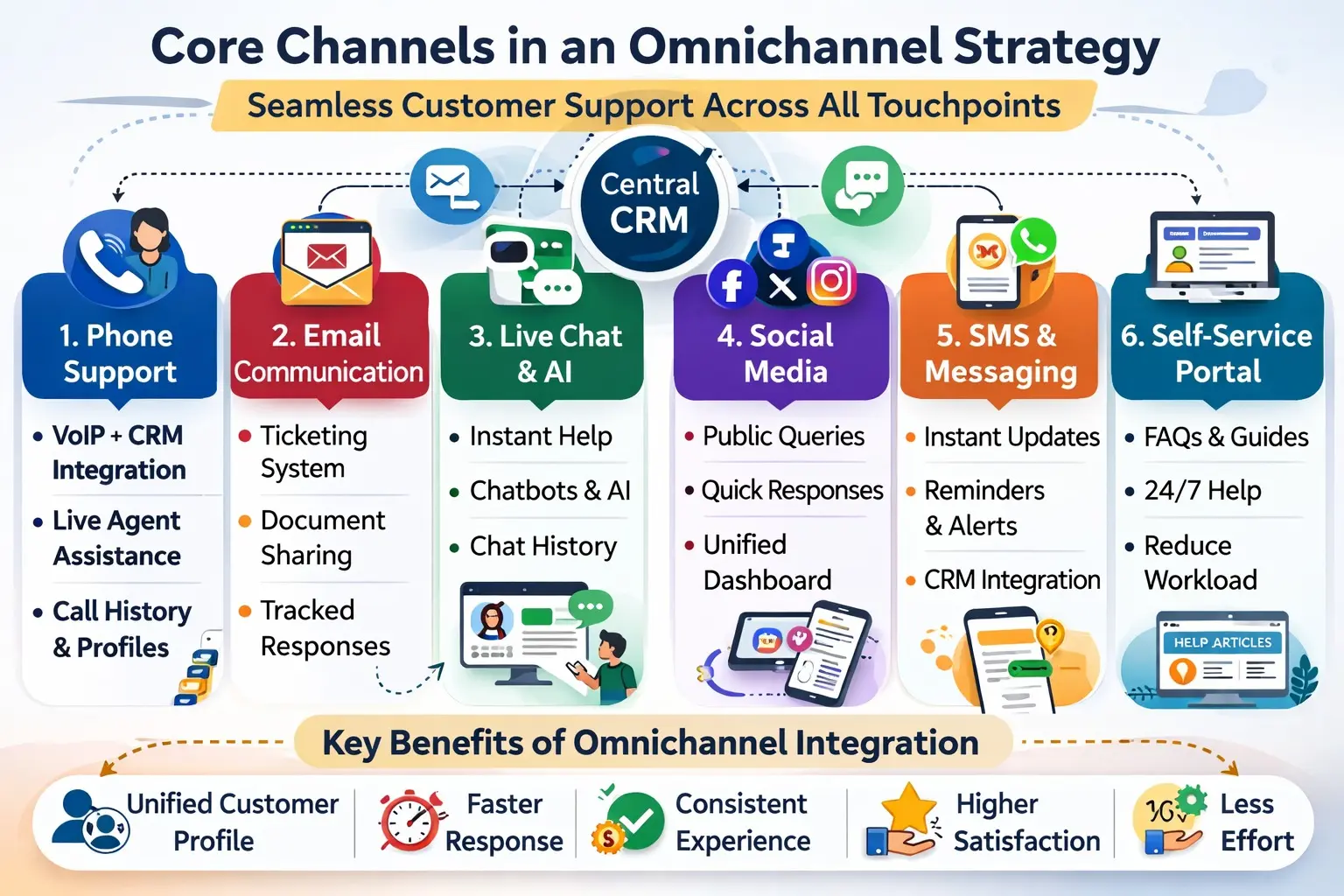
An effective omnichannel strategy focuses on the channels customers actually use. Businesses should connect key touchpoints into one system to ensure consistent and seamless interactions.
1. Traditional voice and phone support
Phone support remains essential for urgent or complex issues. Many customers still prefer speaking directly with an agent for faster resolution.
Integrated systems allow agents to access customer data instantly. This helps deliver more personalized and efficient support.
2. Email communication
Email is widely used for detailed inquiries and formal communication. It provides a written record that customers can refer to later.
In an omnichannel system, emails are tracked alongside other interactions. This makes responses more organised and consistent.
3. Live chat and conversational ai
Live chat allows customers to get instant support while browsing a website. Businesses can also use chatbots to handle simple questions quickly.
When issues become more complex, conversations can be transferred to agents with full context. This ensures continuity and faster resolution.
4. Social media platforms
Customers often reach out through social media for quick support or public feedback. These interactions require fast and professional responses.
Integrated tools help businesses manage messages across platforms in one place. This improves response time and consistency.
5. Sms and instant messaging applications
Messaging apps offer direct and convenient communication for quick updates. They are often used for reminders, notifications, and short interactions.
When integrated into a unified system, these conversations are tracked alongside other channels. This ensures a consistent customer experience.
6. Self-service portals and knowledge bases
Self-service tools allow customers to find answers without contacting support. This improves efficiency and reduces workload for support teams.
Agents can also see which resources customers have accessed. This helps provide more relevant and faster assistance.

How Industries Apply Omnichannel Customer Service
Omnichannel customer service becomes clearer when applied in real scenarios. Different industries use integrated communication to resolve issues faster and improve customer experience.
1. Retail industry transformation
Retail uses omnichannel to connect online and in-store experiences. Customers can start a request digitally and complete it in-store without repeating information.
This improves convenience and speeds up service. It also enhances customer satisfaction across channels.
2. Telecommunications and tech support
Telecom companies handle complex issues that require multiple interactions. Omnichannel allows agents to access previous diagnostics and continue support seamlessly.
This reduces repetition and speeds up resolution. Customers experience less frustration and faster service.
3. Banking and financial services
Banks use omnichannel to handle urgent issues while maintaining security. Customer interactions can move across channels without losing context.
This ensures faster resolution and better coordination between teams. It also improves trust and reliability.
4. E-commerce and direct-to-consumer brands
E-commerce brands use omnichannel to deliver personalized support. Agents can access previous interactions and respond without requiring customers to repeat requests.
This improves efficiency and creates a smoother experience. It also strengthens customer loyalty over time.
Best Practice for Omnichannel Customer Service

Implementing omnichannel customer service requires alignment between people, processes, and systems. Businesses must ensure every channel delivers a consistent and connected experience.
Understanding customer behaviour across platforms also helps improve strategy. Data-driven decisions allow businesses to build smoother and more efficient support workflows.
1. Map the complete customer journey
Businesses need to identify every touchpoint across marketing, sales, and support. This helps uncover gaps and improve transitions between channels.
Collecting customer data and feedback helps refine workflows. This supports more seamless and consistent experiences.
2. Invest in the right technology stack
A strong technology foundation ensures all channels are connected and data is centralised. Using system for customer management helps unify interactions and keep communication records organised.
Choosing scalable and secure platforms enables real-time synchronization. This improves consistency and supports long-term growth.
3. Empower and train customer support agents
Well-trained agents are essential for delivering effective omnichannel service. They must understand how to access and use customer data across systems.
Proper training helps agents respond faster and more accurately. This improves both efficiency and customer satisfaction.
4. Maintain context across all channels
Maintaining context ensures customers do not need to repeat their issues. Every interaction should be recorded and accessible across channels.
This continuity allows agents to respond quickly and consistently. It also creates a smoother and more reliable customer experience.
How to Implement Omnichannel Customer Centre
Implementing an omnichannel system requires a phased approach to avoid disrupting operations. Businesses should integrate channels step by step while maintaining service continuity.
- audit existing communication channels
Review all current channels such as phone, email, social media, and messaging apps. Understand how customer data flows across each platform.
- implement a centralized crm
Integrate all channels into one system to unify customer data. This allows every interaction to be tracked in a single dashboard.
- train support teams
Ensure agents understand how to use the system effectively. Proper training helps them access customer data and respond faster.
- set up automated routing
Route customer inquiries to the most suitable agents automatically. This improves response time and overall efficiency.
Essential KPIs to Monitor in Omnichannel Customer Service
Businesses need to track performance to evaluate both efficiency and customer experience. These key metrics help measure how well the system performs.
- first contact resolution (FCR)
Measures how often issues are resolved in the first interaction. Higher FCR indicates more efficient support.
- customer effort score (CES)
Tracks how easy it is for customers to resolve their issues. Lower effort leads to a better experience.
- average handle time (AHT)
Measures how long agents take to handle each interaction. This should decrease as agents become more efficient.
Common Pitfalls and How to Avoid Them
Even with proper planning, businesses can face challenges when implementing omnichannel customer service. Identifying these issues early helps maintain a smooth and consistent customer experience.
1. Breaking down data silos
Data silos occur when departments use separate systems that do not share information. This leads to inconsistent communication and poor customer experience.
Using a unified CRM system helps centralise data across teams. This ensures all interactions are recorded and accessible in one place.
2. Inconsistent brand communication
Different communication styles across channels can confuse customers. Inconsistent messaging may weaken brand trust.
Clear guidelines and templates help maintain a consistent voice. This ensures customers receive the same experience across all channels.
How CRM Platforms Integrate Customer Service Channels for Australian Retail Industry
Omnichannel customer service is widely used in Australia’s retail sector to deliver consistent experiences. Large retailers such as Woolworths Group use integrated systems to connect online and offline interactions.
Omnichannel is rapidly gaining popularity across Australia. Reported by Inside Retail, 80% of the Australian brands they audited offer click and collect, and 66% of them have live chat features on their website.
CRM software plays a crucial role in unifying customer service channels by consolidating interactions into a single platform. This integration allows businesses to provide a seamless and efficient experience, ensuring customers receive consistent support across all touchpoints.
In retail, CRM systems connect customer interactions across e-commerce, physical stores, and support channels. This helps businesses track customer journeys from browsing to post-purchase in one system.
By centralising customer data and interaction history, retail companies can respond faster and deliver more personalised service. This ensures a consistent experience across all touchpoints.
Conclusion

Frequently Asked Question
Omnichannel customer service connects multiple support channel, such as phone, email, chat, and social media, into one unified system. This allows agents to see a customer’s full interaction history and provide faster, more personalized support.
Multichannel support offers several communication platforms, but they operate separately. Omnichannel support integrates all channels so customer data and conversations are shared in one system.
It improves customer satisfaction, increases agent efficiency, and ensures consistent communication across all channels.
Businesses typically use a centralized CRM system, cloud-based platforms, and integration tools to connect all customer communication channels.