














You might think that generating interest in your product or service is the hardest task, but it isn’t. In reality, many businesses struggle with the chaotic process of organizing, tracking, and engaging the people who show interest in their brand.”
Without a customer strategy platform, valuable opportunities slip away, response times lag, and potential revenue is lost to competitors who are faster and more organized. Lead management serves as the backbone of a successful sales strategy, bridging the gap between marketing and sales execution.
By implementing a lead management framework, businesses can ensure their sales teams focus on only promising prospects, thereby increasing conversion rates and maximizing ROI. This page will introduce you to lead management and how you can utilize it to enhance your business.
Key Takeaways
Lead management is the systematic process of capturing, tracking, and qualifying potential customers to streamline the transition from marketing to sales.
Lead management is vital for preventing lead leakage, aligning sales and marketing teams, and significantly improving conversion rates and revenue growth.
The lead management process is a structured four-step cycle involving lead capture, qualification, nurturing, and final conversion is essential for consistent sales success.
The best practices of lead management are implementing automated scoring, establishing SLAs, and utilizing advanced CRM technology are crucial best practices for optimization.

What Is Lead Management?

Lead management is a comprehensive process used by companies to acquire potential customers, assess their viability, and guide them through the sales funnel until they make a purchase. It acts as a system that ensures no potential client is overlooked and every interaction adds value to the customer journey.
Unlike simple lead generation, which focuses solely on bringing people into the funnel, lead management covers the entire lifecycle of a prospect. It starts from the initial point of contact and continues all the way to the final closing of a deal.
At its core, lead management identifies which prospects are ready to buy immediately, which need more time, and which are unlikely to convert. In 2026, this process has evolved into a dynamic ecosystem powered by artificial intelligence and automation.

The Lead Management Process
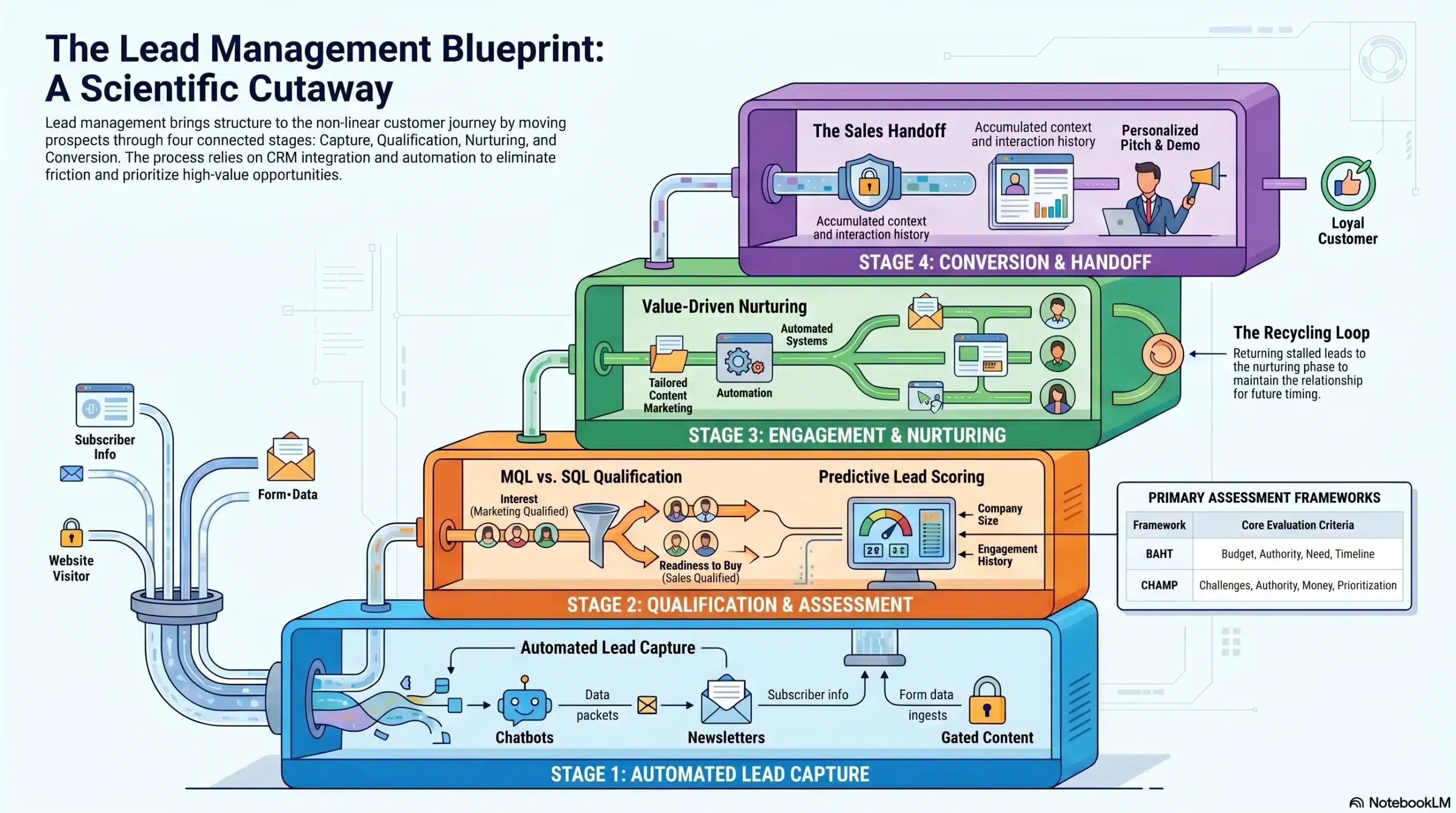
Turning a website visitor into a loyal customer is rarely linear, but lead management brings structure to the process. It moves prospects through four connected stages, using the right strategies and tools to keep them progressing smoothly without friction.
1. Lead Capture
2. Lead Qualification
Lead qualification is the process of evaluating prospects to decide if they fit the ideal customer profile and have an intent to purchase. This step prevents high-value sales personnel from spending time on leads that are unlikely to convert.
Qualification typically involves analyzing demographic data (company size, industry, job title) and behavioral data (website pages visited, email engagement, content downloaded).
Businesses often use frameworks like BANT (Budget, Authority, Need, Timeline) or more modern variations like CHAMP (Challenges, Authority, Money, Prioritization) to standardize this assessment.
Leads are categorized into Marketing Qualified Leads (MQLs) & Sales Qualified Leads (SQLs). An MQL is a prospect who has shown interest and fits the profile but may not be ready to buy, while an SQL is vetted by the sales team and deemed ready for direct engagement.
Advanced lead management systems utilize predictive lead scoring, assigning a numerical value to each lead based on its likelihood to convert, ensuring the best leads are prioritized.
3. Lead Nurturing
A large portion of leads may be in the research phase and require time to reach a decision. Lead nurturing builds relationships with these prospects through consistent and value-driven communication to keep the brand top-of-mind and gently guide the prospect toward a purchasing decision.
Effective nurturing relies heavily on content marketing and marketing automation. Instead of generic emails, businesses use tailored content based on the lead’s industry, role, or previous interactions.
For example, a prospect who downloaded a guide on accounting might receive a follow-up email with tips on “Streamlining Financial Reporting,” whereas a prospect who viewed a pricing page might receive a case study proving ROI.
4. Conversion
The final stage of the lead management process is conversion, where a nurtured lead finally takes the desired action, such as signing a contract or making a purchase. This phase involves the transition from marketing to sales responsibilities and the closing activities performed by the sales team.
At this point, the sales representative uses all the accumulated context—qualification scores, interaction history, and identified needs—to tailor their pitch and overcome objections.
Conversion is not just about the final transaction; it is about the seamless execution of the sales process. This includes scheduling demos, sending proposals, negotiating terms, and finalizing agreements. A robust lead management system ensures that no momentum is lost during this critical phase.
If a lead stalls at this stage, they may be recycled back into the nurturing phase again rather than being discarded, ensuring that the relationship is maintained until the timing is right. Once conversion occurs, the focus shifts to onboarding and retention, completing the cycle.
Key Elements of Effective Lead Management
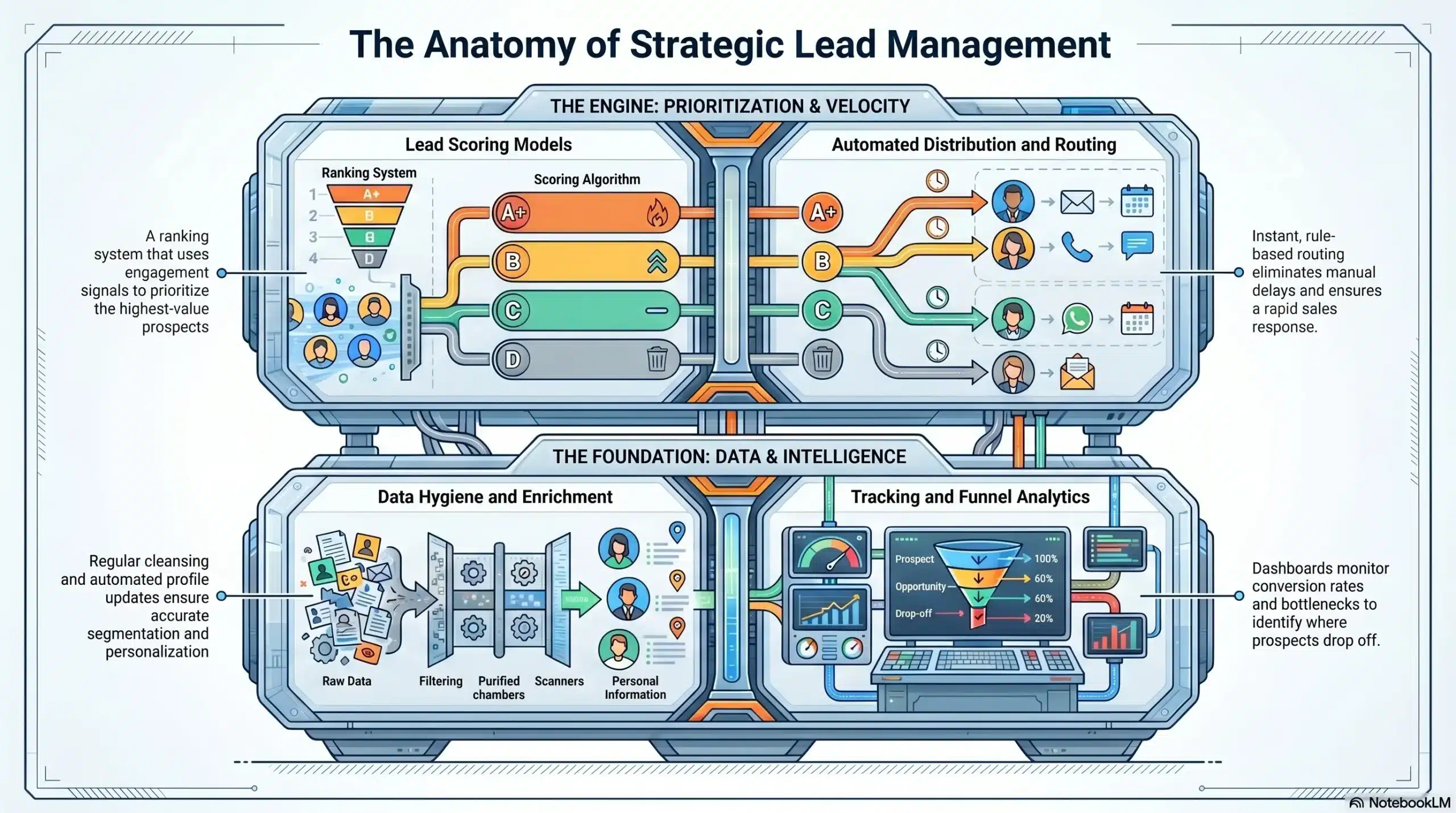
Implementing a lead management strategy requires specific structural elements that enable the system to function efficiently. These elements ensure that data is accurate, communication is timely, and insights are actionable. Without them, even the best-designed process can fail to deliver results.
- Lead Scoring Models
- Lead Distribution and Routing
Lead management automates the distribution that routes leads to the sales representative instantly. Routing rules can be based on geography or other distribution to ensure workload balance. This eliminates the delay of manual assignment, ensuring that a prospect receives a response while their interest is at its peak.
- Tracking and Analytics
A comprehensive analytics dashboard is essential for monitoring the health of the lead management process. Key metrics include lead volume, conversion rates at each funnel stage, average time to close, and cost per lead.
These insights allow management to identify bottlenecks, such as a high drop-off rate between MQL and SQL, and implement corrective measures. Advanced tracking also attributes revenue to specific marketing campaigns, providing more understanding of ROI.
- Data Hygiene and Enrichment
The effectiveness of lead management is directly tied to the quality of data. Duplicate entries, incorrect contact details, and outdated information can paralyze a sales team.
Effective systems incorporate regular data cleansing protocols and enrichment tools that automatically update lead profiles with public information. Clean data ensures that segmentation is accurate and that personalization efforts are effective.
Best Practice to Improve Lead Management
- Establish a Service Level Agreement (SLA)
- Implement Automated Lead Nurturing Workflows
- Prioritize Response Time
- Leverage Lead Management System
- Regularly Review and Refine Lead Scoring
A lead scoring model must be reviewed regularly, as markets and buyer behavior change. Companies should reassess criteria quarterly, using insights from successful deals to refine scoring rules. Ongoing adjustments keep the definition of a quality lead aligned with real sales outcomes.
- Omnichannel Attribution and Management
Modern buyers move across devices and channels, such as clicking an ad on Instagram and chatting on a website. Advanced lead management connects these touchpoints into a single profile through a Customer Data Platform (CDP), ensuring consistent messaging everywhere.
- Integration of Third-Party Intent Data
- AI-Driven Predictive Lead Scoring
Essential Metrics and KPIs

To evaluate the health of a lead management system, businesses must look beyond irrelevant metrics and shift to efficiency, velocity, and revenue contribution. The following KPIs provide a granular view of performance.
- Lead Velocity Rate (LVR)
LVR measures the real-time growth of qualified leads month-over-month. A consistently positive LVR suggests that the sales pipeline will expand in the coming months. It is calculated as: (Current Month Qualified Leads – Last Month Qualified Leads) / Last Month Qualified Leads * 100.
- Marketing Contribution to Pipeline
This metric answers the question: “What percentage of the sales pipeline originated from marketing efforts?” In high-performing B2B businesses, this figure often exceeds 40-50%. It validates the ROI of marketing spend and its effectiveness.
- Lead-to-Opportunity Conversion Rate
- Time to Conversion (Sales Cycle Length)
Effective lead management should shorten the sales cycle. By nurturing leads with the right information before they speak to sales, the prospect should be more educated and ready to buy. Tracking the average days from first interaction to closed deals helps measure the efficiency of the nurturing tracks.
- Cost Per Pipeline Opportunity
Cost Per Pipeline Opportunity is a more accurate financial metric than Cost Per Lead (CPL), calculated by: Total Marketing Spend ÷ Number of Leads That Became Sales Opportunities. This ensures marketing is incentivized to generate quality, not just quantity.
How CRM Platforms Help Manage Leads for B2B Businesses in Australia
Lead management is especially important for B2B businesses, where sales cycles are longer and involve multiple decision-makers. According to the Green Hat/AMI B2B Marketing Research Report 2021, only 34% of businesses have a lead management process aligned across the full funnel.
This gap shows why CRM software is valuable for B2B businesses in Australia. CRM platforms help manage leads by automating workflows, centralising data, and improving coordination between marketing and sales teams.
They also help businesses track interactions, assign leads faster, and improve follow-up. This creates a more consistent sales process and supports long-term growth.
Common Pitfalls and Mitigation Strategies
Even with sophisticated tools, lead management initiatives often fail due to human and process errors. Recognizing these pitfalls early is essential for long-term success.
1. The “Black Hole” of Data
Leads enter the system but are never acted upon because they don’t fit a specific assignment rule, or the assigned sales rep has left the company. These unmanaged leads represent your wasted budget.
2. Dirty Data and Duplicates
A prospect fills out a form using a personal email, then later uses a work email. The system creates two records. The sales rep calls the first one, gets no answer, and marks it “dead,” unaware that the prospect is actively engaging via the second record.
Use tools that automatically detect and merge duplicate contacts, even if the email addresses are different but the name and company match. Also, tighten your form rules, such as blocking free emails like Gmail for B2B forms, to ensure cleaner, more reliable data.
3. Over-Automation
Excessive automation can dehumanize the process. A lead asks a specific question via email, but the system replies with a generic “Thanks for downloading” auto-responder. This destroys trust.
Set up “break logic.” If a lead replies to an automated email, the automation should pause immediately, and a task should be created for a human to review the response. Automation should support human interaction, not replace it entirely.
4. The Marketing-Sales Handoff Fumble
Marketing nurtures a lead perfectly, but when it is passed to sales, the rep has no context. They call the prospect and ask basic qualification questions that the prospect has already answered in a form. The prospect feels frustrated and misunderstood.
Ensure the CRM view for sales reps shows exactly which pages were visited, which emails were opened, and what form data was submitted before the rep makes the call. The conversation should start with, “I saw you were interested in our X solution,” rather than “Tell me what you do.”
Conclusion
Lead management is a strategic system that turns interest into revenue. Clear lead processes, clean data, and strong sales-marketing alignment help reduce wasted effort and improve conversions.
Businesses that treat lead management as an ongoing process perform better than those with a one-time setup. Continuous tracking and improvements help teams adapt faster and focus on high-value opportunities.

Frequently Asked Question
A lead manager oversees how enquiries are captured, tracked, qualified, and handed to sales. Their role is to improve follow-up speed, lead quality, and conversion rates.
Lead management is important for both B2B and B2C businesses. B2B often involves longer sales cycles, while B2C focuses on faster responses and high-volume enquiries.
Alignment ensures both teams agree on what qualifies as a lead and how it should be handled. This improves follow-up speed, lead quality, and overall revenue performance.
CRM software stores lead data, tracks interactions, automates follow-ups, and improves visibility across the sales funnel. It helps businesses manage leads more efficiently.
The three common types of leads are Marketing Qualified Leads (MQLs), Sales Qualified Leads (SQLs), and Product Qualified Leads (PQLs). Each type reflects a different stage of buying intent.