










Cold storage warehouses are temperature-controlled facilities that store perishable goods and pharmaceuticals within defined temperature ranges, from +4°C for chilled produce down to −40°C for blast freezing.
They operate through a tightly controlled cycle of receiving, zone assignment, stock rotation, continuous monitoring, and dispatch. Every stage must preserve temperature integrity without exception.
In Australia, FSANZ food safety standards and TGA cold chain guidelines make temperature control a legal obligation for food and pharmaceutical operators, not just a quality measure.
Key Takeaways
Cold storage warehouse is a temperature-controlled facility maintaining conditions from +4°C down to −40°C, serving industries from fresh produce distribution to pharmaceutical manufacturing.
Five facility types: chill rooms, freezer stores, blast freezers, controlled atmosphere storage, and pharmaceutical cold rooms.
WMS for cold storage can automate FEFO rotation, integrates temperature logs with lot records, and delivers real-time visibility across all zones.
Australian compliance requirements: FSANZ Standard 3.2.2, TGA cold chain guidelines, and HACCP programmes can all apply to the same facility simultaneously

What Is a Cold Storage Warehouse?

A cold storage warehouse is a temperature-controlled facility purpose-built to store perishable goods, pharmaceuticals, and other temperature-sensitive products within strictly defined temperature ranges.
Industrial refrigeration systems, insulated panel construction, and continuous environmental monitoring maintain those conditions 24 hours a day, 365 days a year, regardless of ambient conditions outside.
Temperature accuracy is non-negotiable. A single-degree deviation can compromise an entire pallet of pharmaceutical product or accelerate protein spoilage beyond recoverable limits.
Cold storage facilities serve a broad range of Australian industries: fresh produce distribution, dairy, frozen seafood, meat processing, pharmaceutical manufacturing, vaccine cold chains, and online grocery fulfilment.
Each sector carries its own temperature specifications, handling requirements, and compliance obligations. The product type determines which regulations apply and how the facility must be designed and operated.

Types of Cold Storage Warehouses
Not all cold storage facilities operate at the same temperature. Five main types serve distinct product categories, each with different infrastructure requirements and compliance implications.
Understanding which type applies to your operation determines your facility design, the regulatory body with authority over your processes, and the documentation systems you need to maintain.
| Type | Temperature Range | Typical Use (Australia) |
|---|---|---|
| Chill room | 0°C to +4°C | Fresh produce, dairy, deli products, chilled beverages |
| Freezer store | −18°C to −25°C | Frozen seafood, meat, ice cream, frozen prepared meals |
| Blast freezer | −30°C to −40°C | Rapid freezing of fresh protein, seafood, and high-value produce |
| Controlled atmosphere | 0°C to +4°C + modified gas | Apples, pears, stonefruit, fresh berries for export |
| Pharmaceutical cold room | +2°C to +8°C | Vaccines, biologics, TGA-listed therapeutic goods |
1. Chill Room
Chill rooms store fresh produce, dairy, deli products, and chilled beverages within the 0°C to +4°C range. They are the most common single-zone facility in Australian food distribution operations.
2. Freezer Store
Freezer stores maintain −18°C to −25°C for frozen seafood, meat, ice cream, and frozen prepared meals. These are the backbone of Australia’s frozen food supply chain and the most widely operated commercial freezer type.
3. Blast Freezer
Blast freezers rapidly freeze fresh protein, seafood, and high-value produce at −30°C to −40°C. Speed of freezing is critical: slower freezing damages cell structure and degrades product quality and shelf life.
4. Controlled Atmosphere Storage
Controlled atmosphere storage combines 0°C to +4°C temperatures with a modified gas environment, reducing oxygen and increasing carbon dioxide to slow respiration and extend shelf life.
This type is used almost exclusively for export-grade horticultural products: apples, pears, stonefruit, and fresh berries destined for Asian markets.
5. Pharmaceutical Cold Room
Pharmaceutical cold rooms maintain the TGA-mandated +2°C to +8°C range for vaccines, biologics, and other TGA-listed therapeutic goods.
These rooms require validated monitoring equipment, qualified facility design, and calibrated continuous temperature logging, separate from food storage zones in multi-product facilities.
Most large-scale Australian facilities operate multiple temperature zones under one roof. Efficient from a logistics standpoint, but every additional zone adds separate monitoring, records, and compliance obligations.
Facilities handling both food and pharmaceutical products must satisfy FSANZ food safety standards and TGA cold chain guidelines simultaneously, within the same physical operation.
Why Cold Storage Demand Is Growing in Australia
Australia’s cold storage sector is under sustained pressure from demand from three industries converging simultaneously. CBRE Australia consistently ranks cold storage among the tightest industrial asset classes nationally.
Sustained low vacancy rates across Sydney, Melbourne, Brisbane, and Perth reflect a supply pipeline that has not expanded fast enough to match demand from multiple growth sectors at once.
According to the Australian Bureau of Statistics, food and agricultural export volumes continue to grow year-on-year, compounding demand for cold chain infrastructure across the supply chain.
1. Fresh Food Exports
Australia exports significant volumes of chilled and frozen protein, dairy, and horticultural products to Asian markets. Each consignment requires temperature-controlled storage at origin before being shipped by refrigerated sea or air freight.
Export volume growth translates directly into cold storage demand at port-adjacent logistics precincts in every major capital city, with no equivalent growth in purpose-built supply.
2. Pharmaceutical Distribution
Post-pandemic vaccine rollout infrastructure has permanently expanded Australia’s validated pharmaceutical cold chain. Biosimilar growth is sustaining this demand well beyond the COVID period.
Increased in-country pharmaceutical manufacturing and a growing volume of biologics entering the supply chain mean purpose-built pharmaceutical cold storage remains structurally undersupplied.
3. Online Grocery Fulfilment
E-commerce grocery platforms run dedicated chilled and frozen fulfilment centres separate from ambient distribution. These require more cold storage footprint per revenue dollar than traditional retail supply chains.
The model demands dense, highly accessible cold storage in metropolitan locations, intensifying pressure on an asset class that is already undersupplied across Australia’s major capital cities.
For operators managing existing facilities, this supply constraint makes operational efficiency inside the four walls more commercially valuable than at any previous point in the industry’s history.
How Does a Cold Storage Warehouse Work?
A cold storage warehouse runs on a tightly controlled operational cycle. A break anywhere in the chain can mean product loss, a regulatory notification, or a recall event.
This five-stage cycle applies whether you are running a single-temperature chill room or a multi-zone distribution centre handling multiple product classes simultaneously.
1. Receiving
Inbound goods arrive at a temperature-controlled dock. Products are scanned, assigned a lot number, and temperature-checked on arrival.
Most facilities target under 20 minutes of ambient exposure before temperature-sensitive product enters a controlled zone. Arrival temperature is documented and linked to the inbound lot record.
2. Zone Assignment
Each product class has a designated temperature zone. WMS slotting logic assigns storage locations based on product type, rotation priority, and expiry date.
High-velocity SKUs go to accessible locations near dispatch. Slow-moving stock is positioned higher or further back, where pick frequency is lower and retrieval time matters less.
3. Stock Rotation
Cold storage operations use First-In-First-Out (FIFO) or, for perishables with expiry dates, First-Expiry-First-Out (FEFO) rotation.
FEFO ensures the soonest-expiring product is always picked first, regardless of which location is most accessible to the picker at the time of the pick.
Manual FEFO compliance is unreliable under time pressure. It is the most common source of write-offs in cold storage facilities that have not automated this step with a warehouse management system.
4. Continuous Temperature Monitoring
Sensors in each zone log readings at defined intervals, typically every 5 to 15 minutes. Automated alerts notify supervisors immediately when a zone deviates beyond its configured tolerance.
Temperature logs are retained as compliance records. Both FSANZ and TGA require records that are traceable to specific product lots, not just to a zone or a date range.
5. Dispatch
Picked orders are consolidated and loaded into refrigerated vehicles. Cold chain handover documentation accompanies each outbound shipment, including temperature records for the full storage period.
This documentation is the final link in the compliance chain before product leaves your facility. Any gap at this stage creates regulatory exposure at the handover point.
Key Features of a Cold Storage Warehouse
Well-designed cold storage facilities share five infrastructure features that determine whether they can reliably maintain product integrity and meet compliance requirements.
Each one is an operational baseline. Missing any of them compromises product safety, regulatory compliance, or both.
1. Refrigeration and Temperature Monitoring
Industrial cold storage uses ammonia-based or hydrofluorocarbon (HFC) refrigerant systems. Compressor racks distribute cooling capacity across multiple temperature zones.
The refrigeration system must deliver consistency, not just raw cooling power. Zone temperatures must remain stable within tight tolerances even when dock doors open or ambient conditions change.
IoT temperature sensors throughout each zone transmit continuous readings to a central monitoring platform. Pharmaceutical cold rooms typically require validated monitoring equipment, not commercial-grade thermometers.
Temperature deviation alerts are configured for both supervisors and on-call maintenance staff, with escalation protocols for sustained deviations that trigger product disposition decisions.
2. Thermal Insulation and Cold Room Construction
Cold room panels, polyurethane foam or polystyrene sandwiched between metal facings, form the thermal barrier between zones and between the facility and outside conditions.
Vapour barriers prevent condensation from penetrating panel joints and causing long-term structural degradation. Loading dock design is where most thermal leakage occurs in practice.
Dock levellers, dock seals, and rapid-roll doors reduce the volume of warm, humid air entering the facility during receiving and dispatch operations, protecting both energy efficiency and zone temperatures.
3. Reliable Backup Power System
A power failure in a cold storage facility is not just an inconvenience. It is a potential product-loss event and, for pharmaceutical operators, a regulatory notification trigger.
Uninterruptible power supplies (UPS) protect monitoring and control systems during brief outages. Diesel generators provide sustained backup refrigeration for longer events.
Documented power failure response protocols, covering action thresholds, monitoring requirements during the event, and product disposition criteria, are a standard HACCP cold chain prerequisite.
4. Inventory and Stock Management System
Capturing lot numbers, expiry dates, quantity, and location at every stock movement is the foundation of cold chain traceability. Barcode or RFID scanning at receipt, pick, and dispatch builds that complete record.
At small volumes, paper-based or spreadsheet systems can manage this. Above a few hundred active SKUs, a warehouse management system becomes the practical requirement, not an optional upgrade.
Facilities managing multiple product classes with different rotation rules, temperature zones, and expiry profiles need a WMS to maintain accuracy across every movement and every shift.
5. Security and Access Control
Cold storage facilities restrict zone access for both compliance and safety reasons. Validated pharmaceutical cold rooms require documented access logs covering who entered the zone and when.
CCTV coverage of storage and dispatch areas is standard in any facility operating under food safety or pharmaceutical regulatory frameworks.
SafeWork Australia’s model Work Health and Safety Regulations govern cold environment PPE requirements for staff in frozen zones, including mandatory break schedules and PPE provision.
Cold Storage Warehouse Challenges
Even well-designed cold storage facilities face persistent operational challenges. Understanding where the risks concentrate helps operators prioritise the systems and procedures that matter most.
1. High Energy and Operating Costs
Refrigeration systems run continuously. Cold storage is one of the most energy-intensive industrial operations in Australia, and refrigeration typically accounts for the largest share of ongoing operating costs.
Strategies to manage energy consumption include variable-speed drives on compressor motors, LED lighting with motion controls, heat reclaim systems, and demand response programmes with energy retailers.
Automated defrost cycles timed to off-peak periods reduce peak-demand charges without compromising product temperatures, delivering meaningful savings in high-tariff capital city markets.
2. Space Optimisation and Slotting Efficiency
Cold storage space costs more to build and more to run than ambient warehousing. Wasted vertical space, poor slotting, and dead stock occupying prime picking locations all carry a hidden operating cost.
Regular slotting analysis matches high-velocity SKUs to ground-level accessible locations and repositions slow-moving product to upper storage positions, recovering usable capacity without capital expenditure.
It also reduces pick travel time, which matters more in a freezer room at minus 22°C than in an ambient warehouse where cold is not a physical factor for operators.
3. Regulatory Compliance Complexity
Australian operators managing both food products and pharmaceutical goods face overlapping regulatory obligations simultaneously: FSANZ Standard 3.2.2, TGA cold chain guidelines, and HACCP prerequisite programmes.
Maintaining temperature logs, traceability records, and product disposition documentation across multiple systems creates compliance risk, particularly during staff transitions or unplanned temperature events.
A missed record or incomplete temperature log can jeopardise a facility’s food safety certification on inspection. The documentation gap, not the deviation itself, is often what triggers a finding.
4. Equipment Maintenance and Downtime Risk
Refrigeration equipment failure does not generate a maintenance ticket. It generates a potential stock-loss event and, for pharmaceutical operators, a regulatory notification requirement.
Preventive maintenance programmes for compressors, condensers, and evaporator coils are standard practice. Scheduling them without disrupting a 24/7 operation requires careful planning.
Most operators handling pharmaceutical or high-value perishable product maintain service contracts with 24/7 emergency callout provisions. The cost of a compressor failure vastly exceeds the annual contract cost.
5. Workforce Safety in Cold Environments
Sustained work in frozen conditions presents genuine health risks: hypothermia, cold burns on exposed skin, and musculoskeletal strain from operating heavy PPE while handling pallets.
SafeWork Australia’s model Work Health and Safety Regulations require cold environment risk assessments, mandatory break schedules with access to warming facilities, and appropriate PPE provision.
These requirements are well understood but inconsistently applied in high-throughput facilities operating under delivery pressure. Non-compliance creates both regulatory exposure and real harm to the workforce.
How WMS Software Improves Cold Storage Management
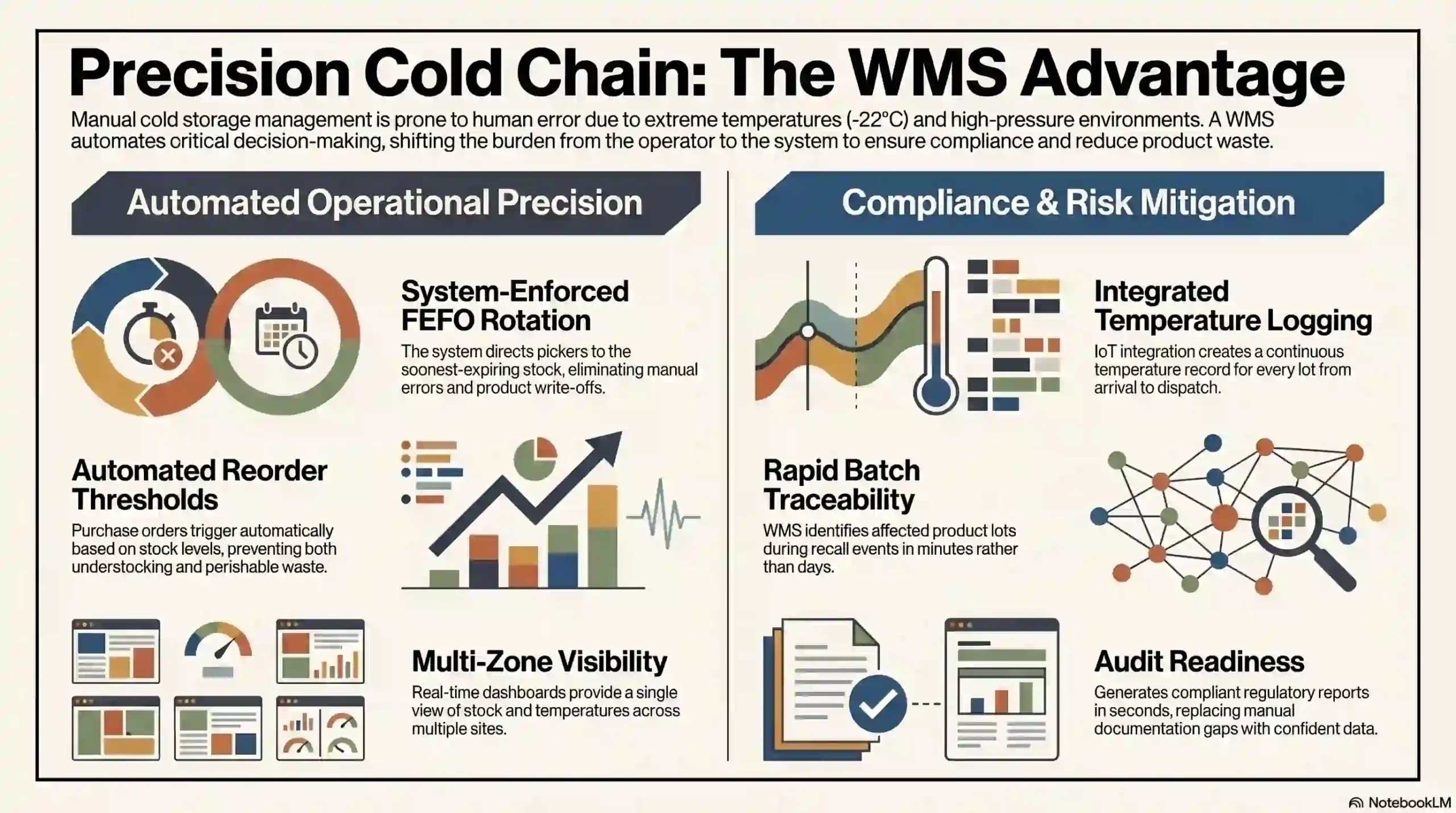
The storage management tool addresses the operational limits of manual cold storage management. It automates the decisions that carry the most risk when done inconsistently under time pressure.
1. FEFO-Driven Stock Rotation
In a manual system, FEFO compliance depends on pickers identifying and choosing the soonest-expiring stock correctly, every time, in a freezer room at −22°C, under pick rate pressure.
A WMS enforces FEFO at the system level. The pick instruction directs the operator to the specific location containing the soonest-expiring lot. The picker does not make that decision; the system does.
This eliminates the most common cause of cold storage write-offs: product expiring in storage because a more accessible pallet with a later date was picked first.
2. Temperature Log Integration
Modern WMS platforms integrate with IoT monitoring systems, associating temperature readings with specific stock movements and storage periods. Every lot number accumulates a temperature record from arrival to dispatch.
When a FSANZ inspector or TGA auditor requests temperature records for a specific product on a specific date, the report generates in seconds.
That is not just an efficiency gain. It is the difference between a confident audit response and a documentation gap that creates a compliance finding.
3. Lot and Batch Traceability
When a recall event occurs, the regulatory clock starts immediately. A WMS with full lot traceability identifies within minutes which customer deliveries contained product from an affected lot.
Without it, operators reconstruct movement records manually from disparate sources. That process takes days, introduces errors, and happens at exactly the moment when the operation is under maximum external pressure.
4. Automated Reorder Thresholds
Perishable stock management is unforgiving in both directions. Understocking means missed orders with no quick replacement; overstocking on short-shelf-life product means write-offs.
A WMS tracks stock levels against minimum and maximum thresholds and triggers purchase orders automatically, with parameters set per product and temperature class.
Operators configure the rules once and the system runs them. That removes human judgement from a decision where inconsistency directly generates waste.
5. Multi-Zone Visibility
Operators running facilities with multiple temperature zones, or multiple sites across different states, need consolidated visibility across all of them in real time.
A WMS provides a single operational view of stock levels, expiry profiles, zone temperatures, and pick performance across chill rooms, freezer rooms, and pharmaceutical cold rooms.
No manual stock counts. No spreadsheet consolidation. One dashboard covers the entire cold storage operation, regardless of how many zones or sites are involved.
Cold Chain Compliance Requirements in Australia
Australian cold storage operators navigate compliance obligations from multiple regulatory bodies. In many facilities, more than one framework applies at the same time.
1. FSANZ Standard 3.2.2 Food Safety Practices
FSANZ Standard 3.2.2 applies to food businesses including cold storage and distribution operations.
It requires documented temperature control during storage and transport, product traceability records, and demonstrated recall capability at the lot level.
2. TGA Cold Chain Management Guidelines
TGA Cold Chain Management Guidelines apply to manufacturers, distributors, and storage operators of TGA-listed therapeutic goods.
Key requirements include a validated temperature range of +2°C to +8°C for biologics and calibrated continuous monitoring throughout the storage and distribution chain.
3. HACCP Cold Chain Prerequisite Programmes
HACCP cold chain prerequisite programmes apply to all food businesses handling temperature-sensitive products.
Requirements include hazard identification, critical control points with defined limits, corrective action documentation, and ongoing verification procedures.
Conclusion
A cold storage warehouse is only as reliable as the systems running inside it. Manual processes introduce the risk that costs operators the most: FEFO failures, incomplete temperature records, and slow recall responses.
For Australian operators, a cold storage WMS is the practical requirement for a compliant and efficient facility, not a future investment. This is especially true for business that requires a scalable storage solution to operate.
If you are interested in this subject and want to learn more, you can book a free consultation with us for free. Start today and learn vital business insights.
Frequently Asked Questions
-
What is the difference between a cold storage warehouse and a refrigerated warehouse?
The terms are often used interchangeably. “Refrigerated warehouse” covers any facility with mechanical cooling, while “cold storage warehouse” refers to a purpose-built commercial facility with multiple temperature zones and documented FSANZ or TGA compliance systems.
-
What temperature is maintained in a cold storage warehouse?
Temperature depends on the product class: chilled rooms run at 0°C to +4°C, freezer stores at −18°C to −25°C, blast freezers at −30°C to −40°C, and pharmaceutical cold rooms at +2°C to +8°C. Most large Australian facilities maintain multiple zones, each monitored independently.
-
How much does cold storage cost in Australia?
Third-party rates in Australian capital cities range from $8 to $18 per pallet per week for chilled product and $15 to $30 for frozen storage. Rates vary by location, volume, and service level, with ongoing energy and maintenance adding to operating costs.
-
Is cold storage a good investment in Australia?
Australian cold storage is among the tightest industrial asset classes nationally, with demand structurally undersupplied. Pharmaceutical distribution, fresh food exports, and online grocery fulfilment are the primary growth drivers, supporting stronger yields than comparable ambient warehousing.
-
What are Australia’s cold chain compliance requirements?
Operators must comply with FSANZ Standard 3.2.2 for food products and TGA Cold Chain Management Guidelines for therapeutic goods. Both frameworks require documented temperature records, lot-level traceability, corrective action procedures, and demonstrated recall capability.
-
What software is used to manage cold storage warehouses?
Cold storage warehouses use a WMS to automate FEFO rotation, integrate temperature logs with stock records, and maintain lot traceability. A capable WMS delivers real-time visibility across all temperature zones and generates audit-ready compliance reports for FSANZ and TGA.