















Punch list is a construction checklist used to record incomplete tasks, defects, or minor repairs that must be finished before a project reaches final handover. It helps contractors, project managers, and clients track outstanding work and ensure practical completion runs smoothly.
Construction projects rarely finish in one clean sweep. Doors stick, lights flicker, and skirting boards need a touch-up before the keys change hands.
A punch list captures every one of those small issues so nothing slips through to handover. For Australian builders, it is the difference between a smooth practical completion and a project that drags weeks past the agreed date.
This guide provides an integrated construction system overview, covering what a punch list is, how it differs from a defect or snag list, and how to manage closeout. You will also find ready-to-use templates for residential, commercial, and practical-completion scenarios.
Key Takeaways
A punch list captures every incomplete or defective item identified during construction closeout, keeping practical completion on schedule.
Punch lists, defect lists, and snag lists each play a different role across the build, the contract, and the defects liability period.
A strong punch list template needs project details, location, responsible trade, priority, status, and photo evidence to be useful in the field.
Centralised, mobile-ready punch list tools beat scattered spreadsheets for coordination, accountability, and faster handover sign-offs.
What Is a Punch List?
A punch list is a single document that records every incomplete or defective item identified during a project’s closeout. Site supervisors, project managers, and clients use it to track work that still needs attention before practical completion.
The term comes from the old practice of punching a hole next to each completed task on a paper checklist. The purpose remains the same today: capture issues, assign trades, and confirm rectification.
In short, the punch list keeps everyone honest about what still needs to be done. Without one, small issues pile up and become disputes during the final walkthrough.
Punch List vs Defect List vs Snag List
These three documents often get mixed up on Australian sites, but each one plays a slightly different role. Understanding the difference keeps records clean and contractual obligations clear.
A punch list is created near the end of construction and lists every outstanding work item the contractor needs to address. It covers both incomplete works and minor defects discovered during inspection.
A defect list focuses on faulty or substandard work that fails to meet contract requirements. Defects can appear at practical completion or during the 12-month defects liability period under standard Australian contracts.
A snag list is the term used more widely in the UK and Ireland, but it appears on some Australian sites too. It covers small cosmetic issues like paint touch-ups, scratches, and minor adjustments.
Why Punch Lists Matter in Construction Closeout

Closeout is critical for managing construction projects effectively, especially at the final stage of a build. Trades are demobilising, the client is waiting for keys, and small oversights can quickly turn into delayed payments or disputes.
Help teams catch incomplete or defective work before handover
A punch list gives the supervisor a structured way to walk every room and flag issues before the client does. Documenting each item with a photo and assigned trade prevents defects from surfacing only after the owner moves in.
Improve accountability across contractors and subcontractors
When every item has a name attached, accountability becomes obvious. Subcontractors see their jobs, the project manager tracks progress without chasing emails, and the head contractor has one source of truth.
Reduce delays during practical completion and final inspection
Practical completion hinges on how quickly outstanding items get closed out. A live punch list reduces back-and-forth between trades and the superintendent, so inspections move faster and handover dates hold firm.
Create a clearer record for follow-up and rectification
Defects can reappear during the rectification period, even after practical completion. A maintained punch list becomes the record that proves what was identified, who fixed it, and when, protecting everyone if a dispute arises.
When to Use a Punch List During a Construction Project
Punch lists are used across key construction project phases, not just at the end of a build. The strongest projects keep them running through several touchpoints from late construction through to closeout.
Before practical completion
In the weeks leading up to practical completion, the head contractor walks the site to identify outstanding works. This early pass lets trades finish jobs while still mobilised, which is far cheaper than calling them back later.
During site inspections and walkthroughs
Each formal inspection by the architect, surveyor, or client representative generates new items. Capturing them in real time on a tablet keeps the record current and avoids forgotten verbal feedback.
Before client handover
Just before keys change hands, the project team and client conduct a final walkthrough. Remaining issues join the punch list with agreed dates, so the client signs off knowing exactly what will be rectified.
During defect rectification and closeout follow-up
Once practical completion is reached, the document continues into the defects liability period. New defects raised by the owner get added, tracked, and closed against the same record for a complete history.
What Should a Construction Punch List Include?
A punch list works only if it captures enough detail for trades to act without follow-up calls. The fields below are the minimum every well-run construction punch list should contain.
Project details and inspection information
Each list should open with the project name, address, contract number, inspector, and date of inspection. This makes the document defensible if it is ever referenced in a dispute or claim.
Item description and exact location
Vague entries like ‘fix paint’ cause more problems than they solve. Each item should describe the issue and pinpoint the location, for example ‘Bedroom 2, north wall, paint chip near skirting’.
Responsible trade or subcontractor
Every item must be assigned to a specific trade or subcontractor. This removes the ‘not my job’ defence and gives the project manager a clear path for follow-up.
Priority level and target completion date
Some items are urgent like a leaking pipe, while others are cosmetic like a scuffed door frame. Assigning a priority and target date helps trades sequence their work and keeps closeout moving.
Completion status and verification details
Each entry needs a status field (open, in progress, complete) and a verification box for the inspector to sign off. This double-check keeps standards high right through to closeout.
Notes, comments, and photo reference
Photos remove ambiguity faster than any written description. A good punch list attaches before-and-after images to each item, plus space for trade or supervisor notes.
Punch List Template for Australian Construction Projects
Templates, alongside recommended software options for builders, make life easier when running multiple projects. Below are six punch list templates tailored for the most common Australian construction scenarios.

Construction Punch List Template
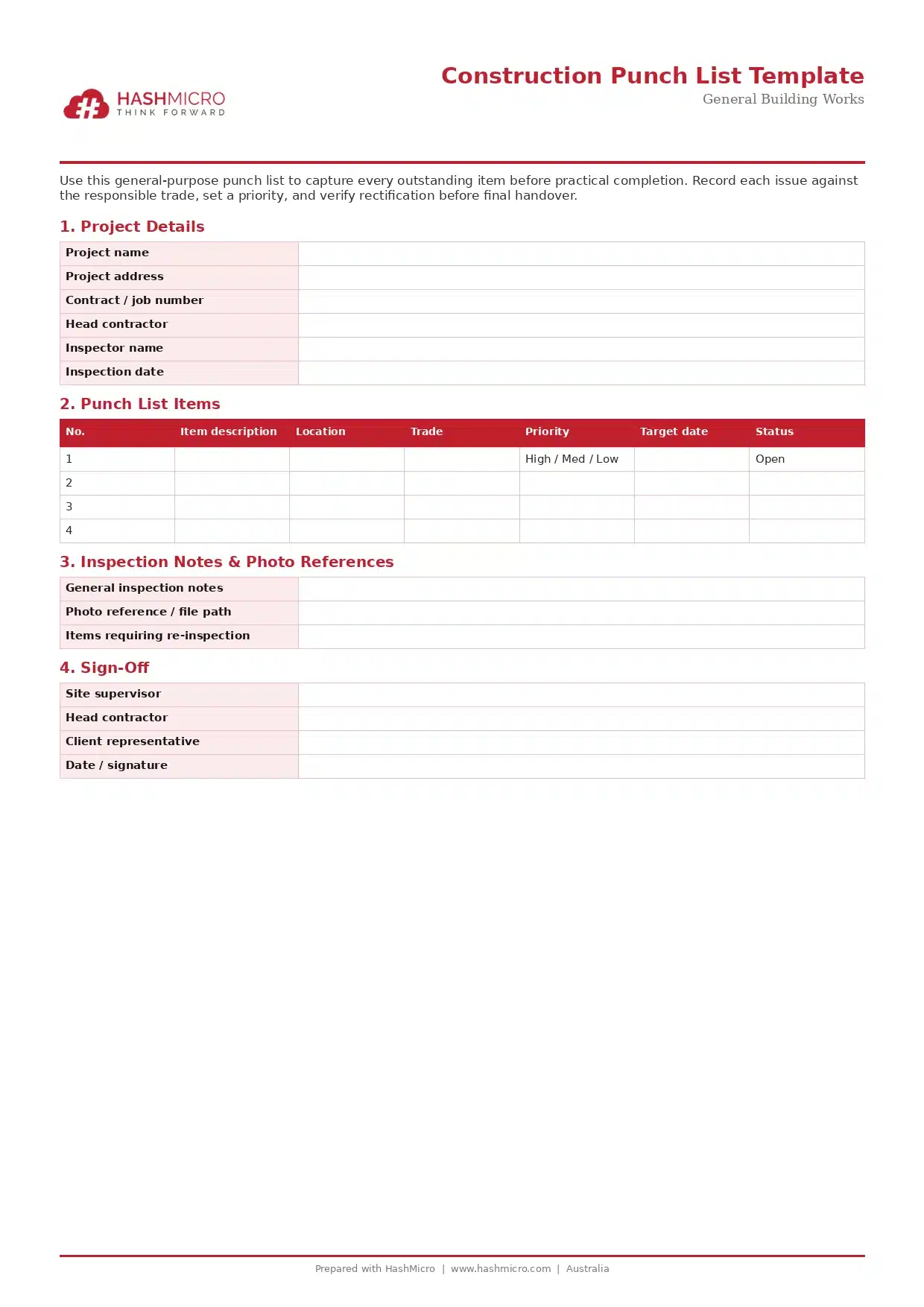
A general-purpose template suited to most building works. It includes project details, item descriptions, location fields, responsible trades, priority levels, and verification columns.
Construction Punch List Template
Residential Punch List Template
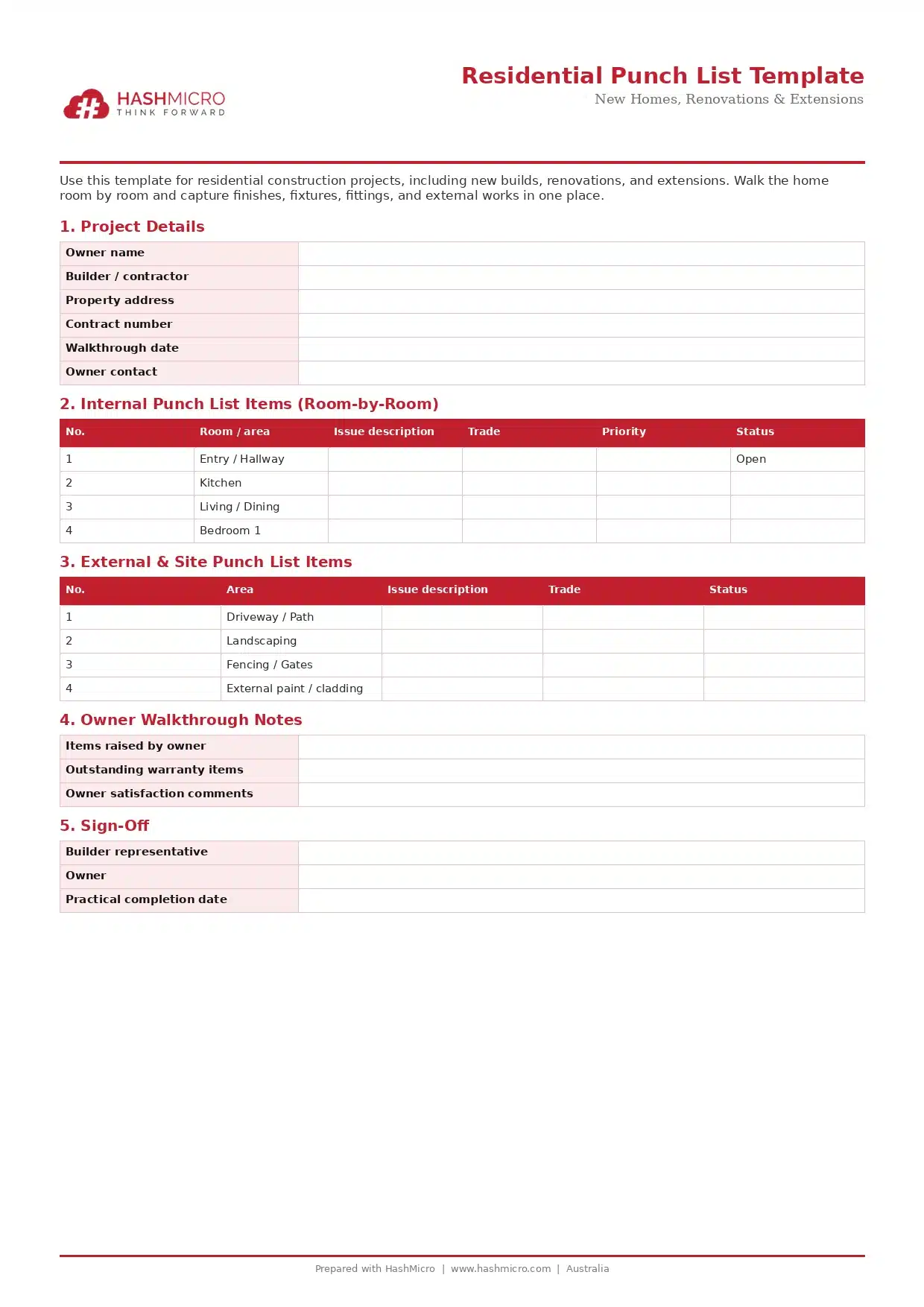
Built for new home builds, renovations, and extensions. Sections cover finishes, fixtures, fittings, and external works, with extra space for owner walkthrough notes.
Residential Punch List Template
Commercial Punch List Template
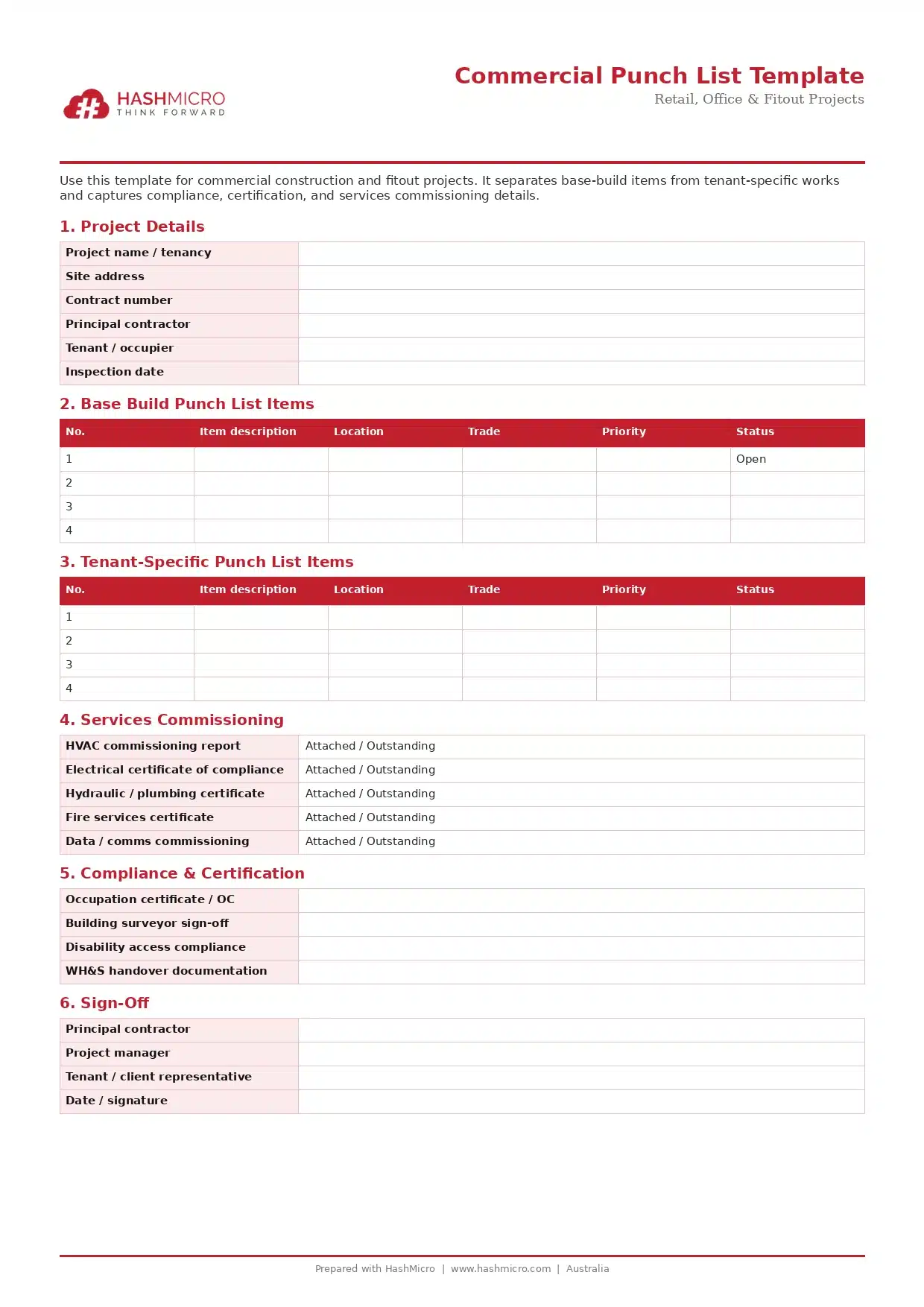
Designed for retail, office, and fitout projects. It separates base-build items from tenant-specific works and includes fields for compliance, certification, and services commissioning.
Commercial Punch List Template
Practical Completion Punch List Template
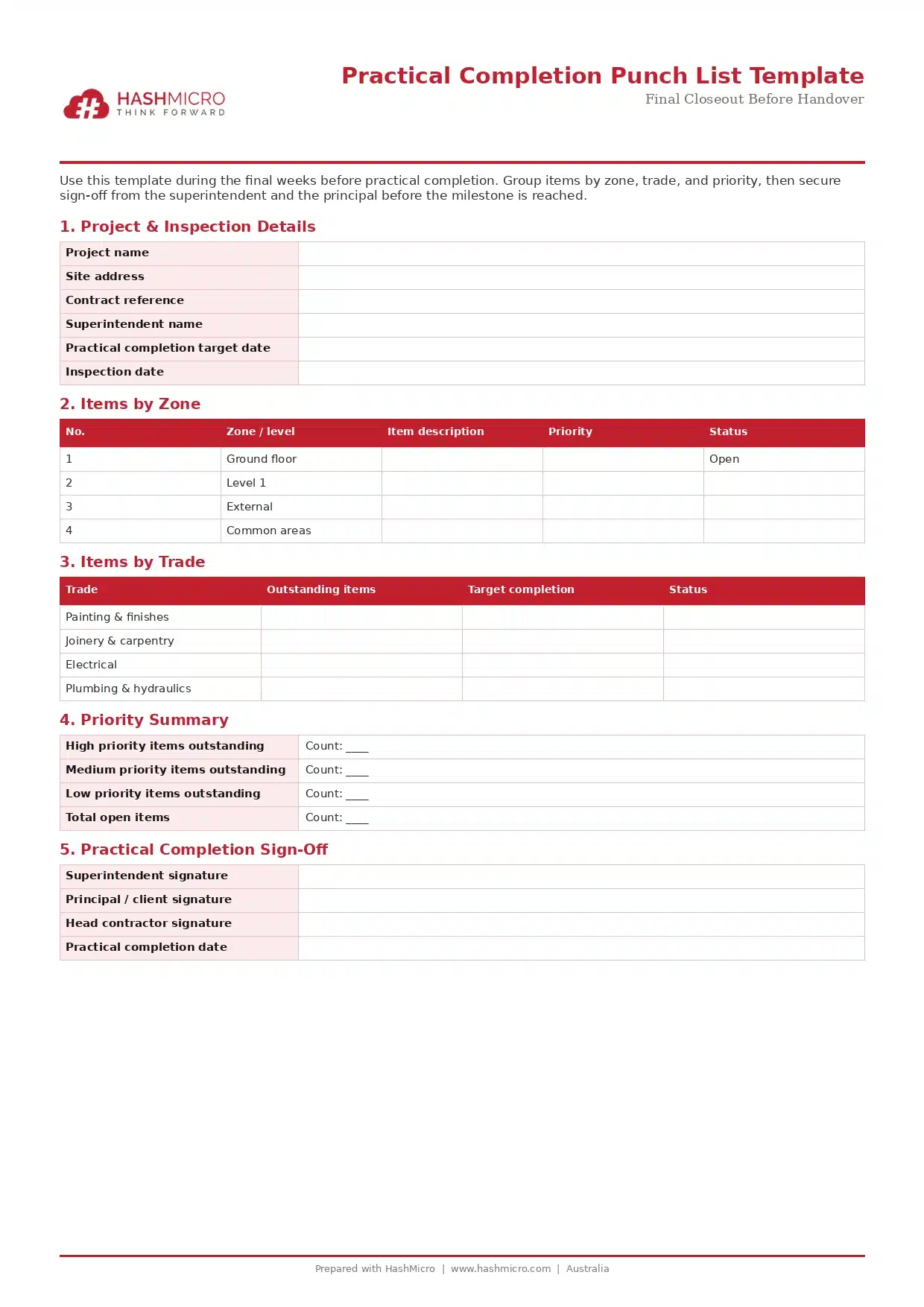
Used during the final weeks before practical completion. It groups items by zone, trade, and priority, with sign-off columns for the superintendent and the principal.
Practical Completion Punch List Template
Defect Rectification Tracker
A focused template for use during the defects liability period. It tracks each defect raised after practical completion, the rectification date, and the trade responsible.
Defect Reactification Tracker
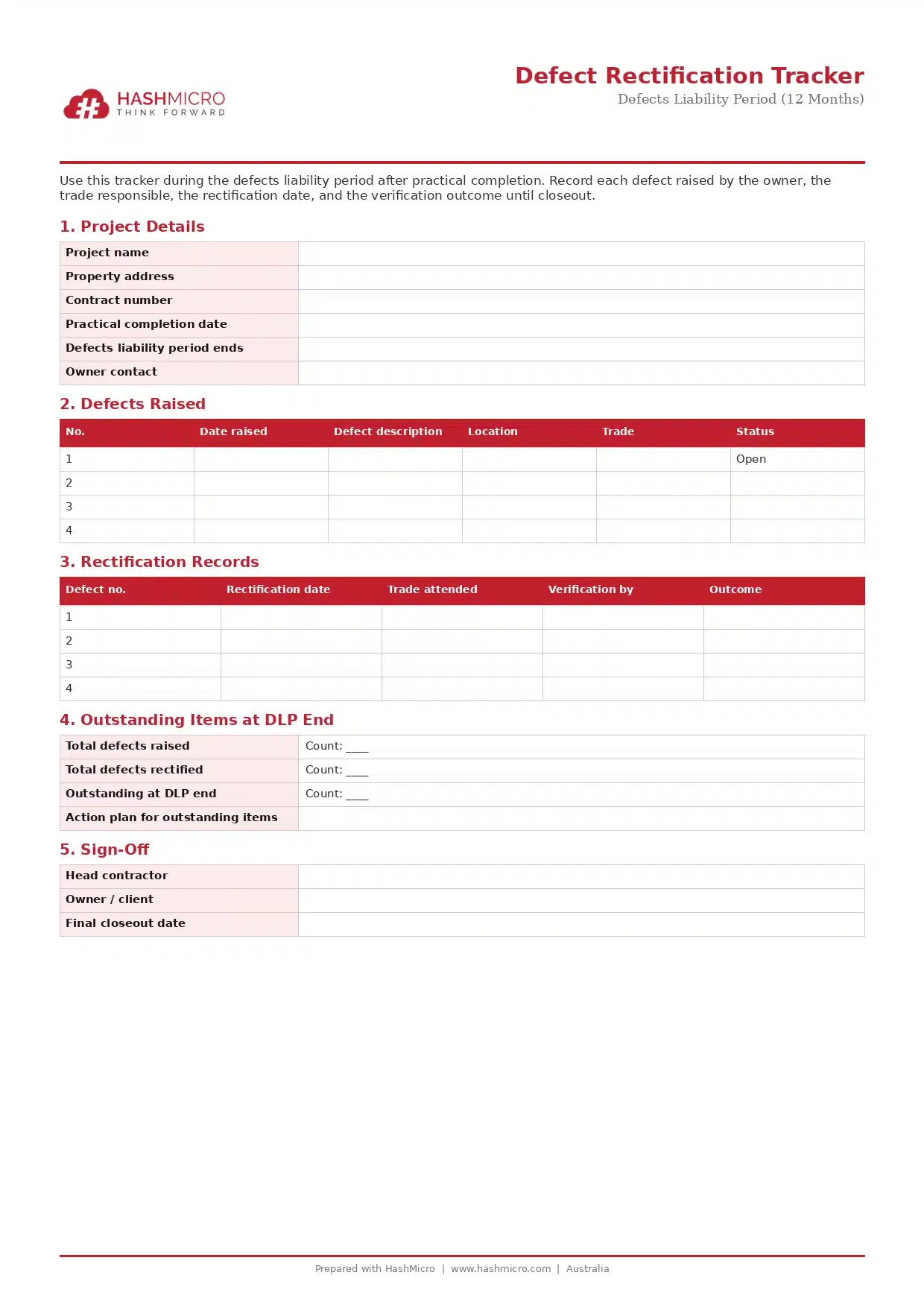
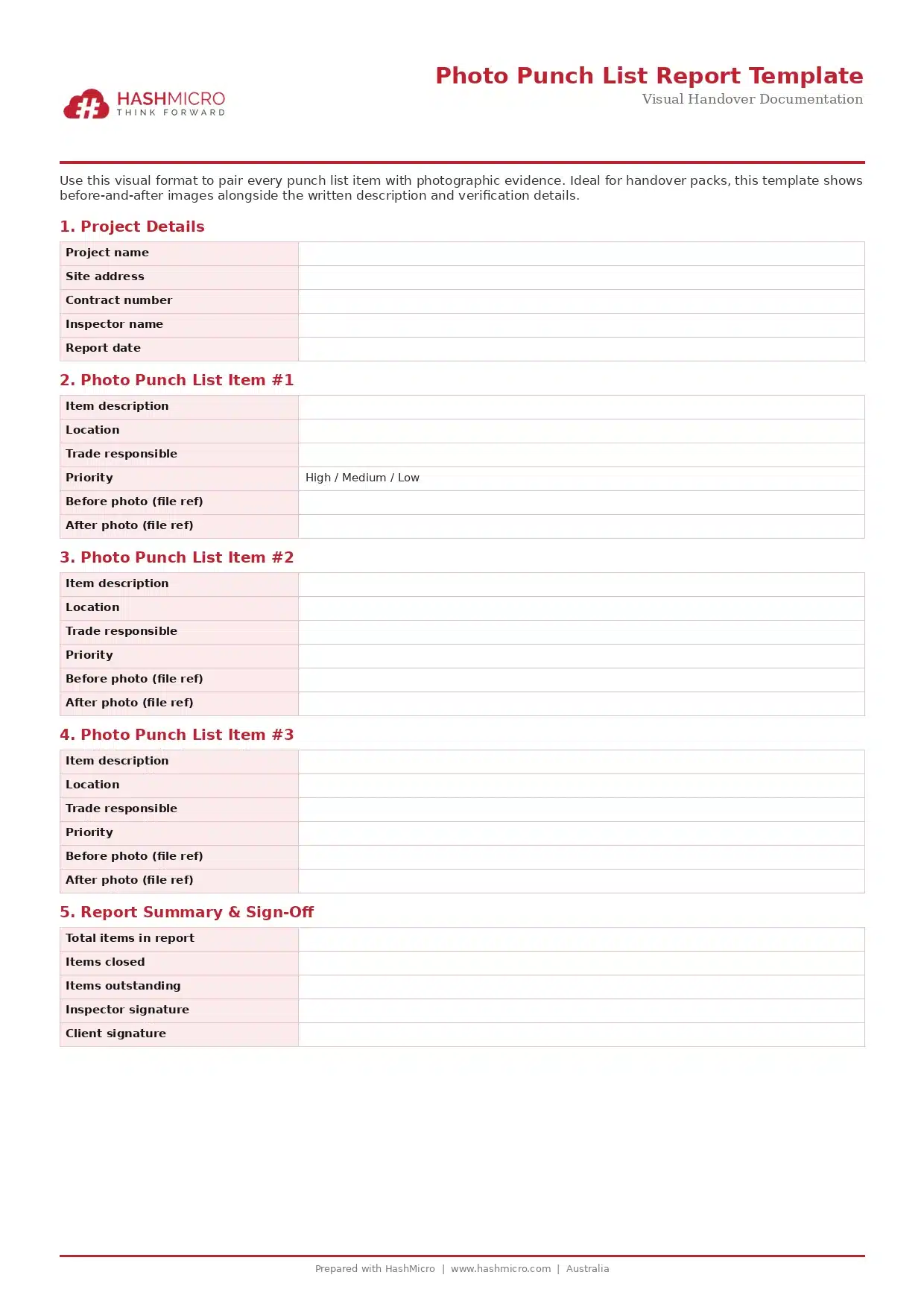
Photo Punch List Report Template
A visual format that pairs each item with photographic evidence. Ideal for handover packs, this template shows before-and-after images alongside the written description.
Photo Punch List Report Template
How to Create a Punch List Step by Step
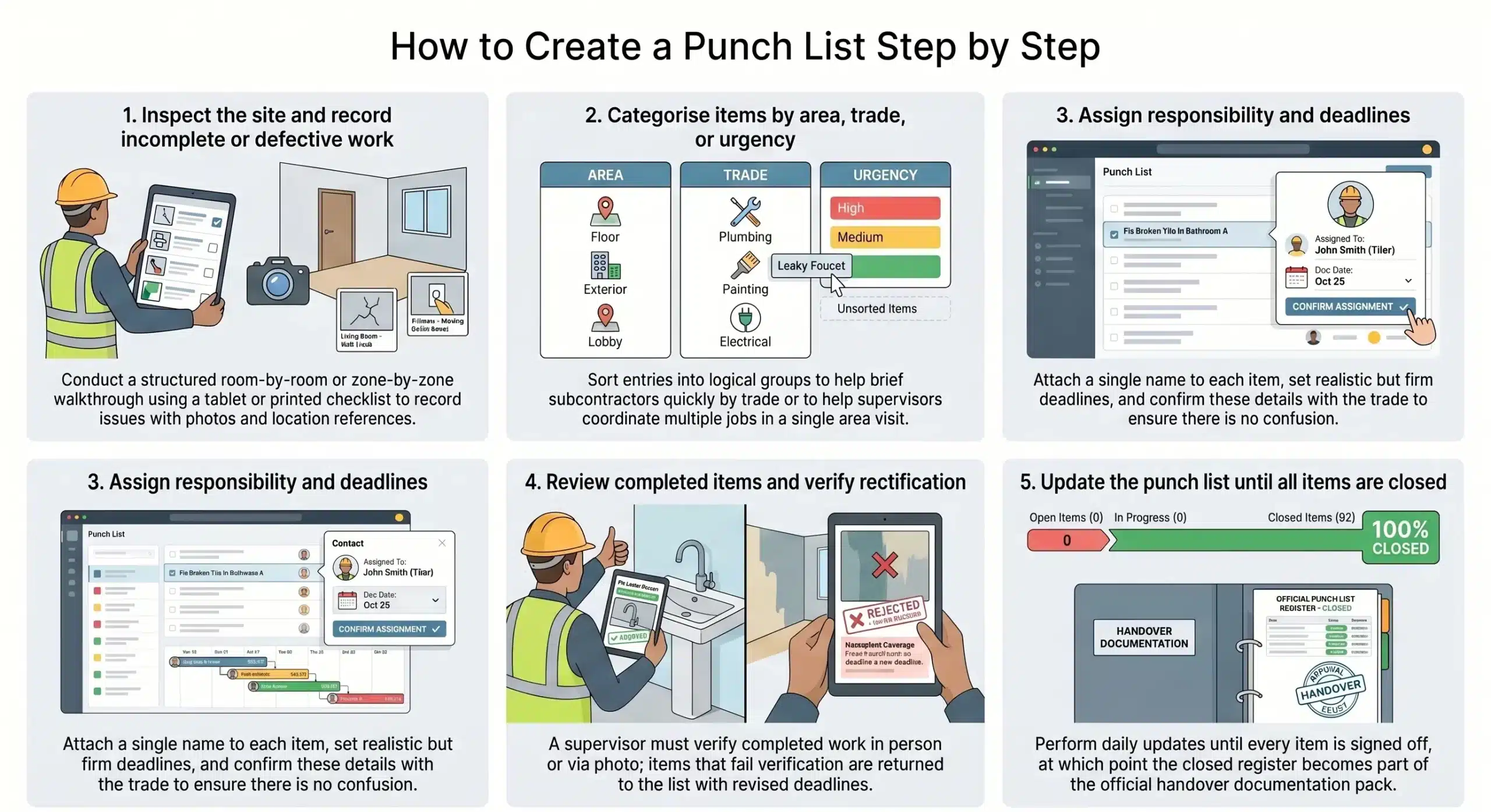
Building a punch list from scratch is straightforward when you follow a consistent process. The five actions below take you from first inspection to final sign-off without losing track of any issue.
1. Inspect the site and record incomplete or defective work
Start with a structured walkthrough, room by room or zone by zone. Use a tablet or printed checklist to record every issue, including a photo and location reference.
2. Categorise items by area, trade, or urgency
Once the raw list is complete, sort entries into logical groups. Categorising by trade lets you brief subcontractors quickly, while sorting by area helps the supervisor coordinate jobs in one visit.
3. Assign responsibility and deadlines
Each item needs a single name attached, not a team or company. Set realistic but firm deadlines, and confirm with the trade so there is no confusion later.
4. Review completed items and verify rectification
When a trade marks an item complete, the supervisor or inspector verifies the work in person or via photo. Items that fail verification go back into the list with revised deadlines.
5. Update the punch list until all items are closed
Continue updating the list daily until every item is closed and signed off. The closed register then becomes part of the official handover documentation pack.
Who Is Responsible for Completing Punch List Items?
Punch list responsibility is shared across several roles, and clear documentation prevents most disputes. Below is how the typical Australian construction project assigns punch list duties.
Role of project managers and site supervisors
Project managers and site supervisors own the master punch list. They run inspections, assign items, chase trades, and verify completion before the document is closed.
Role of contractors and subcontractors
Head contractors are contractually responsible for delivering completed works to the client. They pass items down to the relevant subcontractors, who carry out the rectification on the ground.
Role of owners, consultants, and inspectors
Owners, architects, engineers, and building surveyors raise items they identify during walkthroughs. Their feedback feeds into the master list and informs sign-off at practical completion.
Why responsibility should be documented clearly
Without written ownership of each item, disputes over who pays for rectification become almost inevitable. Documenting responsibility upfront keeps relationships professional and protects everyone involved.
Common Punch List Items Before Practical Completion

Knowing what typically appears on punch lists helps inspectors run more thorough walkthroughs. These are the most common categories seen on Australian sites just before practical completion.
Finishes, paintwork, and surface defects
Paint touch-ups, plaster cracks, scuff marks, and uneven finishes top the list. Lighting often hides issues, so inspectors should check surfaces under both natural and artificial light.
Doors, windows, locks, and hardware issues
Doors that bind, locks that catch, window seals with gaps, and missing hardware are extremely common. Each one is small in isolation but adds up to a poor first impression at handover.
Electrical, lighting, and switch defects
Misaligned switches, flickering lights, missing covers, and circuits that misbehave need immediate attention. Many of these issues can also flag underlying compliance concerns.
Plumbing fixtures and drainage issues
Leaking taps, slow drains, loose toilet seats, and inconsistent water pressure show up regularly. Inspectors should run every fixture for a full minute to catch intermittent problems.
Flooring, ceilings, and joinery defects
Lifting tiles, scratched timber, ceiling cracks, and gaps in cabinetry are common joinery items. Document each one with a photo and the exact location.
Cleaning, labelling, and final presentation items
A final clean, labelled switchboards, completed signage, and tidy outdoor areas often get rushed at the end. Capturing these on the punch list ensures presentation matches the build quality.
Australian Construction Closeout and Defect Rectification Considerations
Australian construction projects operate within specific contract frameworks like AS 4000-1997 and AS 2124-1992. Understanding the closeout requirements that apply locally helps the punch list serve its real purpose.
Practical completion requirements
Practical completion under most contracts means the works are complete except for minor omissions and defects that do not prevent client use. The punch list captures those minor items so the milestone can be reached on time.
Defect rectification requirements
Most contracts include a defects liability period of 12 months from practical completion. Defects raised by the owner during this time must be rectified by the contractor at no extra cost.
Inspection and handover documentation requirements
A complete handover pack includes the punch list, certificates of compliance, warranties, manuals, and as-built drawings. Missing documents can hold up final payment and certificates of occupancy.
Contractor responsibility and follow-up requirements
Contractors remain responsible for follow-up rectification throughout the defects period. Keeping the punch list active during this window demonstrates compliance and protects the head contractor’s reputation.
Record-keeping requirements for project closeout
Australian builders typically retain construction records for at least 7 years, longer for some structural works. Final punch lists form part of those records and should be archived securely.
How to Manage Punch Lists More Efficiently
Even the best-drafted punch list fails if it lives in a forgotten spreadsheet. The five practices below help busy teams keep their punch list management tight from start to finish.
Standardise punch list formats across projects
A consistent format means every supervisor, trade, and client knows exactly where to look. Therefore, standardisation cuts onboarding time and reduces errors across the business.
Use live tracking instead of scattered spreadsheets
Static spreadsheets fall out of date the moment three people start editing them. Live tracking platforms keep everyone on the same version and timestamp every update automatically.
Improve coordination between site teams and subcontractors
Coordination gaps cause most closeout delays. A shared punch list with mobile access lets site teams and subcontractors update items in real time, instead of waiting for the next site meeting.
Centralise status updates, photos, and approvals
Pulling status, photos, and sign-offs into one centralised tool removes the need for separate emails, chats, and paper records. Everyone sees the same information at the same time.
Use construction tools for more streamlined updates
Once a project runs more than 20 subcontractors or spans several weeks, a single spreadsheet punch list becomes a liability. Version conflicts, missed updates, and status gaps between trades compound quickly.
As part of an all-in-one construction software suite, HashMicro’s construction module connects punch lists to budgets, schedules, work orders, and compliance records. Site teams update from mobile, and sign-offs happen in the same platform without email chains.
Conclusion
A well-run punch list keeps construction closeout on time and protects relationships with clients, subcontractors, and consultants. With a clear template behind it, every defect, missing item, and finishing issue gets logged, assigned, and verified before practical completion.
For Australian builders moving away from spreadsheets, a connected punch list workflow enables faster sign-offs and cleaner handovers. You can get free consultation to streamline construction closeout and project management.

Frequently Asked Question
A punch list template is a ready-made checklist construction teams use to record every incomplete or defective item before practical completion. It captures project details, item descriptions, locations, responsible trades, priorities, and completion status in a single consistent format.
A strong template includes project information, inspection date, item description, exact location, responsible trade, priority level, target completion date, status, verification details, and a photo reference. These fields keep records defensible and easy for trades to act on.
Yes, free punch list templates are available in residential, commercial, and practical-completion formats. Each one is structured around standard Australian contract frameworks like AS 4000-1997 and the 12-month defects liability period.
Walk the site room by room, log each issue into the template, attach a photo, and assign a responsible trade. Update the status as items are completed and verified, then archive the closed list with your final handover documentation.
A punch list template captures all outstanding works before practical completion, including incomplete items and minor defects. A defect rectification tracker focuses specifically on defects raised after practical completion during the 12-month defects liability period.