















Budget forecasting refers to the process of estimating future financial performance based on real data and changing conditions. It works by continuously updating projections using actual results, trends, and key assumptions.
This approach helps businesses identify gaps early, improve accuracy, and make better financial decisions. Many companies rely on a budget prediction solution to keep forecasts aligned with real performance.
Key Takeaways
understand how budget forecasting aligns financial plans with real performance and supports better decision making
learn how budgeting, financial forecasting, and budget forecasting differ and work together
identify essential elements such as revenue projections, expense planning, and cash flow forecasting
learn how to create a structured budget forecast using data, assumptions, and scenario analysis
Understanding Budget Forecasting in Financial Planning
A budget forecast is an estimate of future financial outcomes that projects whether a business or individual will meet their financial goals. It combines the fixed targets set in a budget with real-time data and predictive analytics to produce a realistic picture of what is likely to occur financially in a given period.
Budget forecasting is a financial planning approach that keeps projections aligned with actual performance and changing conditions. It allows companies to maintain clear visibility over future outcomes by continuously updating financial expectations.
This process compares budgets with real data, then adjusts projections based on trends. Many teams use forecast-driven finance tools to update forecasts quickly and improve accuracy.
Unlike static budgets, forecasts evolve over time based on actual results. This makes financial planning more flexible and better aligned with real business conditions.
Budget Forecasting vs Budgeting vs Financial Forecasting
Budget forecasting, budgeting, and financial forecasting are often used interchangeably, but they serve different purposes. Understanding how they differ supports decision making to apply the right approach for planning and decision making.
Each concept focuses on a different role in financial management. When combined, they provide a more complete and realistic view of business performance.
| Aspect | Budgeting | Financial Forecasting | Budget Forecasting |
|---|---|---|---|
| Purpose | Set financial targets | Predict future outcomes | Adjust projections based on performancem |
| Flexibility | Fixed and rarely updated | Regularly updated | Continuously adjusted |
| Data Usage | Based on planned assumptions | Based on historical data and trends | Combines budget and actual data |
| Focus | Control and allocation | Prediction and estimation | Alignment and adjustment |
| Time Horizon | Usually fixed period | Short to medium term | Continuous and rolling |
Budgeting
Budgeting is the process of setting financial targets for a specific period, usually based on expected revenue and planned expenses. It acts as a baseline that guides how resources are allocated across the business.
Once approved, budgets typically remain fixed. This helps control spending but can become less relevant when conditions change.
Financial forecasting
Financial forecasting estimates future financial outcomes based on historical data and current trends. It focuses on predicting what is likely to happen rather than setting targets.
Forecasts are updated regularly to reflect new information. This makes them more flexible and useful for tracking performance.
Budget forecasting
Budget forecasting combines the structure of budgeting with the flexibility of forecasting. It compares planned targets with actual performance and adjusts expectations accordingly.
This approach works best when supported by a reliable financial planning system that connects data across departments.






Why Budget Forecasting Matters for Business Planning
Budget forecasting plays a key role in helping businesses maintain control over financial performance. By continuously updating projections, companies can respond faster to changes and make more informed decisions.
Without forecasting, financial planning often relies on outdated assumptions. A structured approach allows businesses to stay aligned with real conditions and reduce unexpected risks.
- Improve Cash Flow Visibility
Budget forecasting allows companies to predict when cash will come in and go out. This makes it easier to identify potential shortfalls before they affect operations.
Better visibility provides stronger cash planning insights and supports smoother financial operations.
- Support Data Driven Decision Making
Forecasting provides a clearer view of future financial outcomes based on real data. This allows businesses to evaluate decisions using measurable insights instead of assumptions.
As a result, resources can be allocated more effectively and risks can be reduced.
- Strengthen Stakeholder Confidence
Accurate financial projections show that a business has control over its performance. This builds trust with investors, lenders, and internal stakeholders.
Clear projections also support financial outlook reporting, giving stakeholders a transparent view of future performance.
- Increase Agility in Market Changes
Market conditions can change quickly, affecting revenue and costs. Budget forecasting supports decision making adjust plans based on updated information.
This allows companies to respond faster and stay competitive in uncertain environments.
Key Components of an Effective Budget Forecast
A reliable budget forecast is built on several core components that work together to provide a clear financial outlook. Each element plays a role in ensuring projections are accurate, balanced, and aligned with real business activity.
Without these components, forecasts can become inconsistent and difficult to rely on. A structured approach supports decision making maintain accuracy and improve financial decision making.
- Revenue Projections
Revenue projections estimate how much income a business expects to generate over a specific period. This includes analysing historical performance, current sales pipelines, and expected market demand.
Accurate projections help set realistic expectations and guide planning. They also ensure that growth assumptions are based on measurable data.
- Expense Forecasting
Expense forecasting focuses on estimating future costs required to support operations. This includes both fixed expenses, such as rent and salaries, and variable costs that change with business activity.
Clear expense planning enables teams control spending and protect profitability. It also ensures costs remain aligned with revenue expectations.
- Cash Flow Forecasting
Cash flow forecasting tracks the timing of cash inflows and outflows, rather than just overall revenue and expenses. This helps businesses understand whether they have enough liquidity to operate smoothly.
Strong cash flow visibility reduces the risk of shortages. It also supports better planning for payments, investments, and financial obligations.
- Scenario Planning
Scenario planning involves creating multiple versions of a forecast based on different assumptions. This typically includes best case, worst case, and expected outcomes.
By preparing for different scenarios, businesses can respond faster and reduce the impact of unexpected changes.

Common Budget Forecasting Methods
Different forecasting methods are used depending on business needs, data availability, and the level of accuracy required. Each approach offers a different way to estimate future performance, from simple projections to more advanced models.
Choosing the right method helps improve accuracy and ensures forecasts remain relevant. Many businesses combine multiple approaches to balance flexibility and reliability.
- Top Down Forecasting
Top down forecasting starts with high-level targets set by management, then distributes these expectations across departments. It ensures forecasts align with overall business strategy.
This approach is faster to implement but may overlook operational details. It works best when strategic direction is clear and stable.
- Bottom Up Forecasting
Bottom up forecasting begins with input from individual teams based on actual operations. These projections are then combined into a company-wide forecast.
This method is often more accurate because it reflects real conditions. However, it requires more time and coordination.
- Rolling Forecasts
Rolling forecasts continuously update projections over a fixed time horizon, such as 12 months. As one period ends, a new period is added to maintain a forward view.
This approach improves flexibility and keeps forecasts aligned with current conditions. It is useful in dynamic environments.
- Zero Based Forecasting
Zero based forecasting requires every expense to be justified from the beginning instead of relying on past data. This helps identify inefficiencies and improve cost control.
Although more time-consuming, it supports better resource allocation. It is often used during cost optimisation.
- Scenario Based Forecasting
Scenario based forecasting models different outcomes based on varying assumptions. This usually includes best case, worst case, and expected scenarios.
It allows companies prepare for uncertainty and respond more effectively. This improves decision making.
- Extrapolation
Extrapolation uses historical data to predict future performance by extending past trends. It is simple and quick to apply.
However, it assumes conditions remain consistent. This can reduce accuracy when changes occur.
- Regression and Econometric Forecasting
Regression and econometric forecasting use statistical models to analyse relationships between variables. These models help predict outcomes based on data patterns.
This approach provides more data-driven insights. It requires strong analytical capability and reliable data.
How to Build a Budget Forecast
Building a budget forecast requires a structured approach to ensure projections remain accurate and aligned with real business activity. A clear process helps reduce errors and makes it easier to adjust financial plans when conditions change.
Instead of relying on assumptions alone, businesses need to base forecasts on data, realistic drivers, and regular validation. This ensures projections stay relevant over time.
Gather Historical Financial Data
Start by collecting financial data from previous periods, including revenue, expenses, and cash flow. This provides a baseline for identifying trends and improving forecast accuracy.
Well-organised data makes it easier to detect patterns and avoid inconsistencies. This becomes the foundation of a reliable forecast.
Identify Key Drivers and Assumptions
Determine the factors that have the most impact on financial performance, such as sales volume, pricing, or cost structure. These drivers shape how projections are built.
Clear assumptions help explain how the forecast is structured. They also make it easier to adjust projections when conditions change.
Forecast Revenue Streams
Estimate future revenue based on historical trends, current pipelines, and expected demand. Breaking projections into segments improves visibility and control.
Realistic revenue expectations help prevent overestimation. This supports more stable financial planning.
Estimate Operating and Capital Expenses
Project both operating costs and long-term investments required to support business activity. This includes fixed and variable expenses.
Aligning costs with revenue expectations helps maintain profitability. It also ensures spending remains controlled.
Model Cash Flow Impacts
Translate projected revenue and expenses into actual cash movement. This shows when cash is available and highlights potential shortfalls early.
Strong cash flow visibility reduces the risk of shortages. It also supports better financial decision making.
Build Scenario Analysis
Create different versions of the forecast based on varying assumptions. This allows businesses to prepare for both expected and unexpected outcomes.
Scenario planning improves flexibility. It also enables teams to respond more effectively to changes.
Review and Validate with Stakeholders
Share the forecast with relevant stakeholders to ensure alignment with business goals. This includes finance teams, management, and department leaders.
Regular validation helps improve accuracy and maintain consistency. It ensures the forecast remains useful over time.
How Different Industries Use Budget Forecasting
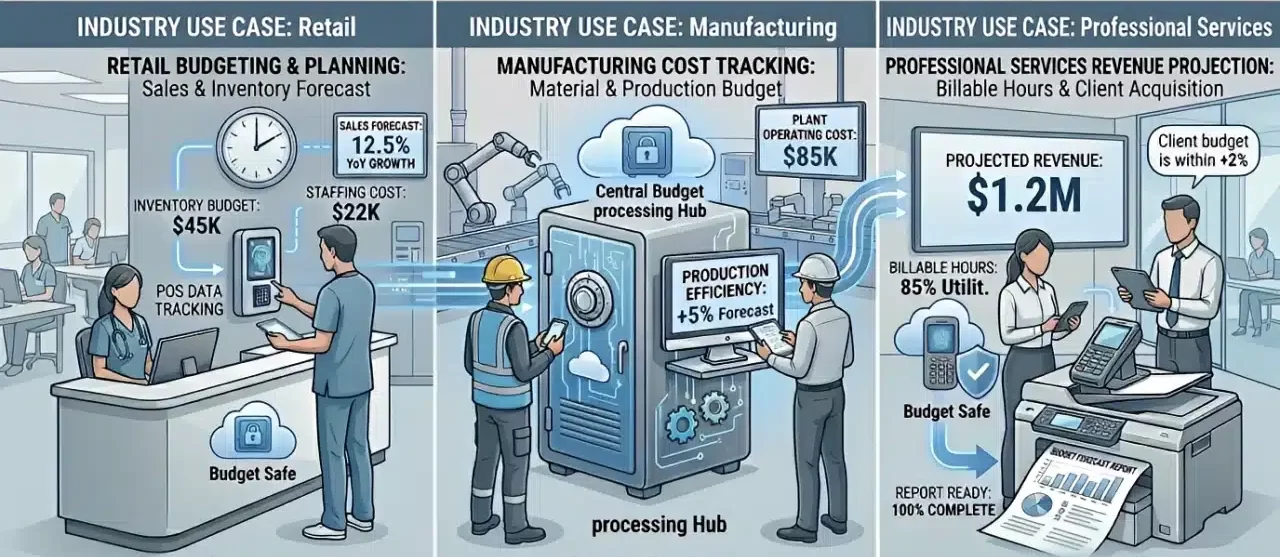
Budget forecasting is applied differently across industries depending on operational structure, cost drivers, and revenue patterns. Each sector uses forecasting to address specific challenges and improve financial control.
Understanding these differences enables teams to apply the right approach. It also ensures forecasts reflect real operational conditions.
Retail and E Commerce
Retail and e commerce businesses deal with fluctuating demand, seasonal trends, and changing consumer behaviour. Budget forecasting helps adjust inventory planning, marketing spend, and staffing based on real-time sales performance.
This improves stock management and reduces overstock or shortages. It also allows businesses to respond quickly to demand changes.
Manufacturing and Supply Chain
Manufacturing and supply chain operations face cost variability from raw materials, labour, and logistics. Budget forecasting helps model these changes and adjust production planning accordingly.
By tracking cost movements, businesses can protect margins and maintain efficiency. It also supports better coordination across supply chain activities.
Professional Services and Technology
Service-based and technology companies rely heavily on workforce costs and project-based revenue. Budget forecasting helps align hiring plans and resource allocation with current demand.
This ensures teams are neither overstaffed nor under-resourced. It also improves profitability and operational efficiency.
Common Challenges in Budget Forecasting
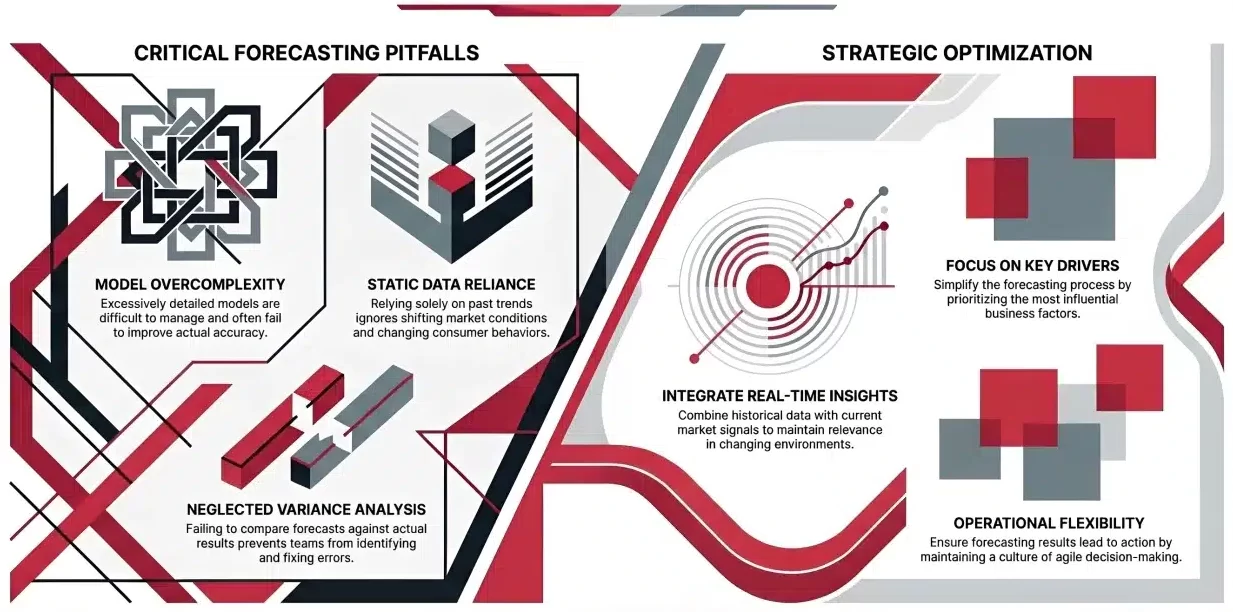
Budget forecasting can become less effective when processes are overly complex or not aligned with real business conditions. Common challenges often affect accuracy, making forecasts harder to maintain and less useful for decision making.
Identifying these issues early supports better decision making forecasting quality. A more structured and practical approach ensures projections remain reliable over time.
Overcomplicating the Model
Building overly detailed models can make forecasts difficult to manage and update. This often leads to unnecessary complexity without improving accuracy.
Focusing on key drivers helps simplify the process. It also makes forecasts easier to maintain and use.
Relying Only on Historical Data
Using past data without considering current conditions can lead to inaccurate projections. Market changes, customer behaviour, and external factors may not follow previous trends.
Combining historical data with real-time insights improves accuracy. This helps forecasts stay relevant in changing environments.
Ignoring Variance Analysis
Failing to analyse differences between forecasted and actual results reduces the value of forecasting. Without this, businesses miss opportunities to improve future projections.
Regular variance analysis helps identify the cause of gaps. It also supports better decision making and continuous improvement.
Lack of Operational Flexibility
A forecast is only useful if businesses are willing to act on it. Rigid processes can prevent teams from adjusting plans when needed.
Advanced Budget Forecasting Practices
As forecasting processes become more structured, businesses can adopt advanced approaches to improve accuracy and efficiency. These methods go beyond basic projections by using better data, clearer relationships, and more predictive insights.
Adopting these practices allows companies respond more effectively to changes. It also strengthens long-term financial planning.
Zero Based Forecasting
Zero based forecasting requires all expenses to be justified from the start, rather than relying on previous data. This helps identify unnecessary costs and ensures resources are allocated based on current priorities.
Although more time-consuming, it improves cost control and eliminates inefficiencies. It is often used when businesses need tighter financial discipline.
Driver Based Modelling
Driver based modelling links financial projections to key business drivers such as sales volume, pricing, or operational output. Changes in these drivers automatically adjust financial outcomes.
This approach provides a clearer connection between operations and financial results. It also helps teams make more informed and responsive decisions.
AI and Machine Learning Integration
AI and machine learning enhance forecasting by analysing large datasets and identifying patterns that may not be visible manually. These tools can generate more accurate and unbiased projections.
Automation also reduces manual workload and speeds up the forecasting process. This allows finance teams to focus on analysis and strategy.
Flexible decision making allows businesses to respond quickly. This ensures forecasts are used effectively to guide actions.
Conclusion
Budget forecasting helps businesses maintain accurate financial planning by aligning projections with real performance. With a structured approach, companies can improve visibility, reduce errors, and make more confident decisions.
As conditions continue to change, relying on static budgets increases the risk of inaccurate planning. Continuous forecasting allows businesses to stay responsive, maintain control, and improve overall performance.

FAQ About Budget Forecasting
-
What is budget forecasting used for?
Budget forecasting is used to estimate future financial performance based on actual data and trends. It helps businesses plan resources, manage cash flow, and adjust strategies more effectively.
-
How is budget forecasting different from budgeting?
Budgeting sets fixed financial targets, while budget forecasting updates projections based on real performance. Forecasting is more flexible and reflects current business conditions.
-
Why is budget forecasting important for businesses?
It improves financial visibility, supports decision making, and helps businesses respond to changes faster. This reduces risks and keeps financial plans aligned with actual results.
-
What are common challenges in budget forecasting?
Common challenges include overcomplicated models, reliance on outdated data, lack of variance analysis, and limited flexibility in decision making.