
Managing the lifecycle of a customer order is a core responsibility and effective sales order management plays a critical role for businesses that deliver goods or services. As markets accelerate and order volumes rise, many organisations struggle to maintain accuracy when relying on manual workflows or disconnected systems. These gaps often result in delayed fulfilment, limited visibility, and higher operational risk.
To address these pressures, many enterprises are adopting more structured and technology enabled approaches to streamline the end to end order process. Strengthening sales order workflows enables organisations to improve operational control, reduce process friction, and maintain more consistent service performance across teams.
When managed effectively, sales order management connects sales, inventory, and fulfilment activities into a more coordinated operating flow. This article explores the key processes, common challenges, and best practices that define effective sales order management in modern operations.
Key Takeaways
|
Understanding Sales Order Management
Sales order management goes beyond recording transactions; it governs the full lifecycle of a customer order from request to fulfilment. The process acts as the operational bridge between customer demand and value delivery. When managed effectively, orders move through the business accurately and without unnecessary friction.
The workflow typically begins when a customer places an order through channels such as e commerce, email, or sales representatives. This action triggers coordination across sales, inventory, warehouse, and finance functions. If any part of this chain is disconnected, order processing delays and service issues can quickly follow.
Manual environments often struggle to maintain accuracy as operations scale. Data entry mistakes, limited inventory visibility, and fragmented systems increase the risk of fulfilment errors and broken customer commitments. Structured sales order systems reduce these risks by centralising and synchronising data across departments, especially when supported by a scalable customer management system that aligns order, customer, and fulfilment data in one view.
Beyond logistics, sales order management directly impacts the order to cash cycle. Faster and more accurate processing enables quicker invoicing and payment collection, improving cash flow stability. For many organisations, optimising this workflow is both an operational and financial priority.
The scope also extends to post sales activities such as returns, exchanges, and order status enquiries. Planning for these reverse flows helps maintain customer trust even when issues occur. As highlighted in recent McKinsey operations research, organisations that strengthen end to end order processes are better positioned to scale efficiently while maintaining service reliability.
Key Components of Sales Order Management
A well structured sales order process relies on several interconnected components working together. Each element supports accuracy, visibility, and execution speed across the order lifecycle.
1. Centralised Customer Database
A unified customer database stores contact details, shipping information, credit limits, and purchase history. This visibility enables faster order processing and more personalised service. Accurate customer data also helps prevent fulfilment errors and reduces payment disputes.
2. Inventory Visibility and Allocation
Real time inventory visibility ensures sales teams only commit stock that is actually available. Advanced systems apply allocation logic such as FIFO or priority rules when inventory is constrained. This alignment protects customer commitments and reduces overselling risk.
3. Order Entry and Validation
Order entry captures requests from multiple channels while validation rules check pricing, SKUs, and delivery feasibility. Catching errors early prevents downstream bottlenecks in warehousing and finance. Automation at this stage significantly improves processing speed.
4. Fulfilment and Shipping Integration
Once validated, orders flow directly to warehouse execution through digital pick instructions. Shipping integration selects carriers, generates labels, and returns tracking data automatically. This end to end flow helps organisations meet modern delivery expectations.
5. Invoicing and Payment Processing
The system converts fulfilled orders into accurate invoices, ensuring financial records match physical shipments. Integration with payment gateways or receivables modules accelerates cash collection. Faster invoicing directly improves working capital performance.
6. Returns Management (RMA)
Structured returns workflows track incoming items, inspection outcomes, and inventory disposition. Efficient RMA handling improves customer retention and prevents stock discrepancies. It also provides feedback data to identify recurring product or fulfilment issues.
7. Reporting and Analytics
Analytics tools aggregate order data into actionable operational insights. Teams can monitor cycle time, error rates, profitability, and fulfilment performance. These insights support continuous improvement and more informed decision making.
Types of Sales Order Management Systems
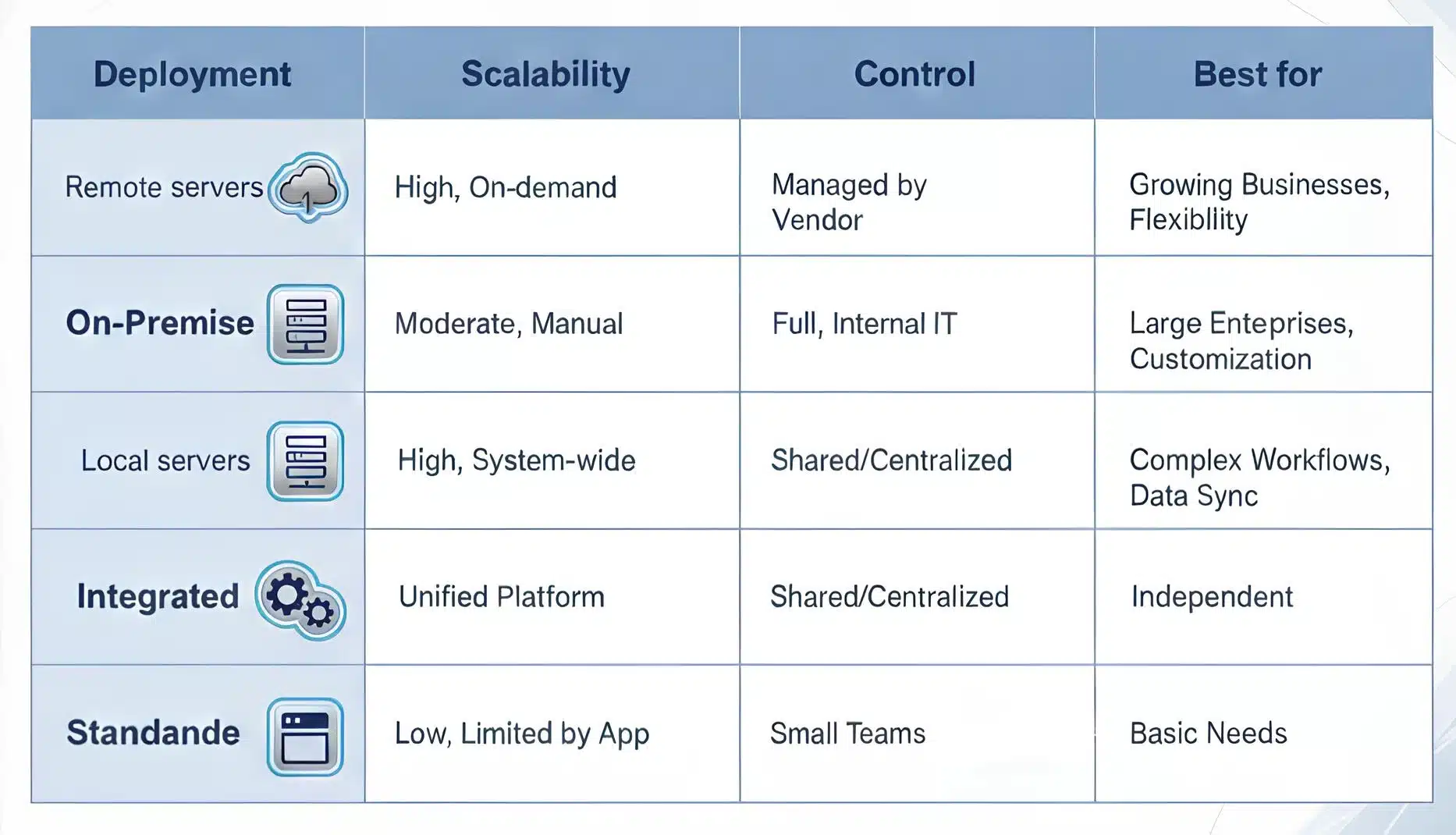
Sales order management approaches vary based on business size, operational complexity, and IT strategy. There is no single model that fits every organisation. The right choice depends on integration needs, scalability requirements, and how tightly order processing must connect with other business functions.
Most solutions differ primarily by deployment model and level of system integration. Understanding these distinctions helps decision makers select an approach that supports long term operational efficiency and growth.
Cloud Based Solutions
Cloud based systems, typically delivered as Software as a Service (SaaS), run on vendor managed infrastructure and are accessed through the internet. This model removes the need for companies to maintain their own servers and reduces upfront IT investment.
Their main advantage is accessibility. Teams can view real time order data from anywhere, while the vendor handles updates, security, and maintenance. This supports more flexible operations with less internal IT burden.
Cloud platforms also scale easily as order volumes grow, usually through subscription upgrades rather than hardware expansion. However, performance depends on stable internet connectivity and vendor reliability.
On Premise Solutions
On premise systems are installed on a company’s internal servers, giving organisations full control over data, infrastructure, and security policies. This approach is often preferred in industries with strict compliance or data sovereignty requirements.
The trade off is greater internal responsibility. Businesses must manage maintenance, upgrades, and backups, which typically requires dedicated IT resources and higher upfront capital expenditure.
On premise environments also allow deeper customisation. However, remote access usually requires VPN configuration, and scaling capacity often involves additional hardware deployment.
Integrated Systems
Integrated sales order management systems connect order processing directly with functions such as inventory, finance, and procurement, often within an ERP environment. This structure eliminates data silos across departments.
When an order is created, updates flow automatically across the organisation. Inventory adjusts in real time, invoicing accelerates, and procurement gains earlier visibility into replenishment needs.
This single source of truth improves reporting accuracy and cross functional coordination. Although implementation can be more complex, integrated systems typically deliver stronger long term efficiency.
Standalone Systems
Standalone solutions focus specifically on sales order processing without being natively embedded in a broader ERP platform. They are generally faster to deploy and may offer deeper functionality for order specific workflows.
Their simplicity makes them attractive for smaller organisations or businesses addressing a targeted operational bottleneck. Implementation is usually quicker and less resource intensive.
The main limitation is potential data fragmentation. Without proper integration, information must be transferred between systems, increasing manual effort and error risk. APIs can reduce this risk but require ongoing technical oversight.
Operational Impact of Effective Sales Order Management
Implementing structured sales order management delivers measurable value beyond the warehouse. Its impact extends across finance, sales, operations, and customer service. Understanding these benefits highlights why order management has become a strategic operational priority.
Enhanced Operational Efficiency
One of the most immediate gains is improved efficiency. Automating the flow from quote to order and invoice eliminates repetitive manual entry and reduces processing time across teams.
This allows staff to focus on higher value work. Sales teams spend more time selling, while warehouse teams concentrate on fulfilment rather than administrative tasks. The result is a leaner operation that can support higher order volumes without proportional headcount growth.
Reduced Human Error
Manual entry remains a major source of fulfilment mistakes. Incorrect quantities, pricing errors, or wrong SKUs can lead to missed shipments, billing disputes, and costly returns.
Structured order management introduces validation rules that catch issues early. Automation keeps data consistent from order capture through invoicing, reducing correction costs and protecting service reliability.
Improved Customer Experience
Customers increasingly expect fast, transparent order updates. Optimised order management provides real time visibility into stock availability, order status, and delivery progress.
When integrated with multi-channel customer support, service teams can respond consistently across email, chat, phone, and portals without switching between disconnected systems.
Real Time Visibility for Better Decisions
Disconnected order processes often leave critical data scattered across systems. Centralised order management consolidates this information into a single operational view.
With real time insight, managers can respond faster to demand shifts, potential stockouts, or regional slowdowns. This visibility supports more proactive and data driven decision making.
Scalability to Support Growth
Manual processes that work at low volume rarely scale efficiently. As order complexity increases, operational bottlenecks become more visible.
A structured sales order system provides the foundation to support expansion into new channels, products, or markets. This scalability helps organisations grow without repeatedly redesigning their workflows.
Optimised Inventory Control
Inventory represents tied up working capital. Excess stock increases carrying costs, while insufficient stock risks missed sales.
Sales order management improves demand visibility and supports more accurate reorder planning. With better data confidence, businesses can reduce safety stock while maintaining service levels.
Faster Order to Cash Cycle
Cash flow depends heavily on how quickly orders convert into invoices and payments. Delays in order processing often slow revenue recognition.
Automated invoicing and payment tracking accelerate the order to cash cycle. Faster billing and proactive reminders help reduce days sales outstanding and improve overall financial liquidity.
How Sales Order Management Applies Across Industries
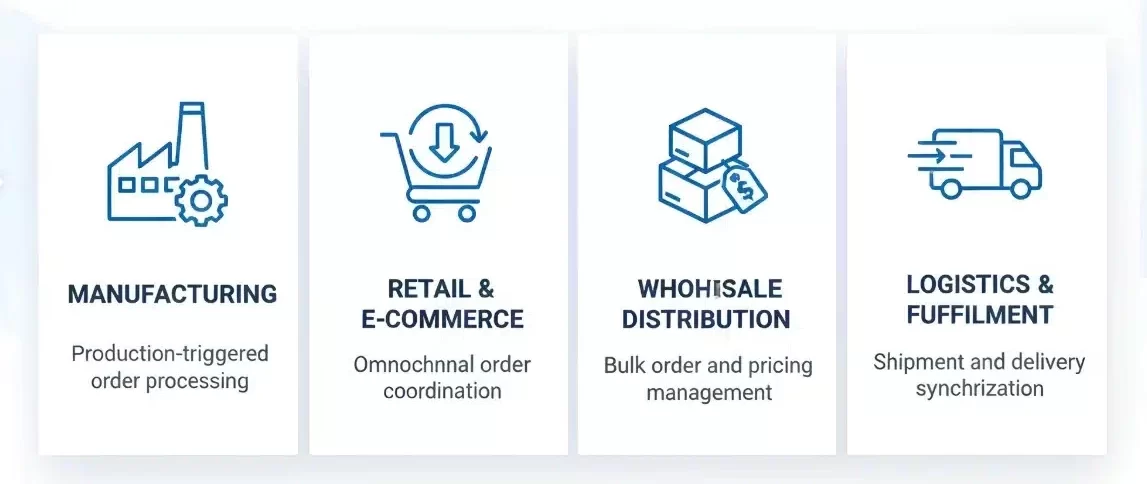
Although the core flow of receiving, processing, and fulfilling orders is similar, sales order management (SOM) requirements vary widely by industry. A generic approach often fails to address sector specific operational challenges.
Understanding these differences helps organisations design workflows that align with their production model, channel complexity, and customer expectations. Below are the most common industry patterns.
Manufacturing: Production Driven Order Flows
In manufacturing, a sales order often triggers production rather than simple shipment. Effective SOM must integrate closely with Material Requirements Planning (MRP) and production scheduling to maintain delivery accuracy.
For Make to Order (MTO) and Engineer to Order environments (ETO), the system must validate complex configurations and generate reliable Available to Promise dates based on material availability and capacity.
- Key Challenge: Raw material delays impacting delivery commitments.
- Solution: Two way synchronisation between SOM and ERP to update production and delivery timelines in real time.
Retail and E Commerce: High Volume and Omnichannel Pressure
Retailers and e commerce businesses face challenges around order volume, speed, and channel synchronisation. Customers expect a consistent experience across marketplaces, social commerce, and branded stores.
Distributed order management (DOM) plays a critical role by selecting the optimal fulfilment location, whether from a central warehouse, store, or third party logistics partner.
- Key Challenge: Overselling during peak events.
- Solution: Real time inventory synchronisation with channel level safety buffers.
Wholesale Distribution: B2B Complexity and Bulk Orders
Distributors typically manage fewer orders but with higher per order complexity. Sales order workflows must support customer specific pricing, credit checks, and freight based shipping logic.
Advanced systems handle split shipments and automated backorders. For example, if only part of an order is available, the system allocates stock, creates a backorder, and invoices accordingly without manual intervention.
Strategic Implementation: A Roadmap for Success
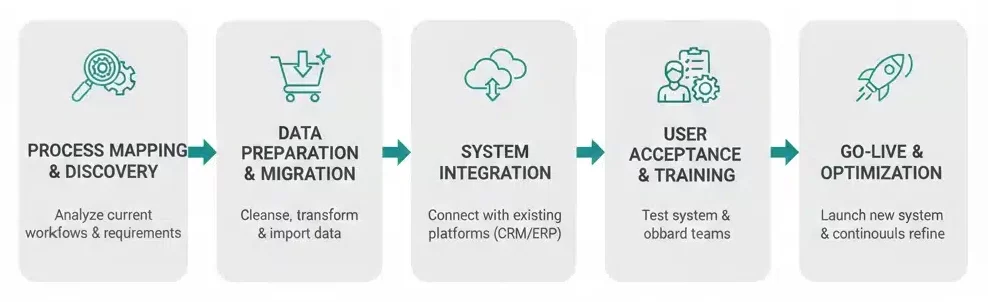
Implementing a robust Sales Order Management system is a transformative process that requires careful planning. Rushing the implementation often leads to data silos and operational friction. Below is a phased approach to deployment.
Phase 1: Process Discovery and Mapping
Start by documenting the full order lifecycle, including standard flows and edge cases such as returns or custom orders. Map how order data moves across systems like CRM, WMS, and accounting.
This step clarifies integration requirements and exposes hidden bottlenecks before technology decisions are made.
Phase 2: Data Cleansing and Migration
System performance depends heavily on data quality. Duplicate customers, obsolete SKUs, and inconsistent pricing rules should be standardised before migration.
Clean master data ensures more reliable reporting, smoother automation, and fewer downstream corrections.
Phase 3: Integration and User Testing
Next, connect SOM with the existing technology stack. Testing should involve real end users, not only IT teams, to validate practical workflows.
Stress testing with high transaction volumes helps confirm the system can handle peak demand without performance degradation.
Key Metrics to Measure SOM Performance
To quantify the ROI of a Sales Order Management strategy, businesses must track specific Key Performance Indicators (KPIs). These metrics highlight bottlenecks and operational efficiency.
1. Order Cycle Time
This measures the average time elapsed between a customer placing an order and the order being handed over to the carrier. Reducing this metric is a primary goal of automation.
Formula: (Time Order Shipped – Time Order Placed) / Total Number of Orders
2. Perfect Order Rate
Perhaps the most critical metric for customer satisfaction, this tracks the percentage of orders that meet four criteria: on time, complete (no missing items), undamaged, and accompanied by correct documentation.
Formula: (Total Perfect Orders / Total Orders) x 100
3. Order Accuracy Rate
This specifically measures picking and packing errors. A low accuracy rate indicates problems in the warehouse or data transmission errors between the sales and fulfillment teams.
4. Backorder Rate
While some backorders are inevitable, a consistently high rate suggests poor inventory forecasting or a disconnect between sales and procurement. The SOM system should help lower this by providing better visibility into stock levels.
Common Implementation Pitfalls to Avoid
Even with capable software, SOM initiatives can stall due to execution gaps. Awareness of common risks improves long term success.
Pitfall: Over Customization
The Issue: Businesses often try to bend the software to fit inefficient legacy processes rather than adapting their processes to standard best practices. This leads to “spaghetti code” that breaks whenever the software provider releases an update.
Mitigation: Adopt a “configuration over customization” mindset. Change internal workflows to match the software’s logic unless a specific process provides a distinct competitive advantage.
Pitfall: Neglecting Change Management
The Issue: Employees accustomed to manual entry or spreadsheets may resist the new system, creating workarounds that defeat the purpose of automation.
Mitigation: Involve end users early in the selection process. Provide comprehensive training and explain why the change is happening focusing on how it eliminates their repetitive tasks rather than just how it benefits the company bottom line.
Pitfall: Ignoring Reverse Logistics
The Issue: Many implementations focus entirely on outbound orders and treat returns as an afterthought. This leads to inventory discrepancies and frustrated customers.
Mitigation: Build the returns workflow (RMA generation, receiving inspection, restocking) into the initial implementation plan. Ensure the SOM can distinguish between restockable inventory and damaged goods.
Advanced Practices for Future Ready SOM
Leading organisations are extending beyond basic automation toward more adaptive order management capabilities.
Dynamic Inventory Allocation
Modern systems prioritise orders using business rules rather than simple first in, first out logic. High value customers or expedited orders can be automatically prioritised when stock is constrained.
This approach protects revenue while maintaining service commitments.
Customer Self Service Portals
Self service portals allow customers to track orders, download invoices, and initiate returns without contacting support. This improves transparency while reducing service workload.
Over time, combining these capabilities with Australia’s best customer handling solutions helps organisations reduce cost to serve while maintaining high service standards.

Conclusion
Effective sales order management delivers the greatest value when processes, data, and systems are fully aligned. With the right structure in place, organisations can improve order accuracy, accelerate fulfilment, and maintain consistent service performance as operations scale.
Each organisation will have different priorities, whether focused on inventory visibility, order automation, or cross functional integration. Evaluating solutions based on operational fit, scalability, and integration capability helps ensure long term effectiveness.
A structured evaluation helps organisations avoid fragmented tools and ensures the selected solution supports both current workflows and future growth requirements. If you are planning to modernise your order processes, you can discuss your goals with a specialist to determine the most suitable approach.

Frequently Asked Questions About Sales Order Management
-
What is the main purpose of sales order management?
The main purpose of sales order management is to ensure customer orders are processed accurately and efficiently from order capture through fulfilment and invoicing. A structured workflow improves visibility, reduces errors, and supports faster order to cash cycles.
-
How does sales order management improve operational efficiency?
Sales order management improves efficiency by automating the flow of data between sales, inventory, warehouse, and finance teams. This reduces manual entry, shortens processing time, and enables organisations to handle higher order volumes with fewer operational bottlenecks.
-
What is the difference between standalone and integrated order management systems?
Standalone systems focus mainly on order processing and are typically easier to deploy, but they can create data silos if not properly connected. Integrated systems link order management with ERP functions such as inventory and finance, providing end to end visibility and stronger cross functional coordination.
-
Which industries benefit most from sales order management systems?
Sales order management systems deliver value across manufacturing, retail, e commerce, and wholesale distribution. Although workflows differ by sector, most organisations benefit from improved order accuracy, better inventory visibility, and more reliable fulfilment performance.