
Businesses face constant pressure to deliver better products and services while keeping costs under control. Simply asking employees to work harder rarely solves the problem. Real improvement comes from closely examining how work actually flows through the organization.
Improving operations also means challenging the habit of doing things “the way they’ve always been done.” Workflows shape how fast, cost-effective, and reliable the final results are, whether a company produces physical goods or digital services.
As more organizations focus on improving business processes with a system, clear and efficient workflows become even more important. Automating a flawed process only spreads mistakes faster, which is why improving workflows should come first.
Key Takeaways
Understand the core definition, strategic value, and historical context of optimising business operations.
Explore foundational frameworks including Lean, Six Sigma, Agile, TQM, and Kaizen.
Discover the essential components like process mapping, root cause analysis, and performance metrics.
Follow a comprehensive, five-step guide to executing a successful and sustainable optimisation strategy.
What Is Process Improvement?

Process improvement means reviewing how work is done and finding practical ways to make it better. Teams examine each step in a workflow to spot delays, repeated tasks, or unnecessary costs. After identifying the problems, they adjust the process to make it simpler, faster, and more efficient.
The concept started in manufacturing but now applies to almost every business function. Departments like finance, HR, marketing, and customer service all rely on clear workflows for managing business processes more effectively. Instead of rebuilding processes from scratch, process improvement usually focuses on refining what already exists.
Types of Process Improvement Methodologies
Different businesses face different operational challenges, so one improvement method rarely fits all situations. Over time, several process improvement methodologies have been developed, each offering its own tools and approach to solving workflow problems. Understanding these methods helps organisations choose the strategy that best fits their goals and way of working.
Lean
Lean is a widely used process improvement method that originated from the Toyota Production System in Japan. The main idea behind Lean is simple: remove anything in a workflow that does not add value for the customer.
Lean identifies eight common types of waste, often remembered using the acronym DOWNTIME:
- Defects: Products or services that fail to meet quality standards and require rework or cause customer complaints.
- Overproduction: Producing more than what customers currently need, which ties up resources and increases storage costs.
- Waiting: Idle time when work stops because teams are waiting for approvals, materials, or information.
- Non-utilised Talent: Not fully using employees’ skills, knowledge, or ideas to improve processes.
- Transportation: Unnecessary movement of materials, products, or information between locations.
- Inventory: Holding too much raw material, unfinished work, or finished products that may sit unused.
- Motion: Extra physical or digital movement by employees, such as searching for files or using poorly designed systems.
- Extra-processing: Doing more work or adding features that customers do not actually need.
To find these problems, teams often map out the entire value stream, the full journey of a product or service from start to delivery. This makes it easier to see where time, effort, or resources are being wasted.
Six Sigma
Six Sigma focuses on improving quality by reducing errors and inconsistencies in a process. Developed by Motorola engineers in the 1980s, this method relies heavily on data and statistical analysis to understand why problems happen.
The goal is to make processes highly reliable and consistent, ideally limiting defects to only a few per million opportunities. Six Sigma follows a structured five-step framework known as DMAIC:
- Define: Identify the problem, set clear goals, and understand customer requirements.
- Measure: Gather data to understand how the current process performs.
- Analyse: Study the data to find patterns and uncover the root causes of problems.
- Improve: Develop and test solutions to fix the issues and optimise the process.
- Control: Monitor the improved process to ensure the results are maintained over time.
This method works especially well in industries where precision and consistency are critical, such as manufacturing, finance, and healthcare. Many organisations train employees in Six Sigma, with certification levels often referred to as Green Belt or Black Belt.
Agile
Agile is a process improvement approach that first became popular in software development but is now used in many industries. It focuses on flexibility and quick adjustments rather than strict long-term planning.
The idea is simple: business needs and customer expectations change quickly, so teams must be able to adapt just as fast. Instead of completing a project all at once, Agile teams break work into short cycles called sprints, which usually last one to four weeks.
Total Quality Management (TQM)
Total Quality Management (TQM) focuses on improving quality across the entire organisation. Instead of leaving quality control to one department, every team and employee shares responsibility for maintaining high standards. This encourages departments to work together to meet customer expectations and improve performance.
TQM also promotes strong leadership, employee involvement, and continuous improvement. Staff are encouraged to share ideas, report issues, and suggest better ways of working. Over time, this helps organisations build a culture that prioritises quality and long-term customer satisfaction.
Kaizen
Kaizen is a Japanese term that means “change for the better” and focuses on continuous improvement. Instead of relying on large, disruptive changes, it encourages small improvements made consistently over time. These small adjustments can gradually lead to major improvements in efficiency and quality.
This approach encourages employees to improve the tasks they perform every day. Since they understand the work best, their ideas often lead to practical solutions. Many companies also run short Kaizen events, where teams review a process and implement improvements within a few days.

Key Elements of Process Improvement
No matter which process improvement method an organisation uses, a few key elements are always important for success. These elements help teams understand how work flows, measure results, and make informed decisions.
Process Mapping and Analysis
You cannot improve a process if you do not clearly understand how it works. Process mapping helps teams visualise each step in a workflow, including decisions, inputs, and outputs. Tools like flowcharts or value stream maps turn complex procedures into clear diagrams.
Teams usually start by mapping the “as-is” process, which shows how the workflow currently operates. Visualising the process helps identify bottlenecks, repeated approvals, and unnecessary handoffs between teams. Once these issues are clear, teams can design a better “to-be” process that removes those inefficiencies.
Root Cause Identification
A common mistake in operations management is fixing the symptoms of a problem instead of the real cause. For example, if shipments are always late, asking the logistics team to work faster does not solve the underlying issue.
Real improvement comes from identifying why the delay keeps happening in the first place. One simple technique is the “5 Whys”, where teams keep asking “why” until they reach the root cause of the problem.
Example of Problem: The Shipment was Late.
- Why? The product was not ready on the loading dock.
- Why? The final assembly was delayed.
- Why? A critical component ran out.
- Why? The purchasing team did not reorder it in time.
- Why? The inventory system did not trigger an automatic reorder alert. (Root cause)
Another useful tool is the Ishikawa (Fishbone) diagram, which helps teams organise possible causes of a problem.
Stakeholder Involvement
Workflows are carried out by people, so any change will directly affect them. When organisations introduce new processes without involving employees, resistance often follows. That is why stakeholder involvement is essential for successful improvement.
Effective change also requires open communication and early collaboration. Frontline employees often understand where the real bottlenecks and daily challenges are. When organisations involve them in discussions, the improvements are more practical and easier to implement.
Performance Metrics and KPIs
To know whether a process change actually works, organisations need clear and measurable metrics. Key Performance Indicators (KPIs) help teams track how well a workflow performs and whether it is improving. Without data, it becomes difficult to judge success.
Common metrics include:
- Cycle Time: The total time needed to complete one full workflow.
- Throughput: The amount of work completed within a specific period.
- Error Rate / Defect Rate: The percentage of outputs that require rework.
- Resource Utilisation: How much available time employees or machines spend on productive work.
- Customer Satisfaction (CSAT): How satisfied customers are with the final result.
Teams should also record baseline metrics before making any changes so they can measure the real impact of improvements.
How to Implement a Process Improvement Plan
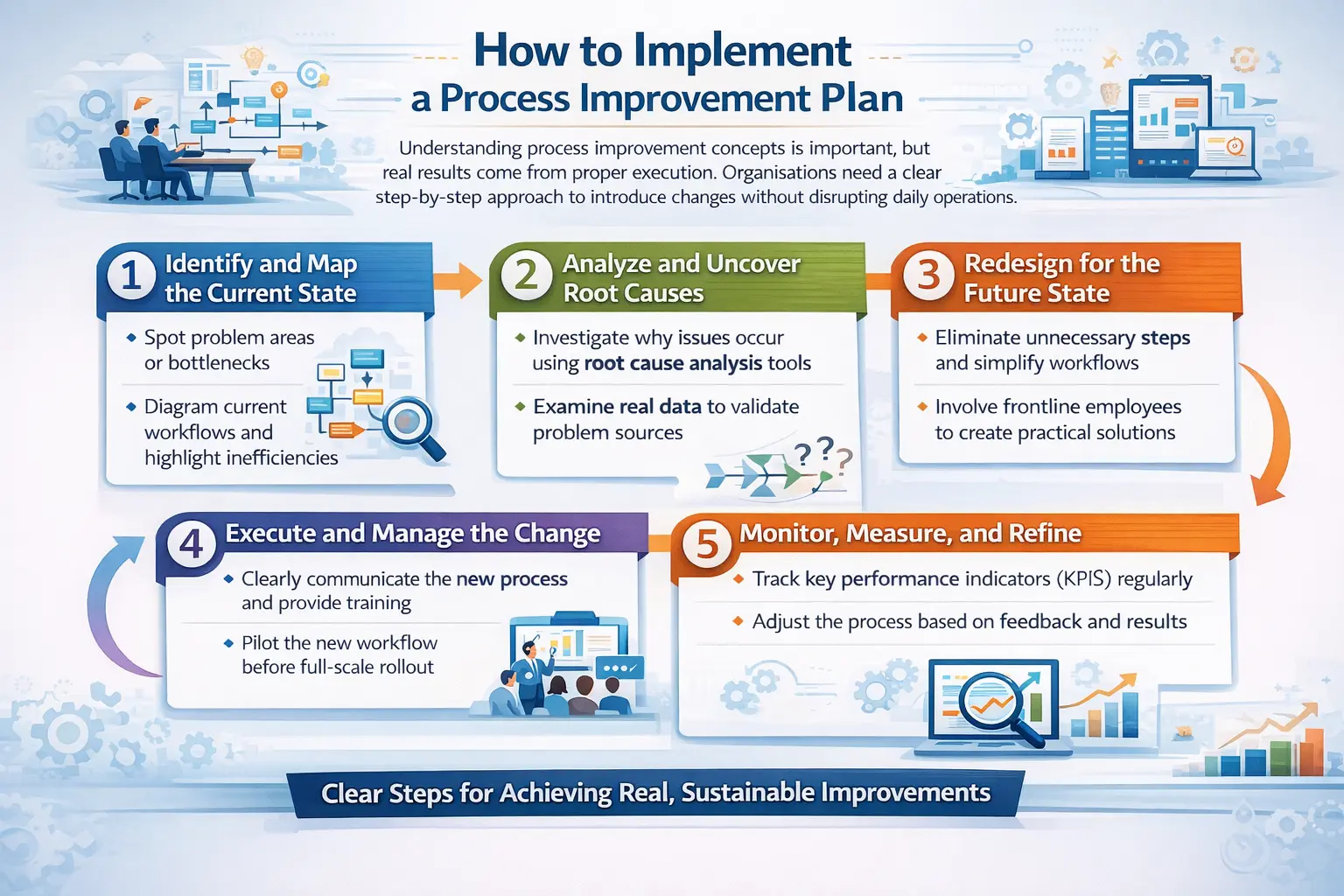
Understanding process improvement concepts is important, but real results come from proper execution. Organisations need a clear step-by-step approach to introduce changes without disrupting daily operations.
Step 1: Identify and Map the Current State
The first step is to identify which process needs improvement. This often becomes clear when issues appear, such as customer complaints, missed deadlines, or rising costs.
Once the process is selected, teams map the workflow step by step using tools like flowcharts or value stream maps. This helps identify bottlenecks, repeated steps, and wasted effort.
Step 2: Analyze and Uncover Root Causes
After mapping the process, teams analyse why it is not performing well. Tools like the Five Whys or Fishbone diagrams help identify the real causes of inefficiencies.
Teams should also rely on real data, such as cycle time, error rates, and resource usage, to understand the scale of the problem.
Step 3: Redesign for the Future State
Once the root causes are clear, the team can start designing a better future process. This stage focuses on removing unnecessary steps, simplifying workflows, and identifying opportunities for automating business process without repeating existing inefficiencies.
Frontline employees should also be involved in this stage because their experience helps ensure the new workflow is practical and realistic.
Step 4: Execute and Manage the Change
Implementing a new process can be difficult because it requires people to change how they work. Clear communication helps employees understand what is changing and why the change matters.
Many organisations test the new workflow through a pilot program before rolling it out across the entire company.
Step 5: Monitor, Measure, and Refine
Process improvement does not stop after implementation. Teams must monitor performance regularly using KPIs to ensure the changes deliver the expected results.
If performance declines or new problems appear, teams can adjust the process and continue refining it over time.
Common Process Improvement Mistakes to Avoid
Many process improvement initiatives fail even when companies invest time and resources. These failures often happen because of common mistakes that weaken implementation.
- Lack of Executive Sponsorship: Without strong support from leadership, improvement initiatives often lose momentum.
- Ignoring Frontline Employee Input: Employees who perform the work daily understand the real operational challenges.
- Analysis Paralysis: Excessive analysis can delay real action and prevent progress.
- Poor Change Management: Employees may resist changes if they do not understand the purpose or receive proper training.
- Automating Broken Processes: Technology cannot fix a poorly designed workflow. Organisations should simplify processes before automating them.
Best Practices for Successful Process Improvement
Even with the right methodology, process improvement efforts can fail without the right approach. Following a few practical best practices helps teams focus their efforts, avoid common mistakes, and achieve lasting results.
- Start with High-Impact Processes
Focus on processes that create the biggest operational problems, such as delays, high costs, or frequent customer complaints. Improving these areas first helps organizations see faster and more meaningful results. - Involve Frontline Employees Early
Employees who perform the work every day often understand the real bottlenecks in a workflow. Including them early in the improvement process leads to more practical solutions and smoother implementation. - Document Everything Before and After
Recording how a process works before changes are made helps teams clearly understand the workflow. It also allows organizations to compare the old process with the improved version and maintain consistency. - Treat Improvement as an Ongoing Cycle
Process improvement should be continuous rather than a one-time project. Regular reviews and small adjustments help organizations maintain efficiency as business needs and technologies evolve.
Conclusion
Process improvement helps organisations work more efficiently by reviewing how tasks are performed and identifying better ways to complete them. By removing unnecessary steps, reducing errors, and improving workflows, businesses can deliver better results while using fewer resources.
Most importantly, process improvement should be treated as an ongoing effort rather than a one-time project. When organisations continuously review workflows, involve employees, and track performance through clear metrics, they can maintain long-term operational efficiency.
To explore the right system and strategy for your operations, book a free consultation with our team.
Frequently Asked Question
Process improvement is the practice of reviewing existing workflows and making changes to improve efficiency, reduce errors, and eliminate unnecessary steps. It helps organizations deliver better results while using fewer resources.
Common methods include Lean, Six Sigma, Agile, Total Quality Management (TQM), and Kaizen. These approaches provide tools to identify inefficiencies, improve quality, and streamline business workflows.
Process improvement helps businesses operate more efficiently by reducing delays, lowering operational costs, and improving product or service quality. It also helps organizations stay competitive and adapt to changing business needs.