






Strong business performance and employee development rarely happen by accident, and the gap between the two often shows up first in a single underperforming team member. Performance management has moved well beyond the annual review, growing into a continuous process built on feedback, improvement, and professional growth.
One important tool within this process is the Performance Improvement Plan (PIP). When used correctly, a PIP helps businesses address performance gaps while giving employees a clear opportunity to improve and realign with expectations.
This guide explains what a Performance Improvement Plan is, when you should use it, and how businesses can implement it effectively to support both employee development and business performance.
Key Takeaways
A Performance Improvement Plan is a structured tool that businesses use to address performance gaps and guide employee improvement.
Clear warning signs, such as missed targets and declining quality, indicate when an employee may need structured performance intervention.
A Performance Improvement Plan works towards defined objectives that support employee development rather than punishment.
An effective Performance Improvement Plan brings together key components, including clear goals, realistic timelines, and proper support resources.

What Is a Performance Improvement Plan?
A Performance Improvement Plan (PIP) is a structured document used by managers and HR teams to address ongoing performance issues. It outlines specific areas where an employee’s performance does not meet expectations and defines clear actions required for improvement.
Unlike informal coaching or routine feedback, a PIP is a formal performance management system. It provides measurable goals, defined timelines, and documented expectations so employees understand exactly what changes are required.
The primary objective of a PIP is not punishment but improvement. By identifying performance gaps and offering targeted support such as training, mentorship, or clearer guidance, businesses create an opportunity for employees to regain performance standards.
A well designed PIP also protects businesses fairness and transparency. It ensures that expectations, feedback, and improvement steps are clearly documented, helping both the employee and the businesses manage performance issues professionally.
Signs an Employee May Need a PIP
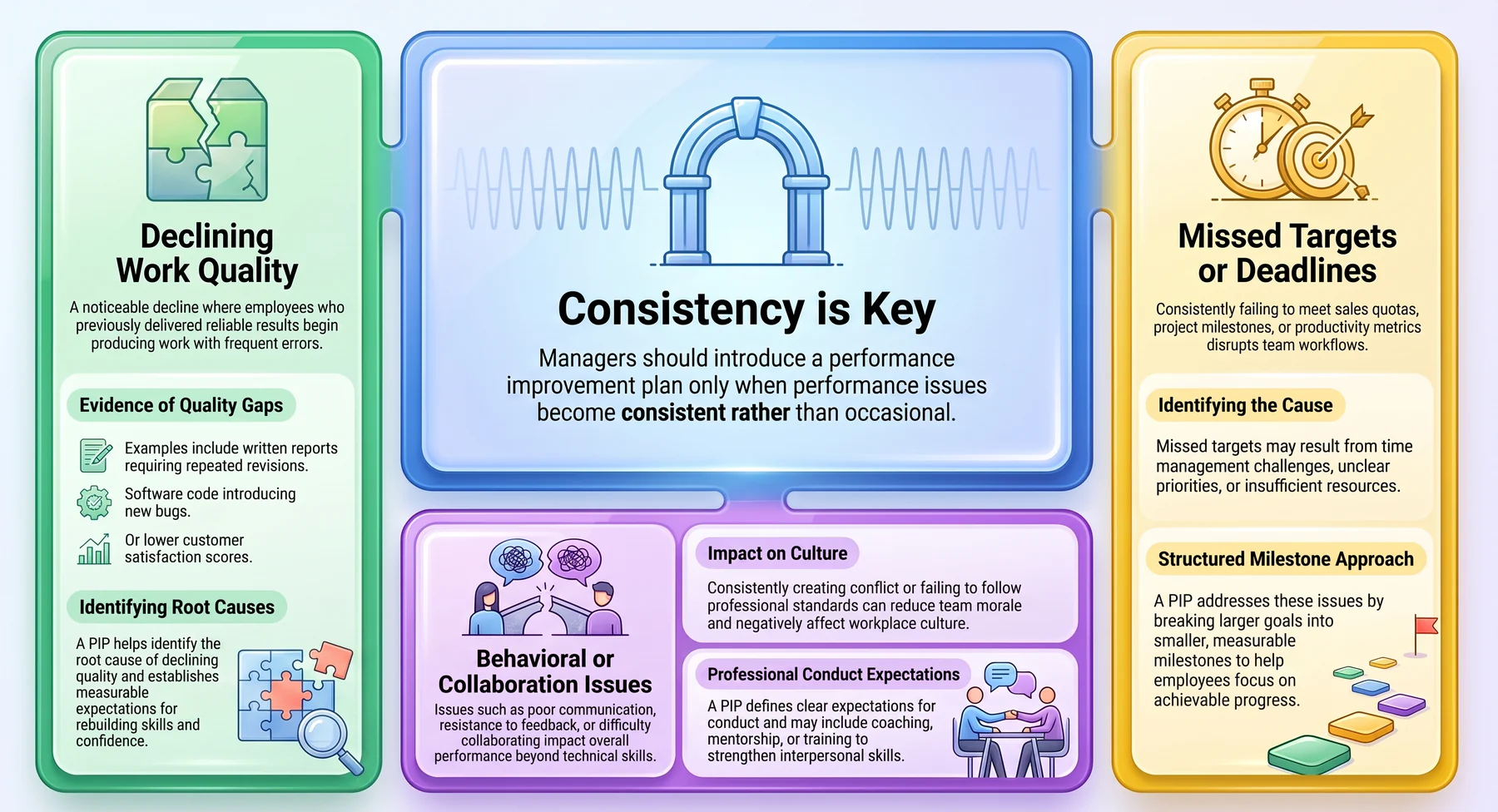
Managers should introduce a performance improvement plan only when performance issues become consistent rather than occasional. Performance issues that lead to a PIP typically fall into three categories: declining work quality, missed targets, and behavioral challenges that affect team collaboration.
1. Declining Work Quality
A noticeable decline in work quality is often one of the first indicators of performance issues. Employees who previously delivered reliable results may begin producing work that contains frequent errors or fails to meet expected standards.
For example, written reports may require repeated revisions, software code may introduce new bugs, or customer interactions may lead to lower satisfaction scores. When these problems occur repeatedly, they suggest a deeper performance gap.
A PIP helps identify the root cause of declining quality and establishes measurable expectations for improvement. This allows managers to track progress while supporting the employee in rebuilding their skills and confidence.
2. Missed Targets or Deadlines
Consistently missing targets or project deadlines is another common signal that performance intervention may be required. Many roles rely on measurable indicators such as sales quotas, project milestones, or productivity metrics.
When employees repeatedly fail to meet these expectations, it can disrupt team workflows and delay business outcomes. Missed targets may result from time management challenges, unclear priorities, or insufficient resources.
A PIP addresses these issues by breaking larger goals into smaller, measurable milestones. This structured approach helps employees focus on achievable progress while allowing managers to monitor improvements over time.
3. Behavioral or Collaboration Issues
Performance challenges are not always related to technical skills or productivity. Behavioral issues such as poor communication, resistance to feedback, or difficulty collaborating with colleagues can also impact overall performance.
Employees who consistently create conflict within teams or fail to follow professional standards may require structured intervention. These issues can reduce team morale and negatively affect workplace culture.
A PIP focused on behavior defines clear expectations for professional conduct and collaboration. It may also include coaching, mentorship, or training to help employees strengthen their interpersonal skills.
The Purpose of a Performance Improvement Plan
A Performance Improvement Plan does more than correct performance problems, since it aligns employee capabilities with business objectives, sets transparent expectations so employees understand exactly how their performance is evaluated, and gives them a structured opportunity to improve before any serious disciplinary action is considered.
1. Clarifying Performance Expectations
One of the most important functions of a PIP is to remove ambiguity around job expectations. Employees may struggle simply because they are unsure what success in their role actually looks like.
A PIP defines specific performance standards, measurable goals, and clear timelines for improvement. This structured guidance allows employees to focus their efforts on the most critical priorities.
By documenting these expectations, both managers and employees share a common understanding of the performance targets that must be achieved.
2. Providing Structured Support
A PIP is not only about identifying problems; it also ensures employees receive the support necessary to improve. Businesses often include training resources, mentorship, or regular coaching sessions as part of the plan, supported by modern HRM platforms in Australia.
This structured support helps employees develop the skills required to meet expectations. It also demonstrates that the Businesses is committed to helping them succeed.
By combining clear expectations with practical resources, a PIP creates an environment where improvement becomes achievable rather than overwhelming.
3. Encouraging Accountability
Accountability is another critical objective of a Performance Improvement Plan. The plan establishes clear milestones and performance evaluation points so employees can track their own progress.
Regular review meetings allow managers and employees to discuss improvements, address obstacles, and adjust strategies if necessary. This process ensures that performance management remains transparent and objective.
When employees take ownership of their development, the PIP becomes a collaborative effort that strengthens both individual performance and team outcomes.
Keeping a PIP accountable is far easier when milestones, review notes, and progress live in one place instead of scattered across spreadsheets and inboxes. Hashy OS, the AI coworker layer on top of your ERP, tracks each performance milestone, surfaces upcoming review meetings, and keeps every update in a shared record both managers and employees can see.
Keeping a PIP accountable is far easier when milestones, review notes, and progress live in one place instead of scattered across spreadsheets and inboxes. Hashy OS, the AI coworker layer on top of your ERP, tracks each performance milestone, surfaces upcoming review meetings, and keeps every update in a shared record both managers and employees can see.
Keeping a PIP accountable is far easier when milestones, review notes, and progress live in one place instead of scattered across spreadsheets and inboxes. Hashy OS, the AI coworker layer on top of your ERP, tracks each performance milestone, surfaces upcoming review meetings, and keeps every update in a shared record both managers and employees can see.
Keeping a PIP accountable is far easier when milestones, review notes, and progress live in one place instead of scattered across spreadsheets and inboxes. Hashy OS, the AI coworker layer on top of your ERP, tracks each performance milestone, surfaces upcoming review meetings, and keeps every update in a shared record both managers and employees can see.
Keeping a PIP accountable is far easier when milestones, review notes, and progress live in one place instead of scattered across spreadsheets and inboxes. Hashy OS, the AI coworker layer on top of your ERP, tracks each performance milestone, surfaces upcoming review meetings, and keeps every update in a shared record both managers and employees can see.






What a Performance Improvement Plan Includes
An effective Performance Improvement Plan must be structured, specific, and transparent, since a vague plan only confuses managers and employees and makes progress hard to measure. When it clearly defines the performance problems, sets improvement expectations, and documents the support and timeline both parties can see, the PIP becomes a practical roadmap toward measurable improvement.
1. Clear Performance Issues
The first component of a Performance Improvement Plan is a clear explanation of the performance problems that need to be addressed. These issues must be described using objective and observable examples.
Instead of vague statements such as “poor performance,” the plan should identify specific situations or patterns that demonstrate the problem. This may include repeated errors, missed deadlines, or documented client complaints.
Providing concrete examples helps employees understand exactly what needs to change and prevents misunderstandings during the improvement process.
2. Measurable Improvement Goals
A PIP should define measurable goals that describe what successful improvement looks like. These goals often follow the SMART framework specific, measurable, achievable, relevant, and time bound.
For example, instead of simply asking an employee to “improve productivity,” the plan may require completing a defined number of tasks or meeting specific performance metrics.
Clear improvement goals make it easier for both managers and employees to track progress and evaluate whether the objectives have been achieved.
3. Timeline and Evaluation Period
Every Performance Improvement Plan must include a defined timeframe for improvement. Most businesses set evaluation periods ranging from 30 to 90 days, depending on the complexity of the role.
During this period, managers conduct regular progress reviews to monitor improvements and address any challenges the employee may encounter.
A clear timeline ensures that the improvement process remains structured while giving employees sufficient time to demonstrate measurable progress.
4. Support Resources and Training
A PIP should also outline the support resources that will be provided to help the employee succeed. These resources may include training programs, mentoring sessions, or additional coaching from supervisors.
Providing structured support shows that the businesses is committed to employee development rather than simply documenting poor performance.
When employees receive the right guidance and resources, they are more likely to meet the expectations outlined in the improvement plan.
5. Consequences and Outcome Scenarios
A Performance Improvement Plan must clearly explain the possible outcomes at the end of the evaluation period. This ensures transparency and helps employees understand the importance of meeting the outlined goals.
If the employee successfully meets the improvement targets, the plan may conclude with a return to normal performance monitoring. In some cases, additional development plans may follow to support long term growth.
However, if the required improvements are not achieved, businesses may proceed with further disciplinary actions, reassignment, or termination according to company policy.
"A well structured Performance Improvement Plan helps businesses address performance gaps while giving employees a clear path to improve and succeed."
Fair Work and Compliance Considerations in PIPs
A Performance Improvement Plan does not sit outside the law, since how a business manages underperformance can carry real consequences under the Fair Work framework. The considerations below help managers run a PIP that stays fair, lawful, and defensible.
1. Procedural fairness and the right to respond
Procedural fairness means giving the employee clear notice of the concerns and a genuine chance to respond before any decision follows. A manager should explain the specific performance gaps, share supporting examples, and let the employee put their side forward. Therefore, a well-documented conversation protects both the employee and the business if the matter escalates.
2. Unfair dismissal and the Small Business Fair Dismissal Code
A PIP often becomes evidence that a business gave an employee a fair opportunity to improve before considering dismissal. According to the Fair Work Ombudsman, a fair process includes clear warnings, support, and reasonable time to lift performance. As a result, a properly run PIP strengthens a business's position if an unfair dismissal claim arises.
3. General protections and adverse action
General protections rules prevent a business from taking adverse action against an employee for exercising a workplace right. A PIP should focus strictly on genuine performance, not on any complaint or protected attribute the employee holds. However, keeping the plan objective and evidence-based helps a business avoid the perception of unlawful treatment.
4. Documentation and record-keeping
Accurate records turn a PIP from a verbal understanding into a defensible account of what happened and when. Managers should keep dated notes of meetings, agreed goals, feedback, and the employee's responses throughout the plan. Consequently, this record supports fair decisions and satisfies any later review of the process.
Industry Specific Use Cases for Performance Improvement Plans
Although the core principles stay the same, businesses usually tailor each Performance Improvement Plan to the metrics, workflows, and regulations of a specific role and industry. The examples below show how PIPs are commonly applied across several major industries.
1. Technology and Software Development
In technology teams, performance challenges often appear through missed sprint goals, low development output, or recurring software defects. Because technical work is highly measurable, improvement plans usually rely on clear productivity metrics.
For example, a developer may be expected to complete a certain number of story points per sprint or reduce the number of code revisions during peer reviews.
A PIP in this environment typically focuses on technical training, stronger code review practices, and improved collaboration with engineering teams.
2. Sales and Business Development
Sales roles are heavily driven by measurable performance targets. When employees consistently miss quotas or struggle to build a reliable sales pipeline, businesses may introduce a Performance Improvement Plan.
Sales PIPs often include specific activity targets such as call volumes, meetings scheduled, or proposals delivered within a defined timeframe.
In addition to numerical targets, improvement plans may include coaching sessions, sales training, and closer supervision from experienced sales managers.
3. Healthcare and Clinical Settings
In healthcare environments, performance management must prioritize patient safety and regulatory compliance. Even small mistakes can have significant consequences for both patients and healthcare providers.
A PIP in this sector may focus on improving clinical documentation accuracy, adherence to medical protocols, or communication with patients and colleagues.
Improvement plans frequently involve additional supervision, compliance training, and ongoing performance reviews to ensure healthcare standards are consistently maintained.
4. Customer Service and Support
Customer service teams are typically evaluated based on communication quality and service efficiency. Metrics such as response time, customer satisfaction scores, and issue resolution rates are commonly used indicators.
When performance falls below expectations, a PIP may require employees to improve response times, enhance communication with customers, or follow service protocols more consistently.
Coaching sessions, call monitoring, and targeted training programs are often used to support employees during the improvement period. A unified customer support platform can also help improve the employees performance and their productivity overall.
Step by Step Process to Implement a PIP
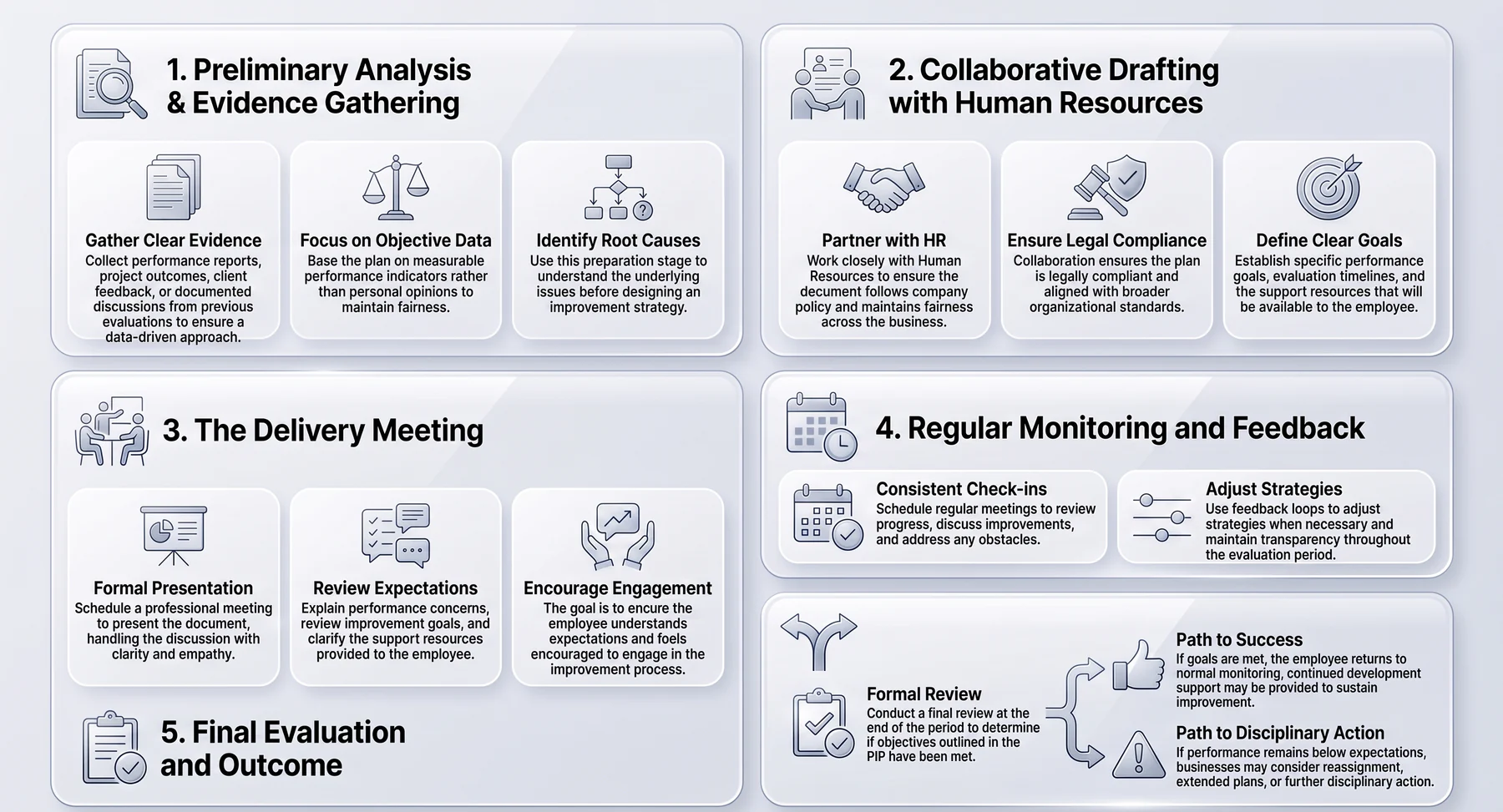
Implementing a Performance Improvement Plan takes careful planning and consistent communication, so rather than acting as a sudden disciplinary measure, a PIP should follow a clear sequence that helps businesses diagnose the problem, provide meaningful support, and evaluate results fairly. The steps below outline a common process HR teams use when introducing one.
1. Preliminary Analysis and Evidence Gathering
Before initiating a PIP, managers must gather clear evidence of the employee’s performance challenges. This may include performance reports, project outcomes, client feedback, or documented discussions from previous evaluations.
Collecting objective data ensures that the improvement plan is based on measurable performance indicators rather than personal opinions.
This preparation stage also helps managers identify the root causes of the issue before designing the improvement strategy.
2. Collaborative Drafting with Human Resources
Managers should work closely with the human resources department when drafting a Performance Improvement Plan. HR ensures that the document follows company policy and maintains fairness across the business.
During this stage, managers define clear performance goals, evaluation timelines, and the support resources available to the employee.
Collaboration with HR also helps ensure that the plan is legally compliant and aligned with broader organisational standards.
3. The Delivery Meeting
Once the plan is prepared, managers should schedule a formal meeting with the employee to present the document. This discussion must be handled with clarity, professionalism, and empathy.
Managers should explain the performance concerns, review each improvement goal, and clarify the resources available to support the employee.
The purpose of this meeting is to ensure that the employee understands the expectations and feels encouraged to engage in the improvement process.
4. Regular Monitoring and Feedback
A PIP requires consistent monitoring throughout the evaluation period. Managers should schedule regular check ins to review progress and provide constructive feedback.
These meetings allow both parties to discuss improvements, address obstacles, and adjust strategies when necessary.
Frequent communication helps maintain transparency and ensures the employee remains focused on achieving the improvement goals.
5. Final Evaluation and Outcome Determination
At the end of the evaluation period, managers conduct a formal review to determine whether the employee has met the objectives outlined in the PIP.
If the employee successfully meets the required goals, they may return to normal performance monitoring. Continued development support may also be provided to sustain improvement.
However, if performance remains below expectations, businesses may consider reassignment, extended improvement plans, or further disciplinary action according to company policy.
Common Pitfalls When Managing a PIP
Even a well-intentioned Performance Improvement Plan can fail when it is poorly designed, creating confusion, eroding trust, and making progress harder, so knowing the most common mistakes helps managers run PIPs fairly and transparently.
Common pitfalls include:
- Creating vague goals
Improvement plans must contain clear and measurable objectives. Vague expectations such as “improve communication” or “perform better” make it difficult for employees to understand what success looks like. - Using a PIP only as termination documentation
Some businesses misuse PIPs as a formal step before termination rather than a genuine opportunity for improvement. When employees feel the outcome is predetermined, motivation and engagement decline. - Lack of managerial support
A PIP requires active involvement from managers. Without regular guidance, feedback, and coaching, employees may struggle to meet improvement goals. - Changing expectations during the process
Adjusting targets or adding new requirements during the evaluation period creates confusion and undermines trust. Expectations should remain consistent throughout the plan.
Advanced Practices in Modern Performance Management
Modern businesses are moving beyond formal-only performance management, adopting proactive strategies that support employee growth earlier, which reduces the need for formal PIPs while strengthening both employee development and business performance.
1. Pre PIP or Early Performance Warnings
Some businesses implement early intervention steps before initiating a formal Performance Improvement Plan. These informal coaching periods are sometimes referred to as “Pre PIPs.”
During this stage, managers provide clear feedback and short term improvement goals. This allows employees to address performance concerns before a formal HR process becomes necessary.
Early intervention often reduces stress for employees while preventing minor issues from becoming long term performance problems.
2. Peer Mentorship Programs
Peer mentorship is another strategy that supports employee development during performance improvement. Instead of relying solely on managers, businesses pair struggling employees with experienced colleagues.
Mentors can provide practical guidance, share effective work strategies, and offer daily feedback. This collaborative approach often feels less formal and more supportive than traditional supervision.
Peer mentorship also strengthens knowledge sharing and team collaboration across the business.
3. Psychological Safety During PIP
Being placed on a PIP can create significant stress for employees. Anxiety and fear of failure may actually reduce performance if the process is not handled carefully.
Businesses that prioritize psychological safety ensure that employees feel respected and supported throughout the improvement period.
Managers play a key role by encouraging open communication, providing constructive feedback, and focusing on development rather than punishment.
4. Post PIP Maintenance Plans
Even after successfully completing a PIP, continued support is important to maintain performance improvements. Some businesses implement short post PIP monitoring periods to ensure progress remains consistent.
During this phase, managers conduct periodic check ins and provide additional guidance if necessary. This helps reinforce positive behaviors and prevents employees from returning to previous performance challenges.
By maintaining structured follow up support, businesses can ensure long term performance improvement and stronger employee development.
How HRM Software Supports Performance Improvement Plans
Running a PIP by email and spreadsheet makes it hard to keep goals, reviews, and records aligned across a full cycle. Modern HRM software gives managers one place to plan, track, and document every part of the process, and the capabilities below show how.
1. Centralised goal and milestone tracking
HRM software keeps each performance goal, milestone, and deadline in a single shared view that both manager and employee can follow. This clarity removes the confusion that comes from scattered notes and conflicting versions. As a result, everyone works from the same up-to-date picture of progress.
2. Automated review reminders and scheduling
The software schedules check-in meetings and sends reminders, so no review slips through during a busy quarter. Regular, prompted conversations keep the plan active rather than letting it stall after the first meeting. Therefore, the PIP stays on track and the employee receives consistent support.
3. Documentation and audit-ready records
Every meeting note, goal update, and piece of feedback lives in one secure record that the business can revisit at any time. This audit-ready trail supports fair decisions and satisfies Fair Work expectations around a documented process. Consequently, managers spend less time reconstructing events and more time coaching.
4. Performance data and objective evaluation
HRM software pulls performance metrics together, so managers judge progress against real numbers rather than impressions. Clear data helps keep the evaluation objective and reduces the risk of bias creeping into the review. In addition, HashMicro's HRM software links performance tracking with the wider employee record, giving growing Australian businesses one connected view of development and outcomes.
Conclusion
Performance Improvement Plans help businesses address performance challenges in a structured and professional way. By clearly defining expectations, measurable goals, and evaluation timelines, companies can guide employees toward meaningful improvement.
When implemented correctly, a PIP becomes more than a corrective measure. It encourages transparency, strengthens accountability, and supports employee development while maintaining organisational performance standards.
If your business is looking to improve performance management processes, request a free consultation with our professional team to explore how integrated HR software can help manage employee performance more effectively.
Frequently Asked Questions About Performance Improvement Plans
A Performance Improvement Plan (PIP) is a structured document used by managers and HR teams to address employee performance issues. It outlines specific performance gaps, improvement goals, timelines, and support resources to help employees meet organisational expectations.
Managers typically use a Performance Improvement Plan when an employee consistently fails to meet performance expectations, such as declining work quality, missed deadlines, or behavioral issues that affect team collaboration.
Most Performance Improvement Plans last between 30 and 90 days. The timeline depends on the role, the severity of the performance issues, and the amount of improvement required.
If an employee does not meet the required improvement goals within the evaluation period, businesses may consider further disciplinary action, role reassignment, or termination according to company policy.
Yes. Many employees successfully complete a Performance Improvement Plan when clear goals, regular feedback, and proper support are provided. A well implemented PIP focuses on development rather than punishment.