







 Limited to 100 registrants

Performance appraisals have evolved far beyond annual checkbox exercises. In modern HR management, they are strategic tools for fostering growth, managing capability of employees to support business objectives, and building a culture of continuous improvement.
A well-structured evaluation does more than determine raises or promotions. It uncovers hidden talent, identifies skill gaps, and transforms observations into actionable insights that boost employee engagement and drive sustainable business success.
Stay with us to learn more in-depth knowledge regarding performance appraisal and learn how you can enhance your business with it.
Key Takeaways
A performance appraisal is a formal, documented process for assessing employee performance against standards to align individual effort with business goals and supporting long-term career development.
To prepare for a performance appraisal, Managers should review KPIs, gather multi-source feedback, and read employee self-assessments before the meeting.
A performance appraisal implementation follows five steps: establishing objectives, selecting a method, training key individuals, conducting evaluation, and following up with Individual Development Plans.
The best practices for performance appraisal is to avoid recency bias, use structured rubrics, keep compensation discussions separate from developmental conversations, and build a culture of continuous feedback

What Is a Performance Appraisal?

A performance appraisal, also called a performance review or employee evaluation, is a systematic process through which a business assesses an employee’s job performance and contribution. It evaluates skills, achievements, and growth against company standards set at the start of the review cycle.
Historically, appraisals focused on looking back and assigning a numerical rating. Today, the approach has shifted toward something more holistic, measuring not just what was achieved but planning what comes next, using performance review tools.
The process covers both quantitative metrics like sales figures and deadlines met, and qualitative competencies like leadership, communication, and teamwork. The goal is not just to critique but to build a documented record that informs compensation, training, and career decisions.
It is also important to distinguish appraisals from performance management. Performance management is a continuous, year-round process. The appraisal is a formal milestone within that process where ongoing feedback is synthesized into a structured, documented summary.
That summary creates a standardized benchmark ensuring fairness and transparency across teams. It bridges the gap between an employee’s daily tasks and the long-term strategic direction of the business, particularly when supported by advanced HRM systems tailored for Australian organisations.
The Role of Appraisals in Workplace Performance
A good performance evaluation framework can significantly improve productivity. Appraisals can motivate employees by clarifying expectations, recognizing achievements, and providing a clear view of individual performance. It also gives management broader insight into organizational health.
Beyond administrative compliance, evaluations help build a high-performance culture. They ensure accountability, highlight development opportunities, and align individual contributions with broader business objectives.
Aligning Individual and Company Goals
One of the most critical functions of a performance appraisal is aligning individual employee objectives with broader business goals. In many workplaces, employees become siloed, focusing on daily tasks without understanding how their work connects to the bigger picture.
Appraisals give managers a structured opportunity to make that connection explicit. Frameworks like OKRs and KPIs are reviewed and recalibrated during the evaluation, linking individual responsibilities directly to the company’s mission and targets.
When employees understand how their contributions move the needle, intrinsic motivation increases. A software developer coding a feature may see it as routine work until a manager shows that it improved customer retention by ten percent.
That context shifts the perception of work from a task to a strategic contribution. It ensures the workforce is not just working hard but working cohesively in the right direction, reducing wasted effort across the business.
Identifying Strengths and Skill Gaps
Performance appraisals serve as a diagnostic audit of the current talent pool. In today’s rapidly evolving environment, the half-life of professional skills is shrinking. What was cutting-edge three years ago may already be obsolete, making regular evaluation essential.
By assessing employees against modern competency frameworks, managers can pinpoint exactly where individuals excel and where they need development. Both sides of that equation matter equally.
Recognizing strengths allows businesses to put the right people on high-stakes projects or pair strong performers with junior staff as mentors. Identifying gaps prevents future operational failures before they happen.
If an appraisal cycle reveals that a large portion of the marketing team is struggling with new analytics software, HR can intervene immediately with a targeted training program rather than waiting for performance to suffer.
If certain teams are found to be underperforming, a plan for improving performance can be prepared immediately to recover the business performance. By responding quickly, the negative impact of this underperformance can be minimized.
This proactive approach to skill management keeps the business agile, competitive, and equipped to handle whatever disruptions the industry brings next.
Supporting Career Development
Performance appraisals are the cornerstone of career development and succession planning. For most employees, a job is more than a paycheck. It is a pathway to growth and fulfillment, and appraisals create the space to have that conversation formally.
Discussions naturally shift from past performance to future aspirations. Managers can ask about long-term goals, desired responsibilities, and skills employees want to build, mapping out personalized career trajectories within the business.
When your employees feel their employer is genuinely invested in their future, retention and loyalty follow. Workers who see a clear path forward are far less likely to look for opportunities elsewhere.
Appraisals also feed directly into succession planning. Identifying high-potential employees during reviews gives leadership time to groom the next generation of managers and executives from within.
That internal talent pipeline reduces reliance on expensive external hiring and ensures future leaders already understand the culture and operational realities of the business before stepping into senior roles.
Preparing for a Performance Appraisal
The success of a performance appraisal is largely determined before the meeting even begins. Without thorough preparation, the discussion risks becoming subjective, shaped by recent events rather than a complete view of the entire review period.
When both the manager and employee prepare properly, the appraisal shifts from a potentially anxiety-inducing confrontation into a collaborative, data-driven conversation focused on mutual growth and honest alignment.
Reviewing Goals and KPIs
The foundational step in appraisal preparation is reviewing the goals, targets, and KPIs established at the start of the evaluation cycle. Managers must revisit the SMART goals the employee agreed to pursue and use them as the objective baseline for the discussion.
Business environments are fluid, and some goals may have shifted due to changing priorities or unforeseen challenges. That context must be factored in before drawing any conclusions about performance.
Key questions to work through before the meeting include: did the employee meet their targets, were there circumstances outside their control that affected results, and where performance exceeded expectations, what made that possible?
Analyzing these metrics before the meeting grounds the evaluation in factual evidence rather than vague impressions. It protects the credibility of the process and ensures the employee feels judged fairly on criteria both sides agreed to up front.
Gathering Feedback and Performance Data
Relying solely on a manager’s perspective limits the accuracy of any appraisal. Building a comprehensive evaluation requires gathering performance data from multiple sources across the entire review period, not just recent memory.
This means compiling client praise, project completion notes, training records, and documented instances where the employee went beyond their standard duties. The fuller the picture, the fairer the assessment.
Qualitative feedback from peers, subordinates, and cross-functional team members adds another critical layer. An employee may interact very differently with their manager than they do with colleagues or external vendors.
Gathering this broader input gives a 360-degree view of behavioral competencies, communication style, and teamwork. It also helps mitigate recency bias, the tendency to weigh recent events more heavily than performance from earlier in the year.
A well-prepared manager brings a balanced compilation of data that spans the full evaluation timeline, not just the last few weeks before the review meeting.
Employee Self-Assessment
Employee self-assessments are an increasingly vital part of appraisal preparation. Before the formal meeting, employees should document their achievements, acknowledge areas where they struggled, and outline goals for the year ahead.
This gives employees an active voice in the process rather than treating them as passive recipients of judgment. That shift fosters ownership and accountability over their own career trajectory.
Self-assessments also give managers critical insight into an employee’s level of self-awareness. If an employee of yours rates themselves highly in an area where the manager sees a significant gap, that discrepancy signals a communication issue that needs to be addressed directly.
The reverse is equally valuable. An employee might highlight an achievement the manager had overlooked or forgotten, adding important context before the meeting begins.
Reviewing the self-assessment alongside their own notes allows the manager to structure the discussion around aligning perspectives, addressing discrepancies constructively, and building a shared understanding of actual performance.
Conducting the Appraisal Discussion
The appraisal discussion is where preparation meets execution. It is a sensitive interpersonal interaction that requires emotional intelligence, active listening, and clear communication from both sides.
The setting matters. The meeting should be private, comfortable, and free from interruptions. That environment establishes the psychological safety needed for an honest, productive conversation.
The goal is a two-way dialogue that leaves the employee feeling respected, understood, and motivated, regardless of whether the feedback is largely positive or calls for significant improvement.
Discussing Achievements and Challenges
The conversation should open with achievements. Acknowledging hard work and celebrating milestones sets a collaborative tone and reinforces the behaviors the business wants to see more of.
Praise must be specific to be meaningful. Saying “your leadership on the Q3 campaign drove a 15% increase in lead generation” lands far differently than “you did a good job this year.” Specificity validates and motivates.
Once your achievements are covered, the conversation moves to your challenges. This phase requires tact. Challenges should be framed as operational hurdles to analyze together, not personal failures to assign blame for.
Open-ended questions work best here. Asking “what roadblocks prevented you from hitting the target?” or “how can we better support you in this area?” invites the employee to share their perspective rather than becoming defensive.
This approach shifts the dynamic from punitive critique to collaborative problem-solving, which is where the most productive and honest conversations actually happen.
Giving Constructive Feedback
Delivering constructive feedback is often the most daunting part of an appraisal, yet it is the most critical for employee growth. Effective feedback must be clear, actionable, and free of personal attacks.
The Situation-Behavior-Impact (SBI) model is one of the most effective frameworks for this. It structures feedback around a specific situation, the observable behavior, and the tangible impact that behavior had on the team or project.
Instead of saying “you are a poor communicator,” the SBI approach would be: “During yesterday’s client presentation, you interrupted the client repeatedly. This caused visible frustration, and the meeting ended abruptly, putting the contract at risk.”
That specificity removes the personal sting and provides undeniable context for why the behavior needs to change. The employee understands exactly what happened and what the consequences were.
Constructive feedback must always be paired with a path forward. If a weakness is identified, the manager and employee should immediately define the steps needed to improve before the meeting ends.
Setting Future Performance Goals
The final phase of the appraisal must shift from looking backward to looking forward. Setting future goals is where the strategic value of the evaluation is truly realized, and it should be a collaborative effort, not a top-down directive.
Goals should combine what the business needs the employee to achieve with what the employee needs to develop to advance their career. Buy-in from both sides is what drives genuine commitment.
The SMART framework should be applied rigorously. Vague goals like “improve coding skills” or “increase sales” are ineffective. A SMART goal would be “complete the advanced Python certification by the end of Q2 to reduce debugging time by 20%.”
That level of specificity gives both the manager and employee a shared, unambiguous roadmap for the next cycle. There is no room in your company for misaligned expectations when success is clearly defined from the start.
A forward-looking close ensures the appraisal ends with purpose, momentum, and mutual alignment rather than simply a summary of what went wrong or right.
Appraisal Methods Used by Organizations
There is no single perfect method for conducting performance evaluations. The right approach depends on your business’s size, culture, industry, and the specific roles being assessed.
Over the decades, HR professionals have developed a range of appraisal methodologies, from traditional assessments to collaborative multi-rater frameworks. Understanding the strengths and limitations of each allows businesses to tailor their evaluation systems to what actually fits their needs.
Manager Evaluation
The traditional manager evaluation, or top-down review, is the most common appraisal method. The direct supervisor is solely responsible for assessing performance, determining ratings, and delivering feedback. Its primary strength is simplicity and clear alignment with most business hierarchies.
The direct manager is typically the person most familiar with the employee’s daily tasks and work ethic, making them theoretically the most qualified to assess performance accurately.
The method’s core weakness is its reliance on a single perspective. If a manager has a personal conflict with an employee or heavily favors one, the evaluation becomes skewed, and outcomes become unfair.
In matrix structures or remote environments, managers may also lack full visibility into an employee’s contributions, especially when that employee collaborates frequently across departments.
Despite these limitations, when managers are properly trained in objective evaluation techniques, this method remains an efficient and straightforward approach for most businesses.
Peer and 360-Degree Feedback
The 360-degree feedback method addresses the limitations of the single-manager review by gathering input from a wide circle of people. A typical review includes self-assessment, manager feedback, subordinate evaluations, peer input, and occasionally feedback from external clients or vendors.
The result is a multi-dimensional portrait of performance, behavioral competencies, and impact that no single reviewer could produce alone.
Its greatest strength is uncovering blind spots. An employee may present a flawless image to their manager while exhibiting toxic behavior toward peers or subordinates. A traditional review misses this entirely. A 360-degree review surfaces it immediately.
The method is also complex and time-consuming to administer. It requires a high level of trust and a mature culture to ensure peer feedback stays constructive rather than turning into personal grievances.
When implemented correctly, it is one of the most effective tools available for holistic talent development and building a genuinely accurate picture of an employee’s impact.
Self-Assessment Reviews
Self-assessment is rapidly becoming a standalone appraisal methodology. In this model, the employee takes the lead in evaluating their own performance, compiling achievements, analyzing shortcomings, and presenting their work to a manager or evaluation committee.
The manager’s role shifts from primary evaluator to facilitator, coach, and validator of the employee’s self-reflection.
This approach works especially well for knowledge workers, creatives, and senior professionals whose specialized work is difficult for a non-specialist manager to assess granularly. It builds intrinsic motivation by trusting employees to own their professional narrative.
The risk is overestimation by overly confident employees or underestimation by those struggling with imposter syndrome. Either extreme distorts the picture.
For this reason, self-assessments are rarely used in isolation. They are most effective as a heavily weighted component of a broader evaluation framework, where self-perception is ultimately balanced by external input and validation.
Development and Training Plans
When an appraisal identifies a skill gap or a desire for new responsibilities, the immediate next step is creating an Individual Development Plan (IDP). An IDP is a customized roadmap outlining the specific training, mentorship, and experiential learning needed to close the gap.
If a marketing executive needs to improve digital analytics skills, the IDP should specify the exact courses, the budget allocated, and the timeline for completion. That level of detail transforms vague feedback into a concrete, actionable strategy.
Aggregating development needs across all appraisals also gives HR a powerful macro-level view of training requirements. If multiple reviews across departments reveal a widespread gap in cross-cultural communication, HR can deploy a company-wide initiative to address it.
Linking appraisal outcomes directly to the Learning and Development budget ensures training investments are targeted at real, documented needs rather than generic programs that may not address what the business actually requires.
Industry-Specific Use Cases for Performance Appraisals
Performance appraisal principles remain consistent across industries, but the specific metrics and methodologies vary significantly by sector. Tailoring the process to industry demands ensures feedback is relevant and directly tied to what actually drives success in that environment.
- Technology and Software Development: Traditional annual reviews are often replaced by agile, project-based evaluations. Appraisals focus on sprint completions, code quality, peer programming feedback, and adaptability to new tech stacks. Continuous feedback loops are critical to keep pace with rapid product iterations.
- Healthcare and Medical Services: Evaluations prioritize patient outcomes, safety protocol adherence, and clinical competencies. Appraisals incorporate peer reviews, patient satisfaction scores like HCAHPS, and completion of continuing medical education credits to ensure knowledge stays current.
- Retail and Hospitality: Appraisals lean heavily on customer service metrics, point-of-sale accuracy, inventory management, and shift reliability. Mystery shopper reports and direct customer feedback are commonly used to assess soft skills, conflict resolution, and brand representation.
- Manufacturing and Logistics: The focus shifts toward quantitative output and strict compliance. Key KPIs include production line efficiency, defect and error rates, adherence to safety standards like OSHA, and equipment maintenance logs.
Step-by-Step Implementation Guide
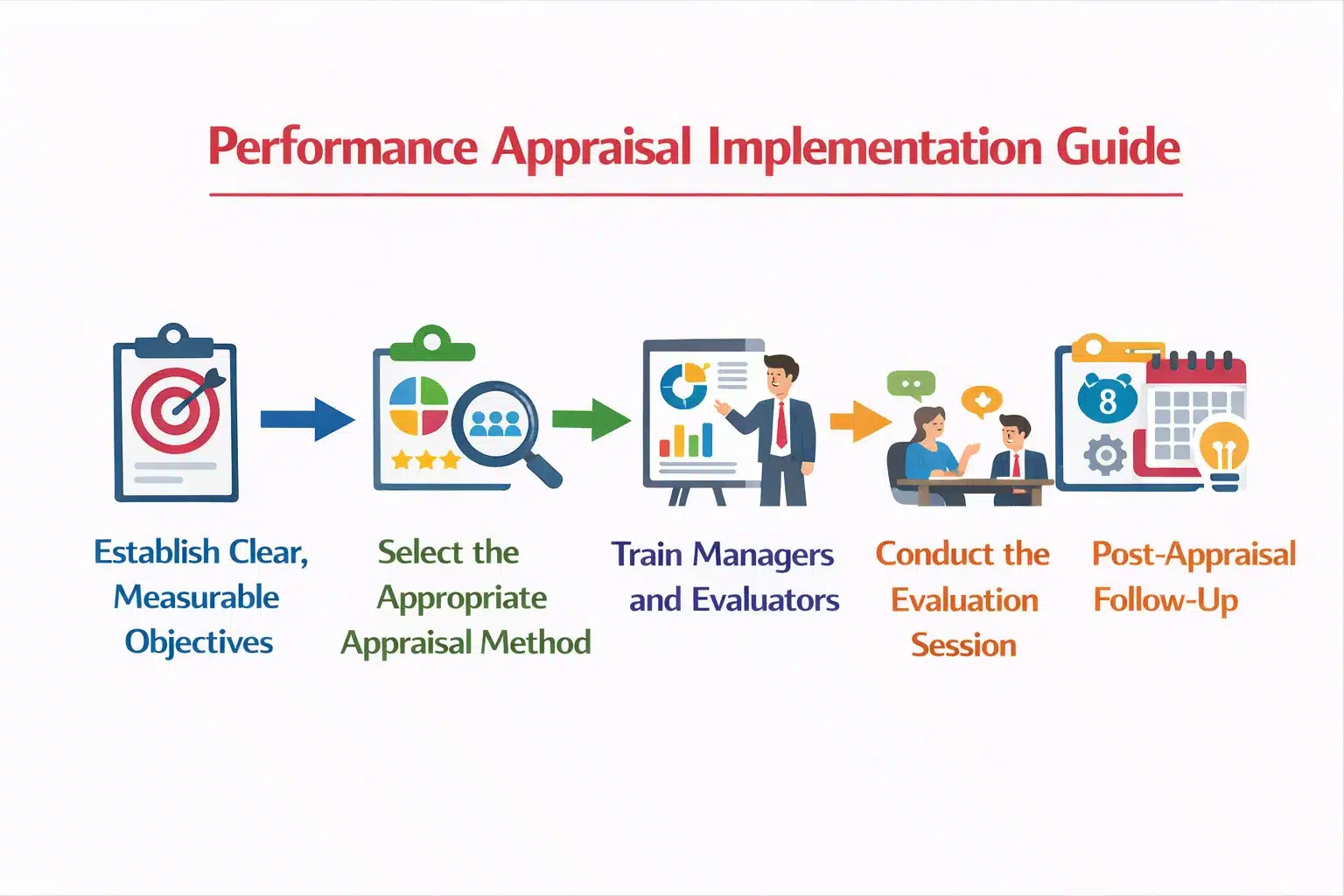
Deploying a successful performance appraisal system requires meticulous planning and execution. Businesses looking to establish or revamp their evaluation framework should follow a structured approach to ensure fairness, transparency, and lasting efficacy.
1. Establish Clear, Measurable Objectives
Before any evaluation begins, leadership must define what success looks like for every role. You should use the SMART framework to set specific, measurable, achievable, relevant, and time-bound expectations and KPIs that both your managers and employees understand upfront.
2. Select the Appropriate Appraisal Method
Choose a framework that fits the culture and structure of the business. A collaborative, matrixed team may benefit most from 360-degree feedback, while a structured sales team might be better served by Management by Objectives or behaviorally anchored rating scales.
3. Train Managers and Evaluators
The system is only as good as the people running it. Managers need comprehensive training on delivering constructive feedback, active listening, accurate documentation, and identifying their own unconscious biases before conducting any evaluations.
4. Conduct the Evaluation Session
Schedule dedicated, uninterrupted time for the appraisal meeting. The session should be a two-way dialogue where the employee is encouraged to share their self-assessment, discuss roadblocks, and highlight achievements that may not be visible to the manager.
5. Post-Appraisal Follow-Up
An appraisal is not a standalone event. After the review, managers and employees should co-create an Individual Development Plan with scheduled check-ins throughout the year to monitor progress and adjust goals as circumstances evolve.
Common Pitfalls and How to Avoid Them
Even well-intentioned appraisal systems fail when managers fall into common evaluation errors. Recognizing these pitfalls is the first step toward preserving the integrity and fairness of the review process.
- Recency Bias
Recency bias occurs when managers disproportionately weigh an employee’s actions from the last few weeks while ignoring months before. The fix is simple but requires discipline: maintain continuous performance logs throughout the entire review cycle, not just before appraisal season.
- The Halo and Horns Effect
This occurs when one exceptionally positive or negative trait overshadows the entire evaluation. A strong first impression or a single recent mistake should not define a year’s worth of performance. Structured rubrics grounded in specific, observable behaviors help prevent this distortion.
- One-Way Communication
When a review becomes a lecture, employee engagement drops immediately. Managers should aim for genuine dialogue, asking open-ended questions that prompt the employee to reflect rather than simply receive feedback passively.
- Mixing Compensation with Development
When employees know their pay raise is directly on the line, they are less likely to admit weaknesses or ask for help. Many businesses now hold compensation and development discussions in entirely separate meetings to encourage honesty and genuine growth conversations.
Advanced Practices in Performance Evaluation
Forward-thinking businesses are moving beyond traditional appraisal models to adopt practices that are more dynamic, data-driven, and employee-centric. You can follow these advanced approaches to reshape how performance is evaluated and developed.
Continuous Feedback and Check-Ins
The traditional annual review is rapidly being supplemented by continuous feedback models. Weekly or bi-weekly one-on-ones allow managers to course-correct in real time, recognize achievements instantly, and prevent minor issues from becoming major performance failures.
Integration of HR and Appraisal Software
Modern HR platforms centralize performance data, automate review scheduling, and eliminate the administrative burden of managing appraisals manually.
The right software makes it easier to track goals year-round, consolidate feedback, and generate reports that support fair, consistent evaluations. With this performance context connected, Hashy AI helps managers review appraisal information and identify the next action.





Automated Learning and Development Triggers
Advanced appraisal systems integrate directly with Learning Management Systems. If an employee scores low in a specific competency, the system automatically assigns relevant training modules. They can also suggest internal mentorship programs to bridge the gap without waiting for the next review cycle.
Strengths-Based Appraisals
Rather than focusing on weaknesses, the strengths-based approach identifies what employees do best and aligns their responsibilities with those talents. This shift can boost morale, increase psychological safety, and drive meaningful productivity gains for your employees.
Conclusion
Performance appraisals are one of the most powerful tools a business has for developing its people and strengthening its operations. They align individual effort with goals, surface talent, close gaps, and build a workplace culture where employees feel valued.
The businesses that treat appraisals as a strategic priority rather than an administrative obligation are the ones that retain their best people, develop strong internal leaders, and build teams capable of delivering consistent, high-quality results over the long term.
If you are interested in this topic and want to learn further, you can consult the experts of our team to dive deeper into this subject and be guided on the practical implementation of effective performance appraisal for your company.

Frequently Asked Question
A performance appraisal is a systematic process through which a business formally assesses an employee's job performance, skills, and contributions against predetermined standards. It produces a documented record used to inform decisions around compensation, training, promotions, and career development.
Performance management is a continuous, year-round process involving ongoing coaching, real-time feedback, and daily goal alignment. A performance appraisal is a formal milestone within that process where all continuous feedback is synthesized into a structured, documented summary.
Most businesses conduct formal appraisals annually or semi-annually. However, many are now supplementing these with continuous feedback models, including weekly or bi-weekly one-on-one check-ins that allow managers to course-correct in real time rather than waiting for the next formal cycle.
The Situation-Behavior-Impact model is a framework for delivering constructive feedback. It structures critique around a specific situation, the observable behavior displayed, and the tangible impact that behavior had on the team or project. This approach depersonalizes feedback and focuses purely on professional development.
An Individual Development Plan is a customized roadmap created after an appraisal that outlines the specific training, mentorship, and experiential learning an employee needs to close identified skill gaps or prepare for new responsibilities. It transforms appraisal feedback into a concrete, actionable strategy.