
Key Takeaways What is Delivery Management System? It is a digital platform that digitizes and automates the entire logistics lifecycle, from order intake to final proof of delivery. The Importance of The Delivery Management System lies in its ability to meet rising customer expectations for speed while controlling operational costs. Key Elements of Effective Delivery Management include automated route optimization, real-time tracking, and comprehensive fleet analytics.
What is Delivery Management System?

A Delivery Management System (DMS) is a digital logistics transportation system that helps businesses plan, monitor, and improve delivery operations. It connects dispatchers, drivers, and managers within one centralized platform so delivery information can be tracked and shared in real time.
The system also analyzes factors such as delivery schedules, vehicle capacity, driver availability, and traffic conditions. By using this information, a DMS can suggest the most efficient routes and delivery plans. This helps businesses complete deliveries faster while reducing delays and operational costs.
A modern DMS also supports the entire delivery process, from the first mile to the last mile of logistics. Because the last mile is often the most complex and expensive stage, businesses use DMS tools to manage routes, coordinate drivers, and track deliveries more effectively. These systems can also integrate with ERP or warehouse management systems to keep delivery updates connected with inventory, orders, and billing records.
The Importance of The Delivery Management System
Over the past decade, delivery has evolved from a simple logistics task into an important part of the customer experience. Customers now expect fast shipping, accurate delivery times, and clear updates, and delays can quickly harm a company’s reputation. A Delivery Management System (DMS) helps businesses meet these expectations by improving visibility and making deliveries easier to plan, track, and complete.
A DMS also helps businesses run their logistics operations more efficiently as demand grows. By optimizing routes, coordinating drivers, and reducing failed deliveries, companies can lower costs such as fuel, labor, and vehicle usage. The data collected by the system also helps managers analyze delivery performance and improve operations over time.
Key Elements of Effective Delivery Management
Effective delivery management is built on several interconnected elements that work together to ensure goods move smoothly from the warehouse to the customer. Rather than relying on a single tool, most delivery management systems consist of multiple functions that support planning, coordination, and monitoring throughout the logistics process.
1. Order Processing and Management
The delivery process begins with proper order processing. A delivery management system collects order information from different sales channels, such as online stores, mobile applications, or physical retail locations, and places them into one centralized platform. This helps prevent common issues such as duplicate orders, missing information, or miscommunication between departments.
The system also verifies key order details before the delivery process begins. It can check whether addresses are valid, confirm that delivery schedules are realistic, and ensure that the required products are available at the correct dispatch location. By validating this information early, businesses can avoid delivery failures, reduce unnecessary trips, and ensure that resources are used efficiently.
2. Route Planning and Optimization
Route planning is one of the most important functions in delivery management because it directly affects fuel usage, driver productivity, and overall vehicle optimization. Planning routes manually becomes increasingly difficult as delivery volumes grow, especially when distance, traffic conditions, and time windows must all be considered simultaneously.
Advanced systems can also adjust routes when unexpected situations occur. For example, traffic congestion, vehicle issues, or last-minute order changes may require deliveries to be rescheduled or reassigned. By updating routes in real time and communicating these changes directly to drivers, businesses can reduce delays and keep delivery operations running more smoothly.
3. Real-Time Tracking and Visibility
Real-time tracking helps businesses monitor deliveries as they happen. Using GPS and mobile technology, delivery managers can see the location of vehicles and track the progress of each delivery throughout the day. This visibility allows them to respond quickly if a problem occurs, such as a delayed vehicle or a missed stop.
Tracking information also improves communication with customers. Instead of waiting for broad delivery windows, customers can receive estimated arrival times and track their packages while they are in transit. Many systems also send automatic notifications when the delivery is approaching or completed, helping create a more transparent and reliable delivery experience.
4. Delivery Driver and Fleet Management
Drivers and vehicles play a central role in the success of delivery operations. Delivery management systems often provide mobile applications that guide drivers through their daily routes, display delivery details, and allow them to communicate with dispatch teams. This digital workflow reduces reliance on paper documents and helps drivers complete deliveries more efficiently.
Fleet management features also help businesses maintain their vehicles. The system can track mileage and usage data to schedule maintenance activities such as oil changes or inspections. Regular maintenance helps prevent unexpected breakdowns, ensuring that vehicles remain reliable and safe for daily delivery operations.
5. Performance Monitoring and Analytics
Another important element of delivery management is the ability to measure performance. Delivery management systems collect data throughout the delivery process, including delivery times, route efficiency, and vehicle usage. This information is often presented in dashboards or reports that allow managers to evaluate how well the delivery operation is performing.
By analyzing this data, businesses can identify operational issues and improve their logistics strategies. For example, managers may discover that deliveries in certain areas take longer than expected or that specific routes frequently experience delays. With this information, companies can adjust their planning, allocate resources more effectively, and continuously improve the efficiency of their delivery operations.

Benefits of Implementing a Delivery Management System
Implementing a Delivery Management System (DMS) can bring significant improvements to how businesses manage their delivery operations. Beyond helping coordinate deliveries more efficiently, the system also supports long-term business goals such as cost control, customer satisfaction, and operational growth.
1. Cost Reduction and Profitability
One of the most immediate benefits of using a DMS is the ability to reduce operational costs. Route optimization helps vehicles travel shorter and more efficient paths, which lowers fuel consumption and reduces vehicle wear over time. In addition, automated scheduling and dispatching decrease the amount of manual work required to manage deliveries.
A DMS can also reduce the cost of failed deliveries. When delivery information is verified and routes are carefully planned, the chances of missed deliveries or incorrect addresses decrease. This helps businesses avoid the additional costs associated with repeated delivery attempts or reverse logistics.
2. Enhanced Customer Satisfaction and Loyalty
Customer experience has become a key factor in business success, especially in industries that rely heavily on delivery services. A Delivery Management System improves transparency by allowing customers to receive accurate delivery updates and estimated arrival times. This level of communication helps build trust between businesses and their customers.
Reliable delivery services also increase customer satisfaction. When products arrive on time, and customers are informed throughout the delivery process, they are more likely to return for future purchases and recommend the service to others. Consistent delivery performance therefore, contributes directly to long-term customer loyalty.
3. Operational Agility and Scalability
As businesses grow, delivery operations often become more complex. Managing a small number of deliveries manually may be manageable, but larger volumes require better coordination and structured systems. A DMS allows companies to manage increasing delivery demands without significantly increasing operational complexity.
The system also provides flexibility when unexpected changes occur. For example, businesses can adjust routes, reassign deliveries, or allocate additional resources during periods of high demand. This ability to adapt quickly helps organizations maintain service quality even as their operations expand.
4. Improved Employee Satisfaction and Retention
Delivery drivers and dispatch teams play an important role in ensuring that deliveries run smoothly. A DMS supports these teams by providing clear schedules, optimized routes, and digital tools that simplify daily tasks. Drivers can access delivery information through mobile applications, while dispatchers can monitor operations through centralized dashboards.
When employees have access to better tools and clearer workflows, their work becomes more manageable and less stressful. This can contribute to higher job satisfaction and better performance across delivery teams.
5. Data-Driven Strategic Growth
Another key benefit of a Delivery Management System is the ability to collect and analyze operational data. The system records information about delivery times, route efficiency, and vehicle usage, which can then be used to evaluate overall performance. Managers can use this data to identify areas where improvements are needed.
Over time, these insights help businesses make more informed strategic decisions. For example, companies can analyze delivery patterns to determine where additional resources are required or how delivery zones should be adjusted. By using data to guide planning, businesses can continuously improve the efficiency and reliability of their logistics operations.
Industry-Specific Applications of Delivery Management

While the main goal of delivery management is the same, moving goods from one place to another, the way it is used can differ across industries. Each sector has its own operational challenges, customer expectations, and regulations that affect how deliveries are planned and managed. Because of this, modern Delivery Management Systems (DMS) are built with flexible features so businesses can adapt them to their specific logistics needs.
1. Retail and E-commerce: Hyper-Local Fulfillment
In the retail and e-commerce sector, delivery speed and customer convenience are key priorities. Many businesses now offer same-day or next-day delivery, which requires careful coordination between inventory locations, warehouses, and retail stores. A DMS helps retailers manage this process by automatically directing orders to the nearest fulfillment location that has the required products available.
Another important aspect of retail logistics is handling product returns. Delivery management systems can help organize return pickups, update inventory records, and track returned items more efficiently. By simplifying the return process, businesses can improve customer satisfaction and maintain smoother logistics operations.
2. Manufacturing and Construction: Just-in-Time Coordination
In manufacturing and construction industries, delivery management focuses more on timing and coordination rather than speed. Materials often need to arrive at specific times to support production schedules or construction activities. If deliveries arrive too early or too late, it can disrupt workflows and lead to costly delays.
A DMS helps manage these schedules by organizing delivery time slots and ensuring vehicles are assigned according to capacity and route limitations. The system can also support coordination between drivers and on-site teams so that equipment and staff are prepared when materials arrive.
3. Food, Beverage, and Pharmaceuticals: Cold Chain Integrity
For industries that deal with perishable or sensitive products, delivery management must also consider environmental conditions. Food, beverages, and pharmaceutical products often require strict temperature control during transportation to maintain product quality and safety.
Many delivery management systems can integrate with monitoring devices that track conditions such as temperature throughout the delivery process. This allows businesses to ensure that products remain within safe limits and provides documented records that support quality control and regulatory compliance.
4. 3PL and Courier Services: Multi-Tenant Management
Third-party logistics providers and courier companies often manage deliveries for multiple clients at the same time. As a result, they require systems that can organize and separate delivery information for different customers while still maintaining a centralized view of operations.
A DMS helps these companies coordinate shipments more efficiently by combining deliveries when possible and optimizing routes across different client orders. It can also support automated billing and reporting, which simplifies the process of managing logistics services for multiple businesses.
Strategic Implementation Roadmap
Implementing a Delivery Management System (DMS) involves more than simply installing new software. For many organizations, it requires reviewing existing delivery processes, preparing reliable data, and gradually adapting daily operations to a new system. Companies that approach implementation in structured stages are more likely to gain long-term benefits, including improved efficiency, better coordination, and clearer operational visibility.
Phase 1: Audit and Data Preparation
The first step in implementing a DMS is understanding the current delivery workflow. Businesses need to review how orders are processed, how routes are planned, and where delays or inefficiencies commonly occur. At this stage, it is also important to review operational data, since inaccurate information, such as incorrect addresses or outdated vehicle details, can affect delivery planning and routing accuracy.
Preparing clean and reliable data helps the system function properly. Organizations may verify customer addresses using geolocation tools, record detailed information about each vehicle in the fleet, and analyze how long drivers typically spend at each delivery location. Having accurate operational data allows the system to create more realistic schedules and delivery routes.
Phase 2: System Integration
A Delivery Management System usually works alongside other operational platforms rather than replacing them entirely. To function effectively, the system often needs to connect with business tools such as inventory systems, order management platforms, and customer databases. These integrations ensure that information flows smoothly across departments.
For example, when an order is prepared in the warehouse, the system can automatically schedule the delivery. Once the delivery is completed, the information can update billing records or customer order statuses. By connecting these systems, businesses reduce manual data entry and maintain consistent information across their operations.
Phase 3: Monitoring Performance and Key Metrics
After implementation, organizations must monitor the performance of their delivery operations to understand whether the new system is improving efficiency. Delivery management systems typically provide dashboards that track key performance indicators related to delivery accuracy, operational cost, and resource usage.
Common metrics include on-time delivery rates, cost per delivery, and the percentage of successful first-attempt deliveries. Businesses may also analyze vehicle utilization and compare planned routes with the routes drivers actually follow. By regularly reviewing these indicators, companies can identify areas for improvement and continue refining their delivery operations over time.
Common Pitfalls in Delivery Management and Practical Solutions
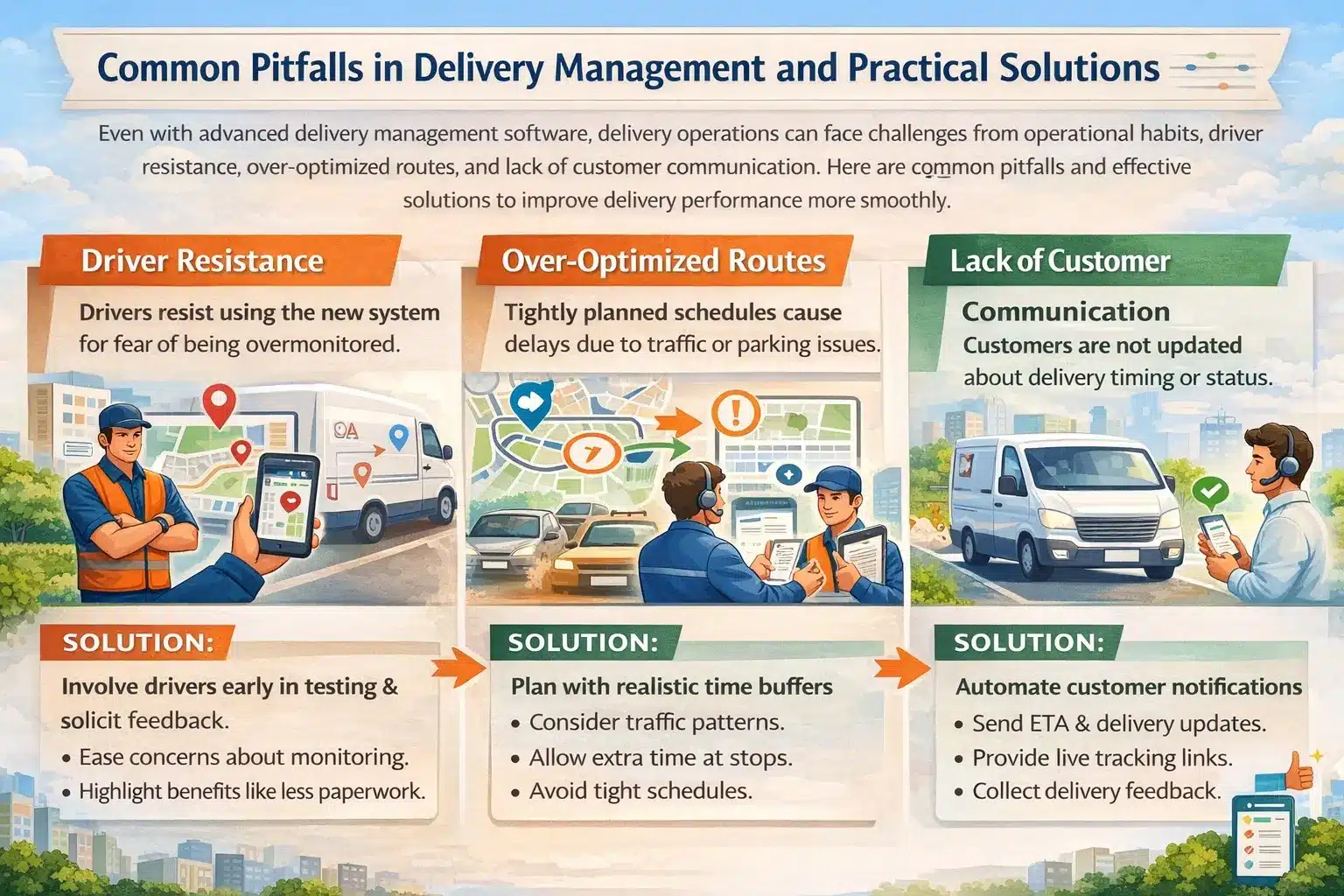
1. Driver Resistance
One common challenge is resistance from delivery drivers. Some drivers may feel uncomfortable with new digital tools, especially if they believe the system is being used to monitor their performance too closely. This can lead to reluctance in using the system fully or following optimized routes.
Solution: Involving drivers early in the implementation process can make a significant difference. Companies can invite experienced drivers to test the system during pilot stages and provide feedback on how the driver application works. When drivers understand that the system helps reduce paperwork, simplify communication with dispatchers, and improve route planning, they are more likely to view it as a helpful tool rather than a form of surveillance.
2. Over-Optimized Routes
Another issue occurs when delivery routes are planned too tightly. If a route schedule leaves no room for unexpected events such as traffic delays, parking difficulties, or longer service times at delivery locations, the entire schedule can quickly fall behind. This can lead to multiple late deliveries throughout the day.
Solution: Businesses should plan routes with realistic time buffers. Delivery systems should consider factors such as traffic patterns, time of day, and typical service times at each stop. Allowing some flexibility in delivery schedules helps drivers adapt to real-world conditions and maintain consistent delivery performance.
3. Lack of Customer Communication
Some organizations focus mainly on operational efficiency and overlook the customer experience. Even if deliveries are well planned, customers may still be dissatisfied if they are not informed about delivery timing or status updates.
Solution: Delivery management systems should include automated customer communication features. Notifications about delivery schedules, estimated arrival times, and completed deliveries help customers stay informed throughout the process. Businesses can also collect feedback after deliveries, which provides valuable insights that can be used to improve service quality in the future.
Conclusion
Modern logistics has evolved from a supporting function into a key strategic priority for businesses. As customer expectations for faster and more transparent deliveries increase, manual processes and disconnected tools are no longer effective. A Delivery Management System (DMS) helps businesses streamline operations by integrating order management, route optimization, real-time tracking, and analytics into one system.
Adopting a DMS is a strategic investment that improves efficiency, reduces costs, and strengthens customer satisfaction. Businesses looking to implement the right solution can consult our expert team to align delivery operations with long-term growth goals.
A courier app typically focuses on the driver's interface for a single delivery, while a Delivery Management System is a comprehensive platform that manages the entire logistics lifecycle, including order processing, fleet management, route optimization, and analytics for the entire organization. Route optimization reduces costs by calculating the most efficient paths for deliveries, which significantly lowers fuel consumption and vehicle maintenance expenses. It also maximizes the number of deliveries a driver can complete in a shift, improving labor efficiency. Yes, modern Delivery Management Systems are designed to integrate seamlessly with existing business software, including ERPs, CRMs, and Warehouse Management Systems (WMS), ensuring data synchronization across sales, inventory, and logistics. Absolutely. While enterprise-grade systems exist, many DMS providers offer scalable solutions tailored for small to medium-sized businesses. These systems help small fleets compete with larger players by improving efficiency and customer service without a massive upfront investment. Electronic Proof of Delivery (ePOD) is a digital method of verifying that a shipment has been delivered. It can take the form of a digital signature captured on a mobile device, a photograph of the package at the doorstep, or a barcode scan, providing indisputable evidence of fulfillment.Frequently Asked Question