Businesses today operate in a fast-changing environment where markets shift quickly, new technologies appear constantly, and customer expectations keep rising. Companies can’t rely on old systems or strategies if they want to stay competitive. This is why having a clear change management process has become essential.
Recognizing the need for change is only the first step. The bigger challenge is guiding the organization through that transition in a structured and organized way. A well-defined change management process helps leaders plan, communicate, and implement change more effectively.
Successful change ultimately depends on people. When employees understand the purpose of the change and receive the right support and training, they are more likely to adapt. A strong change management process helps move a company from its current state to its future goals.
Key Takeaways
Discover the foundational principles and psychological aspects of organizational transitions.
Explore the four main categories of business transformation and their unique challenges.
Learn the five critical steps required to successfully implement and sustain change.
Penjelasan mendalam mengenai Change Management Across Industries.
What Is the Change Management Process?

The change management process is a structured way to help people move from the current way of working to a new one. While project management handles tasks like timelines, budgets, and systems, change management focuses on how employees adapt to those changes. It helps organizations prepare, train, and support people to successfully adopt new tools, processes, or strategies.
A company can introduce new technology or redesign workflows, but if employees keep working the same way, the change will not succeed. The change management process helps reduce confusion and resistance by guiding employees through the transition and helping them feel confident with the new way of working.
Types of Organisational Change
Before building a change management process, leaders need to understand what type of change the organization is facing. Different changes affect structure, technology, processes, or culture in different ways. Knowing the type of change helps organizations choose the right approach and prepare for challenges.
1. Structural Change
Structural change happens when a company changes its hierarchy, departments, or reporting lines. This often occurs during mergers, company growth, downsizing, or shifts in the business model. Because these changes affect roles and managers, employees often worry about job security and how their responsibilities will change.
Leaders need to communicate clearly during structural change. Employees want to understand why the change is happening and how it affects their role. Sharing updated org charts, clear job descriptions, and career paths can reduce confusion and help people adjust faster.
2. Technological Change
Technological change happens when companies introduce new software, systems, or digital tools. Businesses often do this to improve efficiency, manage data better, or enhance customer experience. Examples include adopting cloud tools, automation platforms, or enterprise systems like ERP software.
The biggest challenge is the learning curve. Employees who are used to old systems may feel frustrated or unsure about using new technology. Good change management focuses on practical training, early user involvement, and strong support after launch so employees feel confident using the new tools.
3. Process Change
Process change happens when a company updates the way work gets done. This might include new workflows, procedures, or methods to improve efficiency, quality, or compliance. Approaches like Lean, Agile, or Six Sigma often drive these types of improvements.
Even small process changes can face resistance because people are used to doing things a certain way. To make adoption easier, companies often test new workflows through pilot programs first. Showing real results and collecting employee feedback helps teams accept the new process more quickly.
4. Cultural Change
Cultural change focuses on shifting how people think, behave, and work together in an organization. It may involve moving toward more collaboration, innovation, transparency, or customer focus. This type of change often happens after leadership shifts or company mergers.
Cultural change takes time because habits and beliefs do not change overnight. Leaders must model the new behaviors and reinforce them through rewards, hiring practices, and performance systems. When employees see leaders living the values, the new culture becomes more real and believable.
How to Execute a Change Management Process
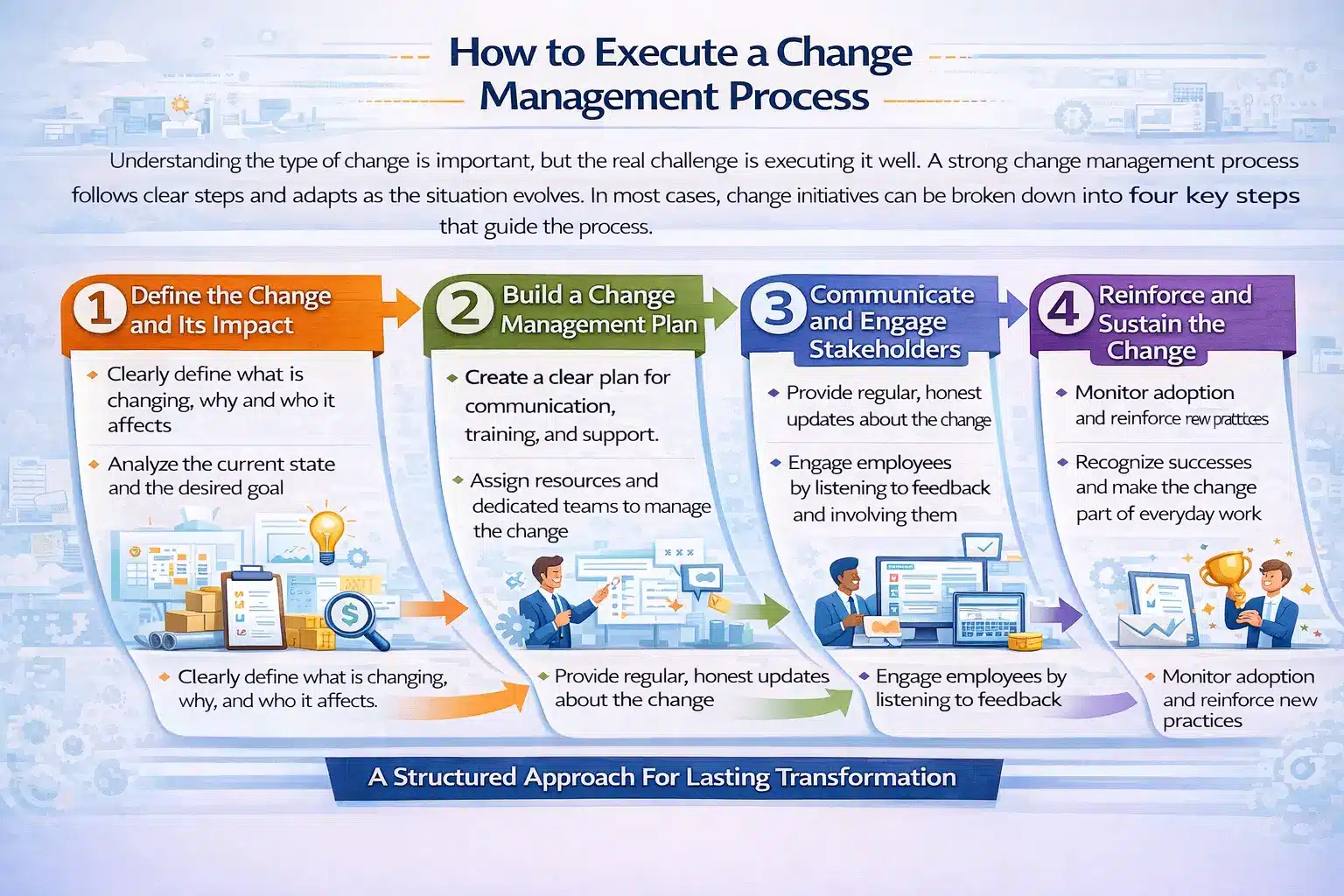
Understanding the type of change is important, but the real challenge is executing it well. A strong change management process follows clear steps and adapts as the situation evolves. In most cases, change initiatives can be broken down into five key steps that guide the process.
Step 1 — Define the Change and Its Impact
The first step is clearly defining what is changing, why it matters, and who it will affect. If leaders cannot explain the change in simple terms, employees will struggle to support it. A clear vision helps people understand the purpose and direction of the change.
Teams also need to analyze the current situation and the future goal. This helps leaders see the gap between where the company is now and where it wants to be. It is also important to identify which teams and roles will be affected so communication and training can be planned properly.
Step 2 — Build a Change Management Plan
Once the change is clearly defined, the next step is creating a practical plan. This plan outlines how the organization will manage communication, training, leadership support, and employee transition. A clear plan helps keep everyone aligned throughout the process.
Strong leadership support is also critical at this stage. Executives and managers must actively support the change by communicating with employees and staying involved. Organizations should also assign resources, budgets, and dedicated teams to guide the change successfully.
Step 3 — Communicate and Engage Stakeholders
Communication plays a major role in any change initiative. Employees need clear, honest updates so they understand what is happening and why. Good communication also allows employees to ask questions and share feedback.
Engaging employees is just as important as informing them. Many companies involve teams through feedback sessions, surveys, or internal change champions. When employees feel included in the process, they are more likely to support the change.
Step 4 — Implement and Support the Transition
This is the stage where the actual change happens. New systems, processes, or structures are introduced, and employees begin adjusting to the new way of working. Because this phase can be challenging, organizations need to provide strong guidance and support.
Training plays a key role during implementation. Employees should receive practical training and access to help when they face problems. Leaders also need to stay visible and supportive so teams feel confident during the transition.
Step 5 — Reinforce and Sustain the Change
The final step focuses on making the change last. Without reinforcement, employees may return to old habits once the initial excitement fades. Organizations must monitor adoption and make sure the new processes are being used consistently.
Celebrating early successes can help strengthen the change. Recognizing employees who adopt the new approach encourages others to follow. Over time, the new practices should become part of everyday work across the organization.
Change Management Across Industries
The core ideas of change management stay the same, but how companies apply them can vary by industry. Factors like regulations, workforce structure, and daily operations influence how change is managed. Because of this, organizations need a flexible approach that fits their industry.
1. Manufacturing and Supply Chain
In manufacturing and supply chain companies, change often comes from automation, Industry 4.0 technologies, or lean production improvements. These changes affect both executives who plan operations and frontline workers who run machines. Because operators may worry about job security, leaders must focus on upskilling and safety.
Communication should be direct and practical. Many shop floor workers rarely check email, so updates should happen through shift briefings, visual guides, and hands-on training. Clear communication helps workers understand the value of the change.
2. Healthcare
In healthcare, change often involves new patient care systems, updated protocols, or hospital mergers. These changes are sensitive because they directly affect patient safety and clinical workflows. Doctors and nurses already face heavy workloads, so resistance can happen if changes slow them down.
Peer leadership plays an important role in healthcare change. Physicians and senior nurses often act as trusted voices during transitions. Training should be short, practical, and supported by quick access to help.
3. Retail and Consumer Goods
Retail companies constantly adapt to changing customer behavior and the growth of online shopping. Businesses often introduce new sales systems, service processes, or inventory tools to stay competitive. These changes must work across many stores and varied employee shifts.
Training needs to be simple and quick for retail teams. Mobile-friendly guides and short tutorials work better than long training sessions. Many retailers also use small rewards to encourage employees to adopt new systems.
4. Financial Services and Banking
In banking and financial services, change is strongly influenced by regulations, security, and risk management. When banks update digital platforms or core systems, even small errors can cause serious problems. Because of this, every change must be carefully planned and tested.
Organizations in this sector rely on strict procedures and strong oversight. Teams monitor systems closely during and after implementation. This helps protect sensitive financial data and ensures compliance with regulations.

Common Pitfalls and How to Avoid Them
Even with a strong plan, change initiatives can still run into problems. Many organizations face similar challenges that slow down progress or cause projects to fail. Understanding these common pitfalls helps leaders prepare and manage change more effectively.
- Ghost Executive Sponsors: Sometimes executives approve a project but disappear during the rollout. When leaders are not visible, employees may assume the change is not important. Sponsors should stay engaged and actively support the initiative.
- Treating Change as a One-Time Event: Some organizations think the work ends once a new system goes live. In reality, employees still need time and support to adjust. Ongoing guidance helps teams build new habits.
- Ignoring the Middle Manager Squeeze: Middle managers often face pressure from both leadership and their teams. Without proper support, they struggle to lead the change effectively. Training and clear resources help them guide their teams better.
Best Practices for Effective Change Management
Successful change management requires more than a good plan. Organizations need clear leadership, open communication, and continuous monitoring to make change stick. The following best practices help teams manage transitions more smoothly and improve the chances of long-term success.
- Secure Executive Sponsorship from the Start: Strong leadership support is critical for successful change. When executives actively back the initiative, employees are more likely to treat it as a real priority.
- Communicate Early and Often: Clear communication reduces confusion during change. Regular updates help employees understand what is happening and how it affects their work.
- Address Resistance Proactively: Resistance is a normal reaction to change. Listening to concerns and addressing them early can help turn hesitation into support.
- Measure Outcomes, Not Just Activities: Track real results such as adoption rates or productivity improvements. Focusing on outcomes helps ensure the change delivers real value.
Conclusion
A well-executed change management process helps organizations move through transformation with less disruption and stronger results. By planning carefully, communicating clearly, and supporting employees throughout the transition, companies can improve adoption and reduce resistance.
In the end, successful change is not just about new systems or strategies; it is about helping people adapt and grow. When leaders stay engaged, and organizations continue reinforcing new ways of working, change becomes a lasting improvement rather than a temporary initiative.
Frequently Asked Question
The change management process is a structured approach organizations use to plan, implement, and manage changes. It helps employees adjust to new systems, processes, or strategies so the transition happens smoothly.
The change management process is important because it helps reduce confusion and resistance during organizational changes. It ensures employees understand the purpose of the change and receive the support they need.
The main steps usually include defining the change, creating a plan, communicating with employees, implementing the change, and reinforcing the new way of working.