














A CRM system is software that stores, manages, and analyses customer data throughout the sales journey. It tracks interactions across email, phone, and social media, automates workflows, and helps businesses improve sales, retention, and growth.
Managing customer relationships is increasingly complex as enquiries, sales, and support come from multiple channels. Without customer management systems, businesses can lose track of leads, miss follow-ups, and weaken the customer experience.
In Australia, that shift is already visible in business technology adoption. The ABS reported that 17% of Australian businesses used CRM software in 2021–22, showing that more companies are moving away from scattered records and toward more structured customer management.
A CRM system brings sales, marketing, and service together in one place, so teams can work with the same customer data and respond more effectively. This guide explains how CRM software works, the main types available, and why it matters for business growth.
Key Takeaways
|
What is a CRM System?
A CRM system acts as a customer management platform that helps businesses store data, track interactions, and manage relationships in one place. It gives teams clearer visibility to respond faster, follow up properly, and build stronger long-term relationships.
More than just a contact database, a customer relationship management system integrates sales, service, marketing, and account management into one platform. It helps teams stay aligned, reduce manual work, and use customer data more effectively.
Modern CRM systems also support automation, reporting, and integrations with tools like email, social media, and ERP, improving decision-making, productivity, and customer lifetime value.
Core Functions of CRM System
A CRM system helps businesses manage sales, marketing, service, and customer data within one connected platform. This allows teams to work with the same information and respond more consistently across the customer journey.
1. Sales
CRM systems help sales teams manage leads, track deal progress, schedule follow-ups, and monitor pipeline activity in one place. This gives teams clearer visibility into opportunities and helps reduce missed follow-ups.
2. Marketing
Marketing teams use CRM software to segment audiences, automate campaigns, and track customer engagement across different channels. This helps businesses deliver more targeted communication without relying heavily on manual processes.
3. Customer Service
Customer service functions allow teams to manage support tickets, customer enquiries, and service history more efficiently. Full access to past interactions also helps support teams respond with better context.
4. Analytics
CRM analytics tools turn customer and sales data into dashboards, reports, and performance insights. Businesses can use this information to identify trends, monitor team performance, and support faster decision-making.
How Does CRM Software Work?
A CRM system collects customer data from different channels and stores it in one place. This helps teams see customer history clearly and support better customer relationship management across sales, marketing, and service.
Below is a simple sales processing overview of how CRM systems turn scattered data into actionable insights and daily operations:
- Capture data: The system gathers customer information from websites, emails, calls, and social media.
- Organise records: It stores contact details, interactions, and account history on a single central platform.
- Generate insights: Analytics help teams understand customer behaviour, needs, and opportunities.
- Support team action: Sales, marketing, and service teams use that information to respond faster and work better.
- Improve outcomes: Businesses use customer management systems to personalise campaigns, shorten sales cycles, and resolve issues more efficiently.
That is why many businesses, including those evaluating crm systems Australia, rely on these tools to strengthen customer relationship management and make more informed decisions.
What CRM Actually Does for Your Business and Why It Matters?

A customer relationship management system does more than store contacts, it helps you understand customers, act faster, and run your business more clearly. Many teams start by asking what a CRM system is, then realise its central role in daily operations.
1. Better visibility across every customer and deal
A CRM system gives your team one complete view of every customer, lead, and deal in progress. Instead of searching through emails, spreadsheets, or chat threads, staff can see contact history, deal stage, past interactions, and next steps in one dashboard.
This visibility helps teams using customer management systems spot risks earlier, prioritise opportunities, and avoid missed information. It also supports more consistent customer relations management by giving everyone a shared source of truth.
2. Faster follow-up and higher sales conversion
Speed matters in sales, and crm systems help teams follow up while interest is still high. As a software for sales manager, a CRM helps teams set reminders, track lead activity, and move prospects through the pipeline without relying on memory alone.
That structure reduces delays and keeps promising deals from going cold. As a result, businesses often improve response times, strengthen engagement, and increase conversion rates.
3. More personalised marketing at scale
Modern customer management systems help marketing teams group audiences based on behaviour, interests, purchase history, or engagement level. This makes it easier to send more relevant messages instead of treating every prospect the same way.
Personalised campaigns usually perform better because they speak to real customer needs and timing. With the right CRM system, businesses can scale that personal approach without creating extra manual work.
4. Stronger team collaboration without the back-and-forth
A shared CRM system helps sales, marketing, and service teams stay aligned without constant follow-up messages. Everyone can access the same notes, updates, and customer history, which reduces confusion and repeated work.
This creates smoother handovers between teams, especially when a lead becomes a customer or when an issue needs support. Better collaboration leads to faster decisions and a more connected customer experience.
5. Higher customer retention through consistent service
Customers are more likely to stay when businesses respond with context, accuracy, and consistency. CRM systems help teams remember past concerns, preferences, purchases, and service history, so every interaction feels more informed.
This makes support more reliable and reduces the frustration customers feel when they have to repeat themselves. Over time, better service strengthens trust, loyalty, and retention.
6. Less manual work through automation
One of the biggest advantages of a CRM system is its ability to automate repetitive tasks. Teams can automate follow-up reminders, lead assignments, status updates, reporting, and routine communications that would otherwise take up valuable time.
This reduces admin work and lowers the chance of human error in daily processes. With less time spent on manual tasks, teams can focus more on selling, serving, and building stronger relationships.
7. Why this matters more for Australian businesses specifically
For businesses comparing CRM systems in Australia, these benefits matter as expectations rise while teams work with tighter time and resources. They need systems that support clearer communication, faster service, and more efficient operations.
A strong customer relationship management approach helps businesses stay competitive without losing control as they scale. That is why many local companies now see crm systems Australia not as optional tools, but as practical infrastructure for growth.
Example of CRM Impact in Practice
A global technology company faced fragmented sales processes due to disconnected tools and limited visibility into customer data. Sales teams struggled to track opportunities consistently, which slowed decision-making and reduced conversion rates.
To address this, the company implemented a centralised CRM system to unify data, automate follow-ups, and improve collaboration. This enabled teams to access real-time information and align their actions more effectively.
As a result, the business improved sales visibility, shortened sales cycles, and increased conversion rates. The CRM system also enabled more personalised customer engagement by using historical data and behaviour insights to guide interactions.
Types of CRM Systems
Not every CRM system serves the same purpose, and choosing the right one depends on how your business manages sales, data, and customer interactions. Different types of CRM systems focus on execution, insight, or collaboration.
Most customer management systems fall into three categories: Operational, Analytical, and Collaborative, with cloud platforms becoming more common.
Operational CRM
Operational CRM focuses on automating day-to-day customer-facing activities such as sales, marketing, and service. It helps teams capture leads, track interactions, and manage the full customer journey in a structured way.
Sales automation keeps pipelines organised, marketing automation supports targeted campaigns, and service tools handle enquiries efficiently. For growth-focused businesses, this type of CRM system improves consistency in customer relations management.
Analytical CRM
Analytical CRM focuses on turning customer data into insights that support better decisions. Instead of managing daily interactions, it helps businesses understand trends such as customer behaviour, purchasing patterns, and churn risks.
Teams can use these insights to refine strategies, improve targeting, and optimise marketing and sales performance. This type of crm systems is especially useful for companies that want to make data-driven decisions at scale.
Collaborative CRM
Collaborative CRM helps different departments share customer information and work more closely together. It removes data silos so sales, marketing, and service teams all access the same customer history and communication records.
This creates a more consistent experience because customers do not need to repeat information across different touchpoints. As part of a broader customer relationship management approach, it improves internal coordination and strengthens overall service quality.
Strategic CRM
Strategic CRM focuses on improving customer retention, loyalty, and long-term relationships. Instead of focusing only on transactions, this approach helps businesses better understand customer behaviour and deliver more personalised experiences.
Businesses often use Strategic CRM to strengthen customer engagement, improve retention strategies, and align customer experience initiatives across sales, marketing, and service teams.
Cloud CRM for small and growing businesses
Cloud-based CRM systems that Australian businesses commonly use are designed for flexibility, accessibility, and scalability. Teams can access data anytime, anywhere, without relying on complex on-premise infrastructure.
These systems integrate easily with other tools and support businesses that need to scale without high upfront costs. Many organisations use cloud-based customer management systems to improve customer relationship management while staying agile.
CRM Examples by Industry

Different industries use CRM systems in various ways based on how they manage customers and operations. From retail to construction, these examples show how customer management systems strengthen customer relationship management across industries.
1. CRM examples for retail and hospitality
Retail and hospitality businesses use a CRM system to track customer preferences, purchase history, and visit frequency. This helps teams personalise promotions, loyalty programs, and service interactions to increase repeat visits.
Staff can quickly access customer data to deliver faster, more consistent service across stores or outlets. With crm systems, businesses improve customer relations management while increasing customer lifetime value.
2. CRM examples for manufacturing and services
Manufacturing and service companies use customer management systems to manage long sales cycles, client relationships, and after-sales support. A CRM system helps track enquiries, quotations, contracts, and service history in one place.
Teams can follow up more effectively, manage accounts better, and identify upsell or renewal opportunities. This strengthens customer relationship management and supports more predictable revenue growth.
3. CRM examples for construction businesses
Construction businesses use crm systems to manage project leads, client communication, and tender processes. A CRM system helps track project stages, stakeholder interactions, and contract progress without relying on scattered records.
Teams can coordinate more effectively between sales, project managers, and clients throughout the project lifecycle. This improves customer relations management while reducing delays and miscommunication.
4. Real estate CRM examples in Australia
Real estate agencies rely on crm systems Australia to manage property listings, buyer enquiries, and ongoing client relationships. A CRM system helps agents track leads, schedule follow-ups, and maintain communication with buyers and sellers.
It also supports personalised property recommendations based on client preferences and past interactions. For agencies, strong customer relationship management leads to faster deal closures and better long-term client retention.
CRM vs ERP: What’s the Difference?
A CRM system manages customer-facing activities like leads, interactions, and service history, while an ERP system handles internal operations such as finance, inventory, and procurement. CRM focuses on growth, while ERP focuses on operational control.
The difference also appears in daily users. Sales, marketing, and service teams rely on customer management systems to manage relationships and improve customer visibility. In contrast, finance and operations teams rely on ERP for process control and data accuracy.
For Australian businesses, this distinction is also tied to compliance. ERP systems often support tax and record-keeping, while CRM systems store personal data that must follow the Australian Privacy Principles to ensure proper handling and data protection.
| Aspect | CRM | ERP |
| Focus | Customer relationships | Business operations |
| Primary users | Sales, marketing, service | Finance, operations |
| Data type | Customer interactions | Financial and operational data |
| Purpose | Drive revenue and engagement | Improve efficiency and control |
Key Features to Look for in a Modern CRM System
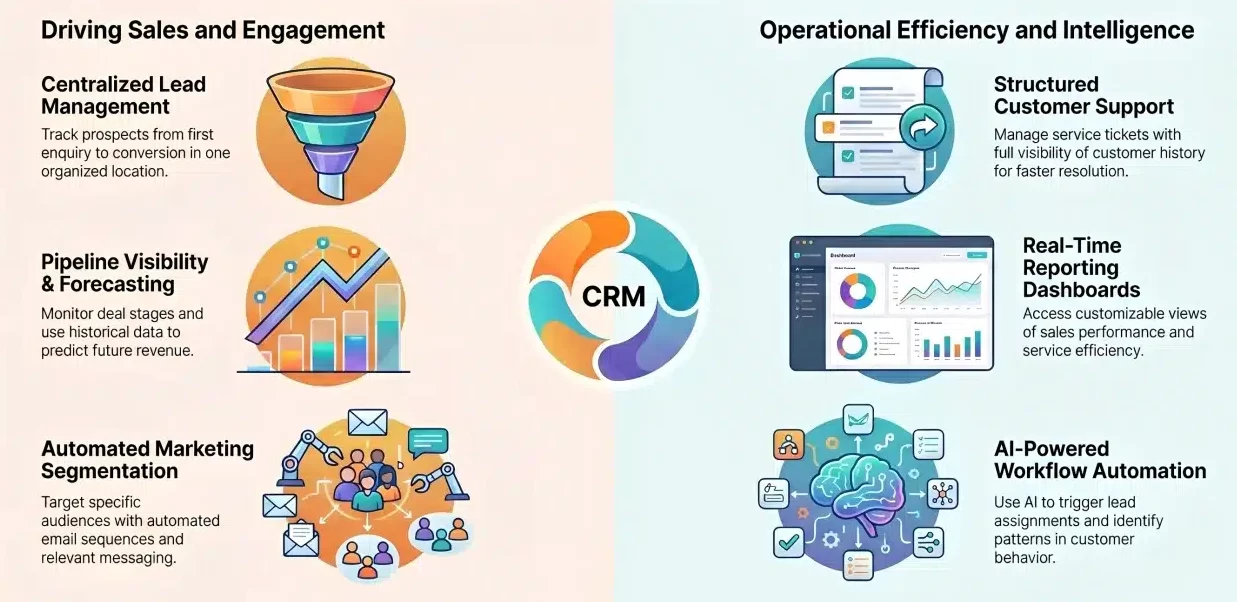
Choosing the right customer relationship management system means focusing on features that improve visibility, speed, and decision-making. These are the core capabilities to prioritise when comparing CRM systems in Australia.
1. Contact and lead management
A CRM system should store and organise all customer and prospect information in one place, including contact details, interaction history, and preferences. It helps teams track leads from first enquiry to conversion without losing context along the way.
Sales teams can prioritise prospects based on readiness, improving focus and efficiency. This feature forms the foundation of strong customer relations management.
2. Sales pipeline tracking and forecasting
Modern crm systems give a clear view of every deal across the pipeline, from initial contact to closing. Teams can track deal stages, monitor progress, and identify bottlenecks early.
Forecasting tools help predict revenue based on current opportunities and historical performance. This allows businesses to plan more accurately and make better sales decisions.
3. Marketing automation and segmentation
Customer management systems help marketing teams segment audiences based on behaviour, demographics, and engagement. Teams can automate campaigns such as email sequences, follow-ups, and targeted promotions.
This ensures messaging stays relevant without adding manual workload. As a result, businesses improve engagement and campaign performance at scale.
4. Customer service and ticket tracking
A strong CRM system includes tools to manage customer support requests in a structured way. Teams can log, assign, and track tickets to ensure issues are resolved quickly and consistently.
Full visibility of customer history helps support teams respond with better context. This improves service quality and strengthens long-term customer relationship management.
5. Reporting and analytics dashboards
Data becomes more useful when teams can see it clearly. CRM systems provide dashboards that display key metrics such as sales performance, customer activity, and service efficiency in real time.
Users can customise views based on their role and priorities. This helps businesses make faster, more informed decisions.
6. AI-powered insights and workflow automation
Advanced crm systems use AI and automation to reduce manual work and improve decision-making. The system can trigger actions such as lead assignment, follow-ups, or notifications in response to specific events.
AI tools also identify patterns, recommend next steps, and highlight opportunities or risks. This allows teams to work smarter and respond more effectively.
7. Mobile access and multi-device usability
Modern CRM systems that Australian businesses use must support access across devices, including mobile, tablet, and desktop. Sales and service teams can update data, check customer history, and respond to enquiries from anywhere.
This flexibility improves responsiveness, especially for field teams or remote work setups. It also ensures that data stays up to date in real time.
8. ERP integration and data centralisation
A CRM system should integrate with ERP and other business tools to create a connected workflow. This ensures customer data flows from sales to operations, billing, and fulfilment without duplication.
Integration reduces errors, improves efficiency, and provides a complete business view. For many organisations, this connection is key to scaling both operations and customer relations management effectively.
How To Choose the Right CRM System
The right CRM system should match how your team works and support business goals without adding unnecessary complexity.
1. Define business goals: Choose a system based on the problems you want to solve in sales, marketing, or service.
2. Ensure ease of use: A system that is difficult to use will reduce adoption and affect data quality.
3. Plan for scalability: The CRM should support growth as your team, processes, and data expand.
4. Check system integration: Ensure the CRM connects with email, marketing tools, ERP, and other business software.
5. Evaluate reporting capability: Clear dashboards and insights help teams make faster and more accurate decisions.
6. Consider security and compliance: Australian businesses must ensure their CRM handles customer data in line with the Australian Privacy Principles (APP) under the Privacy Act 1988. Confirm how the platform collects, stores, and shares personal data, and whether local data hosting is available if required by your industry.
7. Compare value, not just price: Focus on long-term benefits such as efficiency, growth, and customer outcomes.
Conclusion
A CRM system helps businesses bring customer data, sales activity, marketing, and service into one connected platform. With better visibility, teams can respond faster, follow up more consistently, and build stronger customer relationships.
For Australian businesses, this matters even more as customer expectations rise and teams manage more channels with limited time and resources. A strong customer relationship management approach helps businesses stay organised, improve teamwork, and support sustainable growth.
The right platform does more than support daily tasks; it helps your business deliver a more consistent customer experience. If you are comparing crm systems in Australia, book a free consultation with our experts to find the right fit for your business.

FAQ About CRM Systems
-
What exactly is CRM?
CRM stands for Customer Relationship Management. It refers to both the strategy and the software businesses use to manage leads, customer data, sales activity, follow-ups, and service interactions in one place.
-
Do I need a CRM or an ERP?
CRM is used for managing customer relationships, while ERP is used for managing internal operations such as finance and inventory. Many businesses use both systems together.
-
What CRM system is the most popular in Australia?
Popular CRM systems in Australia include Salesforce for large enterprises, HubSpot for small businesses and startups, and Zoho for SMBs seeking an affordable and flexible solution. For growing businesses that need CRM integrated with ERP and operational management, HashMicro provides an all-in-one platform without requiring third-party integrations.
-
When is the right time to adopt a CRM?
Businesses should adopt a CRM when managing leads, customer data, and follow-ups becomes difficult using spreadsheets or disconnected tools.
-
How do I figure out if a CRM is worth the cost?
A CRM is worth the cost if it improves sales efficiency, reduces manual work, and helps increase customer retention or conversion rates.