














Businesses are increasingly recognizing that their most valuable asset is not their technology or infrastructure, but the collective capabilities of their workforce. Unfortunately, traditional HR methods are no longer sufficient to meet that reality.
A strategic framework that bridges individual employee capabilities with business objectives allows leaders to make data-driven decisions on hiring, training, and succession planning, transforming HR into a true strategic partner while improving overall employee capacity management across the organization.
This blog serves as a thorough explanation of how competency management works and a practical guide on how to apply it optimally in your business.
Key Takeaways
Competency management is a strategic approach to identifying, tracking, and developing the skills, knowledge, and behaviors employees need to perform their roles.
The benefits of competency management include improved workforce performance, sharper L&D investment, and stronger talent management across the employee lifecycle.
A skills gap analysis is a diagnostic process that identifies the disparity between the competencies a workforce currently has and what it needs to execute business strategy.
Implementation steps include: aligning the framework to objectives, building a competency model, conducting assessments, and embedding competencies across the full HR lifecycle.
Definition of Competency Management

Competency management is a strategic, systematic approach used by HR professionals to identify, track, develop, and optimize the skills, knowledge, behaviors, and attributes employees need to perform their roles successfully.
It is important to distinguish between a skill and a competency. A skill is a specific learned ability, such as coding in Python or using accounting software. On the other hand, a competency is broader, covering a combination of skills, knowledge, and behavioral traits.
Strategic leadership, for example, is a competency that requires communication skills, industry knowledge, emotional intelligence, and the tendency to take initiative. Consequently, no single skill alone constitutes it.
Competency management involves creating a structured framework that defines what good performance looks like for every role. It moves away from subjective evaluations and relies on objective, observable criteria instead.
The result is a common language across the entire business for discussing performance, potential, and career progression. This ensures the right mix of human capabilities exists to execute the strategic vision at any given time.

How Competency Management Works in Organizations
Competency management is a continuous lifecycle that integrates with nearly every HR function. It begins with competency mapping, where HR collaborates with department heads and leadership to define required competencies.
Three types are typically defined: core competencies that apply to all employees, functional competencies specific to certain departments, and leadership competencies required for management roles. These are compiled into a framework.
Competencies are embedded into job descriptions, used to evaluate candidates during recruitment, and form the basis of onboarding plans and performance appraisals, often supported by capability management software that enables real-time tracking and analysis.
This removes vagueness from your conversations. Instead of telling your employee they need to communicate better, you can reference behavioral indicators within the effective communication competency that must be demonstrated.
Modern HR systems digitally map competencies to individual employee profiles, track assessment scores over time, and automate learning module recommendations based on identified gaps, giving real-time visibility into workforce capability.
Benefits of Competency Management
Improved Workforce Performance
The most immediate benefit of a competency framework is a significant improvement in workforce performance. When your job expectations are clearly defined, employees spend less time on ambiguity and more time executing tasks efficiently.
A competency-based approach ensures every individual understands not just the what of their role but also the how, covering the behaviors and standards expected. This dual focus leads to higher-quality outputs and more consistent delivery, guided by clearly defined main indicators for employee performance.
Because evaluations are tied to observable competencies, you can objectively identify high performers and reward them appropriately. It also makes underperformers easier to spot early, allowing swift intervention before issues escalate.
Modern competency frameworks also include interpersonal competencies such as emotional intelligence, conflict resolution, and collaboration. Valuing and measuring these soft skills reduces friction and improves team performance.
Better Learning and Development Programs
Generic training libraries and company-wide seminars relevant to only a fraction of the audience waste financial resources and frustrate employees.
Competency management transforms L&D by introducing precision and measurable ROI. Training transitions from being event-driven to needs-driven, designed specifically to close identified competency gaps rather than fill calendar slots.
If an assessment reveals that mid-level managers are inadequate in strategic delegation, the L&D team can design a targeted workshop addressing that behavior. Every training dollar is tied directly to a verified business need.
This approach also enables personalized learning journeys. Based on role, current competency levels, and career aspirations, each of your employees receives a customized set of courses, mentorship opportunities, and assignments.
That personalization drives engagement. Employees who can see the direct relevance of training to their own career advancement stop viewing it as a mandatory chore and start treating it as a valued benefit.
Stronger Talent Management
Competency management serves as the foundation that makes effective talent management possible across the employee lifecycle.
In recruitment, hiring based on competencies significantly improves hire quality and reduces turnover. In addition, competency-based interviews ask candidates for specific past behaviors, producing better predictions of future success than normal interviews.
Competency data is equally vital. Without visibility into internal capabilities, leadership is forced to fill roles externally, which is expensive and disruptive. A competency framework surfaces internal candidates ready for development.
By mapping current workforce competencies against future role requirements, HR can build targeted development plans that prepare internal candidates, ensuring business continuity and preserving institutional knowledge.
Moreover, this approach also strengthens retention. When employees see the business actively defining their career paths and offering targeted development, loyalty increases. They feel valued as individuals rather than interchangeable resources.
What Is a Skills Gap Analysis?
A skills gap analysis is a diagnostic process that identifies the precise disparity between the competencies a workforce currently has and the competencies it needs to achieve strategic objectives.
Within competency management, it is the mechanism that translates a theoretical framework into actionable business intelligence.
The analysis can be conducted at multiple levels. At the business level, it reveals trends like a company-wide deficiency in data literacy. At the team level, it pinpoints bottlenecks. At the individual level, it identifies specific development needs.
An unaddressed gap is an operational risk. Additionally, a gap that is too large will cause strategy execution to fail, quality to drop, or compliance issues to emerge. This gap analysis is a risk management tool for the executive suite.
It provides the empirical data needed to justify training investments, new hires, or team restructuring. This transforms abstract concerns about workforce readiness into quantifiable, actionable metrics.
How to Conduct a Skills Gap Analysis
Conducting an accurate skills gap analysis requires a structured, objective methodology aligned with the broader business strategy. The following steps outline best practices for executing this critical diagnostic process.
Step 1: Define Future Organizational Needs
The first step is always forward-looking. HR leaders must consult with their executive management to understand the strategic direction of the business over the next one to five years.
Are there plans to expand into new markets? Is there a shift toward a more consultative sales model? Each strategic direction implies a different set of required competencies.
Based on those goals, HR defines the specific competencies needed to execute the strategy successfully. In other words, this creates the desired state, the target benchmark against which the current workforce will be measured.
Step 2: Inventory Current Workforce Competencies
Once the target is set, the current state must be assessed. This involves gathering comprehensive data on the skills, knowledge, and behaviors present within the workforce. Common methods include:
Self-Assessments: Employees rate their own proficiency against the competency framework. While subjective, they provide valuable insight into employee confidence and self-awareness.
- Managerial Evaluations: Direct supervisors assess team members based on observable behaviors and performance outcomes, grounding the assessment in day-to-day operational reality.
- 360-Degree Feedback: Collects input from peers, subordinates, and clients to provide a holistic view of an employee’s competencies, particularly regarding soft skills and leadership behaviors.
- Objective Testing: Uses standardized assessments, practical demonstrations, or certifications to measure technical skills and theoretical knowledge accurately and without bias.
Step 3: Identify and Analyze the Gaps
With the desired state and current state data collected, the analysis begins. This involves comparing the two datasets to identify discrepancies. The analysis must be highly granular to be actionable.
Saying the sales team needs improvement is not enough. The analysis must pinpoint that 60% of the sales team falls below the required proficiency level in objection handling and negotiation tactics.
Data should be visualized using dashboards or heat maps to identify the most critical and widespread gaps clearly, making it easier for leadership to prioritize interventions and allocate resources.
Step 4: Prioritize the Gaps
Not all skills gaps carry the same weight. Some pose an immediate threat to the business, while others are minor inconveniences. Once identified, gaps must be prioritized based on their potential impact and urgency.
A gap in cybersecurity compliance competencies, for example, takes clear precedence over a gap in advanced presentation skills. Impact and urgency together determine where resources should be deployed first.
Actions to Take After Identifying Skill Gaps
Identifying the gap is only half the battle. The true value lies in the interventions deployed to close it. Once priorities are set, a comprehensive action plan must be developed using a variety of strategic levers.
There is no one-size-fits-all solution. The appropriate action depends on the nature of the gap, the timeline required, and the budget available.
Targeted Training and Development (Build)
For gaps involving skills that can be learned within the required timeframe, internal development is the preferred approach. This covers formal training, e-learning modules, micro-learning, workshops, and external subject matter experts.
The key is that every training initiative must be directly mapped to the specific competencies identified in the gap analysis, not generic programs pulled from a library.
Businesses should also leverage the 70-20-10 model, which recognizes that 70% of learning happens through on-the-job experience. Assignments, job rotations, and special project participation build competencies far more effectively than classroom training alone.
Recruitment and Hiring (Buy)
If a gap is too wide to close through internal training, or the capability is needed immediately to capitalize on a market opportunity, external hiring is the appropriate response.
The competency framework must be integrated into the recruitment process immediately to ensure new hires possess the exact skills the current team is missing.
This approach is most common when a business is adopting entirely new technologies or entering unfamiliar industries where no internal foundation of knowledge exists to build from.
Mentoring and Coaching (Borrow/Share)
Often, the required competencies already exist within the business, just not in the people who need them. In these cases, formal mentoring and coaching programs are highly effective.
Pairing a high-performing employee who has mastered a specific competency with one who has a gap in that area facilitates organic, highly relevant knowledge transfer.
This not only closes the gap but also fosters internal networking, improves team cohesion, and provides meaningful leadership experience for the mentor.
Job Redesign and Technology Implementation
In some scenarios, the best way to address a skills gap is not to change the people but to change the work. If a competency is too difficult or expensive to acquire, workflows can be redesigned to bypass the need for it entirely.
Alternatively, technology can be implemented to automate the tasks that require the missing competency. If there is a widespread gap in advanced data entry and analysis skills, investing in automated data processing software may be far more efficient than training hundreds of employees.
Best Practices for Effective Competency Management
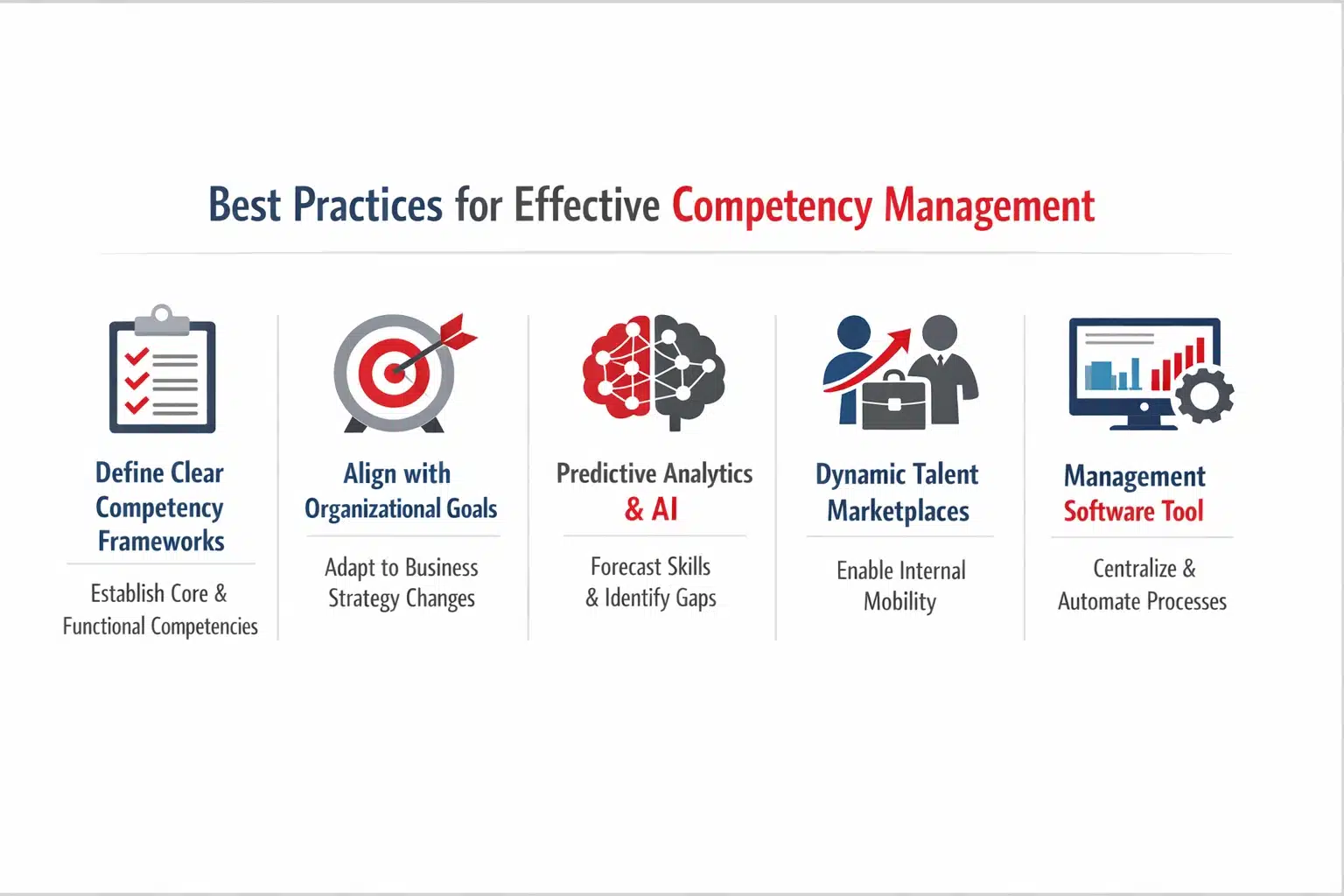
Define Clear Competency Frameworks
The foundation of any successful competency initiative is the framework itself. Creating one is a delicate balancing act. A common pitfall is building a framework so large and complex that it becomes impossible to navigate or manage.
To be effective, a competency framework must be clear, concise, and accessible to every employee, regardless of their HR expertise. Complexity does not equal rigor. It usually just means poor adoption.
Best practices start with a core set of 3 to 5 competencies that every employee must embody to maintain company culture, such as integrity, customer focus, or continuous improvement.
From there, develop functional competencies tailored to specific job families. Keep the total number of competencies for any single role between 8 and 12. Overloading a role dilutes focus and makes evaluation cumbersome.
Every competency must be defined by observable behavioral indicators. Listing leadership as a competency is not enough. The framework must describe what leadership looks like at each proficiency level.
For a junior manager, a behavioral indicator might be conducting weekly team meetings. For an executive, it might be articulating a long-term vision aligned with market trends. Observable behaviors make assessments objective and defensible.
Align Competencies with Organizational Goals
A competency framework must be a living reflection of the business’s strategic intent, not a static document created once and filed away. It must be integrated into the strategic planning cycle and updated as the business evolves.
HR leaders must maintain ongoing dialogue with the C-suite and department heads. Whenever a major strategic shift occurs, such as a merger, a new product line, or a regulatory change, the framework must be reviewed and updated immediately.
If business goals change, the definition of what constitutes a competent employee must change with them. A framework that lags behind strategy quickly becomes irrelevant and loses credibility with both managers and employees.
Communicating these updates transparently to the workforce is equally important. Employees are far more likely to engage with a competency framework when they understand why it exists and how it connects to where the business is headed.
Predictive Analytics and Artificial Intelligence (AI)
Forward-thinking businesses are using AI to perform predictive skills gap analyses. These tools scan internal performance data alongside external labor market trends to automatically forecast the competencies the workforce will need.
This allows HR to address skill shortages proactively before they affect strategy execution or the bottom line, shifting the function from reactive gap-closing to anticipatory workforce planning.
AI-driven platforms can also continuously monitor the gap between current workforce capabilities and evolving role requirements in real time. Rather than waiting for the next annual assessment cycle, HR receives live alerts when a critical gap is emerging.
This is particularly valuable in fast-moving industries where technology adoption outpaces traditional training cycles. By the time a gap is identified through manual assessment, it may already be affecting delivery, quality, or competitiveness.
When combined with scenario modeling, AI allows HR leaders to simulate the workforce impact of different strategic decisions before they are made, such as entering a new market or launching a new product, and plan capability acquisition accordingly.
Dynamic Talent Marketplaces
Leading businesses are integrating competency data with internal talent marketplaces. Through these platforms, employees are algorithmically matched with cross-functional projects, mentorship opportunities, and micro-learning modules based on their competency profiles.
This creates a more fluid, adaptable workforce capable of responding to new strategic demands without waiting for a formal restructuring or external hire. Capability moves to where it is needed, when it is needed.
For employees, the benefit is equally significant. Rather than waiting for a manager to assign development opportunities, they gain visibility into projects and experiences across the business that align with their career aspirations.
This self-directed mobility increases engagement by making career growth feel active and attainable rather than passive and uncertain. Employees who can see a clear internal path forward are far less likely to look for one elsewhere.
At scale, these marketplaces generate rich competency movement data that HR can use to identify which skills are in high demand across the business, where knowledge is concentrated, and where critical capability gaps are quietly forming.
Management Software Tool
Managing competencies manually across a growing workforce is not scalable. Spreadsheets and disconnected HR tools create data silos, inconsistent assessments, and reporting gaps that make it impossible to get a clear picture of workforce capability.
Competency management software centralizes the entire process onto a single platform. Competency frameworks are digitally mapped to every role, assessments are tracked over time, and learning recommendations are generated automatically based on identified gaps.
Modern platforms also integrate directly with existing HR infrastructure, connecting competency data to performance appraisals, recruitment pipelines, succession planning, and L&D programs without requiring manual data transfers between systems.
For businesses looking to implement the right solution, it’s best to book a free consultation to explore options tailored to their workforce needs.
For HR leaders, this means real-time dashboards that display the health of the workforce at a glance, from overall competency coverage across departments to individual development progress against defined benchmarks.
ERP systems with built-in HR modules go a step further by linking competency data to broader business operations. This gives leadership a unified view of how workforce capability connects to productivity, project delivery, and strategic execution.






Industry-Specific Use Cases for Competency Management
While the core principles of competency management are universal, their application varies significantly across industries. Understanding how different sectors use these frameworks offers valuable context for tailoring your own approach.
- Healthcare and Medical Services
In healthcare, competency management is directly tied to patient safety, quality of care, and regulatory compliance. Frameworks ensure clinical staff possess the precise technical skills, certifications, and behavioral attributes required for each department.
Robust competency tracking is also essential for managing mandatory continuing medical education requirements and enabling rapid credentialing of staff during public health emergencies.
- Information Technology and Software Development
In technology, the half-life of technical skills is notoriously short. Competency management allows IT leaders to anticipate emerging role requirements, such as AI specialists or cloud architects, and identify internal talent ready for targeted upskilling.
Continuously mapping competencies ensures teams maintain a competitive edge in an environment where the skills required today may be insufficient or obsolete within two to three years.
- Manufacturing and Engineering
In manufacturing, competency management centers on operational efficiency, equipment mastery, and safety protocol adherence. Frameworks map the exact technical proficiencies required to operate complex machinery alongside behavioral traits like attention to detail.
This targeted approach minimizes production downtime, reduces error rates, and lowers the risk of workplace accidents by ensuring every operator meets a verified, objective standard before working unsupervised.
Step-by-Step Implementation Guide
Deploying a competency management system requires a methodical, phased approach to ensure widespread adoption and measurable ROI. The following steps provide a structured path to implementation.
- Align with Strategic Objectives: Begin by analyzing long-term business goals. Determine exactly what capabilities the business will need to execute its strategy over the next three to five years.
- Develop a Tailored Framework: Avoid generic, off-the-shelf templates. Define core competencies that reflect company values, then build specific functional and leadership competencies customized to your operational context.
- Conduct Baseline Assessments: Use a combination of employee self-evaluations, manager assessments, and objective testing to evaluate the current workforce against the newly established framework.
- Integrate Across the HR Lifecycle: The competency model must be embedded into recruitment rubrics, performance appraisals, succession planning, and L&D pathways to drive real, measurable impact across the business.
Common Pitfalls to Avoid
Even well-resourced competency management initiatives can falter. These are the most common mistakes businesses make and how to avoid them.
- Overcomplicating the Framework
When HR creates exhaustively detailed rubrics requiring managers to evaluate dozens of granular competencies per role, assessment fatigue sets in and adoption rates drop.
A simpler framework that gets used consistently outperforms a comprehensive one that gets ignored. Stay focused on the most critical, measurable drivers of success.
- Treating the Framework as a Static Document
Competency models must be living systems. Failing to review and update required skills and behaviors annually renders the system obsolete as market demands and technologies evolve.
Build a formal annual review into the governance cycle. Any major strategic shift should trigger an immediate framework review, not just a scheduled one.
- Failing to Secure Manager Buy-In
Initiatives often fail because front-line managers view competency management as an HR project rather than a core business operations tool.
Managers are the ones conducting assessments and delivering feedback. Without their genuine engagement, even the best framework becomes a compliance exercise that produces little real development.
- Disconnecting Competencies from Consequences
If the framework has no real bearing on promotions, compensation, or development opportunities, employees quickly learn it does not matter.
Competency data must be visibly used in talent decisions. When employees see the framework influencing real outcomes, engagement with the process rises significantly.
Conclusion
Competency management gives businesses the structure to move beyond guesswork in how they manage people. When competencies are clearly defined, consistently measured, and actively linked to strategy, the entire workforce operates with greater clarity and purpose.
The businesses that treat competency management as a living system rather than a one-time HR project are the ones building workforces that can adapt, perform, and grow alongside the business. The framework is only the starting point. What matters is the discipline to use it.
If you want to manage your workforce like an industry leader, then you can request a free consultation with us and gain vital business insights. We can guide you in implementing competency management most optimally while avoiding risks that your company can face in the process.
Frequently Asked Question
Competency management is a strategic, systematic approach used by HR professionals to identify, track, develop, and optimize the skills, knowledge, behaviors, and attributes employees need to perform their roles successfully. It provides a structured framework that defines what good performance looks like across every role in the business.
A skill is a specific learned ability, such as using accounting software or coding in a particular language. A competency is broader, encompassing a combination of skills, knowledge, and behavioral traits that together produce observable, measurable performance. Strategic leadership, for example, is a competency that no single skill alone can constitute.
A skills gap analysis is a diagnostic process that identifies the disparity between the competencies a workforce currently has and the competencies it needs to achieve its strategic objectives. It produces the empirical data required to justify training investments, new hires, or team restructuring decisions.
Best practice is to keep the total number of competencies for any single role between 8 and 12. Overloading a role with more than this dilutes focus, causes assessment fatigue, and makes performance evaluation cumbersome for both managers and employees.
The most common pitfalls are overcomplicating the framework, treating it as a static document that is never updated, failing to secure genuine buy-in from front-line managers, and disconnecting competencies from real talent decisions such as promotions and development opportunities.