
Modern supply chains place intense pressure on distribution centers and fulfillment hubs. The rapid growth of e-commerce, rising expectations for fast delivery, and increasingly complex logistics networks are making traditional manual warehousing methods unsustainable.
Warehouse automation enables this shift by integrating software, robotics, and data-driven systems into warehouse operations. Automation redesigns how goods are received, stored, picked, packed, and shipped. This allows companies to scale efficiently, reduce operational errors, and build more resilient supply chains.
This blog will cover all the vital information you need to automate your own warehouse and reach operational efficiency. Stay until the very end and let us guide you through this automation journey.
Key Takeaways
Warehouse automation combines software, robotics, and data systems to streamline how goods are received, stored, picked, packed, and shipped.
Automation systems generally fall into four categories: fixed, flexible, robotic, and cognitive, each designed to solve different operational challenges.
Technologies such as AMRs, AS/RS, WMS, conveyor systems, and AI-driven analytics form the core infrastructure of modern automated warehouses.
For Australian businesses, automation improves throughput, increases inventory accuracy, reduces labor dependency, and enables scalable operations without proportional workforce growth.
What is Warehouse Automation?
Warehouse automation is the deployment of specialized equipment, robotics, and intelligent software to perform warehousing tasks with minimal human intervention. Its goal is to streamline repetitive, labor-intensive processes, increase efficiency, improve accuracy, and reduce long-term costs.
Digital automation focuses on managing data, inventory, and workflow coordination. Barcode scanners, RFID tags, and advanced software ensure information flows instantly and aligns perfectly with the movement of goods. This eliminates manual entry, paper lists, and spreadsheet-driven tracking.
Physical automation handles the movement, storage, and retrieval of inventory. Conveyors, robotic arms, automated guided vehicles, and storage systems execute tasks dictated by software. Both systems form an integrated warehouse engine that operates with precision beyond human capability.
Types of Warehouse Automation
Warehouse automation comes in diverse forms, designed to meet varying operational scales, product types, and strategic goals. Choosing the right mix starts with understanding the distinct categories and how they align with facility needs.
Generally, automation falls into four primary types: fixed, flexible, robotic, and cognitive. Each type addresses different challenges, from high-volume repetitive tasks to adaptive, intelligent operations.
1. Fixed automation
Fixed automation, or hard automation, uses rigid, purpose-built machinery to perform repetitive tasks at high speeds. The equipment is physically installed and cannot be easily moved or reconfigured. Examples include conveyor networks, high-speed sorters, and AS/RS systems integrated into racking.
This approach suits facilities with massive, predictable volumes of uniform products. Grocery distribution centers or high-volume parcel hubs rely on fixed automation to process thousands of units per hour.
Its main advantage is reliability and throughput, but it lacks flexibility. Changes in product lines, business models, or facility location require costly re-engineering and downtime. Fixed automation delivers efficiency, but only when long-term operational certainty exists.
2. Flexible/programmable automation
Flexible, or programmable, automation adapts to changing operational needs. Systems can be reprogrammed, rerouted, or physically relocated with minimal effort. Its core strength is handling variations in products, orders, and workflows without new infrastructure.
Early examples include Automated Guided Vehicles (AGVs) that follow magnetic or optical paths, easily rerouted by moving guide markers. Modern solutions include modular conveyors and packaging machines that adjust automatically to different carton sizes.
Flexible automation bridges manual and fixed systems, giving businesses the agility to manage seasonal spikes, evolving consumer demands, and inventory shifts without being locked into rigid workflows.
3. Robotic automation
Robotic automation advances physical handling by focusing on micro-level tasks. Unlike fixed or flexible systems that move pallets or bulk goods, robots manipulate individual items with precision. Key types include robotic picking arms, collaborative robots (cobots), and autonomous mobile systems.
Robotic arms use advanced end-of-arm tooling and machine vision to identify, grasp, and move items from mixed bins. This is ideal for piece-picking, historically one of the most labor-intensive warehouse tasks.
Cobots safely assist humans with heavy lifting or complex handling. Robotic automation transforms warehouses into high-tech environments, reducing worker strain while improving speed, accuracy, and operational efficiency.
4. Cognitive/AI-driven automation
Cognitive automation is the most advanced form of warehouse automation, where systems learn, adapt, and make decisions autonomously rather than following fixed rules. Powered by AI and Machine Learning, it acts as the warehouse’s central intelligence, coordinating robots, conveyors, and software in real time.
These systems analyze historical data, real-time conditions, and external factors to predict demand, optimize inventory placement, and manage workflows automatically. They also enable predictive maintenance, detecting early signs of equipment issues to prevent downtime.
Key Warehouse Automation Technologies

Implementing warehouse automation requires a combination of specialized technologies, each targeting operational challenges. From robotic picking to software orchestration, these tools work together to optimize workflows, and create an integrated and efficient warehouse ecosystem.
1. Autonomous Mobile Robots (AMRs)
Autonomous Mobile Robots (AMRs) transform warehouse operations by moving inventory without fixed infrastructure. Using LiDAR, cameras, ultrasonic sensors, and SLAM technology, AMRs dynamically navigate around obstacles in real time, unlike traditional AGVs.
They support goods-to-person picking, pallet transport, waste removal, and sortation, drastically reducing manual walking and boosting efficiency. AMR fleets are highly scalable, adapting to peak seasons or fluctuating demand without major infrastructure changes.
2. Automated Storage & Retrieval Systems (AS/RS)
Automated Storage and Retrieval Systems (AS/RS) maximize storage density and retrieval speed by combining racks, aisles, and automated mechanisms like cranes, shuttles, or carousels that move vertically and horizontally. This allows warehouses to build upwards, making full use of cubic space.
Variants include unit-load AS/RS for heavy pallets, mini-load AS/RS for cartons or totes, shuttle-based systems, and cube-storage robots. Implementing AS/RS reduces warehouse footprint, removes wide forklift aisles, and improves inventory accuracy and security.
3. Conveyor & Sortation Systems
Conveyor and sortation systems act as the high-speed arteries of a warehouse, moving goods efficiently between receiving, storage, picking, packing, and shipping zones. Modern systems integrate sensors, variable-speed drives, and intelligent routing for precise operations.
Sortation systems automatically identify and direct items using cross-belt, shoe, or tilt-tray sorters. Overhead scanners read barcodes and trigger diverters to send cartons to the correct destination. These systems are essential for ensuring fast, accurate throughput.
4. Pick Assist Technologies
Pick assist technologies enhance human picking in warehouses, especially for irregular, fragile, or varied items, without removing the human role. They increase speed, accuracy, and productivity while bridging manual labor and automation.
Key tools include Pick-to-Light and Put-to-Light systems, which illuminate the correct location and quantity for items. It delivers hands-free verbal instructions and wearable scanners to capture data. These technologies cut search time and reduce risks, creating a highly efficient workflow.
5. Warehouse Management System (WMS)
A Warehouse Management System (WMS) is the central software hub that coordinates all warehouse activities. It provides real-time inventory visibility, tracks every SKU, and manages the flow of goods from receipt to shipment, ensuring physical automation operates efficiently.
Modern WMS platforms optimize storage, picking schedules, and workforce/robot deployment using advanced algorithms. They integrate with other systems, enabling seamless coordination across the supply chain. Implementing a WMS will form the digital backbone of a fully automated warehouse.
6. AI & IoT in the warehouse
AI and IoT are transforming warehouses into self-optimizing, intelligent environments. IoT devices, such as sensors, scanners, robots, and infrastructure, continuously collect data, while AI analyzes it in real-time to optimize operations.
Key applications include predictive maintenance, where AI forecasts equipment failures before they occur, reducing downtime and inefficiency. AI enables digital twins, virtual replicas of the warehouse used to simulate layouts, automation setups, or peak-season strategies without disrupting operations.
Benefits of Warehouse Automation for Australian Businesses
Warehouse automation delivers a strong ROI by tackling key operational challenges. In Australia, these challenges are amplified by geographic spread, labour costs, and strict regulations.
Automation provides strategic advantages, including faster throughput, higher inventory accuracy, reduced labor dependency, and scalable operations, all tailored to local business conditions.
1. Increased operational throughput
Throughput measures how quickly a warehouse can receive, process, and ship orders, directly impacting sales and customer satisfaction. Automation removes manual bottlenecks, allowing continuous, high-speed operations without fatigue or breaks.
For Australian retailers, seasonal peaks like Black Friday, Click Frenzy, or Boxing Day demand rapid scaling. AMRs and automated sortation systems enable thousands of orders per hour, maintaining cut-off times and SLAs, and capturing peak-period revenue efficiently.
2. Improved inventory accuracy
Inventory inaccuracies reduce profitability by causing stockouts, excess safety stock, and wasted labor. Manual counting and data entry are prone to errors, compounding these issues across the business.
Automation, through WMS integration with barcode scanners, RFID, and AS/RS, pushes accuracy significantly. Real-time updates and automated cycle counting give Australian warehouses confidence to reduce safety stock, freeing capital and space while maintaining operational reliability.
3. Labor cost reduction & redeployment
4. Scalability without proportional headcount growth
Historically, warehouse scaling relied directly on hiring more staff. This linear relationship is unsustainable during sudden market shifts or rapid e-commerce growth. Hiring, onboarding, and training large temporary workforces is costly, time-consuming, and often temporarily reduces accuracy and productivity.
Automation breaks this dependency. Flexible systems, such as AMRs and cloud-based WMS platforms, can accommodate higher order volumes by optimizing routes or adding robots to the fleet. Businesses can scale operations exponentially without proportionally increasing headcount.
As a result, Australian companies can grow market share while lowering per-unit fulfilment costs. This approach not only preserves efficiency but also reduces pressure on labor resources during peak periods, providing operational resilience.
Industry-Specific Use Cases for Warehouse Automation
The application of automation technologies varies significantly depending on the unique demands of different sectors. By tailoring robotic and software solutions to specific operational challenges, various industries are unlocking high levels of productivity and compliance.
- E-commerce and Omnichannel Retail
E-commerce warehouses face enormous pressure from high order volumes, seasonal spikes, and frequent returns. Managing individual piece-picks efficiently is critical to maintaining fast delivery times and customer satisfaction.
Autonomous Mobile Robots (AMRs) enable goods-to-person picking, reducing walking time and boosting productivity. Automated sortation systems ensure parcels reach the correct shipping lanes quickly, while a robust Warehouse Management System (WMS) orchestrates rapid batching and workflow coordination.
Together, these technologies allow warehouses to meet next-day or same-day delivery promises without a proportional increase in labor, maintaining operational efficiency during peak demand periods.
- Food and Beverage (Cold Chain)
The FnB sector must handle perishable items while maintaining strict temperature controls, creating operational complexity. Automated Storage and Retrieval Systems (AS/RS) optimize vertical space in cold storage, reducing costly facility footprints and functioning efficiently in sub-zero conditions.
Digital automation complements this by enforcing strict First-In-First-Out (FIFO) rotation and providing full batch traceability. These capabilities ensure compliance with food safety regulations, streamline recall management, and minimize waste, making cold-chain operations both safer and more efficient.
- Manufacturing and Automotive
A Strategic Roadmap: Implementation Steps
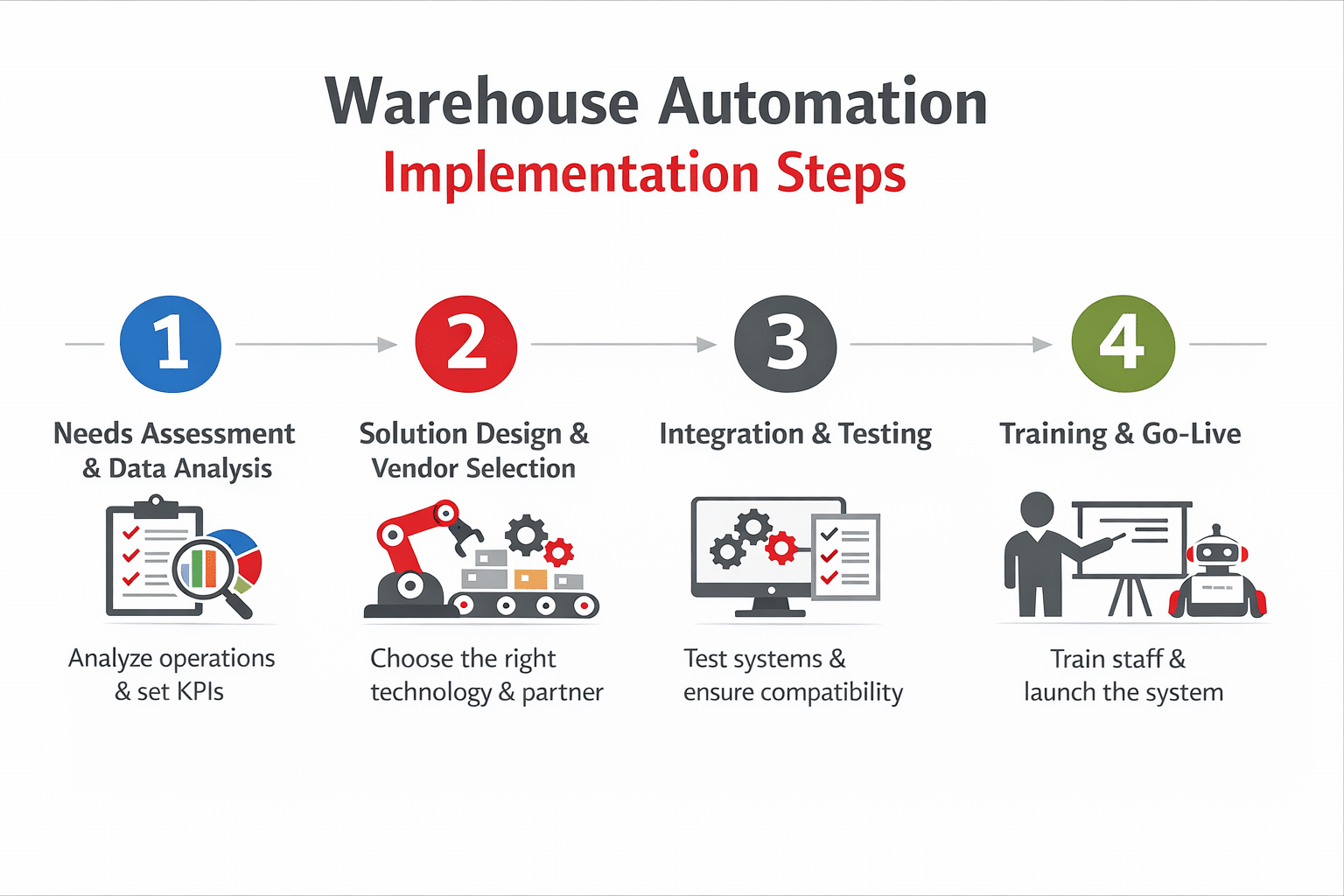
Transitioning from a manual facility to an automated powerhouse is a complex undertaking that requires meticulous planning. A phased approach mitigates risk and ensures the technology aligns perfectly with overarching business objectives.
Phase 1: Comprehensive Needs Assessment and Data Analysis
Before selecting any equipment, companies must conduct a deep dive into their current operations. This involves analyzing historical order data, SKU velocity, seasonal fluctuations, and current labor costs.
The goal is to determine exactly why automation is needed. Is it to increase throughput, solve labor shortages, or improve order accuracy? Clear, measurable Key Performance Indicators (KPIs) must be established at this stage.
Phase 2: Solution Design and Vendor Selection
Once the operational baseline is understood, businesses must collaborate with automation integrators to design a tailored solution. This includes evaluating the full spectrum of technologies and determining which mix best aligns with operational goals.
For example, a facility might weigh an AMR-based goods-to-person system against a traditional conveyor network, considering both short-term efficiency and long-term scalability.
Phase 3: Systems Integration and Rigorous Testing
The physical installation of racking, robots, and conveyors represents only one part of warehouse automation. The more intricate challenge lies in software integration, where the WMS must communicate seamlessly with the Warehouse Execution System (WES) to coordinate all machine movements.
Before going live, rigorous testing in a simulated environment is essential. This includes stress-testing the system under peak-volume conditions to ensure it can handle surges in order processing without failure.
Exception handling must also be evaluated, such as the system’s response when a barcode is unreadable or a robot encounters an unexpected obstacle. Thorough testing at this stage prevents costly downtime and ensures smooth real-world operation.
Phase 4: Change Management, Training, and Go-Live
A common misconception is that automation removes the need for human workers. In reality, it transforms their roles, shifting staff from manual labour to system operators and exception handlers.
Comprehensive training programs are crucial to ensure employees feel confident and safe working alongside robots.
The go-live phase includes rolling out automation in specific zones or product lines before full deployment, allowing your company to manage the transition effectively and address real-time issues without disrupting operations.
Common Pitfalls and How to Avoid Them
Despite the clear benefits, automation projects can fail to deliver their anticipated Return on Investment (ROI) if poorly executed. Recognising these common traps is critical for a successful deployment.
1. Automating Broken Processes
One of the most common mistakes is automating an inefficient process. If warehouse layouts are poorly designed or inventory data is inaccurate, automation simply speeds up the errors.
Before implementing physical automation, businesses must streamline, optimize, and standardize workflows. Lean or Six Sigma methodologies are often employed to ensure processes are efficient and repeatable, creating a solid foundation for technology to add value.
2. Underestimating Software Integration Complexity
Many businesses get distracted by physical robots and overlook the software needed to run them. Without a WMS that processes data in real-time and supports modern APIs, hardware cannot operate efficiently.
Upgrading the core software infrastructure is often essential before deploying physical automation, ensuring seamless communication between systems and full utilisation of robotic capabilities.
3. Neglecting Scalability and Flexibility
Highly rigid, fixed automation can become a liability if business models shift. Transitioning from bulk B2B shipping to individual B2C orders often demands entirely different picking workflows.
Prioritizing scalable, modular solutions, like expanding an AMR fleet or adding modules to a grid-based AS/RS, ensures the warehouse can adapt and grow with changing operational requirements.
Advanced Practices in Modern Warehousing
As technology evolves, warehouse automation continues to expand. Forward-thinking supply chain leaders are already adopting advanced practices to gain a competitive edge and future-proof their operations.
1. Digital Twins and Simulation
A digital twin is a precise virtual replica of a physical warehouse, continuously updated with real-time operational data.
It allows managers to simulate changes, such as adding a new AMR fleet, before implementing them physically. This helps identify bottlenecks, optimize traffic flow, and test layouts without interrupting daily operations.
2. Predictive Maintenance via IoT
Downtime in automated warehouses is extremely costly and can disrupt the entire fulfilment process. IoT sensors monitor equipment for vibration, temperature, and power usage.
Machine learning analyzes this data to predict potential failures, enabling maintenance to be scheduled proactively during planned downtime instead of causing unexpected operational halts.
3. Micro-Fulfilment Centers (MFCs)
Micro-Fulfilment Centers (MFCs) are compact, highly automated warehouses placed in urban areas, often integrated into existing retail stores. They use advanced storage and picking systems to handle high volumes of small orders efficiently.
By positioning inventory closer to consumers, MFCs reduce last-mile delivery costs and significantly shorten transit times, supporting same-day or rapid delivery promises.
4. Use of Warehouse Management System
A Warehouse Management System (WMS) acts as the digital backbone of an automated warehouse. It coordinates human and machine activities, tracks inventory in real-time, and manages order workflows. Without it, even advanced automation hardware cannot perform efficiently.
Modern WMS platforms integrate with Warehouse Execution Systems (WES) and other enterprise software like ERP and TMS. This allows real-time decision-making, optimal task allocation between humans and robots, and seamless coordination of automated machinery.
Advanced features include dynamic slotting, which positions fast-moving SKUs in accessible locations, and wave or batch picking, which groups orders to reduce travel time. AI-driven modules can forecast labor needs and reroute robots to prevent congestion.
By using a robust WMS, warehouses gain full visibility over operations, allowing inefficiencies to be detected and corrected immediately. It ensures predictive analytics, operational optimization, and scalable growth of automation capabilities.
Conclusion
Warehouse automation is becoming a core capability for modern supply chains. As the business grows, manual processes struggle to keep pace with the speed, accuracy, and flexibility required. Technologies allow warehouses to operate with greater efficiency, visibility, and operational control.
Automation is not simply a technological upgrade but a long-term operational strategy. By adopting the right combination of software, robotics, and data-driven systems, companies can scale operations, reduce errors, and build more resilient fulfilment networks capable of supporting future growth.
If you are interested in applying this discipline to your warehouses, then you can consult with an expert from our team for free today. We look forward to helping you achieve your business goals in the near future.
Frequently Asked Question
Implementation timelines vary depending on the scale and complexity of the automation system. Smaller deployments such as AMR fleets or pick-to-light systems may take a few months, while large projects involving AS/RS infrastructure and full system integration can take 12–24 months from planning to full operational deployment.
No, while large distribution centres were early adopters, many automation technologies today are modular and scalable. Solutions like AMRs, cloud-based WMS platforms, and modular conveyors allow small and mid-sized businesses to automate gradually without massive upfront infrastructure investments.
A Warehouse Management System (WMS) manages inventory visibility, order processing, and overall warehouse workflows. A Warehouse Execution System (WES) operates at a more tactical level, coordinating real-time machine activities such as robots, conveyors, and sortation systems to ensure physical automation executes tasks efficiently.
Return on investment is typically calculated by comparing automation costs with long-term operational savings. Businesses evaluate factors such as reduced labour expenses, increased throughput, improved inventory accuracy, lower error rates, and the ability to scale operations without proportional increases in workforce.