
Managing human resources is one of the most complex responsibilities within modern organizations. Companies must handle payroll, recruitment, employee relations, compliance, and workforce development while maintaining operational efficiency.
As businesses grow, these responsibilities become increasingly time consuming and require specialized expertise. Many organizations find that maintaining a fully equipped internal HR department can place significant pressure on resources and management attention.
Human resources outsourcing offers an alternative approach. By partnering with external HR specialists, companies can streamline administrative processes, reduce compliance risks, and focus more on strategic initiatives that drive long term business growth.
Key Takeaways
Understand what human resources outsourcing is and how organizations delegate HR functions to specialized providers.
Explore the main reasons companies adopt HR outsourcing to reduce administrative workload and improve compliance.
Learn which HR functions are commonly outsourced including payroll, recruitment, and workforce management.
Discover the main HR outsourcing models such as full-service HRO, PEO partnerships, and project-based HR outsourcing.
What Is Human Resources Outsourcing (HRO)
Human Resources Outsourcing (HRO) refers to delegating certain HR functions to an external service provider. Instead of managing all workforce administration internally, organizations rely on specialized partners to handle operational HR processes more efficiently.
This approach simplifies processes such as payroll management, recruitment support, and benefits administration. At the same time, companies retain control over strategic decisions related to leadership, company culture, and workforce planning.
As HR operations become more technology driven and compliance requirements grow more complex, outsourcing has become an increasingly practical strategy for organizations seeking efficiency and scalability.
How HRO Works
Human resources outsourcing typically operates through a structured partnership between the company and a third party provider. The provider assumes responsibility for selected HR processes based on a predefined service agreement.
These services may include payroll processing, employee onboarding, compliance management, and recruitment support. The outsourcing provider handles operational execution while the company continues to guide overall HR strategy.
Through this model, organizations gain access to HR expertise and technology platforms without having to maintain a large internal HR infrastructure.
HRO vs In House HR Management
In a traditional in house HR model, companies build internal teams responsible for managing every stage of the employee lifecycle. This approach offers full control but often requires significant investment in staff, technology, and ongoing training.
HR outsourcing provides a different model by transferring operational responsibilities to external specialists. Instead of managing complex administrative tasks internally, companies rely on providers with dedicated HR expertise.
Many organizations adopt a hybrid approach where strategic HR leadership remains internal while routine administrative processes are outsourced.
Why HR Outsourcing Is Growing
The growing complexity of workforce management is one of the main reasons organizations are adopting HR outsourcing. Businesses must now navigate evolving labor laws, competitive talent markets, and rapidly changing workplace expectations.
Outsourcing allows companies to manage these challenges more effectively by leveraging specialized expertise and modern HR technologies. This helps organizations maintain compliance, improve operational efficiency, and support workforce growth.
As a result, HR outsourcing has become an increasingly common strategy for companies seeking flexibility and sustainable organizational development.
Why Companies Choose HR Outsourcing
Organizations adopt HR outsourcing for various operational and strategic reasons. As workforce management becomes more complex, businesses often seek external support to handle time consuming HR responsibilities.
Outsourcing allows companies to reduce administrative pressure while improving access to expertise and compliance support. This flexibility makes HR outsourcing an attractive option for organizations aiming to improve efficiency and scalability.
Reducing Administrative Work
Human resources departments handle a large number of routine administrative tasks every day. Activities such as payroll processing, leave management, employee record updates, and onboarding documentation can consume significant time.
HR outsourcing helps reduce this administrative burden by transferring repetitive tasks to specialized providers. As a result, internal teams can focus more on strategic initiatives rather than manual HR processes.
Access to HR Expertise
Managing human resources requires knowledge across multiple areas such as employment law, compensation strategy, and employee relations. For many organizations, maintaining internal specialists for every HR function can be costly.
HR outsourcing gives businesses access to experienced HR professionals without expanding their internal workforce. These experts provide guidance on workforce planning, talent management, and HR best practices.
Compliance and Risk Management
Employment regulations continue to evolve across different regions and industries. Organizations must comply with various labor laws related to wages, workplace safety, employee benefits, and data protection.
HR outsourcing providers help businesses stay aligned with these legal requirements. Their expertise reduces the risk of regulatory violations and helps companies maintain compliant HR processes.
Scaling HR Operations
Workforce needs often change as organizations grow or enter new markets. Rapid expansion can quickly overwhelm internal HR teams that were designed for smaller operations.
HR outsourcing offers scalable support that adapts to changing workforce demands. Companies can expand HR services during periods of growth while maintaining operational efficiency.
HR Functions Commonly Outsourced
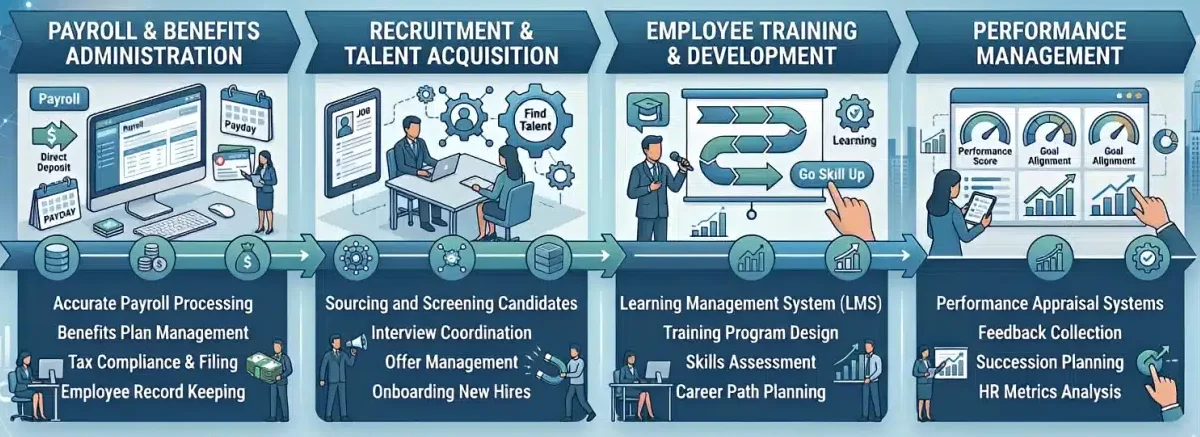
HR outsourcing can cover a wide range of workforce management activities. Many organizations choose to outsource specific HR functions that require specialized expertise or significant administrative effort.
By delegating these functions to external providers, businesses can improve efficiency while maintaining consistent HR operations.
Payroll and Benefits Administration
Payroll processing is one of the most commonly outsourced HR functions. It involves calculating salaries, managing tax deductions, processing payments, and ensuring accurate financial records.
Benefits administration is often outsourced alongside payroll. External providers help manage health insurance plans, retirement programs, and employee benefits enrollment.
Recruitment and Talent Acquisition
Recruitment requires significant time and resources, especially when organizations need to fill multiple positions. HR outsourcing providers assist with job postings, candidate screening, and initial interview coordination.
These providers also leverage professional recruitment networks and applicant tracking systems. This helps organizations identify qualified candidates more efficiently.
Employee Training and Development
Employee training is essential for improving workforce skills and maintaining productivity. However, designing and managing training programs internally can require specialized resources.
HR outsourcing providers support companies by delivering structured learning programs, leadership training, and compliance education. These initiatives help organizations build stronger and more capable teams.
Performance and Workforce Management
Performance management ensures that employees remain aligned with organizational goals. This process includes setting performance indicators, conducting evaluations, and providing feedback.
HR outsourcing providers assist companies in designing structured performance management frameworks. These systems help organizations monitor productivity and support employee development.
HR Outsourcing Models
Organizations can adopt different HR outsourcing models depending on their operational needs and internal capabilities. Each model offers varying levels of responsibility and control between the company and the outsourcing provider.
Understanding these models helps businesses choose the most suitable approach for managing HR processes efficiently.
Full Service HR Outsourcing
Full service HR outsourcing involves delegating most or all HR functions to an external provider. In this model, the provider manages a wide range of responsibilities including recruitment, payroll, benefits administration, and compliance management.
This approach allows organizations to remove much of the administrative burden associated with HR operations. Internal leadership can then focus more on strategic business priorities while the provider manages day to day HR processes.
Professional Employer Organization (PEO)
A Professional Employer Organization (PEO) operates through a co-employment arrangement with the client company. The PEO becomes the employer of record for legal and administrative purposes, while the company continues managing employees’ daily work.
This model allows businesses to access large scale employee benefits and compliance support. Smaller companies especially benefit from the shared resources and risk management provided by the PEO.
Project Based HR Outsourcing
Project based HR outsourcing focuses on specific HR initiatives rather than ongoing operational support. Companies typically use this model when they require specialized expertise for a defined period.
Examples include HR compliance audits, compensation structure redesign, or large scale recruitment projects. Once the project is completed, the outsourcing engagement usually ends.
Key Benefits of HR Outsourcing
HR outsourcing offers several advantages that extend beyond simple administrative support. Organizations often adopt outsourcing strategies to improve efficiency, reduce costs, and enhance workforce management capabilities.
When implemented effectively, HR outsourcing can support both operational improvements and long term business strategy.
Cost Reduction
Maintaining an internal HR department requires significant financial resources. Companies must invest in salaries, training programs, office infrastructure, and HR software systems.
Outsourcing converts many of these fixed costs into flexible service fees. As a result, businesses can reduce operational expenses while maintaining high quality HR support.
Operational Efficiency
HR outsourcing helps streamline administrative processes through specialized workflows and automation tools. External providers typically use optimized systems designed specifically for HR management.
This improves the speed and accuracy of tasks such as payroll processing, employee onboarding, and record management. Organizations can therefore operate more efficiently while reducing manual workloads.
Improved Employee Experience
A well managed HR function plays an important role in employee satisfaction. Outsourcing providers often offer digital HR platforms where employees can easily access information about payroll, benefits, and leave requests.
These systems improve transparency and simplify everyday HR interactions. As a result, employees experience smoother administrative processes and better support.
Access to HR Technology
Modern HR management increasingly relies on advanced technology platforms such as HR information systems and workforce analytics tools. Developing and maintaining these systems internally can require substantial investment.
HR outsourcing providers already operate sophisticated technology infrastructures. Partnering with them allows organizations to benefit from modern HR tools without significant implementation costs.
Strategic Workforce Planning
Beyond administrative tasks, HR outsourcing can support long term workforce planning. External experts analyze workforce data to identify talent gaps, recruitment needs, and employee development opportunities.
These insights help organizations design stronger talent strategies and prepare for future growth. As a result, HR becomes a more strategic contributor to overall business performance.

How to Choose the Right HRO Provider
Selecting the right HR outsourcing provider is a strategic decision that can significantly influence business operations. Organizations must carefully evaluate potential partners to ensure they can deliver reliable HR support and adapt to future growth.
A well chosen provider should align with the company’s operational needs, technology environment, and long term workforce strategy.
Evaluate Business Needs
Before choosing an outsourcing partner, organizations should review their current HR operations and identify key challenges. This may include administrative workload, compliance concerns, recruitment difficulties, or workforce expansion plans.
Understanding these needs helps companies determine which HR functions should be outsourced. A clear scope of services also allows businesses to compare providers more effectively.
Assess Provider Experience
Experience plays a critical role in HR outsourcing partnerships. Providers with strong industry knowledge are better equipped to manage workforce challenges and regulatory requirements.
Organizations should review case studies, client testimonials, and the provider’s track record. Evaluating their HR expertise ensures that the outsourcing partner can deliver reliable guidance and operational support.
Review HR Technology and Integration
Modern HR outsourcing services rely heavily on digital platforms and automation tools. These systems help streamline payroll, employee records, performance tracking, and benefits administration.
Companies should ensure that the provider’s HR technology integrates smoothly with existing business systems. Seamless integration reduces manual work and improves data accuracy across departments.
Industry Use Cases of HR Outsourcing
HR outsourcing is widely used across different industries, although each sector applies it in slightly different ways. Organizations often tailor outsourcing strategies to match workforce structures, compliance requirements, and operational complexity.
Understanding these industry examples helps businesses identify how HR outsourcing can support their specific operational needs.
Startups and Tech Companies
Startups and technology firms often grow rapidly but lack the internal resources to build a full HR department. HR outsourcing allows these companies to manage recruitment, payroll, and employee onboarding more efficiently.
By relying on external HR specialists, startups can focus on product development and market expansion. Outsourcing also helps establish scalable HR processes that support future growth.
Healthcare Organizations
Healthcare institutions operate within strict regulatory frameworks and require specialized workforce management. HR outsourcing helps hospitals and medical facilities manage compliance, credential tracking, and employee scheduling.
External providers also assist with payroll systems that handle complex shift structures. This support ensures that healthcare organizations maintain accurate workforce administration while focusing on patient care.
Manufacturing and Logistics
Manufacturing and logistics companies often manage large workforces with fluctuating staffing requirements. HR outsourcing supports recruitment for temporary or seasonal workers and helps manage complex payroll structures.
Providers may also assist with workplace safety compliance and workforce scheduling. This helps organizations maintain operational continuity while meeting labor regulations.
Retail and Hospitality
Retail and hospitality businesses frequently experience high employee turnover and seasonal hiring demands. HR outsourcing helps these companies manage recruitment, onboarding, and employee scheduling efficiently.
Automated HR systems also simplify time tracking and payroll for hourly employees. As a result, managers can focus more on customer service and daily operations.
Implementing an HR Outsourcing Strategy
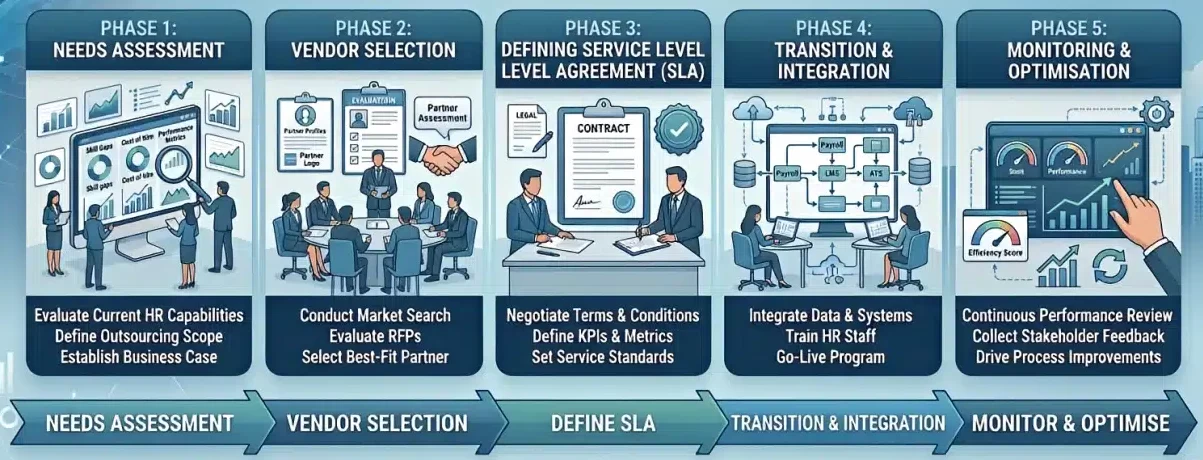
Successfully outsourcing HR functions requires careful planning and structured implementation. A clear strategy ensures that the transition occurs smoothly without disrupting workforce operations.
Organizations typically follow a phased approach when introducing HR outsourcing. This allows them to maintain operational stability while gradually transferring responsibilities to the provider.
Needs Assessment
The first step is evaluating current HR operations to identify areas that require improvement. Organizations must determine which HR functions consume the most resources or present the highest compliance risks.
This assessment helps define the scope of outsourcing and sets clear expectations for the partnership.
Vendor Selection
After defining the outsourcing requirements, companies begin evaluating potential HR providers. The selection process usually involves comparing service offerings, pricing models, and industry experience.
Choosing the right partner ensures that the outsourcing strategy aligns with business goals and workforce management needs.
Defining the SLA
A service level agreement (SLA) outlines the responsibilities and performance standards of the outsourcing provider. This document specifies service scope, response times, and accountability measures.
Clear SLAs help prevent misunderstandings and ensure that both parties maintain consistent expectations throughout the partnership.
Transition and Integration
Once a provider is selected, organizations begin transferring HR processes to the outsourcing partner. This stage often includes data migration, system integration, and process alignment.
A gradual transition helps minimize operational disruptions and ensures that employees adapt to the new HR systems smoothly.
Monitoring and Optimization
After implementation, companies must continuously monitor the performance of the outsourcing arrangement. Regular reviews help ensure that service quality remains consistent and aligned with business needs.
Organizations can also adjust outsourcing scope over time as workforce requirements evolve. Continuous optimization helps maximize the long term value of HR outsourcing.
Risks and Pitfalls of HR Outsourcing
Although HR outsourcing offers many advantages, organizations should also consider potential risks before implementing it. Understanding these challenges helps companies manage outsourcing partnerships more effectively.
By addressing potential pitfalls early, businesses can maximize the benefits of HR outsourcing while protecting internal workforce stability.
- Loss of company culture
Excessive reliance on external providers may create distance between employees and internal leadership. Organizations should continue managing company culture, communication, and employee engagement internally. - Data security concerns
HR outsourcing requires sharing sensitive employee information such as payroll records, personal data, and employment documents. Companies must ensure that providers follow strict data protection policies and security standards. - Hidden outsourcing costs
Some outsourcing agreements include additional service charges beyond the basic contract scope. Organizations should review pricing structures carefully to avoid unexpected operational costs.
The Future of HR Outsourcing
The HR outsourcing landscape continues to evolve as organizations adopt more advanced workforce technologies. New innovations are transforming outsourcing providers from administrative partners into strategic workforce advisors.
These emerging trends are shaping how companies manage talent, compliance, and employee engagement in the modern workplace.
AI in HR Outsourcing
Artificial intelligence is increasingly integrated into HR outsourcing services. AI tools help automate repetitive tasks such as resume screening, employee data processing, and payroll verification.
These technologies also provide predictive insights related to workforce planning and employee retention. As a result, organizations can make more informed HR decisions using data driven analytics.
Global Employer of Record (EOR)
Global Employer of Record services allow companies to hire employees in foreign markets without establishing local legal entities. The outsourcing provider acts as the official employer for compliance, payroll, and tax purposes.
This model simplifies international expansion and reduces administrative complexity. Companies can therefore access global talent while remaining compliant with local labor regulations.
Employee Experience Platforms
Modern HR outsourcing providers increasingly focus on improving the overall employee experience. Digital HR platforms allow employees to manage payroll information, benefits, leave requests, and performance feedback in a centralized system.
These platforms improve transparency and accessibility across HR services. As a result, employees gain a more efficient and user friendly experience when interacting with HR processes.
Conclusion
Human resources outsourcing provides organizations with a flexible way to manage workforce operations more efficiently. By delegating routine HR tasks to external specialists, companies can streamline administration while maintaining compliance and operational stability.
Beyond operational efficiency, HR outsourcing also enables businesses to access professional expertise and advanced HR technologies. This combination helps organizations improve employee management while supporting long term workforce development.
If your organization wants to simplify HR operations and improve workforce management, the right system can make a meaningful difference. Request a free consultation with our experts to explore solutions that streamline HR processes and support sustainable growth.
Frequently Asked Questions About HR Outsourcing
-
What is human resources outsourcing (HRO)?
Human resources outsourcing is the practice of delegating HR tasks such as payroll, recruitment, and employee administration to an external service provider. This allows organizations to streamline operations and access HR expertise without maintaining a large internal HR department.
-
Why do companies outsource HR functions?
Companies outsource HR functions to reduce administrative workload, improve compliance management, and gain access to specialized HR expertise and technology platforms.
-
What HR functions are commonly outsourced?
Commonly outsourced HR functions include payroll processing, benefits administration, recruitment, employee training, and workforce performance management.
-
What is the difference between HRO and a PEO?
In HR outsourcing, companies delegate specific HR functions to a provider while remaining the legal employer. In a Professional Employer Organization (PEO) model, the provider shares employer responsibilities through a co employment arrangement.
-
Is HR outsourcing suitable for small businesses?
Yes. Small and growing businesses often benefit from HR outsourcing because it provides access to professional HR services and technology without the cost of building a full internal HR department.