
Australian organisations face growing pressure to improve how new employees transition into the workplace. Hiring strong talent alone is no longer sufficient, as many businesses still struggle with slow ramp up times and early turnover.
Employee onboarding has evolved into a structured process that aligns operational readiness with cultural integration. When managed systematically, it helps new hires adapt faster while reducing risks caused by fragmented manual approaches.
This article explores the key phases, best practices, and compliance requirements that shape effective employee onboarding programs in modern Australian organisations.
Key Takeaways
Understand workflow automation fundamentals to see how rule based processes reduce manual work and improve consistency.
Learn how workflow automation works in practice through triggers, logic, and system integration that drive efficiency.
Explore the key benefits of workflow automation, including faster processes, fewer errors, and stronger operational control.
Review workflow automation examples by department to understand real world applications across finance, HR, sales, and operations.
Understanding Workflow Automation in Business
Workflow automation is the use of technology to execute routine business processes with minimal manual intervention. It connects tasks, data, and systems so activities move automatically based on predefined rules and triggers.
Instead of relying on emails, spreadsheets, or manual handoffs, workflow automation standardises how work progresses across departments. This improves process consistency, reduces human error, and increases operational efficiency.
In modern organisations, workflow automation often supports functions such as employee onboarding, approvals, document routing, and cross functional coordination. When implemented correctly, it helps teams work faster while maintaining better visibility and control over daily operations.
How Workflow Automation Works in Practice
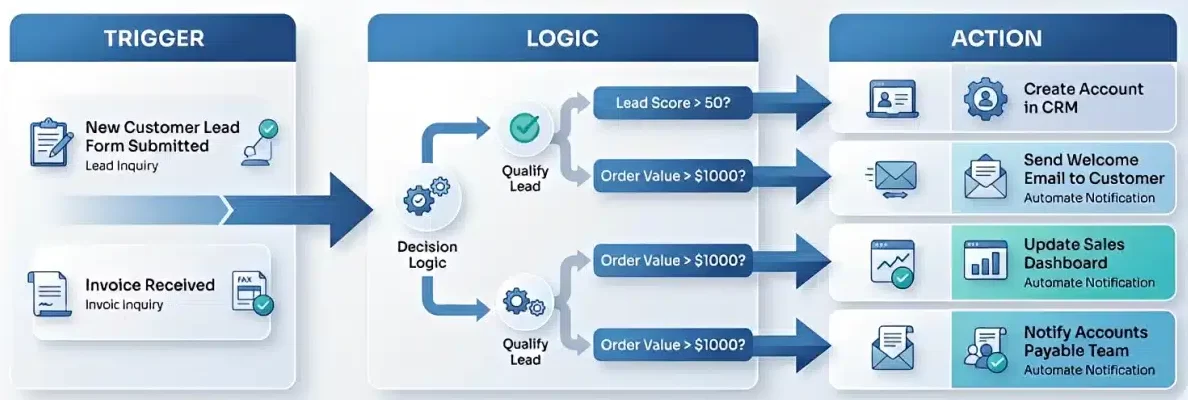
Workflow automation works by structuring business processes into rule based sequences that move data automatically between systems. Although the interface may appear simple, the backend depends on coordinated logic, integrations, and data flows to execute tasks accurately and consistently at scale.
The Architecture of a Workflow
Most automated workflows follow a trigger action framework, where a defined event initiates a specific response from an integrated employee management software. This structure allows organisations to standardise repetitive processes while maintaining decision accuracy, often by leveraging a business process integration platform.
Core components typically include:
- Trigger
The trigger is the starting point of automation. It may be time based, event driven, or condition based, such as when a form is submitted or inventory drops below a threshold. In advanced ERP environments, triggers can be multi layered and activated by real time data combinations. - Conditions and Logic
After activation, the workflow evaluates if then rules to determine the next step. For example, an expense under a set limit may be auto approved, while higher amounts are routed for managerial review. This logic enables automation to handle exceptions in a controlled way. - Actions
Actions execute the required outcome, such as sending notifications, updating records, generating documents, or pushing data to external systems via API.
The Role of Integration
Workflow automation delivers the most value when connected across the technology stack. Integration allows CRM, accounting, and inventory systems to exchange data through APIs, reducing silos and maintaining a single source of truth across the organisation.
Visual Modelling and Mapping
Before implementation, workflows are typically mapped using visual flowcharts. This step helps teams identify redundant steps and process gaps. By refining the workflow first, organisations ensure automation improves efficiency rather than simply digitising inefficient manual processes.
Key Benefits of Workflow Automation
Workflow automation is widely adopted because it delivers measurable business value through a modern payroll administration. For businesses operating in high cost and highly regulated environments, automation helps improve speed, accuracy, and operational control when compared with manual processes.
Enhanced Operational Efficiency
Automation significantly improves operational efficiency by removing manual handling delays. Tasks such as approvals, data routing, and notifications can be completed in seconds rather than days.
Faster workflows enable companies to respond to customers more quickly, maintain inventory continuity, and close financial cycles with greater consistency.
Reduction of Human Error
Manual data entry remains a major source of operational risk. Even small input mistakes can lead to reporting issues, shipment errors, or financial discrepancies.
Workflow automation reduces this risk by transferring data directly between systems and auto populating required fields, improving accuracy and supporting regulatory compliance.
Cost Reduction and Resource Optimisation
Although automation requires upfront investment, it delivers long term efficiency gains. Organisations can scale transaction volumes without proportionally increasing administrative headcount.
Reduced rework, fewer penalties, and improved cash flow timing further strengthen the financial impact of automation initiatives.
Improved Visibility and Accountability
Automated workflows provide real time status tracking across business processes. Managers can quickly identify delays, monitor workload distribution, and resolve bottlenecks earlier.
Built in audit trails record every action within the workflow, supporting stronger governance and simplifying compliance reviews.
Employee Satisfaction and Retention
Automation removes repetitive administrative work that often reduces employee engagement. When routine tasks are automated, teams can focus on analysis, collaboration, and higher value activities.
This shift typically improves job satisfaction, supports retention, and helps organisations maintain a more productive workforce.

Workflow Automation Examples by Department
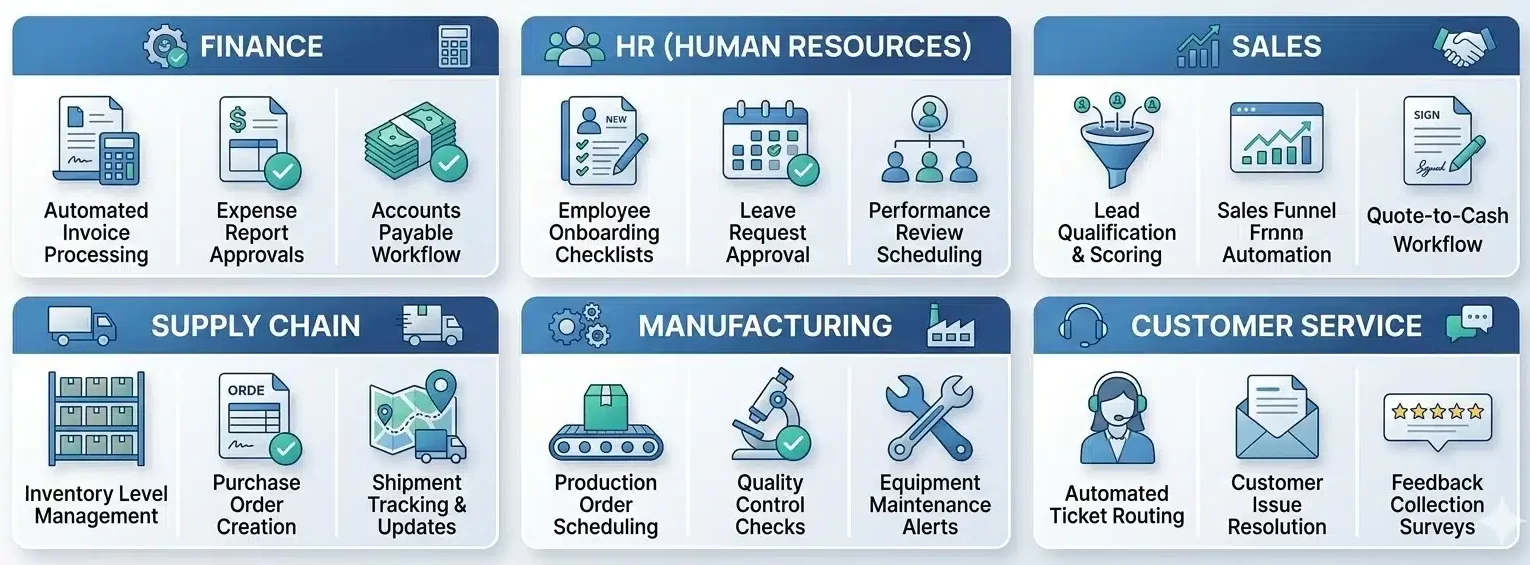
To understand the real impact of workflow automation, it helps to look at how different departments apply it in daily operations. The following examples show how automation improves speed, accuracy, and coordination across key business functions.
Finance and Accounting
Finance teams benefit strongly from automation because most processes follow strict rules and deadlines.
- Accounts Payable automation
OCR scans incoming invoices, extracts key data, and performs three way matching with PO and GRN. If matched, payment is scheduled automatically; if not, the system alerts the responsible manager. - Expense management
Employees upload receipts via mobile apps, and the system reads, categorises, and validates expenses against company policy. Approved claims sync directly to the general ledger for faster reimbursement. - Financial reporting
Automated reconciliation runs continuously, enabling scheduled generation of profit and loss, balance sheet, and cash flow reports without manual compilation.
Human Resources
HR workflows handle sensitive data and cross team coordination, making automation especially valuable.
- Employee onboarding
Once a contract is signed, workflows send digital forms to the new hire while notifying IT and facilities to prepare access and equipment. This ensures day one readiness. - Leave management
Employees submit requests through a portal, the system checks balances in real time, routes approvals, updates calendars, and syncs payroll automatically. - Performance reviews
Automated reminders trigger self assessments and manager reviews based on review cycles, ensuring evaluations stay consistent and well documented.
Sales and CRM
In sales environments, automation reduces admin work so teams can focus on revenue generating activities.
- Lead management and scoring
Leads are scored based on behaviour. When thresholds are met, the system assigns the lead to a sales rep and creates follow up tasks automatically. - Contract management
Customer data populates contract templates, sends them for e signature, and once signed, updates the opportunity status and triggers invoicing. - Pipeline maintenance
Workflows flag stagnant deals or move inactive opportunities into nurture stages, helping managers maintain accurate forecasts.
Procurement and Supply Chain
Automation strengthens control and responsiveness across purchasing and inventory operations.
- Purchase order approvals
Requests are routed automatically based on value thresholds. Once approved, the PO is generated and sent to the vendor without manual handling. - Inventory reordering
Systems monitor stock levels continuously and trigger reorder recommendations or automatic POs when safety stock thresholds are reached. - Vendor management
Supplier onboarding collects required documents through secure portals and monitors performance against agreed SLAs.
Manufacturing and Operations
On the shop floor, automation connects planning systems with real production conditions.
- Production scheduling
Workflows analyse orders, materials, and machine capacity to generate optimised schedules and automatically adjust when disruptions occur. - Quality control
If defect rates exceed thresholds, the system can halt production and notify quality teams immediately to prevent larger losses. - Preventive maintenance
Maintenance work orders are triggered based on usage data, with spare parts reserved and downtime scheduled during low production periods.
Customer Service
Automation ensures customer inquiries are handled quickly and consistently.
- Ticket routing and prioritisation
Incoming tickets are categorised and routed to the correct team automatically, with priority adjusted based on SLA tiers. - Feedback loops
After case closure, the system sends NPS surveys. Negative responses trigger alerts for follow up by customer success teams.
Healthcare and Medical Services
Healthcare providers use automation to improve patient coordination while maintaining strict regulatory compliance.
- Patient intake and triage: Digital forms update health records, verify insurance, and flag high risk conditions before appointments.
- Discharge planning: Approved discharges trigger referrals, prescription forwarding, and patient instruction delivery automatically.
- Compliance auditing: Workflows scan records for missing documentation and assign corrective tasks to relevant staff.
Legal and Professional Services
In professional services, automation reduces non billable administrative work and improves document governance.
- Contract lifecycle management: Workflows route contracts for review, track revisions, and store signed versions securely.
- Client onboarding and verification: Automated checks validate client identity and generate risk profiles for review.
- Conflict of interest screening: Systems cross reference new clients against historical data and flag potential conflicts.
Retail and E commerce
Retail and e commerce operations rely on automation to maintain speed and inventory accuracy across multiple sales channels.
- Returns management: Return requests trigger shipping labels, warehouse notifications, and refund workflows automatically.
- Inventory synchronisation: Sales across channels update stock levels in real time to prevent overselling.
How to Implement Workflow Automation Step by Step
Implementing workflow automation requires structured planning and clear process visibility, often using a HRM solution for enterprise. Without a defined roadmap, organisations risk digitising inefficient workflows. The phased approach below helps ensure automation delivers measurable operational value.
Phase 1: Discovery and Audit
Start by analysing the current manual process. Focus on workflows that are repetitive, rule based, and prone to error. Interview the teams involved to understand where delays and risks occur.
Key questions to assess:
- What triggers this process?
- Where do bottlenecks typically occur?
- How much time is spent on data entry versus decision making?
- What is the business impact of an error?
Tip: Begin with a high volume, low complexity workflow to generate early wins and stakeholder confidence.
Phase 2: Process Mapping
Visual mapping clarifies how the workflow actually operates. Use BPMN diagrams or simple flowcharts to document both the current state and the improved future state.
Define clearly:
- Triggers: what initiates the workflow
- Actions: what the system executes
- Logic or conditions: how decisions branch
This step often reveals redundant activities that should be removed before automation.
Phase 3: Tool Selection
Choose a platform that fits your technical maturity, integration needs, and scalability goals. Workflow automation tools typically fall into three categories: Built-in automation, Integration platforms (iPaaS), and integrated enterprise solutions, that combine multiple business functions into a single system
Many organisations choose a cloud-based business solution to enable scalability, remote access, and seamless updates while supporting workflow automation across departments.
Phase 4: Design and Build
Translate the approved workflow into the automation platform. Build the primary success path first, then layer in exception handling for edge cases such as missing data or unavailable approvers.
A structured build approach reduces rework during later testing stages.
Phase 5: Pilot Testing and Validation
Avoid full scale rollout initially. Test the workflow with a controlled pilot group and monitor performance closely.
Validate:
- Logic accuracy: routing behaves as expected
- Data integrity: information transfers correctly
- User experience: the process is genuinely faster and clearer
Early validation prevents costly downstream fixes.
Phase 6: Change Management and Rollout
User adoption is critical to automation success. Communicate clearly that automation removes repetitive work rather than roles. Provide training, quick reference guides, and clear support channels.
Well managed rollout reduces resistance and accelerates benefits.
Phase 7: Monitor and Optimise
Workflow automation is continuous, not one time. Track KPIs such as cycle time, error rates, and throughput using built in analytics.
Use these insights to refine logic, remove new bottlenecks, and expand automation coverage over time.
Common Workflow Automation Pitfalls to Avoid
Although workflow automation offers clear efficiency gains, many initiatives fall short due to design and governance gaps. Recognising these risks early helps organisations protect ROI and maintain process reliability at scale.
Automating Inefficient Processes
One of the most common mistakes is digitising a workflow that is already flawed. If approvals are redundant or data checks are unnecessary, automation will only accelerate the inefficiency. Organisations should simplify and optimise the process structure before applying automation.
Overengineering the Workflow
Trying to accommodate every possible scenario often results in overly complex workflows that are difficult to maintain. A more effective approach is to automate the standard majority of cases while routing rare exceptions to manual review. This keeps the automation logic clean and sustainable.
Ignoring User Adoption
Automation changes how teams work, and poor adoption can undermine the entire initiative. If users find the system confusing or unreliable, they may revert to manual workarounds. Clear communication, training, and change management are essential to build trust and consistent usage.
Weak System Integration
Workflow automation depends on seamless data exchange between platforms such as CRM, ERP, and finance systems. Weak API connections or inconsistent data mapping can create silos and break automated flows. Ensuring strong integration architecture is critical for long term stability.
Limited Governance and Documentation
In low code environments, different teams may build automations independently. Without central governance and proper documentation, this creates hidden dependencies and operational risk. Establishing clear ownership and maintaining workflow documentation helps keep automation scalable and controlled.
Advanced Workflow Automation Trends
Workflow automation is increasingly converging with AI and analytics to enable more adaptive, intelligent operations. Often referred to as hyperautomation, this shift allows organisations to move beyond simple rule execution toward data driven decision support.
Intelligent Process Automation
Intelligent Process Automation combines rule based workflows with AI and machine learning to handle unstructured data. For example, Natural Language Processing can analyse email content and automatically classify and route messages without manual review.
Intelligent Document Processing
Intelligent Document Processing uses advanced OCR and AI to extract data from PDFs, images, and handwritten files. By converting unstructured documents into usable data, organisations can reduce manual entry in processes such as invoicing and contract handling.
Process Mining and Discovery
Process mining tools analyse system activity to visualise how workflows actually run. This helps teams uncover hidden bottlenecks and prioritise high value automation opportunities based on real operational data.
Citizen Development Governance
No code platforms enable business users to build workflows independently. To maintain control, organisations implement governance guardrails such as access controls, approved components, and development standards that balance agility with security.
As these capabilities mature, workflow automation is evolving into a more connected and intelligent operational layer that supports long term efficiency and scalability.
Conclusion
Workflow automation has become a critical capability for organisations seeking greater speed, accuracy, and operational control. When processes are structured and connected properly, businesses can reduce manual workload while improving visibility across departments.
The greatest impact comes from aligning automation with clear workflows, strong integration, and user adoption. Organisations that take a phased, well governed approach are better positioned to scale automation without creating new operational risks.
As business complexity continues to grow, investing in workflow automation will be key to maintaining efficiency and resilience. If you want help evaluating the right approach, get free consultation with our team today.

Frequently Asked Questions About Workflow Automation
-
What is workflow automation in business?
Workflow automation is the use of technology to execute routine business processes automatically based on predefined rules and triggers. It connects tasks, data, and systems so work moves faster with minimal manual intervention.
-
How does workflow automation improve operational efficiency?
Workflow automation improves efficiency by eliminating manual handoffs, speeding up approvals, and reducing repetitive data entry. Automated workflows allow organisations to complete processes faster while maintaining better accuracy and visibility.
-
Which business processes are best suited for workflow automation?
Processes that are repetitive, rule based, and high volume are typically the best candidates. Common examples include employee onboarding, invoice approvals, purchase requests, leave management, and customer ticket routing.
-
What should organisations prepare before implementing workflow automation?
Organisations should first analyse and simplify existing workflows, map the process clearly, and ensure systems can integrate properly. Strong change management and user training are also essential to achieve successful adoption.