
Stock replenishment is the structured process of moving inventory through the supply chain to keep products available without creating excess stock. It covers both internal transfers from reserve storage to picking locations and external reordering from suppliers. The objective is to maintain steady product flow while controlling holding costs.
Unlike basic purchasing, replenishment focuses on inventory availability and timing. Modern approaches rely on sales velocity, seasonality patterns, and demand signals to determine when and how much to restock. When managed properly, replenishment reduces waste and supports consistent order fulfilment.
Key Takeaways
|

What Is Stock Replenishment and Why It Matters
Stock replenishment is the strategic process of moving inventory through the supply chain to maintain product availability. It includes transferring goods from reserve storage to picking locations or ordering new stock from suppliers. The primary objective is to meet demand without creating unnecessary carrying costs.
Unlike simple purchasing, replenishment focuses on inventory flow and timing rather than just the buying transaction. The process ensures products are available where and when they are needed, supporting smoother warehouse and fulfilment operations.
In modern environments, replenishment decisions rely heavily on sales velocity, seasonality patterns, and real time demand signals. When supported by centralized inventory software, businesses gain unified visibility across locations, helping reduce waste, improve service levels, and maintain healthier inventory balance.
Why Stock Replenishment Is Critical for Operational Performance
Effective stock replenishment directly influences financial health, customer satisfaction, and warehouse productivity. When managed properly, it stabilises operations while preventing costly inventory imbalances.
Stockouts remain one of the most visible risks. When customers encounter unavailable products, they often switch to competitors, resulting in lost revenue and potential long term churn.
At the same time, overstocking creates significant carrying costs. Excess inventory consumes warehouse space, increases handling effort, and ties up working capital that could otherwise support business growth.
Proactive replenishment also improves labour efficiency. When inventory is positioned ahead of demand, warehouse teams can fulfil orders without interruption, reducing urgent replenishment moves during peak picking periods.
Planning Stock Replenishment Decisions for Accurate Inventory Control
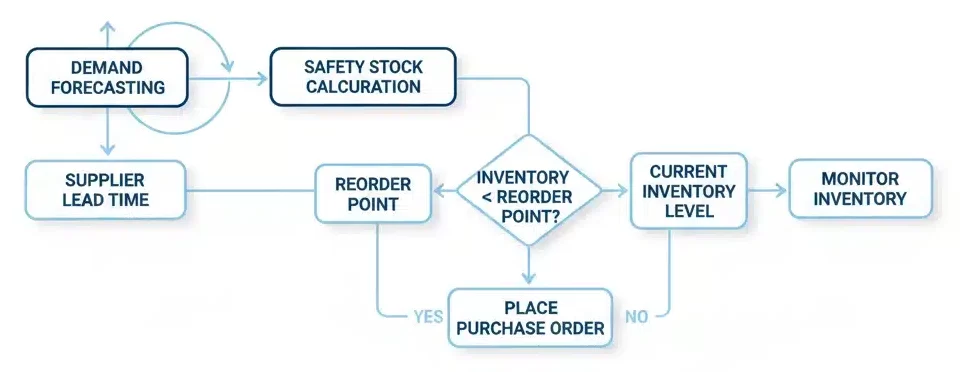
Successful stock replenishment is rarely driven by guesswork. It requires structured planning and careful analysis of several key variables. Operations managers must synthesize data related to demand patterns, timing, and risk to determine when and how much inventory should be reordered.
These planning decisions form the foundation of a reliable inventory policy. By standardizing key parameters, organisations can automate much of the replenishment process, reduce manual intervention, and minimise human error. The three core pillars of effective planning are demand forecasting, supplier lead time, and safety stock calculations.
Demand Forecasting
Demand forecasting relies on accurate demand prediction using historical trends, seasonality, and market signals. When prediction models are regularly reviewed and adjusted, businesses can anticipate inventory needs instead of reacting to shortages.
Modern forecasting tools increasingly use advanced analytics and machine learning to detect seasonality and demand shifts earlier. Even so, forecasts should be reviewed regularly to ensure replenishment parameters remain aligned with actual sales patterns.
Supplier Lead Time
Supplier lead time measures the gap between placing an order and receiving goods. Because inventory continues to decline during this window, inaccurate lead time assumptions are a common cause of stockouts. Tracking actual supplier performance is therefore critical.
Lead time should be monitored continuously rather than treated as a fixed number. Variability caused by production delays, shipping disruptions, or customs clearance must be reflected in replenishment settings to maintain reliable product availability.
Safety Stock and Reorder Points
Safety stock acts as a buffer against uncertainty in demand and supplier variability. The objective is to maintain target service levels while avoiding excessive inventory holding costs.
The Reorder Point (ROP) defines the specific inventory level that triggers replenishment. The standard formula is:
ROP = (Average Daily Usage × Average Lead Time) + Safety Stock
When inventory falls to this calculated threshold, a new order is generated to maintain continuous product availability and prevent stockouts.
Stock Replenishment Methods Used in Modern Warehouses
Different inventory profiles require different replenishment strategies. Most organisations apply a combination of methods based on demand patterns, inventory velocity, and service level targets.
Periodic Replenishment
Periodic replenishment reviews inventory at fixed intervals and restores stock to a predefined target level. The method is straightforward to manage and works best for items with stable and predictable demand.
However, unexpected demand spikes between review cycles can increase stockout risk. To offset this gap, organisations typically maintain slightly higher safety stock levels.
Reorder Point Method
The reorder point method continuously monitors inventory and automatically triggers replenishment when stock reaches a predefined minimum level. This makes it highly responsive to real time demand changes.
The approach performs best when supported by accurate inventory visibility. It is commonly applied to high value or fast moving items where product availability is critical.
On Demand Replenishment
On demand replenishment aligns purchasing closely with immediate production or sales requirements. This strategy reduces holding costs and supports lean inventory operations.
However, the model depends heavily on reliable suppliers and accurate demand signals. Any disruption in supply can quickly impact fulfilment performance.
Top Off Replenishment
Top off replenishment uses operational downtime to refill picking locations before they reach minimum thresholds. This helps balance warehouse workload and reduces urgent replenishment activity during peak hours.
The strategy is particularly effective for fast moving items but requires system controls to prevent overfilling forward pick locations.
How the Stock Replenishment Process Works Step by Step
Stock replenishment follows a structured workflow that connects planning, procurement, and warehouse execution. Understanding each stage helps operations teams identify bottlenecks and maintain consistent inventory availability.
Step 1: Trigger Identification. The process begins when a trigger is activated. This could be a calendar date (in periodic review), a stock level hitting a minimum threshold (in ROP), or a direct demand signal from a customer order. Modern systems automate this detection.
Step 2: Requirement Calculation. Once triggered, the system calculates the quantity needed. This calculation considers the current stock, the quantity already on order (but not received), the safety stock requirement, and the target maximum stock level.
Step 3: Order Generation. A purchase order (PO) or a warehouse transfer request is generated. For external suppliers, this PO is sent via EDI or email. For internal replenishment, a task is created for warehouse staff to move goods from bulk storage.
Step 4: Supplier Fulfillment and Transit. The supplier processes the order and ships the goods. During this phase, the buying organization tracks the shipment to ensure it aligns with the expected lead time. Advanced systems provide visibility into the shipment’s location.
Step 5: Receiving and Inspection. Upon arrival, the goods are received at the dock. This is a critical control point where quantity and quality are verified against the purchase order. Discrepancies must be resolved immediately to maintain data accuracy.
Step 6: Put Away. The final step is moving the goods to their designated locations. This could be a reserve storage location or directly to a forward pick face. Efficient put away processes ensure that the inventory is immediately available for sale in the system.
Best Practices for Modern Stock Replenishment
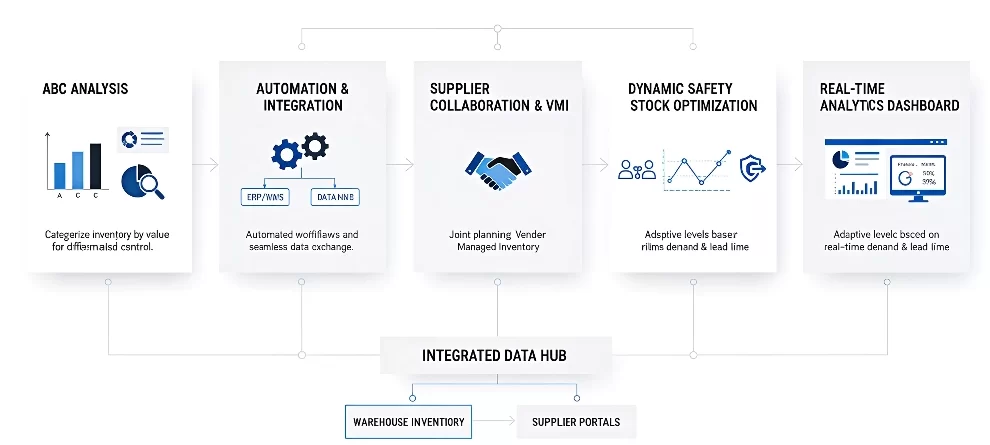
Optimising stock replenishment requires more than basic reorder rules. As supply chains become increasingly data driven, organisations must combine inventory segmentation, automation, and supplier collaboration to maintain availability without inflating working capital. The following practices help build a more responsive and scalable replenishment framework.
ABC Analysis
ABC analysis prioritises inventory based on value and movement patterns. High value, fast moving A items require tighter monitoring and more frequent replenishment, while lower priority C items can follow lighter controls. This segmentation ensures planning effort and inventory investment focus on products that drive the greatest business impact.
Automation and Data Integration
Integrating sales, inventory, and procurement data enables real time replenishment triggers and reduces manual intervention. Many organisations evaluating Australia’s top inventory solutions prioritise platforms that unify these functions to support scalable and automated stock control.
Supplier Collaboration and VMI
Replenishment performance improves when suppliers are embedded in the planning process. Sharing demand forecasts helps vendors align production and reduce lead time variability. In Vendor Managed Inventory arrangements, suppliers monitor stock levels and replenish against agreed thresholds, improving fill rates while lowering administrative workload.
CPFR for Strategic Alignment
Collaborative Planning, Forecasting, and Replenishment extends coordination beyond basic vendor visibility. Trading partners jointly review forecasts, promotions, and supply risks to synchronise inventory plans ahead of demand changes. This proactive alignment reduces stock imbalances and supports more stable service performance.
Dynamic Safety Stock Optimisation
Static safety stock levels often fail in volatile environments. Advanced systems now adjust buffers dynamically based on real time demand variability and supplier performance. This adaptive approach protects service levels during uncertainty while releasing excess working capital when conditions stabilise.
Data Accuracy and KPI Monitoring
Even the most advanced replenishment logic depends on clean inventory data. Regular cycle counts and master data audits help prevent phantom inventory and late reorder triggers. Performance should also be monitored through metrics such as inventory turnover, fill rate, and days sales of inventory to support continuous improvement.
Stock Replenishment Strategies by Industry
Stock replenishment follows the same core principles, but execution varies across industries. Differences in product velocity, value, and demand volatility mean a single approach rarely works well in practice. Understanding these nuances helps organisations design replenishment policies that better support service levels and inventory efficiency.
Manufacturing: Raw Materials and MRO
In manufacturing environments, stock replenishment is primarily driven by production continuity rather than shelf availability. A stockout can halt an entire production line, making reliability more critical than minimising holding costs for key components.
Manufacturers typically separate replenishment into Direct Materials (BOM) and Maintenance, Repair, and Operations (MRO) inventory. Direct materials are usually planned through Material Requirements Planning (MRP) linked to the master production schedule and often aligned with Just in Time (JIT) principles to reduce excess inventory.
MRO demand, however, is more sporadic and difficult to forecast. Many advanced manufacturers deploy vending based replenishment systems that automatically trigger reorders when usage thresholds are reached. This improves traceability, reduces manual counting, and ensures critical spare parts remain available.
High Volume Retail: Brick and Mortar
In physical retail, replenishment must balance availability with shelf presentation. Even when stock technically exists, partially filled shelves can negatively affect customer perception and sales performance.
Retailers commonly apply Min Max replenishment supported by planogram compliance to maintain visual consistency. They must also manage the difference between case pack and each level replenishment to avoid inefficient backroom handling.
Modern retail systems increasingly calculate shelf capacity to enable direct to shelf replenishment, ensuring inventory is only moved when the display location can accept a full case. This reduces double handling and improves labour productivity.
E Commerce and Omnichannel Fulfilment
E commerce replenishment is more complex due to decentralised fulfilment networks. Inventory is often distributed across multiple fulfilment centres to support fast delivery expectations, making location decisions as important as timing.
Advanced operators use Distributed Order Management (DOM) logic to determine whether stock should be transferred internally or reordered from suppliers. This helps balance inventory across the network and reduce fulfilment delays.
Many e commerce businesses also apply pre kitting strategies based on basket analysis. When products are frequently purchased together, they are bundled during receiving to streamline downstream picking. This shifts replenishment from single SKU logic toward demand pattern optimisation.
Wholesale Distribution
Wholesale distributors act as a buffer between variable manufacturing lead times and demanding retail customers. Their replenishment strategy typically emphasises Economic Order Quantity (EOQ) and bulk purchasing efficiency to protect thin margins.
Distributors frequently use forward buying to capitalise on supplier discounts or anticipated price increases. At the same time, they must manage cross docking workflows, where inbound goods are immediately allocated to outbound orders without long term storage.
This requires tight synchronisation between purchasing, warehouse operations, and order management systems to ensure backorders are fulfilled as soon as inventory is received.
Stock Replenishment Implementation Roadmap and KPIs
Transitioning from reactive reordering to a strategic replenishment model requires a structured roadmap. Implementing new software alone is not sufficient. Organisations must first strengthen data quality, segmentation logic, and performance measurement to ensure replenishment decisions remain accurate and scalable.
Phase 1: Data Sanitization and Master Data Management
No algorithm can compensate for bad data. Before setting reorder points, you must audit the Master Data for every SKU. Critical data points include:
- Lead Times: Do not use the “quoted” lead time from the contract. Use the “actual” average lead time from the last 10 receipts.
- Pack Sizes: Verify the Unit of Measure (UOM). If the system thinks a case contains 10 units but it now contains 12, your inventory levels will be perpetually incorrect.
- Dimensions and Weight: These determine how much stock fits in a bin, which dictates the maximum replenishment cap.
Phase 2: Inventory Segmentation (Beyond ABC)
While ABC analysis (ranking items by value) is standard, a robust replenishment strategy requires XYZ Analysis, which ranks items by demand volatility.
- X Items: Steady, predictable demand (e.g., milk, white t shirts). These can be automated with simple Min/Max logic.
- Y Items: Variable demand with seasonality (e.g., umbrellas, holiday decor). These require forecast driven replenishment.
- Z Items: Sporadic, unpredictable demand (e.g., specialized spare parts). These should be “Make to Order” or replenished only upon specific triggers to avoid obsolescence.
Combining these creates a matrix (AX, AY, AZ, BX, etc.) that allows for highly tailored replenishment policies.
Phase 3: Defining Success with KPIs
To measure the effectiveness of your replenishment strategy, you must track specific Key Performance Indicators (KPIs) that go beyond simple inventory value.
1. Gross Margin Return on Investment (GMROI)
GMROI measures how effectively inventory generates profit. It shows how much gross margin is earned for every dollar invested in stock.
Formula: Gross Margin / Average Inventory Cost
A GMROI below 1.0 indicates the inventory is underperforming and replenishment parameters should be reviewed and tightened.
2. Fill Rate vs. Service Level
These are often confused. Fill Rate is the percentage of customer demand met from immediate stock (e.g., “We filled 95 out of 100 orders”). Service Level is the probability of not having a stockout during a replenishment cycle. For high value “A” items, target a 98% service level. For “C” items, a 90% service level may be acceptable to free up cash.
3. Stock to Sales Ratio
This metric helps identify overstocking before it becomes a crisis. If your sales remain flat but your stock to sales ratio is climbing, your replenishment triggers are too aggressive. It serves as an early warning system for inventory bloat.
Common Pitfalls and Mitigation Strategies
Even with sophisticated software, replenishment strategies can fail due to human error and systemic paradoxes. Recognizing these pitfalls is the first step toward mitigation.
The Bullwhip Effect
The Bullwhip Effect occurs when small changes in retail demand create progressively larger fluctuations upstream across distributors and manufacturers. For example, a modest sales increase at the store level may trigger disproportionate safety ordering throughout the supply chain, amplifying inventory volatility.
Mitigation: Prioritise information transparency. Sharing Point of Sale (POS) data enables upstream partners to see actual consumption rather than inflated order signals. Replenishment decisions should be driven by sell through data, not just sell in orders.
Phantom Inventory
Phantom inventory occurs when system records show available stock, but physical inventory is missing. This prevents replenishment triggers from activating and often leads to unexpected stockouts. Common causes include shrinkage, unrecorded damage, or scanning errors.
Mitigation: Implement a structured cycle counting program. High value or fast moving A items should be counted frequently rather than relying on annual stocktakes. In addition, zero sales reports can flag potential phantom inventory when high velocity items suddenly stop moving.
Over Reliance on Historical Data
Traditional replenishment models assume future demand will mirror historical patterns. In volatile markets, this assumption can lead to delayed reactions to demand spikes or sudden slowdowns.
Mitigation: Shift toward demand sensing approaches. Incorporating near real time signals such as recent sales velocity, weather patterns, and promotional activity improves responsiveness. Modern AI driven models can weight recent data more heavily, helping organisations detect emerging demand shifts earlier.

Conclusion
Stock replenishment has evolved into a strategic function that directly affects inventory accuracy, fulfilment speed, and working capital efficiency. When supported by reliable demand signals, lead time visibility, and structured replenishment rules, organisations can maintain product availability without inflating excess stock.
As supply chains become more dynamic, relying on manual judgement or static parameters is increasingly risky. Businesses that strengthen automation, data accuracy, and cross functional coordination are better positioned to prevent stock imbalances and sustain consistent service performance at scale.
If you want help evaluating the right stock replenishment approach for your operations, request a free consultation with our team.
Frequently Asked Questions About Stock Replenishment
-
What is the main goal of stock replenishment?
The main goal of stock replenishment is to maintain product availability while minimising excess inventory. A structured replenishment process ensures the right stock is available at the right time without inflating carrying costs.
-
How does lead time affect replenishment planning?
Lead time determines how early a business must reorder inventory. Longer or highly variable lead times typically require higher reorder points and additional safety stock to prevent stockouts during transit.
-
What is the formula for calculating the Reorder Point (ROP)?
The standard Reorder Point formula is:
(Average Daily Usage × Average Lead Time) + Safety Stock.
This calculation defines the inventory level that should trigger a replenishment order. -
Can stock replenishment be automated?
Yes. Modern inventory systems can automatically trigger replenishment based on real time stock levels, demand patterns, and predefined rules. However, periodic human review is still recommended for strategic adjustments.