Australian industries face growing pressure to manage large scale operational assets across vast geographic distances. Failures in remote mining or regional facilities can quickly escalate into costly downtime, making reactive maintenance increasingly risky.
To mitigate these risks, many enterprises are adopting predictive maintenance supported by real time monitoring and advanced analytics. Modern sensors and machine learning provide earlier visibility into potential equipment failures.
When implemented effectively, predictive maintenance improves reliability, strengthens maintenance efficiency, and supports more stable production performance. This article outlines the key concepts, implementation steps, and best practices for successful adoption.
Key Takeaways
Understanding how predictive maintenance works helps organisations use real time monitoring to anticipate equipment failures more accurately.
The key advantages of predictive maintenance include reduced downtime, lower operating costs, and improved asset reliability across operations.
Following the right steps to implement predictive maintenance helps organisations transition from reactive maintenance to a proactive, data driven approach.
A structured predictive maintenance framework ensures sensors, analytics, and maintenance workflows remain aligned for long term operational performance.

Understanding Predictive Maintenance
Predictive maintenance is an advanced asset management strategy that uses continuous condition monitoring to anticipate equipment failures. It relies on IoT sensors to capture real time data and detect anomalies early, enabling maintenance at the optimal time.
Preventive maintenance follows fixed schedules regardless of asset condition, while reactive maintenance waits for failure. Both create avoidable cost and operational risk. Predictive maintenance closes this gap through data driven forecasting and more precise intervention.
Artificial Intelligence and machine learning enhance accuracy by analysing historical failures and estimating Remaining Useful Life of critical components. As data volumes grow, models improve, enabling proactive repairs and reducing unplanned downtime.
For asset intensive industries, especially in remote or harsh environments, predictive maintenance makes mechanical risk more manageable. Better asset visibility helps organisations optimise schedules, and stabilise production performance.
Key Benefits of Predictive Maintenance
Predictive maintenance delivers measurable operational and financial advantages when supported by accurate condition monitoring and analytics. The following benefits are considered the most critical for modern industrial environments.
-
Reduced unplanned downtime
Continuous monitoring detects early failure signals, allowing maintenance teams to intervene before equipment breakdown disrupts production schedules. -
Lower maintenance and operating costs
Organisations avoid unnecessary preventive work and expensive emergency repairs, while reducing overtime labour and expedited spare part purchases. -
Extended asset lifespan
Early detection of misalignment, overheating, or lubrication issues prevents accelerated wear, strengthening overall asset lifecycle control and helping capital intensive equipment operate closer to full design life. -
Improved workplace safety
Predictive alerts enable controlled maintenance interventions, reducing the risk of catastrophic failures that could endanger personnel or damage facilities. -
Better spare parts and inventory planning
Advance visibility into upcoming failures allows procurement teams to adopt more precise, just in time spare parts strategies instead of holding excessive buffer stock. -
Higher production reliability and service consistency
Stable equipment performance supports more predictable output, helping organisations maintain delivery commitments and protect customer satisfaction.
How to Implement Predictive Maintenance Successfully
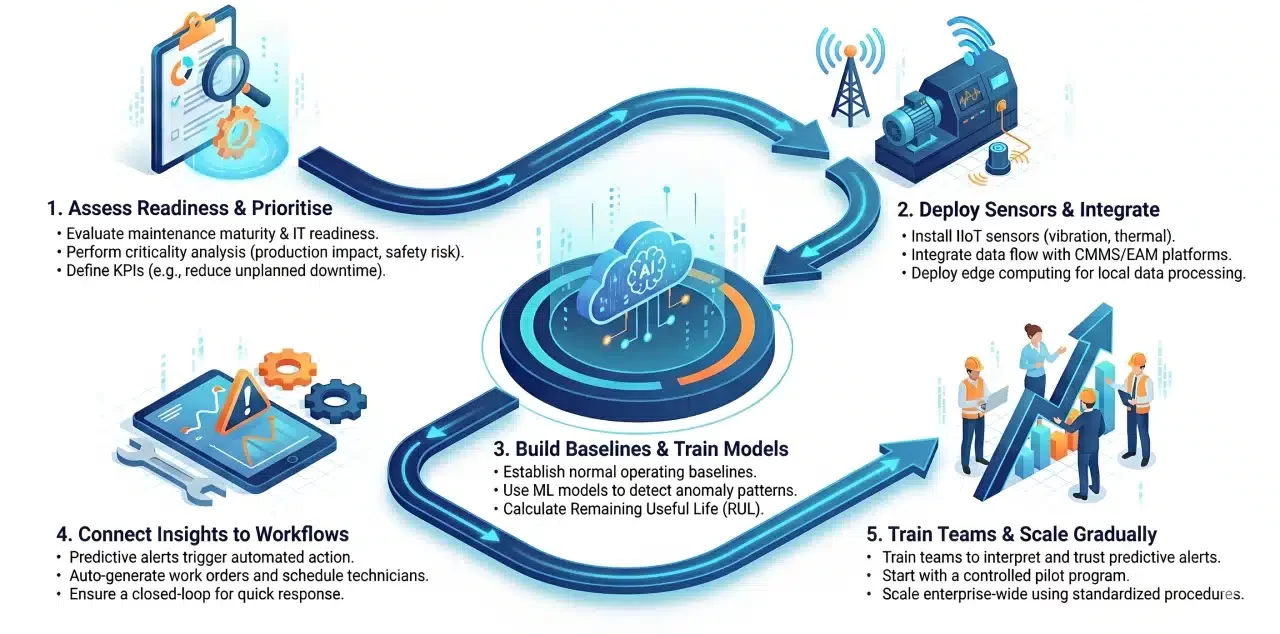
Implementing predictive maintenance requires more than sensor deployment. Organisations must align asset priorities, data infrastructure, and workflows to ensure measurable value. A structured rollout reduces risk and supports long term adoption.
Most initiatives start with focused pilots before scaling enterprise wide. This phased approach validates data accuracy, refines alert thresholds, and builds internal confidence in the predictive model.
Step 1: Assess Readiness and Prioritise Critical Assets
The first step is evaluating maintenance maturity, data availability, and IT readiness. Organisations should avoid monitoring every asset at once and instead perform an asset criticality analysis based on production impact, safety risk, and replacement cost.
High value or failure prone equipment should be prioritised for the initial deployment. Clear KPIs such as reducing unplanned downtime or improving MTBF must be defined early to keep the program focused and measurable.
Step 2: Deploy Sensors and Integrate Data Sources
Once priority assets are identified, the appropriate IIoT sensors such as vibration, thermal, or ultrasonic devices should be installed at optimal monitoring points. Proper placement is critical to avoid noisy or misleading readings.
Sensor data must integrate with existing CMMS or EAM platforms to create a unified data flow. Many organisations also deploy edge computing to filter raw signals locally and reduce bandwidth requirements for remote operations.
Step 3: Build Baselines and Train Predictive Models
During the initial monitoring phase, the system establishes a normal operating baseline for each asset. Machine learning models then analyse historical failures alongside live data to detect early anomaly patterns.
Advanced implementations calculate Remaining Useful Life (RUL) to forecast when components will likely fail. Continuous model retraining is essential to maintain accuracy as equipment conditions evolve over time.
Step 4: Connect Insights to Maintenance Workflows
Predictive alerts only create value when they trigger action. Integration with the CMMS enables automatic work order generation, spare parts checks, and technician scheduling.
This closed loop workflow ensures maintenance teams respond quickly while procurement and planning teams gain advance visibility into upcoming repair needs.
Step 5: Train Teams and Scale Gradually
Human adoption is often the biggest barrier. Maintenance teams must be trained to interpret predictive alerts and trust data driven recommendations.
Most organisations start with a controlled pilot, document early wins, and then scale using standardised deployment procedures. Building a culture of continuous reliability improvement ensures the predictive maintenance program delivers sustained operational impact.
Essential KPIs for Predictive Maintenance Success
To measure program effectiveness, organisations should track a focused set of performance metrics:
- Mean Time Between Failures (MTBF): Indicates improving asset reliability over time
- Mean Time to Repair (MTTR): Measures how quickly teams resolve issues after alerts
- Overall Equipment Effectiveness (OEE): Tracks availability, performance, and quality impact
- Planned Maintenance Percentage (PMP): Reflects the shift from reactive to proactive work
Consistent KPI monitoring helps organisations refine alert thresholds, optimise maintenance schedules, and demonstrate clear ROI from predictive maintenance investments.

Industry Specific Use Cases of Predictive Maintenance
Although condition monitoring principles are consistent, predictive maintenance applications vary across industries. Variations in asset criticality, automation, and operational risk require tailored approaches to prioritise high impact deployments.
Advanced Manufacturing
In advanced manufacturing environments, predictive maintenance is a key enabler of Industry 4.0 operations. Production lines rely on tightly synchronised robotics, CNC machines, and conveyor systems where a single component failure can halt output.
By deploying vibration and thermal sensors on critical spindles and motors, manufacturers can detect early degradation and schedule repairs during planned downtime. This reduces unplanned stoppages, protects product quality, and stabilises overall equipment effectiveness.
Retail and E commerce Fulfilment
Predictive maintenance is increasingly important in automated fulfilment centres. Modern facilities rely on AS/RS systems, high speed sortation conveyors, and autonomous mobile robots that must operate continuously to meet delivery SLAs.
Monitoring conveyor motors, drive systems, and refrigeration units helps operators detect anomalies before peak periods are disrupted. This visibility prevents fulfilment delays, inventory spoilage, and costly emergency repairs during high demand windows.
Distribution and Logistics
In distribution and logistics networks, predictive maintenance focuses heavily on fleet reliability and material handling uptime within an integrated asset handling system. Telemetry data from vehicles and equipment such as engine performance, brake wear, and fluid condition provides early warning of mechanical issues.
Instead of relying on fixed service intervals, operators can perform maintenance precisely when degradation thresholds are reached. This approach extends asset lifespan, reduces unnecessary servicing costs, and improves network availability across complex supply chains.
Predictive Maintenance Implementation Framework
Transitioning from reactive maintenance to a predictive model requires a structured, phased rollout. Organisations must align asset priorities, sensor deployment, and analytics capabilities to ensure the initiative delivers measurable operational value.
A disciplined implementation roadmap helps reduce data noise, accelerate user adoption, and maximise return on predictive maintenance investments.
Step 1: Conduct Asset Criticality Analysis
Organisations should avoid monitoring every asset simultaneously. The process should begin with a formal asset criticality assessment based on production impact, safety exposure, environmental risk, and historical failure cost.
High risk and high value equipment should be prioritised for the pilot phase. This targeted approach delivers faster ROI while preventing unnecessary sensor investment across low impact assets.
Step 2: Deploy IIoT Sensors and Integrate Systems
After identifying priority assets, the appropriate IIoT sensors such as vibration, thermal, or ultrasonic devices must be installed at optimal monitoring points. Proper sensor placement is essential to ensure accurate condition data.
Equally important is system integration. Sensor outputs should connect seamlessly with CMMS or EAM platforms to centralise asset visibility and enable automated work order generation.
Step 3: Establish Baselines and Train Algorithms
During early deployment, the system must capture normal operating behaviour to establish a reliable performance baseline. Machine learning models then analyse both live and historical data to detect early failure patterns.
Over time, advanced models can estimate Remaining Useful Life (RUL), allowing maintenance teams to plan interventions before performance degradation affects operations.
Key KPIs to Measure Predictive Maintenance Performance
To validate business impact, organisations should continuously monitor a focused KPI set:
- Mean Time Between Failures (MTBF): Measures improvement in asset reliability
- Mean Time to Repair (MTTR): Tracks maintenance response efficiency
- Overall Equipment Effectiveness (OEE): Evaluates availability, performance, and quality
- Planned Maintenance Percentage (PMP): Indicates progress toward proactive maintenance (target >85%)
Regular KPI review enables teams to fine tune predictive models, optimise maintenance scheduling, and demonstrate clear ROI from the predictive maintenance program.
Common Pitfalls and Advanced Optimisation in Predictive Maintenance
Even well funded predictive maintenance programs can underperform without disciplined execution. Success depends on strong data quality, workforce readiness, and system integration, not just sensors and analytics.
Recognising these pitfalls and optimisation levers helps organisations scale predictive maintenance more confidently and avoid costly implementation setbacks.
Common Pitfalls and Mitigation Strategies
Data overload and alert fatigue
Large scale sensor deployments can overwhelm teams with excessive raw data. When too many low priority alerts appear, critical warnings may be missed, reducing overall program effectiveness.
Mitigation: Implement edge processing and intelligent filtering so only meaningful anomalies reach the central dashboard.
Cultural resistance and capability gaps
Predictive maintenance shifts organisations from intuition based work to data driven decisions. Without proper change management, experienced technicians may hesitate to trust algorithm generated insights.
Mitigation: Engage frontline teams early, provide role specific training, and demonstrate quick operational wins to build confidence.
Poor data quality and network instability
Predictive models depend on accurate, consistent sensor input. In harsh environments, misalignment, signal interference, or unstable connectivity can quickly degrade reliability.
Mitigation: Establish routine IoT calibration schedules and invest in industrial grade network infrastructure that supports continuous data transmission.
Advanced Best Practices for Future Proofing
As organisations mature in their predictive maintenance journey, the focus typically shifts from basic monitoring toward deeper operational optimisation. Several advanced practices can further strengthen long term performance and scalability.
Leveraging digital twins
Digital twins create virtual replicas of physical assets using real time sensor data. Engineers can simulate conditions, test scenarios, and forecast degradation without disrupting production, enabling more precise planning and lower risk.
Deep Asset Management Software and CMMS Integration
Predictive insights deliver maximum value when integrated with a comprehensive asset maintenance solution and CMMS platforms. Detected risks can automatically trigger work orders, spare parts checks, and maintenance workflows, improving response speed and operational coordination.
Continuous model refinement
Machine learning models must evolve with real conditions. Leading organisations use technician feedback after each alert to improve accuracy, reduce false positives, and maintain long term reliability.
Conclusion
Predictive maintenance delivers the greatest value when data, assets, and workflows are fully aligned. With the right foundation, organisations can reduce downtime, extend equipment lifespan, and maintain more stable operational performance as asset complexity grows.
Priorities vary by organisation, from improving asset visibility to strengthening automation and system integration. Evaluating solutions based on scalability, data readiness, and operational fit is essential for long term effectiveness.
Organisations evaluating predictive maintenance strategies can get expert advice without cost to assess readiness, prioritise assets, and design a scalable implementation roadmap.
A structured approach helps avoid fragmented implementations and ensures predictive maintenance initiatives support both current reliability goals and future growth. If you want help evaluating the right approach, request a free consultation with our team.

Frequently Asked Questions About Predictive Maintenance
-
What is predictive maintenance and how does it work?
Predictive maintenance is a data driven strategy that uses IoT sensors and analytics to monitor equipment condition in real time. By detecting early signs of wear or anomalies, organisations can perform maintenance at the optimal time before failures occur.
-
How does predictive maintenance improve equipment reliability?
Predictive maintenance improves reliability by identifying potential failures early and enabling planned interventions. This reduces unexpected breakdowns, stabilises production performance, and extends overall asset lifespan.
-
What KPIs should be tracked in a predictive maintenance program?
Key KPIs typically include Mean Time Between Failures (MTBF), Mean Time to Repair (MTTR), Overall Equipment Effectiveness (OEE), and Planned Maintenance Percentage (PMP). Monitoring these metrics helps organisations measure reliability improvements and program ROI.
-
Can predictive maintenance be integrated with CMMS or ERP systems?
Yes. Modern predictive maintenance platforms are commonly integrated with CMMS or ERP systems to automate work orders, check spare parts availability, and synchronise maintenance planning. This integration ensures predictive insights translate into timely operational action.