In today’s deeply interconnected economy, supply chains have become complex systems vulnerable to unexpected disruptions. A single supplier delay can halt production and even damage customer trust. This has pushed businesses to move beyond basic purchasing and adopt structured vendor management.
Procurement is no longer just about finding the lowest price. Companies now view vendors as strategic partners who support innovation and reduce risk. A structured vendor management approach optimizes the entire lifecycle and turns procurement into a value driver.
Consequently, this leaves business owners in today’s economy concerned. If you are one of these people, then you’re in luck, because this blog contains all the necessary information you need to implement your own vendor management.
Key Takeaways
Vendor Management is a strategic discipline that encompasses the entire lifecycle of supplier relationships, moving beyond simple purchasing to include performance monitoring and risk mitigation.
The importance of vendor management lies in controlling costs and maintaining supply chain stability. Structured oversight prevents maverick spending, protects product quality, and reduces operational risk.
Key components of vendor management include rigorous selection processes, contract lifecycle management, active risk assessment, and fostering long-term strategic collaboration.
Implementing vendor management requires vendor segmentation, clear policies, and measurable KPIs. These elements help companies monitor performance, manage risk, and maintain supplier accountability.
What is Vendor Management?


The Importance of Vendor Management
The importance of vendor management lies in controlling costs and preventing unapproved purchases. Vendors represent a large share of company expenses, so structured oversight helps enforce purchasing discipline and improve financial visibility.
Vendor management also protects operational stability. Businesses depend on external suppliers for materials, technology, and logistics, meaning supplier failure can halt operations. Continuous monitoring helps detect risks and prepare contingency plans.
Quality assurance is another key role. Since final products often rely on supplier components, poor-quality inputs can damage brand reputation. Clear standards and service level agreements ensure vendors consistently meet expectations.
There are also International standards that global businesses should adhere to. Successfully complying with them can be very beneficial for your company, such as reduce risk of operation and increasing brand image, to both consumers and vendors alike.
Vendor management also enables innovation through collaboration. Suppliers often bring specialized expertise and new ideas. Strong partnerships can help you improve products, adopt better processes, and reduce long-term costs.
The Key Components of Vendor Management
A strong vendor management strategy relies on several core components that work together to control risk, ensure performance, and create long-term value. When these elements operate in alignment, your company will gain better visibility, stronger supplier relationships, and more stable supply chains.
1. Supplier Selection and Onboarding
Supplier selection begins with clearly defining business needs and evaluating potential vendors through structured processes such as RFI, RFP, or RFQ. This allows companies to compare vendors based on price, capabilities, reliability, and overall fit.
Due diligence is essential before signing agreements. Businesses verify financial stability, past performance, and regulatory compliance to avoid partnering with unreliable suppliers.
Onboarding then integrates the vendor into the company’s systems and processes. Collecting essential documents, setting communication channels, and aligning procedures help establish a smooth and efficient working relationship.
2. Contract and Performance Management
Contracts define the scope, pricing, delivery expectations, and penalties for non-compliance. Effective contract management ensures agreements remain clear, enforceable, and properly monitored throughout their lifecycle.
Performance management ensures vendors deliver what was promised. Companies track KPIs and SLAs such as delivery reliability, quality rates, and response times to measure vendor effectiveness.
Accurate data support objective performance evaluation. Vendor management systems capture operational data, allowing companies to make informed decisions about contract renewal, renegotiation, or termination.
3. Risk Management
Vendor relationships introduce operational, financial, and reputational risks that companies must actively monitor. Risks may include supply disruptions, financial instability, regulatory violations, or cybersecurity threats.
Effective risk management requires continuous assessment rather than one-time checks. Companies often classify vendors by strategic importance and apply stricter oversight to critical suppliers.
Mitigation strategies reduce dependency and potential disruption. These can include dual sourcing, compliance audits, insurance requirements, and collaborative efforts to strengthen supplier resilience.
4. Vendor Relationship and Strategic Collaboration
Vendor relationship management focuses on building trust, communication, and long-term alignment with key suppliers. Strong relationships move beyond transactional buying toward collaborative partnerships.
Strategic collaboration may include shared planning, joint innovation projects, or supply chain integration initiatives. These efforts allow both parties to improve efficiency and support future growth.
When vendors feel valued as partners, they are more likely to invest in the relationship. This approach encourages innovation, stronger cooperation, and greater stability during supply chain disruptions.
Difference Between Vendor Management and Vendor Procurement

Vendor management and vendor procurement are often used interchangeably, but they play different roles in the supply chain. Procurement focuses on obtaining goods or services and includes activities such as identifying needs, sourcing suppliers, issuing purchase orders, and processing payments through a structured procurement workflow solution.
Vendor procurement represents the focus on supplier selection and acquisition. Companies may use tools such as Request for Information (RFI), Request for Proposal (RFP), and Request for Quotation (RFQ) to evaluate vendors on various factors to secure the best suppliers.
Vendor management operates on a broader and more strategic level. It oversees the long-term relationship between your company and your suppliers. Vendor management includes monitoring vendors, managing risks, ensuring regulatory compliance, and developing suppliers to maintain a good supply base.
Another important distinction is the duration of responsibility. Procurement activities generally end once the goods are delivered and payment is processed. Vendor management continues after the transaction, ensuring the supplier maintains performance standards and remains a reliable partner.
The difference can be illustrated with a workforce analogy. Procurement resembles the hiring process: defining the role, evaluating, negotiating, and signing the contracts. Vendor management is like human resource management, conducting reviews, maintaining engagement, and ensuring productivity.
Modern enterprise systems often integrate both functions into a single platform. Enterprise resource planning systems combine procurement workflows with vendor monitoring tools. Even though the software may unify them technologically, the conceptual distinction remains important.
Implementing a Vendor Management Framework: Steps and Metrics
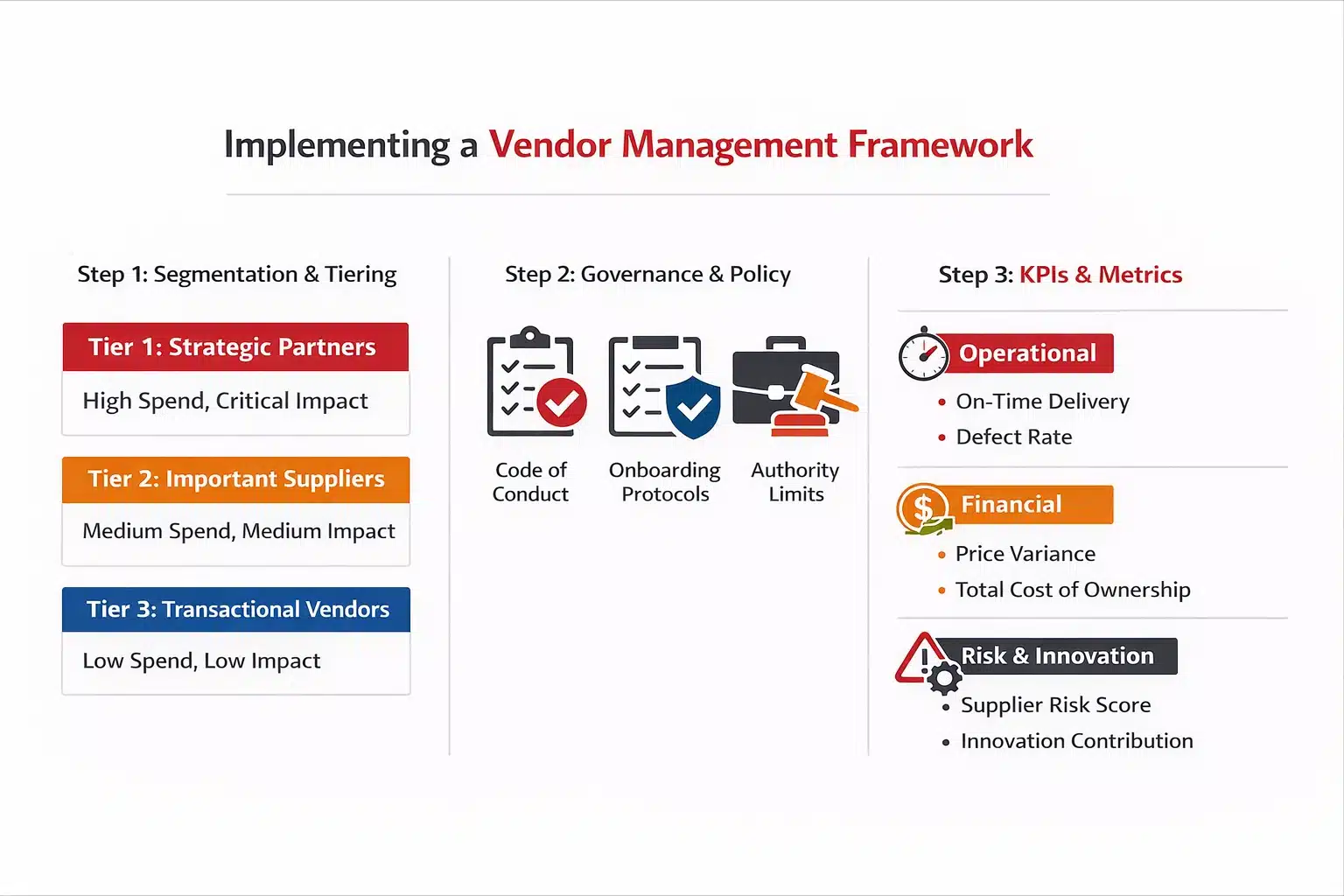
Transitioning from improvised purchasing to a structured vendor management framework requires a deliberate implementation roadmap.
Step 1: Segmentation and Tiering
Not all vendors require the same level of scrutiny. The first step in implementation is categorizing the vendor base, often using a system that weighs spending volume against strategic importance and tracks incoming purchase request activity across departments.
- Strategic Partners (Tier 1): High spend, high impact. These vendors provide critical components or services. They require quarterly business reviews (QBRs), continuous monitoring, and executive-level relationships.
- Important Suppliers (Tier 2): Medium spend, medium impact. These require standard performance monitoring and annual reviews. Alternatives exist, but switching would be disruptive.
- Transactional/Commodity Vendors (Tier 3): Low strategic impact. These are managed through automated procurement systems with a focus on price efficiency and ease of transaction.
Step 2: Establishing Governance and Policy
Before evaluating vendors, the company must define the rules of engagement. This involves creating a Vendor Management Policy that outlines:
- Code of Conduct: Ethical standards regarding labor, environment, and anti-bribery that all vendors must sign.
- Onboarding Protocols: The specific financial, legal, and security checks required before a vendor is added to the master data file.
- Authority Limits: Who is authorized to sign contracts or approve price variances.
Step 3: Defining KPIs and Metrics
A robust framework relies on accurate data, not intuition. Below are the essential Key Performance Indicators (KPIs) that should be tracked, ideally via a dashboard.
- Operational Metrics:
- On-Time Delivery (OTD): (Number of on-time deliveries / Total deliveries) x 100. This measures reliability.
- Defect Rate: (Number of rejected items / Total items received) x 100. This measures quality.
- Lead Time Variance: The difference between the quoted lead time and the actual lead time. High variance forces companies to hold excess safety stock.
2. Financial Metrics
- Price Variance: The difference between the contracted price and the invoiced price. This helps identify “invoice creep.”
- Total Cost of Ownership (TCO): Tracking shipping, duties, storage, and quality costs alongside the purchase price to understand the true cost of the vendor.
3. Risk and Innovation Metrics
- Supplier Risk Score: A composite score based on financial health, geopolitical stability of their location, and cybersecurity posture.
- Innovation Contribution: Tracking the number of new ideas, product improvements, or process efficiencies proposed by the vendor that were implemented.
Common Pitfalls and Mitigation Strategies
Even with a framework in place, businesses often stumble due to behavioral or structural issues. Recognizing these pitfalls early can save significant resources.
1. The “Set and Forget” Mentality
Many companies invest heavily in the selection and contracting phase, but neglect the relationship once the contract is signed. They only engage the vendor when a problem arises.
To mitigate this, implement a schedule of regular performance reviews. For Tier 1 vendors, these should be Quarterly Business Reviews (QBRs) that evaluate strategy, not just performance. Treat the contract as a living document that evolves with market conditions.
2. Maverick Spend and Shadow Procurement
Employees bypassing established procurement channels to buy from non-approved vendors is a risk that you have to watch out for. This leads to data fragmentation, loss of volume discounts, and significant compliance risks.
Mitigation includes utilizing a “Procure-to-Pay” (P2P) system that makes buying from approved catalogs easier than going outside the system. Combine this with strict policy enforcement, where expenses from unapproved vendors are not reimbursed without executive override.
3. Data Silos and Fragmented Communication
Vendor data lives in many different places. Contracts in legal, invoices in finance, performance data in operations, and communication in personal email inboxes. This makes it impossible to get a complete view of the vendor.
The solution to this is to invest in a centralized Vendor Management System (VMS) or Supplier Relationship Management (SRM) platform. Ensure that all stakeholders use this single source of truth for document storage and communication logging.
4. Ignoring the “Long Tail.”
Focusing 100% of energy on the top 20% of suppliers while the bottom 80% (the long tail) remains unmanaged. While the spend is lower, the administrative burden of thousands of small vendors can be massive, and compliance risks often hide here.
Use automation to manage the long tail. Implement self-service portals where smaller vendors can update their own certifications and banking details, reducing the manual workload on your team.
Advanced Best Practices for Mature Companies
Once the foundational elements of vendor management are secure, companies can move toward advanced practices that use the supply base to gain a competitive advantage.
1. Establishing a Vendor Management Office (VMO)
A Vendor Management Office (VMO) standardizes how companies manage supplier relationships. It provides governance, tools, and methodologies for vendor engagement. It typically doesn’t perform purchasing itself but ensures all departments follow consistent standards when working with vendors.
2. Collaborative Planning, Forecasting, and Replenishment (CPFR)
3. Sustainable Procurement and ESG Integration
Modern vendor management extends into Environmental, Social, and Governance (ESG) goals. Advanced businesses are not just asking for low prices; they are demanding low carbon footprints and fair labor practices.
Best practices include:
- Emissions Tracking: Working with vendors to calculate and reduce the carbon emissions generated in the supply chain (which often dwarf the company’s direct emissions).
- Supplier Diversity Programs: Actively sourcing from minority-owned, women-owned, and veteran-owned businesses. This is not just corporate social responsibility; it introduces agility and innovation into the supply chain by avoiding the “usual suspects” that competitors use.
4. Leveraging an Integrated Procurement System
Conclusion
Vendor management has evolved from a back-office administrative task into a strategic business function. In volatile and competitive supply chains, the ability to effectively select, manage, and collaborate with suppliers drives value, innovation, and operational resilience beyond simple cost reduction.
By implementing structured vendor selection, contract management, risk mitigation, and relationship development, companies can transform procurement into a strategic asset. Supported by modern technology and partnership-oriented collaboration, vendor management strengthens supply stability and enables sustainable long-term growth.
From everything that we have discussed until now, you can begin to understand why vendor management is more than just a formality. If you wish to learn more about this topic, you can consult our expert to gain even more insight and apply it to your business to surpass the competition.
Frequently Asked Question
The primary goal is to optimize the value derived from suppliers by controlling costs, mitigating risks, and ensuring service quality. It centralizes data to improve visibility and decision-making across the procurement lifecycle.
Vendor management is a broader term covering the entire lifecycle, including risk, contracts, and performance metrics. Supplier relationship management (SRM) is a subset focused specifically on the strategic, collaborative, and long-term engagement aspects of the partnership.
Risk management ensures that a vendor has the financial stability and operational capacity to deliver without disruption. It protects the buying company from reputational damage, legal non-compliance, and supply chain failures.
Common KPIs include on-time delivery rates, defect or error rates, lead time variance, and adherence to negotiated pricing. Service-based vendors are often evaluated on response times and resolution efficiency.
Yes, small businesses benefit significantly by establishing clear expectations and stabilizing their supply chain. Even without complex software, applying structured principles helps small firms negotiate better terms and avoid reliance on unreliable suppliers.