In modern sales, relying on intuition leads to missed follow-ups, disorganized deal tracking, and inconsistent revenue. Teams juggling multiple prospects without a clear system often lose visibility into existing sales opportunities, leading to lost follow-up opportunities.
A structured sales pipeline brings order to this chaos by mapping each stage of the buyer journey. It improves forecasting accuracy, highlights bottlenecks, and creates a scalable framework for consistent revenue growth.
If you are interested in further improving your sales processes, we can assure you that this topic will be beneficial for you and your company in the long run. We will cover the definition of sales pipelines, how it differs from the sales funnel, its implementation, and how CRM plays a role in it.
Key Takeaways
Understand the core definition of sales pipelines as a systematic approach to tracking and managing sales.
Building a sales pipelines is done through a structured sequence, starting with mapping your customers, establish exit criterias, and implement it to your CRM
Managing your sales pipeline effectively pipeline is necessary to maintain a healthy, accurate, and moving pipeline.
The best practices for sales pipelines are the standard for managing sales pipelines in today's competitive market
What Is a Sales Pipeline?

While these terms are often thought of as having the same meaning, they represent different perspectives of the same process. It is crucial to distinguish between the two to manage your sales strategy effectively.
- The Sales Pipeline: This is viewed from the perspective of the sales representative. It focuses on the actions the sales team must take to move a deal forward. It deals with stages like “Qualification,” “Meeting,” “Proposal,” and “Closing”.
- The Sales Funnel: This is viewed from the perspective of the customer. It represents the conversion rates and the volume of leads that drop off at each stage. It deals with the numbers, how many leads entered the top, and how many came out of the bottom as customers.
Understanding this distinction ensures that you are not just counting numbers but are actively managing the activities that influence those numbers.
Stages of a Sales Pipeline
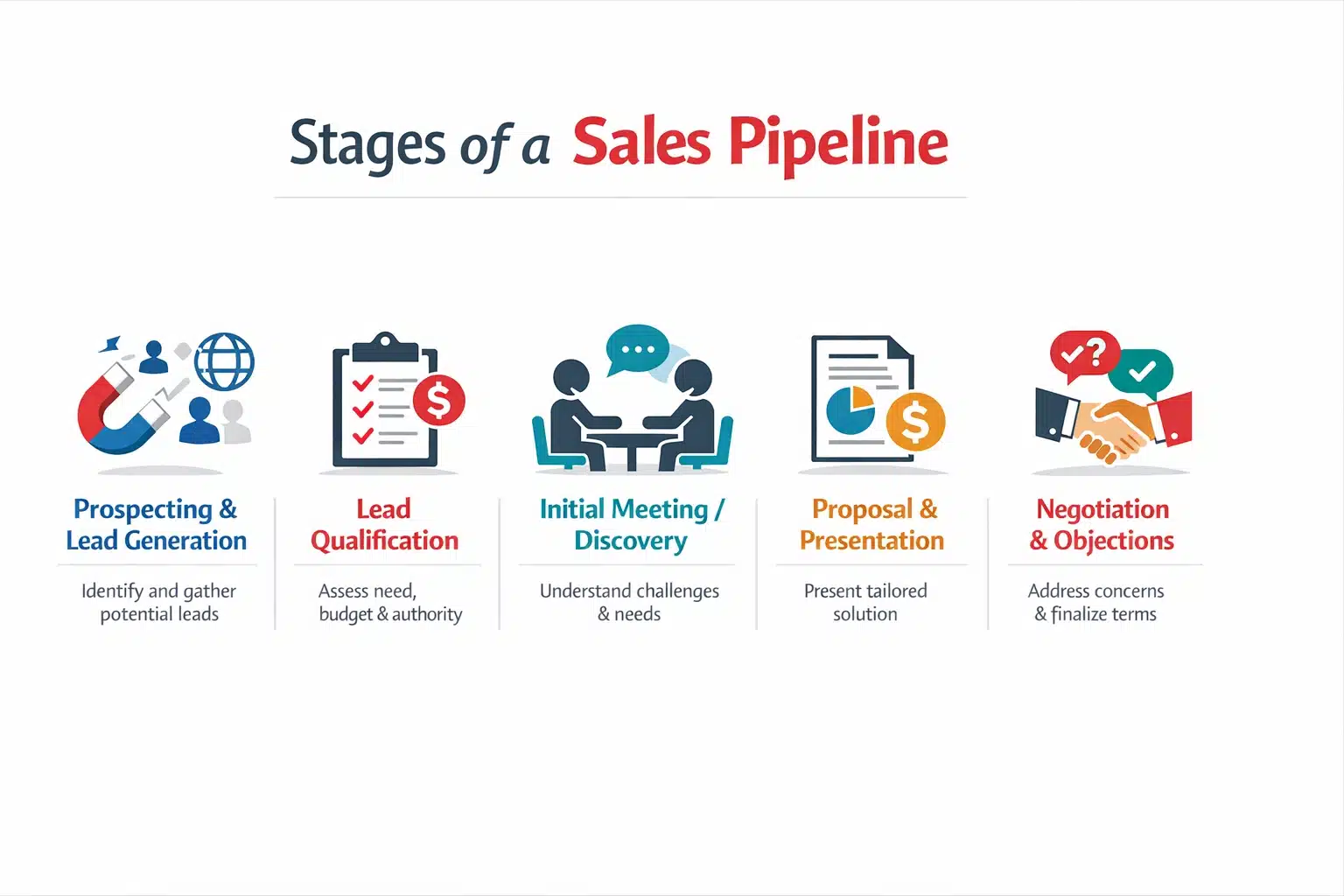
Although each business has its own nuances, most B2B sales cycles follow a similar structure. Clearly defined and standardized stages are critical for accurate reporting and team alignment.
1. Prospecting and Lead Generation
This stage marks the beginning of the pipeline, where potential buyers who fit your Ideal Customer Profile (ICP) are identified through inbound and outbound efforts. Leads at this point come from sources such as content downloads, contact forms, cold outreach, events, or social platforms.
2. Lead Qualification
This is the most important filtering stage in the pipeline. Qualification determines whether a prospect has a real need, sufficient budget, and decision-making authority, separating Marketing Qualified Leads (MQLs) from Sales Qualified Leads (SQLs).
Sales teams often use frameworks like BANT or MEDDIC to evaluate viability. Leads that fail to meet the required criteria should be removed from the active pipeline to avoid wasting time and resources on leads with a high probability of failure to convert.
3. Initial Meeting or Discovery
After qualification, the next step is a meaningful interaction, such as a discovery call or product demo. The focus is on understanding the prospect’s pain points, goals, and challenges through active listening.
This stage builds the foundation of the relationship. Instead of selling features, the goal is to diagnose the problem and confirm mutual interest, ideally leading to a request for a detailed proposal or a broader discussion with stakeholders.
4. Proposal and Presentation
Using insights from the discovery stage, the sales team prepares a customized proposal detailing how the solution addresses the prospect’s needs, along with timelines and pricing.
In B2B sales, proposals are usually reviewed by multiple stakeholders. The presentation must address technical feasibility, financial return, and strategic fit to gain approval across different decision-makers.
5. Negotiation and Handling Objections
6. Closing
7. Post-Sale and Retention
How to Build a Sales Pipeline

Building a sales pipeline from scratch, or revamping an existing, ineffective one, requires a blend of strategic thinking and data analysis. It is not enough to simply copy a template; the pipeline must mirror your specific customer journey.
Step 1: Define Your Ideal Customer Profile (ICP)
Before you can build a path for your customers, you must know who they are. Analyze your most successful existing customers. What industry are they in, and what is their company size? Building a pipeline for enterprise software requires different stages than a pipeline for small business consulting.
Step 2: Map the Customer Journey
Shift focus from your sales activities to the buyer’s actions. Identify the steps customers take before purchasing, such as researching online, requesting a demo, or issuing a request for proposal (RFP), and align your pipeline stages with those behaviors.
Step 3: Establish Exit Criteria for Each Stage
This is a common breakdown in pipeline management. Reps often move deals to “Proposal Sent” just because a PDF was emailed, even without client validation. The result is a bloated pipeline filled with revenue that never closes.
You must define strict Exit Criteria for each stage. For example:
- To move from Discovery to Proposal: The prospect must have confirmed the budget, stated a timeline, and explicitly requested a proposal.
- To move from Proposal to Negotiation: The prospect must have reviewed the pricing and engaged in a discussion regarding terms.
Strict exit criteria ensure that your pipeline reflects reality, not optimism.
Step 4: Determine Probability Percentages
Assign a winning probability to each stage. Historically, what percentage of qualified leads eventually buy? What percentage of proposals result in a closed deal?
- Qualification: 10%
- Discovery: 20%
- Proposal: 50%
- Negotiation: 80%
- Closed Won: 100%
These weighted percentages allow you to calculate the “Weighted Pipeline Value,” giving you a much more accurate financial forecast than simply summing up the total value of all open deals.
Step 5: Implement the Process in Your CRM
How to Manage Your Sales Pipeline Effectively
Conduct Regular Pipeline Review Meetings
Pipeline reviews are not the same as forecast calls. A forecast call asks, “What will close this month?” A pipeline review asks, “How are we building the future?”
Schedule bi-weekly reviews focused on the health of the pipeline. Specific questions to ask include:
- Which deals have been sitting in the same stage for longer than the average sales cycle?
- Are there any empty stages? (e.g., plenty of proposals but no new leads coming in).
- Is the data accurate? Are the close dates realistic?
Practice “Pipeline Hygiene”
Focus on Velocity, Not Just Volume
Diversify Lead Sources
Key Sales Pipeline Metrics to Track
You cannot manage what you do not measure. To optimize your sales process, you need to track specific Key Performance Indicators (KPIs) that reveal the health of your pipeline.
1. Pipeline Value (Total and Weighted)
Total Pipeline Value is the sum of the potential revenue of all open deals.
Weighted Pipeline Value takes the total value of each deal and multiplies it by the probability of closing based on its current stage. Weighted value is the gold standard for forecasting.
2. Sales Pipeline Velocity
This metric measures how fast you are making money. The formula is:
(Number of Deals × Average Deal Size × Win Rate) ÷ Length of Sales Cycle
Tracking velocity helps you understand the efficiency of your team. A high velocity means you are closing deals quickly and effectively.
3. Conversion Rate per Stage
Knowing your overall win rate is good, but knowing your conversion rate between stages is better. If 50% of leads move from Discovery to Proposal, but only 10% move from Proposal to Negotiation, you have identified a specific weakness. Perhaps your proposals are not compelling, or your pricing is misaligned.
4. Average Deal Size
Are deal sizes increasing or declining? Tracking average contract value (ACV) is essential for effective resource allocation. In some cases, pursuing fewer high-value clients delivers better returns than acquiring large volumes of smaller accounts.
5. Sales Cycle Length
This is the average time it takes to close a deal. By tracking this, you can identify outliers. If the average cycle is 60 days, and a deal has been open for 120 days, it is a red flag. It likely requires immediate executive intervention or should be purged from the active pipeline.
The Role of CRM in Sales Pipeline Management
Relying on spreadsheets or manual notes is no longer viable in modern sales. A Customer Relationship Management (CRM) system or integrated sales operation software automates and organizes the pipeline, turning theoretical stages into actionable insights.
CRMs centralize data, track interactions, and provide real-time visibility, enabling teams to scale operations efficiently while maintaining the personalized approach that drives conversions.
Centralized Data and Real-Time Visibility
A CRM acts as a centralized hub, unifying customer data across marketing, sales, and finance to eliminate silos.
It preserves the full interaction history, from emails, calls, meetings, and shared documents, so knowledge stays within the system even if a rep leaves. This transparency gives managers real-time insight into the pipeline, enabling informed coaching and decision-making.
Automation for Lead Capture, Follow-Ups, & Task Reminders
Salespeople should spend their time selling, not entering data. Modern CRM platforms and dedicated lead management software automate the administrative burden.
- Lead Capture: When a prospect fills out a form on your website, the CRM automatically creates a new lead record and notifies the appropriate rep.
- Task Reminders: If a deal moves to the “Proposal” stage, the system can automatically set a task to “Follow up on proposal” in three days.
- Email Sequences: For early-stage leads, the CRM can trigger automated nurture sequences, keeping your brand top-of-mind until the prospect is ready to engage.
This automation ensures that no lead falls through the cracks due to human error or forgetfulness.
Reporting, Dashboards, and Sales Forecasting
CRMs turn raw data into actionable insights through customizable dashboards that display key metrics at a glance, saving time on manual reporting.
By analyzing historical data, CRMs enable accurate revenue forecasting that accounts for seasonality, rep performance, and pipeline velocity, empowering leadership to make informed decisions on hiring, inventory, and integration with an order management solution to ensure seamless post-sale fulfillment.
Lead Scoring and Deal Prioritization
Not all leads are created equal. A CRM can implement automated lead scoring models. By assigning points based on demographic data (e.g., CEO title, Enterprise company size) and behavioral data (e.g., visited pricing page, opened 3 emails), the system can highlight the “hottest” leads.
This ensures that sales representatives prioritize their time effectively. Instead of calling down a list alphabetically, they can focus their energy on the top 20% of leads that are most likely to convert, significantly improving efficiency and morale.
Neglecting the Top of the Funnel
Sales teams often fixate on closing deals at the bottom of the pipeline (The “Decision” or “Negotiation” stages) to hit immediate quotas. However, neglecting prospecting creates a “revenue air pocket”, a month or quarter with zero closings because the pipeline dried up weeks ago.
The Fix: Mandate dedicated prospecting time regardless of how many active deals a rep has. Balance the focus between closing current business and generating future opportunities.
Over-Automation
While automation is powerful, over-relying on automated email sequences and generic follow-ups can alienate prospects in the middle of the funnel. A pipeline that relies entirely on bots for follow-up often sees high drop-off rates during the consideration phase.
The Fix: Use automation for administrative tasks (data entry, meeting reminders) but ensure that communication during the “Proposal” and “Negotiation” phases is personalized and human-led.
Advanced Practices for Scaling Organizations
Once your pipeline is functional and your team is compliant, it is time to move from management to optimization. Advanced pipeline practices leverage data and psychology to accelerate revenue.
Pipeline Velocity Optimization
Most leaders look at total pipeline value, but velocity, how fast a lead turns into a customer, is a superior metric for scaling. The formula for Pipeline Velocity is:
(Number of Opportunities × Average Deal Size × Win Rate) ÷ Length of Sales Cycle
By breaking this down, you can pull specific levers. For example, if you cannot increase the number of opportunities, you might focus entirely on shortening the sales cycle by introducing digital contract signing or pre-approved pricing packages to increase velocity.
Multi-Threading Stakeholders
In complex B2B sales, depending on a single point of contact is risky. Advanced pipeline management encourages tracking multiple stakeholders within the CRM, ensuring that before a deal progresses, reps engage key players like the Champion, Economic Buyer, and Technical Validator.
Weighted Pipeline Forecasting
Weighted forecasting gives a clearer picture of potential revenue. By assigning probabilities to each stage of the pipeline and calculating a weighted value, organizations can move beyond simple totals and make more realistic predictions about future income.
The Post-Sale Pipeline
In the modern subscription economy, closing a deal is just the beginning. Forward-thinking companies build a secondary “Customer Success” pipeline to track customers from onboarding to adoption, and ultimately renewal or upsell, ensuring long-term satisfaction and recurring revenue.
By treating your sales pipeline as a living, evolving system rather than a static spreadsheet, you transform it into a powerful revenue engine. Whether refining stage criteria or optimizing velocity, a dynamic pipeline drives clarity, predictability, and sustained business growth.
Conclusion

Frequently Asked Questions About Sales Pipeline
-
What is the difference between a sales pipeline and a sales funnel?
A sales pipeline focuses on the actions taken by sales reps (process-oriented), while a sales funnel focuses on conversion rates and the volume of leads dropping off at each stage (outcome-oriented).
-
How many stages should a sales pipeline have?
Most B2B pipelines have 5 to 7 stages, typically including Prospecting, Qualification, Meeting, Proposal, Negotiation, Closing, and Retention. However, this should be customized to match your specific customer journey.
-
How often should I review my sales pipeline?
Pipeline reviews should be conducted bi-weekly or weekly. This ensures data accuracy, helps identify stalled deals early, and keeps the sales team focused on high-priority opportunities.
-
What is a good sales pipeline conversion rate?
Conversion rates vary by industry, but a general benchmark for B2B sales is a 20-30% conversion rate from a qualified opportunity to a closed deal. Monitoring stage-by-stage conversion is more actionable than looking at the overall rate.
-
Why is CRM important for pipeline management?
A CRM centralizes data, automates manual tasks, provides real-time visibility into deal status, and enables accurate revenue forecasting, which is impossible to achieve effectively with spreadsheets alone.