















Businesses that fail to control stock levels risk tying up capital in excess inventory or losing sales due to stockouts. Effective inventory management helps you prevent both outcomes by keeping the right products available at the right time, especially when supported by a reliable stock control system.
Modern supply chains require a systematic, data-driven approach to tracking how goods move in, through, and out of a business. Without accurate stock data, businesses cannot reliably meet demand, control costs, or respond quickly to supply disruptions.
This guide covers the key definitions, methods, components, and best practices for effective inventory management. It also includes a practical guide that you can easily follow.
Key Takeaways
Inventory management is the process of sourcing, storing, tracking, and selling the goods a business uses to generate revenue.
Types of inventory management include periodic, perpetual, barcode, and RFID systems.
Key components of inventory management are inventory tracking, order management, forecasting, storage management, and reporting.
The 5 steps of implementation involves stock audits, choosing inventory methods, selecting hardware and software, managing data, and developing staff to operate the system.

What Is Inventory Management?

Inventory management is the process of sourcing, storing, tracking, and selling the goods a business uses to generate revenue. It covers the lifecycle from the moment goods are purchased from a supplier to delivery to the end customer.
The primary goal is to ensure products are available in the right quantities, at the right locations, and at the right time. This must be achieved while minimizing the costs associated with holding and handling stock.
Businesses typically manage four inventory types: raw materials used in production, work-in-progress (WIP) items being manufactured, finished goods ready for sale, and MRO supplies used in daily operations.
In some cases, businesses may also deal with consignment supplies, where inventory is held by a retailer but owned by the supplier until it is sold.

Types of Inventory Management
Different businesses require different inventory management approaches based on their size, industry, and operational complexity. Understanding the available methods helps businesses select the right framework for their needs.
1. Periodic Inventory Management
The periodic system updates inventory records only at scheduled intervals, such as the end of a month or a financial quarter. Stock levels and cost of goods sold (COGS) are calculated using physical counts conducted at those intervals.
This method suits small businesses with low sales volumes and minimal SKUs. However, it provides no real time visibility between counts, leaving businesses exposed to undetected stockouts or shrinkage.
2. Perpetual Inventory Management
Perpetual inventory management tracks stock continuously, with records updated in real time as each transaction occurs. Sales, receipts, returns, and transfers are all captured immediately through integrated POS and warehouse systems.
This method provides accurate, up-to-date stock visibility and eliminates the need for large-scale physical counts. It is best suited to e-commerce businesses, multi-location retailers, and companies using a platform for automating stock management.
3. Barcode Inventory Management
Barcode systems assign a unique machine-readable code to every SKU, which employees scan at each stage of the supply chain. This reduces manual data entry errors and speeds up receiving, picking, packing, and shipping processes.
Barcoding is cost-effective and scalable, forming the backbone of most modern warehouse operations. The primary limitation is that scanners require direct line-of-sight to the label, which can slow operations if labels are damaged or obscured.
4. RFID Inventory Management
RFID uses microchips embedded in tags that transmit data via radio waves, eliminating the need for line-of-sight scanning. A single RFID reader can detect hundreds of tags simultaneously, even through sealed packaging or stacked pallets.
This technology significantly reduces the labor required for inventory counts and enables real time asset tracking across a facility. The main drawback is the higher cost, as both tags and reader infrastructure are more expensive than barcode systems.
Key Components of Inventory Management
Effective inventory management relies on several interconnected components. Each must function together to ensure smooth goods flow and accurate data across the supply chain.
1. Inventory Tracking and Visibility
Inventory tracking monitors the exact location, status, and quantity of every item in the supply chain at any given time. This includes lot and batch tracking, serial number tracking, and expiry date monitoring.
Lot tracking is essential for industries like food and pharmaceuticals, where businesses must trace products to their source materials in the event of a recall. Serial number tracking supports warranty management and theft prevention for high-value items.
2. Order and Reorder Management
Order management covers the end-to-end process of handling customer orders and supplier purchases. It includes verifying stock availability, allocating inventory to orders, and updating stock levels once items are shipped.
Reorder management ensures stock is replenished before it runs out by setting accurate reorder points based on minimum stock levels, supplier lead times, and consumption rates. Automated systems can generate purchase orders when stock falls below a predefined threshold.
3. Demand Forecasting
Demand forecasting predicts future customer demand using historical sales data, market trends, seasonality, and promotional activity. Accurate forecasting reduces both overstocking and stockout risk across the business.
Advanced forecasting uses algorithms and machine learning to analyse large datasets and generate procurement recommendations. This supports more accurate purchasing decisions across changing market conditions.
4. Warehouse and Storage Management
Warehouse management determines where inventory is stored and how it moves within a facility. Poor warehouse layouts increase picking times, raise labour costs, and create a higher risk of damaged goods.
Key strategies include placing high-velocity items near packing areas, using efficient picking methods such as wave or batch picking, and cross-docking to reduce storage time for fast-moving goods.
5. Reporting and Analytics
Reporting converts raw inventory data into actionable insights that support strategic decision making. Key metrics include inventory turnover ratio, days sales of inventory (DSI), gross margin return on investment (GMROI), and shrinkage rate.
Regular reporting helps businesses identify slow-moving stock, reduce carrying costs, and improve procurement planning. A well-configured reporting dashboard gives management a clear view of supply chain performance at any time.
How to Implement an Inventory Management System
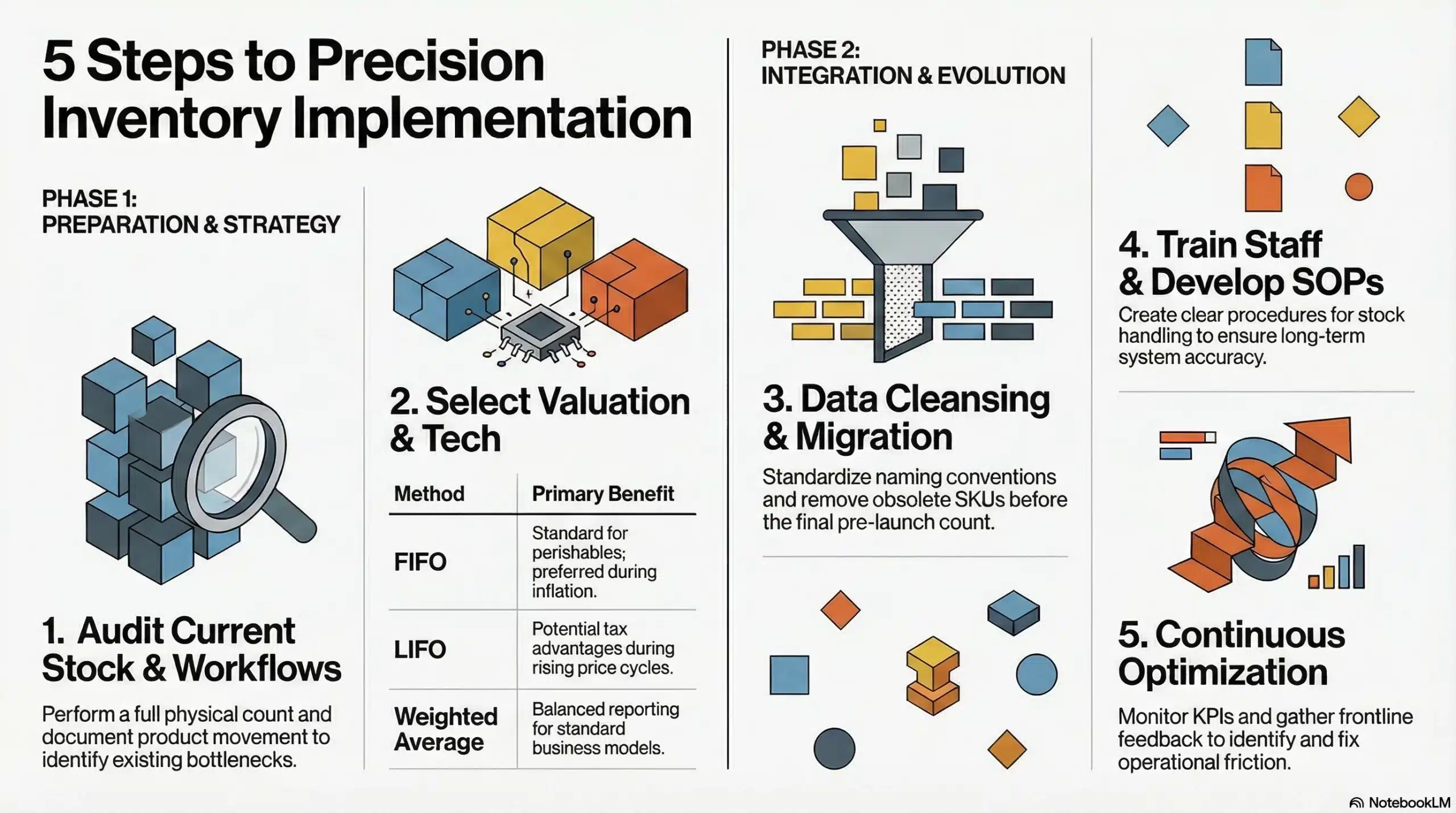
Transitioning to a modern inventory management system requires careful planning, accurate data, and strong change management. A structured approach reduces the risk of data errors and operational disruption during the transition.
Step 1 — Audit Your Current Stock and Processes
Begin with a full physical count of all inventory, including the identification and removal of dead stock, damaged goods, and obsolete materials. This establishes an accurate baseline before any new system is configured.
Simultaneously, map out how products currently move from receiving to storage to shipping. Documenting these workflows helps identify bottlenecks and data entry points that the new system must address.
Step 2 — Choose an Inventory Management Method
Select the valuation method that best suits your business model and reporting requirements. Common options include First-In First-Out (FIFO), Last-In First-Out (LIFO), and weighted average cost.
FIFO is standard for perishable goods and is generally preferred in inflationary environments. LIFO may offer tax advantages in certain jurisdictions during periods of rising prices.
Step 3 — Select Software and Hardware
Choose an inventory management solution that matches your business scale and operational complexity. Small businesses may suit lightweight cloud-based tools, while larger businesses typically require a scalable stock management solution or an ERP system.
Confirm that your chosen hardware, such as barcode scanners, RFID readers, or mobile devices, is fully compatible with your software. Scalability and ease of use should be key selection criteria.








Step 4 — Cleanse and Migrate Data
Before migrating data to the new platform, remove obsolete SKUs, standardise naming conventions, and update unit-of-measure definitions. Poor quality data at the point of migration will undermine system accuracy from day one.
Conduct a final physical count immediately before go-live to confirm that opening stock figures in the new system match actual warehouse quantities. This step is critical for long-term data integrity.
Step 5 — Train Staff and Develop SOPs
Develop updated standard operating procedures (SOPs) that clearly outline how inventory is received, stored, picked, packed, and shipped using the new system. Provide comprehensive training for all staff involved in stock handling.
Training must cover both the operational steps and the broader purpose of the new processes. Well-trained staff is essential for maintaining data accuracy over the long term.
Step 6: Continuous Monitoring and Optimization
Implementation does not end on the go-live date. During the initial weeks of operation, closely monitor system performance and user adoption.
Gather feedback from frontline workers to identify any unforeseen friction points. Regularly review your established KPIs to ensure the system is driving the desired improvements in efficiency, accuracy, and cost reduction.
Inventory Management Across Industries
While the core principles of stock control remain consistent, practical application varies significantly by industry. Different sectors face unique regulatory requirements, consumer behaviors, and supply chain constraints.
Retail and E-commerce
Retailers must maintain real time stock visibility across multiple fulfilment centers, physical storefronts, and third-party logistics providers. Safety stock calculations are critical to preventing stockouts during seasonal demand spikes such as end-of-year sales periods.
Omnichannel fulfilment, including buy-online-pick-up-in-store (BOPIS), requires accurate inventory synchronization across all sales channels. Efficient management of customer returns is also a key operational consideration.
Manufacturing
Manufacturing operations must manage raw materials, work in progress, and finished goods simultaneously. Many manufacturers use Just-in-Time (JIT) methodologies to minimize carrying costs, which requires precise forecasting and reliable supplier relationships.
Real time tracking, bill of materials (BOM) management, and vendor-managed inventory (VMI) agreements are critical in this environment. A single delayed shipment of raw materials can halt an entire production line.
Healthcare and Pharmaceuticals
Healthcare inventory management must comply with strict regulations covering traceability, serialization, and storage conditions. Many medical supplies require cold chain logistics, with constant temperature monitoring from supplier to patient.
First-Expired First-Out (FEFO) methodologies ensure medications are dispensed before their expiry dates. This minimizes waste and supports patient safety across clinical settings.
Food and Beverage
The food and beverage industry requires exceptionally high inventory turnover to prevent spoilage and protect profit margins. FIFO and FEFO tracking are standard practices across distributors, grocers, and food service businesses.
Lot tracking and batch control are essential, as businesses must trace any ingredient to its source within minutes in the event of a contamination or recall. Failure to do so carries significant health and legal risks.
Common Inventory Management Pitfalls and How to Avoid Them
Even with the best intentions, businesses often fall into traps that compromise their stock control efforts. Recognizing these common pitfalls is the first step toward building a more resilient and profitable supply chain.
Relying on Intuition Instead of Data
Using gut feeling for demand forecasting rather than data-driven tools often leads to severe overstocking or stockouts. Purchasing decisions should always be based on actual sales data, current stock levels, and predictive modelling.
Small fluctuations in retail demand can cause large overreactions further up the supply chain when forecasting is not anchored in real time analytics. Businesses that skip data-driven forecasting frequently carry excess inventory at the wrong time.
Poor Warehouse Layout
A disorganized physical warehouse causes picking errors, excessive travel time, and operational slowdowns that no software can fully compensate for. Fast-moving items stored at the back of a facility or placed alongside similar-looking products significantly increase error rates.
Slotting optimization, which places high-velocity items near packing stations, directly reduces picking time and labor costs. Regular review of storage layouts ensures the warehouse keeps pace with changes in product mix.
Treating Training as a One-Time Event
Inventory data quality degrades over time when staff training is treated as a one-off activity during software onboarding. New employees learning from peers rather than official SOPs introduce inconsistencies that compound over time.
Continuous training programs, cross-training initiatives, and periodic refresher courses maintain data accuracy. This is especially important in environments with high staff turnover.
Failing to Automate Reordering
Manual purchase order generation is time-consuming and prone to human error, increasing the risk that critical items are not reordered until stock has already run out. Businesses should use their inventory software to set automated reorder points and safety stock thresholds.
When stock falls below a predefined level, the system should generate a purchase order automatically for management approval. This is where a platform for automating stock management can significantly reduce operational risk and improve efficiency.
Advanced Practices for Inventory Control
As global supply chains become more complex and consumer expectations rise, the tools used to manage inventory are evolving at a breakneck pace. Forward-thinking organizations are already adopting next-generation technologies to push the boundaries of inventory optimization and gain a distinct competitive edge.
Set and Monitor Key Performance Indicators
Establish clear inventory KPIs before and after implementing any new system to measure performance accurately. Useful metrics include inventory turnover ratio, days sales of inventory (DSI), order accuracy rate, carrying cost, and backorder rate.
Regular KPI reviews help identify underperforming stock categories, procurement inefficiencies, and emerging demand trends. Businesses that monitor these metrics consistently are better positioned to make proactive adjustments.
Implement Cycle Counting
Rather than conducting large, disruptive full physical counts, cycle counting involves regularly auditing a small subset of inventory on a rotating schedule. This maintains data accuracy without halting warehouse operations.
High-value or fast-moving items should be counted more frequently than slow-moving stock. A consistent cycle count program reduces discrepancies and catches shrinkage earlier.
Use Systems to Centralize Inventory Data
An ERP system connects inventory data with procurement, sales, finance, and production in a single platform. This eliminates data silos and provides management with an accurate view of stock across the entire business.
Integrated inventory modules within an ERP system automate reordering, support demand forecasting, and generate real time reports across multiple locations. This reduces manual workload and improves decision-making accuracy.
Adopt Technology That Matches Your Scale
Small businesses may benefit from cloud-based inventory tools that integrate with existing e-commerce or POS platforms. Larger businesses require more robust systems that support multi-location tracking, advanced analytics, and supplier integration.
Selecting technology that can scale with business growth avoids the disruption of switching systems too frequently. The right fit depends on current operational complexity and projected growth over the next three to five years.
Conclusion
Effective inventory management reduces costs, supports accurate demand planning, and helps businesses maintain reliable stock levels across their supply chain. When implemented with the right tools and processes, it becomes a genuine competitive advantage.
Whether you are reviewing your current approach or selecting a new system, the steps covered in this guide provide a practical starting point. If you want guidance on the right solution for your business, you can consult our expert anytime you are ready.

Frequently Asked Question
Inventory management is the process of sourcing, storing, tracking, and selling goods throughout their lifecycle. It matters because poor control leads to excess stock that ties up capital or stockouts that result in lost sales and weakened customer trust.
The main types include periodic systems, which update stock at scheduled intervals, and perpetual systems, which track inventory in real time. RFID-based systems that use radio signals to track items without requiring direct line-of-sight.
An effective system relies on accurate inventory tracking, efficient order management, reliable demand forecasting, well-organized warehouse and storage management, and strong reporting and analytics to support decision-making.
It starts with auditing current stock & workflows to establish a baseline. Next is selecting an inventory method, followed by choosing compatible software & hardware. Data is then cleaned and migrated before training staff & establishing SOP. Afterwards, continuous monitoring & optimization are maintained.